Quick answer: The best solo dungeon crawler card games are One Deck Dungeon and Mini Rogue for something small and quick, Warhammer Quest: The Adventure Card Game and Hand of Fate: Ordeals for a fuller dungeon run, and Gloomhaven: Jaws of the Lion if you want a long campaign driven by cards. TerraClash Lite is a free print and play option you can try tonight.
A dungeon crawler is a game about going into a dangerous place, fighting what lives there and coming out stronger, or not coming out at all. Most dungeon crawlers come in huge boxes full of miniatures and map tiles. Card-based ones do the same job with a deck and a few dice, which makes them cheaper, faster to set up and much easier to play on your own at the kitchen table.
These are the solo dungeon crawler card games I'd recommend. I've noted how many players each takes and how long a run lasts. One of them is mine, TerraClash, so weigh what I say about that one accordingly.
What to look for
A good solo dungeon crawler needs three things. Your character has to get stronger in a way you can feel, through new gear, skills or levels. The dungeon has to be different each time, so you're not memorising it. And the game has to run the monsters for you without a pile of upkeep, because when you play alone, every bit of bookkeeping is yours.
Quick picks
Game
Players
Run length
One Deck Dungeon
1 to 2
About 30 minutes
Mini Rogue
1 to 2
About 30 minutes
Warhammer Quest: The Adventure Card Game
1 to 4
About an hour
Hand of Fate: Ordeals
1 to 4
About an hour
Gloomhaven: Jaws of the Lion
1 to 4
A campaign of scenarios
TerraClash
1 to 6
45 to 90 minutes
1. One Deck Dungeon
One Deck Dungeon is exactly what it sounds like: the whole dungeon is a single deck. You flip cards to reveal rooms, then roll dice and place them to beat each challenge. Every card you defeat can become a new skill, an item or experience, so you're constantly deciding what kind of hero to build. It's small, fast and a good first solo crawler.
2. Mini Rogue
Mini Rogue started as a tiny print and play game and grew into a full release. You lay out a grid of cards as a dungeon floor, choose your route through it and roll dice to fight, rest, shop and search. Food, health and gold are all tight, so the game is about deciding which risks are worth taking. It's the closest thing on this list to a video game roguelike.
3. Warhammer Quest: The Adventure Card Game
This is a co-op card game set in the Warhammer world. Each hero has a small set of action cards that get exhausted as you use them, so you have to decide when to attack, when to rest and when to help your allies. Solo, you control two heroes at once. It has a short campaign, and the enemy behaviour is simple enough to run without slowing you down.
4. Hand of Fate: Ordeals
Hand of Fate: Ordeals is based on the video game Hand of Fate. You travel through a laid-out map of cards, meeting encounters that you resolve with card draws and dice, gathering equipment and fighting bosses at the end of each run. It has a strong roguelike feel, and the encounters give it a storytelling element that makes each run feel different.
5. Gloomhaven: Jaws of the Lion
Jaws of the Lion is the smaller, cheaper way into Gloomhaven. It isn't a card game in the strict sense, because there's a board and figures, but every action you take comes from a hand of cards, and managing that hand is the whole game. It has a full campaign with a tutorial built into the first few scenarios, and it plays very well solo with two characters.
6. TerraClash
TerraClash is the game Jim and I make. It's a fantasy card and dice game for 1 to 6 players. You pick a hero, explore the lands one card at a time, fight creatures, collect terra coins to spend on gear and spells, then take on a final boss. Solo, the game is a race to make your hero strong enough before the boss fight, and you can raise the difficulty to Hard, Legend or Hardcore when you're ready.
Because it's a print and play game, you can start tonight. TerraClash Lite is free. If you like it, the full print and play game has 10 heroes, three level 3 bosses and 194 cards. We're also running a Kickstarter for TerraClash Digital, a version you play in your browser, which is live until 22 November 2026.
How to choose
You want something quick: One Deck Dungeon or Mini Rogue.
You want a roguelike: Mini Rogue or Hand of Fate: Ordeals.
You want a campaign: Gloomhaven: Jaws of the Lion.
You'd like to play with friends as well: Warhammer Quest or TerraClash.
You want to try one without spending anything:TerraClash Lite.
Questions about solo dungeon crawlers
What is a dungeon crawler card game?
It's a game where you explore a dungeon, fight monsters and collect loot, with cards doing the job that map tiles and miniatures do in a bigger box. The dungeon is usually a deck you draw from, so it's different every time.
What's the easiest solo dungeon crawler to learn?
One Deck Dungeon. The rules are short, the setup takes a couple of minutes and the game teaches you as you play.
No. Apart from Jaws of the Lion, every game on this list plays without them. If you want the feel of a tabletop RPG without a dungeon master or a box of figures, a card-based crawler is the easiest way to get it.
Best Solo Board Games 2026: 10 Worth Playing Alone
Quick answer: The best solo board games in 2026 are still the ones that were designed with solo play in mind: Spirit Island and Mage Knight for heavy strategy, Arkham Horror: The Card Game for story, Wingspan and Cascadia for something relaxed, and Friday, Final Girl and Under Falling Skies for games built for one player only. If you'd like to try a solo fantasy adventure for free first, TerraClash Lite is a print and play card and dice game you can play tonight.
Solo board gaming has gone from a niche to one of the main ways people play. Most new games now ship with a solo mode, and some of the best games of the last ten years were designed for one player from the start. That also means a lot of solo modes are an afterthought, bolted on so the box can say "1 to 4 players".
This list sticks to games where playing alone is a good experience in its own right, not a way to practise for game night. I've grouped them by what you're in the mood for and noted how long each takes. One of them, TerraClash, is mine, so weigh my opinion on that one accordingly.
What makes a good solo board game
A good solo game gives you hard decisions without anyone else at the table to create them. The best ones do that in one of three ways: an opponent the game runs for you (often called an "automa"), a puzzle that changes every time you set it up, or a story that unfolds as you play.
It also needs to be quick to set up. If a solo game takes 40 minutes to lay out, it stays on the shelf. Most of the games below are on the table in ten minutes or less.
Quick picks
Game
Players
Best for
Spirit Island
1 to 4
Deep strategy
Mage Knight
1 to 4
A long, epic fantasy game
Arkham Horror: The Card Game
Solo or co-op
A story campaign
Wingspan
1 to 5
A relaxed evening
Cascadia
1 to 4
A quick puzzle
Final Girl
1
Horror film fans
Friday
1
A small, cheap deck-builder
Under Falling Skies
1
Dice placement and tension
Sprawlopolis
1 to 4
A pocket-sized game
TerraClash
1 to 6
A fantasy RPG you can print at home
Heavy strategy
1. Spirit Island
You play spirits of an island defending it from colonising invaders. It's a co-op game, so the solo mode is the full game, not a cut-down one. Each spirit plays very differently, the invaders spread in a pattern you can predict but never quite stop, and the difficulty can be tuned with adversaries and scenarios. Expect two hours for a full game.
2. Mage Knight
Mage Knight is a fantasy adventure where you explore a map, recruit units, fight monsters and assault cities, all driven by a deck of cards you improve as you go. Each turn is a puzzle: how do you get the most out of the five cards in your hand? It's long and the rules take a while to learn, but plenty of solo players consider it the best solo game there is. The Ultimate Edition includes the expansions.
Story and campaigns
3. Arkham Horror: The Card Game
You play an investigator working through a campaign of linked scenarios in the world of H.P. Lovecraft. Your choices carry from one scenario to the next, your character grows, and the story branches. It's best with one or two players, and solo you can run one investigator or two at once. If you want something that feels like a tabletop RPG campaign in card form, start here.
4. Final Girl
Final Girl is built for one player. You're the last survivor in a horror film, trying to save victims and stop the killer before time runs out. Each box gives you a killer and a location, and you mix and match them. Games are quick, around 30 to 60 minutes, and tense.
Something relaxed
5. Wingspan
Wingspan is an engine-builder about attracting birds to your wildlife reserve. The solo mode uses the Automa, a deck of cards that plays as a simple rival, and you try to beat its score. It's calm, it looks beautiful and it's a good one for winding down.
6. Cascadia
Cascadia is a tile-laying puzzle. You build a landscape and place animals on it to score patterns. The solo game uses the same rules with a target score to beat, and it plays in about 20 minutes. It's an easy one to teach yourself.
Small and cheap
7. Friday
Friday is a solo deck-builder. You're Friday, helping Robinson Crusoe survive his island, and you build his deck by beating hazards. It's a small box, it sets up in two minutes and it's harder than it looks. If you've never played a deck-builder, it's a good way in.
8. Under Falling Skies
Under Falling Skies is a dice placement game where alien ships descend on your city. Every die you place moves a ship closer, so the stronger the action you take, the faster the danger comes. It started life as a free nine-card print and play game before being published as a full box, and it has a campaign mode.
9. Sprawlopolis
Sprawlopolis is a city-building game made from 18 cards. You lay them out to build a city, and three random scoring cards change what you're aiming for each game. It fits in a pocket and plays in 15 minutes. It also started as a print and play game.
A fantasy adventure you can print tonight
10. TerraClash
TerraClash is the game Jim and I make. It's a fantasy card and dice game: you pick a hero, explore the lands, fight creatures, collect terra coins, then take on a final boss. Solo, you're racing to get strong enough before the boss fight, and you can turn the difficulty up from Normal to Hard, Legend or Hardcore once you've learned it. A game takes 45 to 90 minutes, and the same rules play with up to 6 people.
It's a print and play game, so there's nothing to wait for. TerraClash Lite is free. If you like it, the full print and play game has 10 heroes and 194 cards. We're also running a Kickstarter for TerraClash Digital, a version you play in your browser, which is live until 22 November 2026.
How to choose
You want the deepest game you can find: Spirit Island or Mage Knight.
You want a story: Arkham Horror: The Card Game.
You've got 20 minutes: Cascadia, Sprawlopolis or Friday.
You're new to solo games: Friday or Wingspan.
You want to try one free before spending anything:TerraClash Lite.
Questions about solo board games
What is the best solo board game for beginners?
Friday and Cascadia are the easiest to learn on your own. Both have short rulebooks, quick setup and games under 30 minutes. Wingspan is a step up but still friendly.
Are solo board games worth it?
If you enjoy puzzles, yes. A solo game gives you something to think about without needing to organise a group, and many people use them to learn a game before teaching it to friends. The trick is to pick games designed for solo play rather than ones with a solo mode added at the end.
What's the difference between a solo game and a co-op game played alone?
A solo-only game, like Friday or Final Girl, is designed around one player. A co-op game, like Spirit Island, is designed for a group working together, and playing alone usually means running one or more characters yourself. Many co-op games are excellent solo, because nobody else is making decisions for you.
Can I play solo board games for free?
Yes. Lots of good solo games are released as free print and play files, including TerraClash Lite. My list of print and play solo games covers more.
Quick answer: The best co-op card games for most groups are The Crew: Mission Deep Sea (a trick-taking game for 2 to 5), Hanabi (2 to 5), The Mind (2 to 4) and Bomb Busters (the 2025 Spiel des Jahres winner). For something deeper, try Aeon's End, Marvel Champions or Arkham Horror: The Card Game. If you want a fantasy adventure you can try for free tonight, TerraClash Lite is a print and play co-op card and dice game.
In a co-op card game, everyone at the table plays against the game rather than against each other. You win together or you lose together. That makes them easier to bring out with people who don't like competitive games, and they're often the best way to get a new player into the hobby, because the experienced players can help without it feeling like cheating.
These are the co-op card games I'd recommend, from ten-minute fillers to campaigns you can play for months. I've noted how many players each one takes and roughly how long a game lasts. One of them is mine, TerraClash, so weigh what I say about that one accordingly.
What makes a good co-op card game
The thing that kills co-op games is one player telling everyone else what to do. Board gamers call it quarterbacking. The best co-op card games stop it by hiding information: you can't see your friends' hands, or you're not allowed to talk about them, so every player has to make their own decisions.
The other thing to look for is a game that pushes back. If the game is too easy, you stop paying attention. If it's too hard, people give up. The games below all have difficulty levels or missions that ramp up, so you can find the point where you only just win.
Quick picks
Game
Players
Best for
The Crew: Mission Deep Sea
2 to 5
Groups who like classic card games
Hanabi
2 to 5
A quick game with non-gamers
The Mind
2 to 4
Ten minutes and a lot of laughing
Bomb Busters
2 to 5
Families and mixed groups
Aeon's End
1 to 4
Deck-building fans
Marvel Champions
Solo or co-op
Superhero fans who want to build decks
Arkham Horror: The Card Game
Solo or co-op
A story campaign
Sentinels of the Multiverse
1 to 5
Big comic-book battles
Paleo
1 to 4
Survival and exploration
TerraClash
1 to 6
A fantasy RPG adventure you can print at home
1. The Crew: Mission Deep Sea
The Crew takes trick-taking, the idea behind Whist and Hearts, and turns it into a co-op puzzle. Each mission tells you which player has to win which tricks, and you can barely communicate. You get one clue each, shown by placing a card in front of you. Mission Deep Sea is the second version and the one I'd buy first: the missions are more varied and the difficulty is marked on each card.
It's a small box, it teaches in five minutes, and anyone who has played a card game with their grandparents will pick it up straight away.
2. Hanabi
Hanabi is the classic hidden-information co-op. You hold your cards facing outwards, so everyone can see your hand except you. On your turn you either play a card, discard one, or give another player a clue about theirs. Together you're trying to build five fireworks in the right order.
It's cheap, it fits in a pocket and it plays in about 25 minutes. It's also a good test of whether your group enjoys co-op games at all.
3. The Mind
The Mind sounds too simple to work. Everyone has numbered cards from 1 to 100, and you have to play them all into one pile in ascending order. You're not allowed to talk. You just wait, and when it feels right, you play.
It works far better than it should. It's the game I'd pick for a group that has never played a modern card game.
4. Bomb Busters
Bomb Busters won the Spiel des Jahres, Germany's biggest board game award, in 2025. The players are a bomb disposal team cutting wires together, and like Hanabi it's about working out what your teammates are holding from very limited information. It comes with a long run of missions that add new rules as you go, so it lasts much longer than the box size suggests.
5. Aeon's End
Aeon's End is a co-op deck-builder. You're mages defending the last city from a nemesis, and you buy spells and gems to improve your deck as you play. The twist is that you never shuffle your deck: you choose the order of your discards, so you can set up your next hand on purpose. The turn order is also random, which forces you to plan around not knowing who goes next.
It plays well solo, and there are plenty of expansions if your group takes to it.
6. Marvel Champions
Each player picks a Marvel hero with a ready-made deck, then you take on a villain together. Your hero flips between their superhero side and their everyday identity, and the game asks you to balance recovering as a civilian against fighting as a hero.
It's a "living card game", which means expansions come as fixed sets rather than random packs. The core box plays well solo, and you add more heroes to play with a bigger group.
7. Arkham Horror: The Card Game
This is the co-op card game for people who want a story. You play investigators working through a campaign of linked scenarios, and what happens in one carries into the next. Your characters gain experience and pick up trauma, and the campaign branches depending on what you do.
It's heavier than anything else on this list and best with one or two players. If you want a card game that plays like a tabletop RPG campaign, this is it.
8. Sentinels of the Multiverse
Sentinels is a superhero brawl. Each player runs one hero deck against a villain deck and an environment deck. The game handles the villain itself, so nobody has to run the bad guy. It's loud, it's long and the board state can get busy, but it captures the feel of a big comic-book fight better than anything else. The Definitive Edition is the current version.
9. Paleo
Paleo puts you in charge of a tribe of early humans trying to survive. Each player explores their own deck of cards, finding food, tools and danger, and you pool what you find to keep the group alive. It sits between a card game and an adventure game, and it plays well solo too.
10. TerraClash
TerraClash is the game Jim and I make. It's a fantasy card and dice game for 1 to 6 players: you pick a hero, explore the lands, fight creatures and collect terra coins, then take on the final boss. You can play it co-op, in teams or every hero for themselves, and a game takes 45 to 90 minutes.
It's a print and play game, so you can try it tonight. TerraClash Lite is free: a few A4 sheets, some ordinary dice and you're set. If you like it, the full print and play game has 10 heroes and 194 cards.
We're also running a Kickstarter for TerraClash Digital, a version you play in your browser, which is live until 22 November 2026.
How to choose
Playing with people who don't play board games: The Mind or Hanabi.
A regular card-game group: The Crew: Mission Deep Sea.
You want a game that lasts: Arkham Horror: The Card Game or Marvel Champions.
You also play solo: Aeon's End, Paleo or TerraClash.
You want a fantasy adventure without buying anything first: print TerraClash Lite.
Questions about co-op card games
What is a co-op card game?
A co-op (cooperative) card game is one where all the players work together against the game. The game itself provides the challenge, usually through a deck of enemies, a timer or rules that limit what you can share. Everyone wins or loses together.
What's the best co-op card game for two players?
The Crew and Hanabi both work well with two, although they're better with more. For two players who want something deeper, Arkham Horror: The Card Game and Marvel Champions are both at their best with one or two.
Can you play co-op card games solo?
Many of them, yes. Aeon's End, Marvel Champions, Arkham Horror: The Card Game, Paleo and TerraClash all have solo play. Hidden-information games like Hanabi and The Mind need at least two people.
Print and play games are board and card games you download as a PDF, print at home and cut out yourself. It sounds like a craft project, and it can be if you want it to be, but most games only need a printer, a pair of scissors and an evening. Get a few things right and your home-printed cards will shuffle and last almost as well as a boxed game.
This is how I'd go about it, from choosing paper to cutting, sleeving and storing your cards. I'll use TerraClash Lite, the free print and play version of my own game, as a worked example near the end, but everything here applies to any print and play game.
What you need
A printer. An ordinary home inkjet or laser printer is fine.
Paper or card. A4 printer paper works. Thin card is nicer. More on this below.
Something to cut with. Scissors will do. A paper trimmer, or a craft knife with a metal ruler and cutting mat, gives straighter edges.
Dice and tokens. Most games use ordinary six-sided dice. Coins, buttons or beads make good tokens.
A pencil and eraser for roll and write games, or for keeping track of scores.
Optional extras: card sleeves, a corner rounder and a small box or tin to keep it all in.
Step 1: Read the files before you print
Open the PDF and have a look before you send anything to the printer. Check:
How many pages are cards and how many are rules. You may want to print the rules on plain paper and the cards on card.
Whether the cards have backs. If the backs are on a separate page, the game expects double-sided printing. Some games skip backs entirely, which makes life easier.
Whether there's a printer-friendly version. Many designers include a version with lighter backgrounds or black and white art to save ink.
The page size. Many games come in both A4 and US Letter. Pick A4 if you're in the UK.
It's also worth reading the rules before you print. If a game turns out not to be your kind of thing, you've saved yourself the ink and the cutting.
Step 2: Get the printer settings right
This is the step that catches most people out. In your print dialogue:
Print at "Actual size" or 100%. Not "Fit to page" or "Shrink oversized pages". Scaling makes the cards slightly smaller, so they won't fit standard sleeves and backs won't line up with fronts.
Choose the right paper type. Telling the printer you're using card or heavy paper usually slows it down and improves the result.
Print one test page first. Measure a card with a ruler and compare it to the size the rules give. It takes a minute and saves a lot of wasted card.
Step 3: Choose your paper or card
Paper weight is measured in grams per square metre (gsm). Ordinary printer paper is around 80gsm. As a rough guide:
Weight
What it's like
Good for
80 to 100gsm
Standard printer paper
Rule books, roll and write sheets, cards you'll put in sleeves
120 to 160gsm
Thicker paper, still flexible
Cards without sleeves for a game or two
200 to 300gsm
Thin card, close to a real playing card
Cards you'll shuffle a lot, player boards
Before you buy card, check the maximum paper weight your printer can handle. You'll find it in the manual or on the manufacturer's website. Many home printers cope better with heavier card through a rear or manual feed tray than the main tray, and feeding one sheet at a time helps avoid jams.
Matt card is generally easier to work with than gloss: it shows less glare under a lamp, and inkjet ink dries more reliably on it.
Step 4: Deal with double-sided cards
If your cards have printed backs, you have three options:
Print double-sided. Use your printer's duplex setting or feed the sheet back through by hand. Print a test sheet first and hold it up to a window to check the fronts and backs line up. Even a couple of millimetres out will show once you cut.
Print fronts and backs separately and glue them. Print each on thin paper, line them up and stick them together with a glue stick or spray adhesive. This makes a thick, sturdy card and hides any misalignment, but it takes time.
Skip the backs and use sleeves. Sleeves with a solid coloured back make every card look the same from behind, so you only need to print the fronts.
Step 5: Cut out the cards
Cutting is the part that takes longest, so put something on to listen to. A few things make it quicker and neater:
Cut the long lines first. Cut each sheet into strips, then cut the strips into cards. It's faster than cutting round each card.
Use a paper trimmer if you have one. A rotary or guillotine trimmer gives straight edges and identical cards. With a craft knife, always use a metal ruler and a cutting mat.
Cut just inside the line. If the cards have a thin border, cutting slightly inside it leaves no white edges.
Round the corners if you like. A corner rounder punch is cheap and makes cards feel much more like the real thing. It also stops corners fraying.
Step 6: Sleeve your cards
Sleeves are the single biggest upgrade you can make to a print and play game. A card printed on plain paper and slipped into a sleeve in front of an old playing card shuffles almost like a bought deck, and it costs far less than buying card stock.
Many games use standard poker-sized cards, 63 x 88mm. Sleeves sold as "standard" size, usually around 66 x 91mm, fit those. Check the card size in your game's rules first, though, because some use smaller or square cards.
If you don't want to sleeve, laminating is another option for cards and player boards you'll use a lot, though laminated cards are harder to shuffle.
Step 7: Gather dice and tokens
Most print and play games use ordinary six-sided dice. If you don't have enough, an old board game from a charity shop is usually a cheaper source than buying new. Different colours are useful when a game uses dice for different jobs.
For tokens, look round the house before you buy anything. Coins, buttons, beads, small pasta shapes and the odd counter from another game all work. A pencil and a scrap of paper can track scores or health in most games.
Step 8: Store it
A small tin, a tuck box or a zip-lock bag keeps everything together. Fold the rule book and keep it in with the cards, so the game is ready to go next time.
Worked example: printing TerraClash Lite
TerraClash Lite is a free fantasy card and dice RPG for 1 to 2 players. Here's how I'd go from download to first game.
Get the files. Put your name and email in at terraclash.co.uk/lite and the download link comes to your inbox. You get 6 card sheets and a 10-page rule book.
Try it first if you like. The same game plays free in your browser, so you can learn the rules on screen and see whether you enjoy it before printing.
Print the rule book on plain paper and the 6 card sheets on A4 paper or card, at actual size.
Cut out the cards. You'll have 2 heroes (the Warrior and the Druid), 13 creatures, King Fendral, 6 terra cards and a starter set of items and spells.
Find your dice. You need ordinary six-sided dice: one action die and up to five wound dice. I'd use a different colour for the action die so you can tell them apart at a glance.
Grab a pencil. It helps to keep track of your hero's durability and terra coins.
Start exploring. Turn over a terra card, see what lives there, and fight it. Solo, you need 6 terra coins to challenge King Fendral. In co-op, both heroes play on the same side, pool coins and need 12 between them.
A game takes about an hour once you know the rules.
Common mistakes to avoid
Printing at "Fit to page". The cards come out slightly too small and backs won't line up.
Printing everything on card. The rule book is easier to read and fold on plain paper, and it saves card.
Forcing heavy card through the printer. Check the maximum weight first. A jammed sheet of 300gsm card is not fun to remove.
Cutting everything in one sitting. Cut what you need for your first game, play it, and finish the rest once you know you like it.
Where to find games to print
Once you've printed one game, you'll want another. I've put together a few lists to get you started:
Beyond those, PnP Arcade and itch.io both have large collections of print and play games, many free or name your own price.
Questions
How do print and play games work?
You download the game as a PDF, print it at home, cut out the cards or boards, and play with your own dice and tokens. Some are a single sheet you fill in with a pencil; others are a full deck of cards.
What paper is best for print and play cards?
Thin card of around 200 to 300gsm feels closest to a real playing card, if your printer can take it. If not, ordinary 80gsm paper in a sleeve, with an old playing card behind it, works just as well.
Do I need a colour printer?
No. Many games include a black and white or printer-friendly version, and most work fine printed in greyscale. Colour helps where a game uses it to tell cards apart, so check the rules.
What size sleeves do I need for print and play cards?
For standard poker-sized cards (63 x 88mm), standard sleeves of around 66 x 91mm fit. Check the card size in your game's rules, as some games use other sizes.
Can I get a print and play game printed professionally?
Some designers allow it for personal use and some don't, so check the licence or the notes that come with the game. Many free games are licensed for personal, non-commercial use only.
Try it with TerraClash Lite
If you want a first print and play project, TerraClash Lite is a good one to start with: 6 card sheets, ordinary dice and about an hour to play. Put your name and email in at terraclash.co.uk/lite and the download link comes straight to your inbox, or play it in your browser first with nothing to print.
Search for printable card games and most of what comes up is for children: matching pairs, times tables and snap. There's a whole other side to print and play, though, made by professional designers for grown-ups who want a proper game on a Friday night without buying another box.
These are the printable card games for adults I'd recommend, split by how you're likely to play them: as a couple, with a group round the table, or on your own. I've noted what each one costs, how many players it takes and what you'll need besides paper. Several are free, and the rest cost about the same as a coffee.
One of them is mine, so weigh my opinion on that one accordingly. The others are games I'd recommend whether or not you ever play TerraClash.
What makes a good card game for adults?
It's not about the theme. A good grown-up card game is one that gives you real decisions in a short time. The ones I come back to tend to have:
Rules you can teach in five minutes, so nobody's reading a booklet while their drink goes warm.
Choices that matter: what to keep, what to give away, when to take a risk.
A sensible length. Twenty minutes to an hour fits an evening without taking it over.
Something to talk about afterwards, whether that's a close finish or a terrible decision.
Printable card games for couples and two players
1. TerraClash Lite: a fantasy card and dice RPG
Players: 1 to 2 (solo, head to head, or co-op with both heroes on the same side) You need: 6 card sheets, the 10-page rule book and some six-sided dice (one action die and up to five wound dice) Cost: free Get it:free at terraclash.co.uk/lite
TerraClash is a fantasy RPG played with cards and dice. Each of you takes a hero, the Warrior or the Druid, and every turn you turn over a terra card to explore somewhere new: a town with a shop and an Inn, a forest, a shrine, a mountain pass. Most places have a creature living there, and the fights are decided with dice and whatever items and spells you've picked up along the way.
For couples, the co-op mode is the one I'd start with. You put both heroes on the same side, pool your terra coins (the team needs 12 to challenge King Fendral), call your partner into a fight when a creature is too much for you, and trade gear between you. If you'd rather compete, head to head works too. A game takes about an hour, and it also plays free in your browser if you want to try it before printing.
Best for: couples who like the idea of D&D but want something that plays in an evening with no preparation.
2. Tussie Mussie: a card game about the language of flowers
Players: 2 to 4 You need: 18 printed cards and a way to keep score Cost: $3 Get it:on PnP Arcade
Tussie Mussie is by Elizabeth Hargrave, who also designed Wingspan, and it's published by Button Shy Games. It's based on the Victorian habit of sending messages through bouquets, where each flower had its own meaning. On your turn you offer your neighbour two cards, one face up and one face down; they choose one and you keep the other. Over three rounds you build a bouquet, trying to score points and hearts. The bluffing in the face-down card is what makes it, and a game takes about 20 minutes.
Best for: a short, gentle game with a bit of bluffing.
3. Circle the Wagons: a two-player frontier town builder
Players: 2 You need: 18 printed cards Cost: $3 Get it:on PnP Arcade
Another Button Shy game, from the designers of Sprawlopolis: Steven Aramini, Danny Devine and Paul Kluka. The cards are laid out in a circle, and you take turns drafting from it and placing what you take into your own frontier town, linking matching land types to score. Three bonus cards in the middle give you extra ways to score, which keeps each game a little different. It's quick, about 15 to 20 minutes, and there's a nice tension in taking the card you want against leaving your partner the one they need.
Best for: couples who like a quick head-to-head puzzle.
Printable card games for game night
4. Good Little Trains: route building for up to four
Players: 2 to 4 You need: 26 printed cards, 5 playing pieces, 40 tokens in 5 colours, 10 coins and a way to keep score Cost: free Get it:free from Good Little Games
Good Little Games is a free print and play label from designers Brett J. Gilbert and Matthew Dunstan. In Good Little Trains you're train drivers delivering cargo to coloured stations around a track network that keeps changing. On your turn you switch one piece of track before your train and a neutral "ghost" train move, which means you're always trying to set yourself up without handing the next player a gift. When every station of one colour has cargo, it's scored. A game takes 15 to 30 minutes.
It needs a few more bits than most games here, but buttons, beads and coins from a jar will do the job.
Best for: a group that enjoys a tactical game where you can mess up each other's plans.
5. Good Little Gardens: a drafting game for up to five
Players: 1 to 5 (solo rules included) You need: 26 printed cards, 20 score tokens (4 in each of 5 colours), 15 "weedkillers" (coins work) and pen and paper for scoring Cost: free Get it:free on PnP Arcade
Also from Good Little Games, this is a light card-drafting game played over four rounds. You pick cards to plant in your garden, scoring for abundance and for variety, while weeds creep in. The twist is that abundance gets harder to score as the game goes on and variety becomes worth more, so the strategy that works in round one won't work in round four. It plays up to five, which is rare for a free print and play game, and takes about 30 minutes.
Best for: a bigger group, or a game night with people who don't usually play board games.
6. Sprawlopolis: a co-op city builder
Players: 1 to 4 (co-operative) You need: 18 printed cards and a way to keep score Cost: $3 Get it:on PnP Arcade
If your group would rather work together than compete, Sprawlopolis is a good pick. Everyone builds one city between you from a shared deck of 18 cards, trying to meet three scoring goals that change every game. You win or lose together, so the talk round the table is about the city rather than about who's ahead. It plays in 15 to 20 minutes.
Best for: groups who don't enjoy beating each other.
Printable card games to play on your own
Several of the games above work solo: TerraClash Lite, Good Little Gardens and Sprawlopolis all have solo rules. If you mostly play alone, I've written a separate list of the best print and play solo games, including Utopia Engine, Four Against Darkness and One for Sorrow, an 18-card game you can play in your hand.
Quick comparison
Game
Players
Style
Cost
Play time
TerraClash Lite
1 to 2
Fantasy card and dice RPG
Free
About an hour
Tussie Mussie
2 to 4
Drafting and bluffing
$3
About 20 minutes
Circle the Wagons
2
Drafting and tile-laying
$3
15 to 20 minutes
Good Little Trains
2 to 4
Route building
Free
15 to 30 minutes
Good Little Gardens
1 to 5
Drafting
Free
About 30 minutes
Sprawlopolis
1 to 4
Co-op city building
$3
15 to 20 minutes
Tips for a printable game night
Print a game before the night, not on it. Cutting out 26 cards takes longer than you'd think, especially with a glass of wine in hand.
Use card or sleeves. Thin paper cards are hard to shuffle and easy to see through. My guide on how to print and play covers paper weight, cutting and sleeves.
Raid the cupboards for tokens. Coins, buttons and dried pasta all work as markers.
Teach by playing. Deal everyone in, play an open first round with hands face up, then start properly.
If you want more ideas, my list of the best free print and play games includes 15 Good Little Tricks, a trick-taking game in the style of Hearts, and Bandada, a short dice-drafting game that works well for two.
Questions
Are there free printable card games for adults?
Yes. Good Little Trains, Good Little Gardens and TerraClash Lite are all free, and itch.io and PnP Arcade have plenty more. Paid print and play games are usually only a few pounds.
What's a good printable card game for couples?
Circle the Wagons is built for two and plays in 20 minutes. If you'd rather team up than compete, TerraClash Lite has a co-op mode where you pool your coins and help each other in fights.
What printable card games work for a group of four or more?
Good Little Gardens plays up to five. Good Little Trains, Tussie Mussie and Sprawlopolis all play up to four.
Do I need a special printer?
No. An ordinary home printer and A4 paper is enough. Thin card makes the cards nicer to handle, but check what your printer can take first.
Why are some games priced in dollars?
PnP Arcade and itch.io are American sites, so prices are shown in US dollars. A $3 game works out at a couple of pounds.
Try TerraClash Lite free
If you want a card game with a bit of adventure for two, give TerraClash Lite a go. It's 6 sheets to print, plays solo, head to head or co-op, and takes about an hour. Put your name and email in at terraclash.co.uk/lite and the download link comes straight to your inbox, or play it in your browser now.
Solo print and play games solve two problems at once. You don't need anyone else to play, and you don't need to spend £40 on a box to find out whether you like a game. Print a few sheets, find some dice and you can be playing tonight.
These are the solo print and play games I'd recommend, from free two-page dice puzzles to a full dungeon crawl you can keep coming back to for months. I've noted what each one costs, how many players it takes and what you'll need besides paper. Most are free or cost a few pounds.
The first game on the list is mine, so weigh my opinion on that one accordingly. Everything else is here because I think it's worth your time, whether or not you ever play TerraClash.
What makes a good solo print and play game?
A solo game has to do something a multiplayer game doesn't: it has to push back. With no opponent across the table, the game itself needs to create the tension, through dice, a shuffled deck or a clock that's always ticking down. The best ones share a few things:
A real chance of losing. If you win every time, there's no reason to play again.
Decisions that matter. The dice can surprise you, but your choices should still decide most games.
Quick to set up. Solo games tend to get played on a quiet evening, so a game that takes half an hour to lay out often stays in the drawer.
Easy to print. A few sheets of A4, ordinary dice and a pencil is the sweet spot.
1. TerraClash Lite: a solo fantasy card and dice RPG
Players: 1 to 2 (solo, head to head, or co-op with both heroes on the same side) You need: 6 card sheets, the 10-page rule book and some six-sided dice (one action die and up to five wound dice) Cost: free Get it:free at terraclash.co.uk/lite
TerraClash is a fantasy RPG played with cards and dice. You pick a hero, the hard-hitting Warrior or the healing Druid, and each turn you turn over a terra card to explore a new land. It might be a town with a shop and an Inn, a forest, a shrine or a mountain pass, and most places have something living there that wants a fight.
Combat is quick. You roll to hit, the creature rolls back, and the items and spells you've collected shift the odds. Win fights to earn terra coins, and once you have 6 you can challenge King Fendral. Push on too hard with low health and you'll be resting more than exploring, so a lot of the game is judging when to press on and when to head back to the Inn.
Lite is the free version of the full game: 2 heroes, 13 creatures plus the King, 6 terra cards and a starter set of items and spells. A solo game takes about an hour. If you'd like to try it before printing anything, it also plays free in your browser.
Best for: anyone who wants the feel of a solo RPG or dungeon crawl without a big rule book or any preparation.
2. Utopia Engine: the classic two-page solo game
Players: 1 You need: a two-page adventure sheet, two six-sided dice, a pencil and eraser Cost: free Get it:free on PnP Arcade
It's hard to write about solo print and play without mentioning Nick Hayes' Utopia Engine. You play an artificer trying to rebuild a legendary machine before doomsday arrives, searching six regions for its lost parts and then piecing them together. Every roll goes into a little grid, and placing the numbers well is the whole game. It takes 30 to 60 minutes and fits on two sheets of paper.
Best for: solo players who like a tense dice puzzle with a story behind it.
3. Four Against Darkness: a pencil and paper dungeon crawl
Players: 1 (it can also be played as a simple co-op game) You need: the rule book, a pencil, two six-sided dice and some grid paper Cost: $8 or more as a PDF Get it:from Ganesha Games on itch.io
Four Against Darkness is the game I'd point to if you want a proper solo dungeon crawl. You build a party of four from the classic fantasy classes, then draw the dungeon on grid paper as you go, rolling on tables to find out what's in each room: monsters, traps, treasure and the occasional quest. Characters can level up, though it's not easy, and there's a large range of add-on adventures if you get hooked.
It's the only paid game in the main list here, and it's more of a rule book than a printable kit, but nothing else on this list gives you as much to explore.
Best for: players who want a long-running solo campaign and enjoy drawing maps.
4. Paper Pinball: five-minute solo roll and write
Players: 1 You need: a printed table, a pencil and three dice Cost: free black and white demos; the full-colour set of seven tables is $15 or more Get it:on itch.io
Paper Pinball is a roll and write that plays like a pinball machine on paper. Each round you roll two dice and fill in a scoring zone, and most zones set off an effect, so the order you fill them in matters. If you can't fill a zone you lose a ball, and three lost balls ends the game. Chasing multipliers and multiball is surprisingly addictive. Each table has its own theme and rules, and a game takes about five minutes.
Best for: a quick game with a cup of tea, and trying to beat your own high score.
5. One for Sorrow: an 18-card game you hold in your hand
Players: 1 You need: the 18-card deck and the rules (available as a regular PDF or a folding Pocketmod) Cost: name your own price Get it:from Kev Makes Games on itch.io
One for Sorrow is an "in-hand" game, which means you don't need a table at all. You play one of the ancient cunning folk, trying to put 13 magpies in order before the vengeful Spectre of Sorrows destroys the forest. It's a small, clever puzzle that you can play on a train or in a queue, and it's the easiest game on this list to print: just 18 cards.
Best for: playing on the move, or anyone short of table space.
6. Dungeon Ink: a one-sheet dungeon crawler
Players: 1 or 2 You need: a single printed sheet, a pencil and two six-sided dice Cost: name your own price, from $3 Get it:from ObsidianGames on itch.io
Dungeon Ink packs a dungeon crawl onto one sheet of paper. You trace your route through a hand-drawn map with a pencil, fighting monsters, finding treasure, dodging traps and facing a boss at the end, with light RPG rules and dice rolls deciding how it goes. Each sheet is a short session, so it sits nicely between a quick filler and a longer game like Four Against Darkness.
Best for: dungeon crawl fans who want something they can finish in one sitting.
7. Sprawlopolis: an 18-card city builder
Players: 1 to 4 (co-operative) You need: 18 printed cards and a way to keep score Cost: $3 Get it:on PnP Arcade
Sprawlopolis, from Button Shy Games, is a city-building puzzle with just 18 cards. Each game, three cards are drawn to set the scoring goals, and you lay the rest down overlapping each other to build a city of parks, homes, shops and factories, trying to meet those goals while keeping your roads short. Because the goals change every game, it doesn't get stale quickly. It plays in 15 to 20 minutes and works well solo, though it's also a good co-op game for two.
Best for: puzzle fans who'd rather build something than fight it.
Quick comparison
Game
Players
Style
Cost
Extras you need
TerraClash Lite
1 to 2
Fantasy card and dice RPG
Free
Six-sided dice
Utopia Engine
1
Dice puzzle
Free
2 dice, pencil
Four Against Darkness
1
Dungeon crawl
$8+
2 dice, pencil, grid paper
Paper Pinball
1
Roll and write
Free demos, $15+ full set
3 dice, pencil
One for Sorrow
1
In-hand card puzzle
Name your price
None
Dungeon Ink
1 to 2
One-sheet dungeon crawl
$3+
2 dice, pencil
Sprawlopolis
1 to 4
City-building puzzle
$3
Score sheet
Which one should you start with?
If you want an adventure with a hero, creatures and loot: TerraClash Lite, then Four Against Darkness when you want something deeper.
If you want a puzzle: Utopia Engine or Sprawlopolis.
If you only have ten minutes: Paper Pinball or One for Sorrow.
If you want to spend nothing at all: TerraClash Lite, Utopia Engine and the Paper Pinball demos are all free.
For more free games, including some that play with a group, see my list of the best free print and play games. If you've played D&D and want something that captures the same feeling, I've also written about board games like D&D.
Questions
What is a print and play solo game?
A game you download, print at home and play on your own. Some are a single sheet you fill in with a pencil, others are a deck of cards you cut out. The rules, dice and cards take the place of an opponent.
What's the best free solo print and play game?
Utopia Engine is the long-standing favourite and costs nothing. If you'd prefer something closer to an RPG, with heroes, creatures and items, TerraClash Lite is free too.
Are solo print and play games hard to make?
Not really. Most need a few sheets of A4, a pair of scissors and some ordinary dice. If you want your cards to last, my guide on how to print and play covers paper weight, cutting and sleeves.
Can these games be played with two people?
Several of them. TerraClash Lite plays head to head or co-op, Dungeon Ink takes two, and Sprawlopolis plays up to four as a co-op game. For more two-player ideas, see my list of printable card games for adults.
Try TerraClash Lite free
If you want a solo game with a bit of adventure in it, give TerraClash Lite a go. It's 6 sheets to print, and you can be fighting your first creature within the hour. Put your name and email in at terraclash.co.uk/lite and the download link comes straight to your inbox, or play it in your browser now with nothing to print.
Dungeons & Dragons is brilliant, but it asks a lot: a group that can meet regularly, and one person willing to be the Dungeon Master and prepare every session. Board games that capture the same feeling, of heroes exploring, fighting monsters and growing stronger, let you skip both.
These are the board and card games I'd point a D&D player towards when they want the adventure without the admin. Every one of them runs itself, so nobody has to sit behind the screen.
What makes a board game feel like D&D?
A hero of your own with abilities that make them play differently from everyone else's.
Exploration: not knowing what's round the next corner.
Dice-driven combat where a good roll can turn a fight.
Loot and progression: finding better gear and getting stronger as you go.
No Dungeon Master needed: the cards, the board or an app do that job.
The best board games like D&D
1. Gloomhaven
Players: 1 to 4
The big one. A campaign dungeon crawler where each scenario is a tactical puzzle and your characters' stories unfold over dozens of sessions. It's the closest a board game gets to a full D&D campaign, but it's a serious commitment of time, table space and money.
Best for: groups who want a long campaign and enjoy tactics.
2. Descent: Legends of the Dark
Players: 1 to 4
A co-operative dungeon crawl where an app plays the Dungeon Master: it runs the monsters, tells the story and reveals the map as you explore. If you miss having someone narrate, this is the one.
Best for: players who want story and atmosphere without a human DM.
3. Mage Knight
Players: 1 to 4
A deck-building adventure where you explore a map, recruit units and conquer cities. It's famously deep and one of the most loved solo board games around, but the rules take time to learn.
Best for: experienced players, especially solo.
4. The D&D Adventure System games (Castle Ravenloft and others)
Players: 1 to 5
Official Dungeons & Dragons board games built to play without a Dungeon Master. You explore tile by tile as a team, and the monsters follow simple rules on their cards. They're a natural bridge from the tabletop RPG.
Best for: D&D fans who want the same world in a board game.
5. TerraClash: a fantasy card and dice RPG
Players: 1 to 6 (the free Lite version plays 1 to 2: solo, head to head or co-op)
This one is mine, so weigh my opinion accordingly. TerraClash is a fantasy RPG you play with cards and dice. Pick a hero, turn over a terra card to explore somewhere new each turn, fight whatever lives there, and build up your gear and spells until you're ready to take on the boss. It plays in about an hour, there's nothing to prepare, and the whole thing fits in a deck of cards rather than a box the size of a suitcase.
Best for: anyone who wants the D&D feeling in an hour, without a big box or a big rule book.
Quick comparison
Game
Players
Who runs the world
Commitment
Gloomhaven
1 to 4
Cards and scenario book
Long campaign
Descent: Legends of the Dark
1 to 4
An app
Campaign
Mage Knight
1 to 4
The rules and decks
Long sessions
D&D Adventure System
1 to 5
Monster cards and tiles
One-off adventures
TerraClash
1 to 6 (Lite: 1 to 2)
Terra cards and creature deck
About an hour
Board game or solo RPG?
If what you miss most about D&D is the storytelling rather than the fighting, a solo RPG might suit you better than a board game. I've written a guide to what a solo RPG is and how to start.
Questions
Is there a board game like D&D without a Dungeon Master?
Yes, every game on this list. Gloomhaven and Mage Knight use cards and rules, Descent: Legends of the Dark uses an app, and TerraClash uses its terra cards and creature deck to decide what you find.
What's the best RPG board game for two players?
Most of these play well with two. If you want something quick, TerraClash Lite plays head to head or co-op, and it's free to try.
Can I play a D&D-style board game solo?
Gloomhaven, Mage Knight and TerraClash all play solo. Mage Knight in particular is often recommended as one of the best solo games ever made.
What's the difference between a dungeon crawler and an RPG board game?
A dungeon crawler focuses on exploring rooms and fighting what's in them. An RPG board game adds more about your character growing and the world around them. In practice most games, TerraClash included, mix the two.
What Is a Solo RPG? How They Work, and Free Ones to Try
A solo RPG is a role-playing game you play on your own, with no Dungeon Master and no group to organise. The game itself takes over the job of the person behind the screen: a set of tables, an oracle, a deck of cards or a handful of dice decides what happens next, and you decide how your hero responds.
If you've ever wanted to play D&D but couldn't get four friends in the same room on the same night, a solo RPG is the answer. Here's how they work, the main types, and a few free ones you can start tonight, including one I made myself.
How does a solo RPG work?
In a normal tabletop RPG, a Game Master describes the world, plays the monsters and decides what's behind each door. In a solo RPG, that role is handed to the game's rules. Most use some mix of:
Oracles: you ask a yes or no question ("Is the bridge guarded?") and roll a die to find out the answer.
Random tables: roll to find out what's in the room, who you meet or what the weather does.
Cards: draw from a deck to reveal the next location, creature or event.
A journal: in some games you write down what happens, and the story you write is the point.
You still make the choices that matter: where to go, when to fight, when to rest and what to risk. The surprise comes from the dice and the cards, so you're never just telling yourself a story you already know.
The three main types of solo RPG
1. Journaling RPGs
These are the most talked-about solo RPGs right now. You answer prompts, often triggered by dice or playing cards, and write the story in a notebook. They're quiet, reflective and often more about character than combat. If you like writing, they're wonderful. If you want to roll dice at monsters, they may not scratch the itch.
2. Full RPGs built for solo play
These are proper role-playing games with characters, stats and progression, designed so one person can play without a GM. Ironsworn by Shawn Tomkin is the best-known example, built for solo and co-op play, and the original rule book is a free download. Tools like Mythic Game Master Emulator (a paid PDF) go a step further: they replace the GM in almost any RPG, including D&D.
3. Solo RPG card and dice games
This is where the line between a solo RPG and a solo board game blurs. You have a hero, you explore, you fight and you level up, but the cards and dice do all the GM work, so there's no journal and no oracle to consult. Four Against Darkness (a paid PDF from Ganesha Games) is a classic pencil-and-dice dungeon crawl. TerraClash Lite, which I'll come to below, is a free card and dice RPG you can print or play in your browser.
Free solo RPGs to try
TerraClash Lite: a free solo RPG card game
Play: solo, head to head or co-op You need: 6 printed card sheets and some ordinary dice, or just a browser Get it:free at terraclash.co.uk/lite
TerraClash is the game I make, so take this with a pinch of salt. It's a fantasy RPG played with cards and dice. You pick a hero, the Warrior or the Druid, and every turn you turn over a terra card to explore somewhere new: a town with a shop and an inn, a forest, a shrine, a mountain pass. Most places have something living there, and the fights are fast: roll to hit, the creature rolls back, and the items and spells you've found change the odds. Earn 6 terra coins and you can challenge King Fendral.
Because the terra cards and creature deck do the GM's job, there's nothing to prepare and nothing to write down. It's a good first solo RPG if you want the feel of a dungeon crawl without learning a big system. If you'd rather not print anything, play it free in your browser.
Ironsworn
A full fantasy RPG designed for solo and co-op play, with a free rule book. It's deeper than TerraClash and leans on fiction and oracles, so it suits players who want a long, story-led campaign.
Utopia Engine
Strictly speaking it's a solo dice game rather than an RPG, but it has a hero, a quest and a doomsday clock, and it fits on two sheets of paper. It's free on PnP Arcade.
Tips for your first solo RPG
Start small. A game that plays in an hour teaches you more than a 300-page campaign book you never open.
Let the dice surprise you. The fun is in the results you didn't plan for, so don't reroll the bad ones.
Keep a light record. Even in a card game, jotting down where your hero went and what they found makes the next session easier to pick up.
Try co-op next. Many solo RPGs, TerraClash Lite and Ironsworn included, also play with a friend on the same side.
Questions
What is a solo RPG?
A role-playing game you play alone. The rules, dice, cards and tables take the place of the Game Master, and you make the choices for your character.
What's the best solo RPG for beginners?
Pick one that matches what you enjoy. If you like writing, try a journaling RPG. If you want a full system and a long campaign, try Ironsworn. If you want to explore, fight and loot without any preparation, a card and dice RPG like TerraClash Lite is the quickest way in.
Can you play D&D solo?
Yes, with a GM emulator such as Mythic, which answers your questions about the world. It works, but it asks you to do a lot of the GM's thinking. A game designed for solo play from the start is usually smoother.
Are there free solo RPG PDFs?
Plenty. Ironsworn's original rule book is free, itch.io is full of free and pay-what-you-want solo games, and TerraClash Lite is a free print and play PDF.
Do I need special dice?
Not for TerraClash Lite or Utopia Engine, which use ordinary six-sided dice. Some RPGs use a full polyhedral set (d4 to d20), so check before you start.
You are probably here because a tiny glass bottle has saved your party more than once, and you want to know whether you are using it properly.
That instinct is right. In potions of healing 5e, the rules look simple, but the decisions around them are not. A healing potion is part emergency button, part pacing tool, and part lesson in resource management. New players often treat it like a health pack in a video game. Experienced players learn that timing matters as much as the healing itself.
A good Dungeon Master sees this all the time. The fighter drops to low hit points, the cleric is out of position, the rogue is one bad roll from disaster, and someone finally remembers the potion tucked away since the first goblin cave. That moment feels dramatic because the item is easy to understand and hard to use perfectly.
If you are still getting comfortable with the game, this beginner-friendly guide to D&D for beginners helps frame where healing potions sit within the wider flow of play.
The Lifesaving Elixir Why Healing Potions Matter
The fighter is still standing on 3 hit points. The cleric is pinned behind the front line. One more solid hit could turn a tense fight into a scramble to stop death saves. In that moment, a healing potion is not just a bottle of red liquid. It is time, position, and one more decision that keeps the party in the game.
A healing potion earns its place in 5e because it is simple to use and easy to understand under pressure. Players do not need to know a spell list or wait for the party healer to fix the problem. They drink the potion, recover hit points, and stay involved in the scene.
Why players value them so highly
The strength of a healing potion is freedom.
It loosens the party’s dependence on a single character to keep everyone alive. A barbarian can carry one. A wizard can carry one. A rogue who never prepared for support can still pull a friend back from the edge. For newer groups, that flexibility makes the whole game easier to read. If you are still learning how the roles fit together, this beginner-friendly guide to D&D classes and party play helps put that into context.
This freedom is most valuable in campaigns where the table wants to preserve momentum. A potion lets the group patch a problem without stopping the whole adventure to rest, retreat, or reorganise around one healer’s spell slots.
A small 2021 EN World poll of 38 respondents found that 52.6% of parties used a Potion of Healing exactly once per long rest. That is too small a sample to treat as a broad rule, but it does reflect a pattern many Dungeon Masters recognise. Groups often carry healing potions as a reserve tool. Useful enough to matter, limited enough that players hesitate before spending one.
Potions are really about pacing
This is why healing potions matter beyond the raw numbers on the dice.
In play, a potion works like a held resource in a modern tabletop game such as TerraClash Grimoire. You can spend it early to protect tempo, or hold it back for a more dangerous swing later. Neither choice is automatically correct. What matters is whether the potion changes the next few turns in your favour.
That makes the item more interesting than it first appears. The bottle may only restore hit points, but the decision around it touches action economy, risk, party confidence, and retreat options. Good players do not ask only, “How much healing do I get?” They ask, “What does this let us survive?”
Tip: A potion can buy one more turn, one more room of progress, or one clean escape route.
This is the essential nature of potions of healing 5e. On the character sheet, they restore HP. At the table, they shape pacing, rescue bad positioning, and turn a near-collapse into a story the group will remember.
Understanding the Four Tiers of Healing Potions
The official game gives you four main healing potion tiers, and each one fills a different role.
The easiest mistake is assuming every red bottle does roughly the same job. It does not. The gap between the weakest and strongest official options is wide enough to change how boldly a party plays.
That table gives you the practical answer most players need in the middle of a session. Roll, recover, move on.
What each tier feels like in play
The Potion of Healing is the everyday emergency vial. It restores 2d4 + 2 hit points, with an average of 7 HP. This is the one most adventurers recognise and carry as a baseline safety net.
A Potion of Greater Healing jumps to 4d4 + 4, averaging 18 HP. Potions at this level start to feel less like patchwork and more like a meaningful reset after a nasty hit.
The Potion of Superior Healing restores 8d4 + 8, averaging 34 HP. At this point, the item can pull a front-line character back from serious danger, not just cushion the next blow.
Then there is the Potion of Supreme Healing, which restores 10d4 + 20, averaging 45 HP. This is the kind of potion players remember because it changes the tone of a fight immediately.
The common point of confusion
New players often think rarity is flavour text. It is not.
Rarity signals how often you are likely to see the potion, but it also hints at how much confidence you should place in it. A common potion helps you endure. A very rare one can reshape a crisis.
Key takeaway: Do not judge healing potions only by colour or name. Judge them by how many hit points they realistically return compared with the damage your party is taking.
Why the basic potion still matters
Even with stronger options available, the common healing potion stays relevant because it is accessible and familiar. It is the tabletop equivalent of a small but reliable utility card. You may not build your whole strategy around it, but you are glad to draw it when things go sideways.
That is the heart of potions of healing 5e. The tiers are simple on paper, yet they create very different tactical choices at the table.
The Rules of Drinking Action Economy and Tactics
Your fighter is on single-digit hit points. An ogre is still standing. The cleric is out of position. In that moment, the question is not how many hit points a potion restores. It is what your turn is worth.
In standard 5e, drinking a healing potion usually costs your Action. That is a steep price in combat, because your action is often your attack, your spell, your escape, or your way to protect someone else. A potion may restore hit points, but it also uses the part of your turn that usually changes the board.
That is the heart of action economy. In plain terms, action economy is the contest over who uses their turns more effectively. A side that spends actions removing threats often gains control. A side that spends actions merely surviving may stay alive, but can still lose ground.
A healing potion works a bit like a defensive card in a fast tactical game. It does not always push you towards victory on its own. It buys time. In modern game design, that matters because tempo matters. TerraClash™ Grimoire uses a similar pressure point. Every turn spent recovering is a turn not spent advancing your plan. D&D combat creates the same tension, only with swords and spell slots instead of cards.
Why the action cost matters so much
A basic healing potion restores a modest amount of health, as noted in Before You Roll’s discussion of healing potion rules. Early on, that can be enough to keep you in the fight. Later, enemies often hit hard enough that the potion feels more like a pause button than a reset.
That does not make the potion weak. It makes the timing of its use more important.
Players often get confused here because they treat healing as automatically safe. It is not. If you spend your action healing while the enemy keeps all of its pressure, you may absorb one more hit before ending up in the same problem again.
The 2024 rules revision changes this discussion at some tables. It introduces a rule that allows potion use as a bonus action, which makes healing far easier to fit into an effective turn. If your group uses that revision or a similar house rule, potions become much stronger in combat because you can often heal and still attack, cast, or move into cover.
A practical example at the table
Suppose your fighter is facing one dangerous enemy.
If the fighter attacks and drops that enemy, the incoming damage may stop completely. If the fighter drinks a potion instead, they recover some hit points, but the threat remains active for another round. The better choice depends on what is more likely to keep the party stable. Remove the source of damage, or survive long enough for help to arrive.
This is why many groups save common potions for moments outside direct pressure, or for rounds where falling unconscious would wreck the party’s position. The decision is less about raw healing and more about preserving tempo. Card game players would call that protecting your line of play. A seasoned DM would call it staying alive without surrendering the fight.
A short visual explanation can also help clarify the flow of potion use in play.
When drinking a potion is the right call
Use the potion when:
Staying conscious protects the party: If you are holding a doorway, maintaining a plan, or stopping enemies from reaching softer allies, healing can preserve the whole group’s position.
Help is unlikely this round: The cleric may be too far away, blocked by line of sight, or saving spell slots for something larger.
You need to survive one more enemy turn: Sometimes the goal is not to win immediately. The goal is to remain standing long enough for the party’s next swing.
Your table uses bonus action potions: In that version of the rule, the opportunity cost drops sharply, so the potion becomes far easier to justify mid-combat.
DM advice for players: Ask, “Does spending my turn on this potion keep our plan intact?” That question usually leads to better choices than staring at the healing dice alone.
Beyond the Basics Potion Interactions and Edge Cases
A fighter drops in a narrow corridor. The rogue is still holding the flank, the cleric is pinned behind cover, and someone asks, “Can I pour a healing potion into his mouth and clear the poison too?”
That question gets to the heart of potion rules. A healing potion restores hit points. It does not function as a catch-all cure unless a separate rule says it does. If the problem is poison, paralysis, fear, a curse, or a monster trait that keeps causing trouble, the potion may help the target survive, but it does not remove the underlying effect.
That split between hit points and conditions trips up plenty of players because both feel like “being hurt”. In 5e, they are different tracks. Hit points measure how close you are to dropping. Conditions and ongoing effects change what your character can do.
What happens with conditions
A character can drink a potion, regain a few hit points, and still be poisoned. They can be conscious and still frightened. They can be back on their feet and still unable to act properly if a condition says so.
The easiest way to read this at the table is to ask two separate questions.
Did the character lose hit points?
Is a rule imposing a condition or special effect?
A healing potion answers the first question. Other spells, class features, or item descriptions answer the second.
Using a potion on someone else
Administering a potion to an unconscious ally is one of the most common table questions. At many tables, and under common readings of the rules, a creature can use its action to feed the potion to another creature. The pressure point is usually position and timing. Can you reach them safely, and is spending your action worth it this round?
That makes healing potions feel less like raw recovery and more like a tempo tool. Modern card games handle resources in a similar way. In TerraClash™ Grimoire, spending a card to keep your board state intact is often stronger than saving it for perfect value later. A potion works much the same way. You are buying one more turn of presence on the board, except the board is a dungeon floor and the piece is your ally.
Potions beside other recovery tools
Healing potions make more sense when you stop comparing them as if every support option is competing for the same job.
Healer’s Kit: Prevents a character from dying in the moment, but does not restore hit points on its own.
Goodberry: Efficient if prepared ahead of time, awkward if the party needs a fast answer in the middle of chaos.
Lay on Hands: Precise and reliable, especially when exact numbers or condition removal matter.
Healing potion: Portable, immediate, and available to characters who do not cast healing magic.
Each tool covers a different gap in the party’s safety net. A seasoned group usually carries more than one kind of answer for that reason.
Edge cases worth clarifying at your table
Some confusion comes from rules text, and some comes from table habit. Clear these points early.
A healing potion does not identify unknown effects. If a character feels awful because of a curse or venom, the potion restores hit points. It does not tell you what caused the problem.
A healing potion does not replace breathing, movement, or freedom from restraint. If a character is drowning, trapped, or magically pinned, extra hit points may buy time, but they do not solve the obstacle.
A healing potion can still be the right play even when it does not fix everything. Staying conscious for one round may be all the party needs.
That last point matters most. Players sometimes reject potions because the item does not solve the whole problem. In play, partial solutions win encounters all the time.
Rule of thumb: If the issue is lost hit points, a healing potion helps. If the issue is a condition, curse, poison, or special creature effect, check the specific rule that caused it.
The Alchemists Art Crafting Potions and Downtime
The party has made it back to town with torn packs, low coin, and one clear lesson from the last dungeon. Next time, they want healing in their own hands before the doors close behind them.
Buying potions solves that problem with gold. Crafting solves it with time, planning, and a bit of character identity. For many groups, that shift matters. It turns downtime into preparation, much like setting aside key cards before the next round in a fast resource game such as TerraClash™ Grimoire. You are spending a calm phase to improve your options in a dangerous one.
The official baseline for crafting
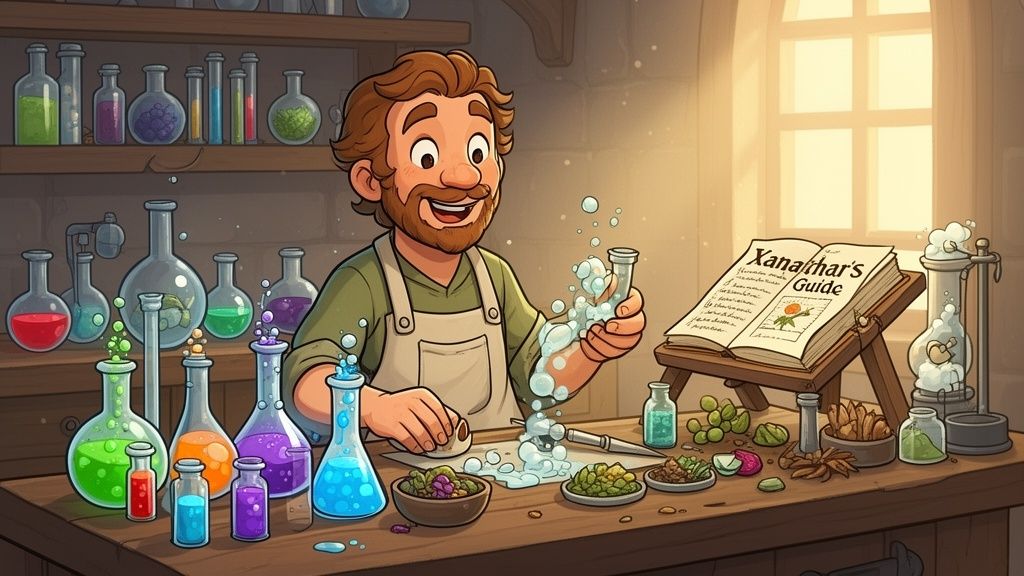
For a common Potion of Healing, Xanathar’s Guide to Everything gives players a clear starting point. Crafting costs 25 gp, which is half the usual 50 gp market price from the Player’s Handbook.
That difference is the whole appeal. If your campaign includes real downtime, a potion is no longer only something found in loot or bought in a shop. It becomes a reserve you can build in advance, one bottle at a time.
Why crafting changes play
Potion crafting works like stocking your bench in a modern strategy game. The benefit does not appear in the quiet scene at the worktable. It appears later, when a fight runs long and the party still has one more answer ready.
That is why careful players often value crafted potions more than their gold-piece maths suggests. They are not only saving money. They are converting spare days into future stability.
Healing potions invite worldbuilding in a way many consumables do not. One DM may describe a monastery’s honey-thick restorative tonic. Another may prefer sharp-smelling hedge-witch draughts bottled in wax-sealed vials. Both still serve the same mechanical role, but the fiction around them gives the setting texture.
That impulse shows up often in community discussions. Many DMs share homebrew crafting rules that draw on local folklore, rare ingredients, or unstable experimental brews, especially in conversations that followed recent playtests. The pattern is easy to understand. Potion making feels more satisfying when it reflects the place it came from.
Crafting is also character expression
A fighter who keeps a satchel of practical battlefield tonics tells a different story from a druid who brews mossy infusions under moonlight. The rules may produce the same healing, but the table learns something about the character from the method.
That matters more than players sometimes expect.
Downtime systems work best when they do two jobs at once. They give a useful reward, and they show who the character is when swords are sheathed. Potion crafting does both.
Questions to ask your DM first
Before a character commits to potion making, check the ground rules.
How much downtime does the campaign allow? Crafting looks strong on paper, but it needs breathing room in the story.
What tools or proficiencies are expected? Some DMs keep it simple. Others want herbalism kits, alchemist’s supplies, ingredients, or roleplay scenes.
How common are potions in the setting? In one world they are routine trade goods. In another they are temple remedies, guild secrets, or rural folk cures.
Can crafted potions vary in flavour without changing mechanics? That small permission often makes the whole system feel more alive.
A short conversation here prevents confusion later. It also helps crafting feel like part of the campaign rather than a line on a shopping list.
For Dungeon Masters House Rules and Loot Placement
A party limps out of a brutal fight. The rogue is on 4 hit points, the cleric is out of spell slots, and someone uncorks a healing potion only to gain so little that the table barely reacts. That moment tells a DM something useful. The item still works by the rules, but it may no longer work for the pace and pressure of your campaign.
At low levels, a healing potion can swing a scene. Later on, the same bottle can feel more like a pause button than a rescue. That gap matters because treasure is not only a reward. It is also a signal. If players stop caring about potions, one part of your loot economy has gone flat.
Why many groups tweak the rules
Online discussion around 5e makes one pattern clear. Many DMs use house rules for healing potions once campaigns move beyond the early game, often preferring table-specific fixes over official variants.
The reason is simple. Players judge an item by what it lets them do right now. Modern card games handle this well. In a fast tactical game such as TerraClash™ Grimoire, a resource has to justify the moment you spend it. A card that costs time or tempo but barely changes the board tends to stay in hand. Healing potions in 5e can run into the same problem. If drinking one feels weaker than attacking, dashing, or preserving an action for something better, players hoard the bottle and wait for a perfect moment that never comes.
That is a warning sign for DMs. A potion no longer feels like treasure if the table treats it like clutter.
You do not need a complicated fix. You need a rule the table remembers under pressure.
Some groups let characters drink a potion as a bonus action. Some keep the normal action cost but give maximum healing when a character uses their full action to drink it. Others place better potions more deliberately so that stronger healing enters play at the same rate the campaign’s danger rises.
Each option changes player behaviour in a different way. Bonus-action drinking makes potions feel like tempo tools. Maximum healing rewards caution and planning. Better loot scaling keeps the official rules intact while adjusting the economy around them.
Use the version that matches the tone of your campaign.
DM takeaway: If players keep saving potions because using one feels like a poor trade, the rule is creating hesitation instead of tension.
Loot placement matters as much as rules text
Where a potion appears often matters more than its price.
Too many potions soften attrition and blur the difference between a hard day and an easy one. Too few make every hit point feel irreplaceable, which can slow decision-making to a crawl. Good placement creates relief without removing uncertainty.
A simple way to place them is to tie each potion to a job in the adventure:
Recovery after pressure: A potion after a draining fight helps the party push on without needing a full reset.
Warning before danger: A stronger potion before a boss, cursed vault, or monster lair tells the group that the threat curve is about to rise.
Payment for smart play: A hidden supply cache, healer’s lab, or allied quartermaster rewards scouting, negotiation, and planning rather than pure luck.
That last category is easy to overlook. Players value consumables more when access feels earned.
Keep the fiction attached to the item
A healing potion is more memorable when it has a place in the world.
Do not write “2 potions” and move on. Put them in a shrine’s medicine chest, a mercenary surgeon’s satchel, a coach guard’s emergency case, or the private stores of a paranoid noble. The mechanics stay the same, but the context does useful work. It tells players who prepared for danger, who expected violence, and what kind of setting they are travelling through.
That is also good game design. In tabletop RPGs, as in modern card games, resources feel better when they carry both function and meaning. A potion should restore hit points, but it should also tell a story about why it was there and why this was the moment the party found it.
Chilling Touch 5e: A Strategist's Guide to the Cantrip
You know the moment. The fighter lands a huge hit, the cleric is down to scraps of healing, and the monster in front of you refuses to stay hurt. Its wounds close. Its grin returns. The table goes quiet for a second because everyone can feel the fight slipping away.
That is where chilling touch 5e earns its place.
A lot of players glance at the spell and file it under “decent ranged cantrip”. That undersells it badly. In practice, Chilling Touch is one of those spells that teaches a deeper lesson about Dungeons & Dragons. The best move is not always the loudest one. Sometimes the winning play is the one that cuts off the enemy’s plan.
As a Dungeon Master, I love spells like this because they reward attention. As a fan of sharp, fast card games, I love them for the same reason. They ask a simple question. Are you only counting damage, or are you reading the board?
The Unsung Hero of a Desperate Fight
The troll had already hit the barbarian twice. The party wizard was nearly out of bigger spells. Every turn felt the same. The group dealt damage, the troll staggered, then the thing started knitting itself back together.
That sort of combat creates panic. Players often respond by reaching for their strongest attack, hoping brute force will solve the problem. Sometimes that works. Sometimes it wastes a round.
Chilling Touch changes the terms of the fight. It does not just chip away at hit points. It tells the target, “No, you do not get that back.”
That is why the spell feels so satisfying in play. It creates a swing without looking flashy. The wizard points, the spectral hand appears, necrotic force lands, and the creature loses access to one of its best defensive tools. Suddenly the rest of the party’s attacks matter more.
Why this spell gets overlooked
Two things cause confusion straight away.
The name misleads people. Newer players often expect cold damage.
The old reputation lingers. Older players may remember a very different version from earlier editions.
At the table, both assumptions can hide what makes the spell strong. Chilling Touch is not about elemental flair. It is about control through disruption.
What smart players notice first
The best users of this cantrip usually spot one of these battlefield truths:
A regenerating enemy is a key priority
A healer-backed foe needs to be shut down
Distance matters more than burst
An undead threat can be pressured safely
A cantrip becomes dangerous when it answers a problem other spells leave untouched.
That is a particular appeal of chilling touch 5e. It rewards calm thinking in ugly fights. If your group has ever stared at a troll, vampire, or any enemy that keeps recovering, this spell stops being “nice to have” and starts feeling like the clever answer that was there all along.
Deconstructing Chilling Touch The Core Mechanics
Chilling Touch is a control cantrip disguised as a damage spell. If you come to it expecting icy damage or a melee grab, the card text, so to speak, reads very differently from the title.
A seasoned DM usually explains it in four parts. Once those four parts are clear, the spell becomes easy to judge at the table.
What the spell does
Start with the rules text in plain English:
Range. It reaches 120 feet, so a caster can pressure a target from well behind the front line.
Attack type. It uses a ranged spell attack, which means you roll to hit the creature’s Armour Class.
Damage type. It deals 1d8 necrotic damage. The name still catches people out here.
Rider effect. On a hit, the target cannot regain hit points until the start of your next turn.
That package is why the spell keeps showing up in smart play. In card game terms, it behaves less like a simple damage card and more like a tempo play that also clips life gain. TerraClash™ Grimoire uses this same design principle in its faster turns. A modest hit becomes far more threatening when it also shuts off the opponent’s stabilising line.
Two common mistakes
The first mistake is reading the flavour instead of the rule. “Chilling” sounds like frost, but the spell uses necrotic damage. If a creature shrugs off cold, that tells you nothing. You need to check for necrotic resistance or immunity.
The second mistake is trusting the spell name’s second word. “Touch” suggests melee, yet 5e treats it as a ranged attack spell. Older editions are part of the confusion here, because the spell used to work very differently.
Those two misunderstandings matter in play because they lead to poor target choices. A player may hold the cantrip back against the wrong monster, or step closer than needed, because the name points them in the wrong direction.
How scaling works
Like other cantrips, Chilling Touch improves with character level:
Level 1 to 4. 1d8
Level 5 to 10. 2d8
Level 11 to 16. 3d8
Level 17 onward. 4d8
This scaling keeps the spell relevant without spending spell slots. It will not replace your biggest burst option, but it does stay useful across a long campaign because the control effect remains attached to damage that continues to rise.
There is also a rules lesson hidden here that newer players often miss. Chilling Touch asks for an attack roll, not a saving throw, so your decision-making changes. Cover, range, and the target’s Armour Class all matter more than its Constitution or Wisdom. If you want a clearer comparison between attack-roll spells and save-based casting, this guide to spell save DC in 5e lays out the distinction neatly.
The key takeaway: Chilling Touch is a long-range necrotic cantrip that rewards timing, target selection, and pressure.
The Unseen Power Preventing Regeneration
The damage is fine. The healing lock is what wins fights.
A creature that regains hit points can erase your party’s progress. That changes the value of every action your side takes. When Chilling Touch lands, it does more than injure the target. It protects the value of everyone else’s attacks.
Why trolls hate this spell
A troll is the classic example because players feel the problem immediately. They hit it hard. It heals. Morale drops.
When Chilling Touch connects, that rhythm breaks. The troll cannot lean on regeneration for that window. Suddenly the party can pile on pressure without watching the target undo their effort.
The same logic applies to vampires and any foe relying on magical or natural recovery. It also matters when enemy support characters are trying to restore hit points. If the target cannot regain them, a healing spell aimed at that creature loses its purpose for the moment.
The tactical question to ask every round
Do not ask only, “Who can I damage?”
Ask this instead:
Who is likely to heal before my next turn
Which enemy becomes manageable if recovery is denied
Will blocking healing help the whole party more than another attack option
Is this the turn to disrupt rather than race
That is advanced play in very plain clothing. A cantrip can turn into battlefield control when you choose the right target.
A practical table habit
Tell your group what the spell has done.
Say it clearly. “That target cannot regain hit points until my next turn.” That one reminder helps the DM track effects, helps allies plan, and stops the table forgetting the rider in the chaos of combat.
If your campaign often uses consumables and recovery, a quick refresher on dnd healing potion timing can also help players see when healing windows matter most.
Chilling Touch rewards target priority more than damage greed.
That is why experienced players keep it prepared. It answers a specific problem cleanly, and D&D rewards that sort of precision.
Battlefield Positioning and Targeting Tactics
A cantrip with 120 feet of reach changes how a caster moves. You can contribute from deep behind the front line, hold a safer angle, and still influence the most important target on the map.
That alone makes chilling touch 5e attractive. Its targeting nuance makes it more interesting.
The hand appears at the target
Chill Touch works as a ranged spell attack, but it does not behave like an arrow streaking through the room. The spectral hand manifests in the creature’s space. According to this rules discussion on the spell’s targeting, that means it requires line of sight but not a traditional projectile path, so it can negate partial cover while still failing against full cover.
That creates a very practical difference on cluttered battlefields.
A chair, a table, another combatant, or awkward positioning may interfere with how players picture ordinary ranged attacks. Chilling Touch is less bothered by those details, provided you can still see the target properly. You cannot cast it around a corner. You can, however, pressure enemies that might feel more awkward to shoot with a physical missile.
How to position for best effect
Try these habits in play:
Stay long. Use the 120-foot range to keep distance from bruisers and grapplers.
Hold sight lines. The spell still needs line of sight, so pick lanes with a clean visual on likely healing targets.
Punish exposed support pieces. If a foe relies on staying behind allies while receiving healing, Chilling Touch can interfere with that plan.
Work from the edge of the fight. Casters often gain more by being hard to reach than by stepping closer for style.
The undead rider matters
Against undead, the spell adds another layer. On a hit, the undead target has disadvantage on attack rolls against you until the end of your next turn, as noted in the same rules discussion.
That turns Chilling Touch into a tidy piece of self-protection. It is not only “damage plus denial”. Against undead, it also says, “and you are less reliable if you come for me.”
This changes target priority. If an undead creature is likely to focus the caster, Chilling Touch can soften incoming pressure while the party deals with the rest of the encounter.
A simple battlefield rule
Choose your target by asking two questions:
Can this enemy recover or be healed?
If it is undead, is it threatening me directly?
If the answer to either is yes, Chilling Touch becomes a strong candidate for your action.
Class Synergies and Powerful Build Concepts
Not every caster uses Chilling Touch in the same way. The spell is available to classes that approach combat very differently, and that is where the fun starts.
A wizard uses it with clinical precision. A sorcerer treats it as part of a tempo game. A warlock values its reliability when the battlefield asks for necrotic pressure rather than a different ranged option.
Wizards and patient control
Wizards often shine when they read the encounter faster than everyone else. Chilling Touch suits that style.
A wizard can stand back, identify the enemy whose recovery matters most, and shut it off while preserving bigger spell slots for later turns. In long adventuring days, that discipline feels excellent. You still contribute meaningful pressure without burning resources every round.
This spell also fits the wizard mindset of solving the actual problem rather than adding more damage to the pile.
Sorcerers and flexible timing
Sorcerers care about action texture. They like shaping rounds in clever ways.
Chilling Touch suits sorcerers who want a cantrip that rewards target choice. The spell is especially satisfying for players who enjoy picking apart encounter logic. If the enemy’s advantage comes from healing, regeneration, or a specific type of resilience, the sorcerer gets to answer that directly.
That is less explosive than a dramatic blast spell, but often more important.
Warlocks and dependable ranged pressure
Warlocks usually have a signature ranged attack in mind, so Chilling Touch competes with strong options. Still, there are campaigns where necrotic damage and healing denial give it a special role.
If your table features undead, regenerating foes, or healing-heavy enemies, Chilling Touch can become a purposeful secondary cantrip rather than a default one.
Build ideas worth considering
Some characters take the spell not because it defines the build, but because it patches a tactical gap.
Character Level
Damage Dice
Average Damage
1-4
1d8
4.5
5-10
2d8
9
11-16
3d8
13.5
17+
4d8
18
A few concepts stand out:
Arcane Trickster. Useful when you want ranged pressure with a disruptive rider before repositioning.
Eldritch Knight. Good for fighters who want a way to interfere with recovery before closing in.
Magic Initiate picks. Handy for non-full-casters who know their campaign includes monsters that lean on healing.
The best build for Chilling Touch is often the one that lacks another clean answer to regeneration.
That is the key comparison. Do not ask only whether it is your strongest cantrip. Ask whether it covers a weakness in the party’s toolkit.
From Cantrip to Card Game A Lesson in Strategy
The party is one round from losing. The troll is barely standing, the cleric is out of position, and a bigger damage spell looks tempting. Then Chilling Touch becomes the smarter play, because stopping recovery matters more than adding another flashy number to the board.
Good spells and good card effects reward the same habit. They ask you to read the state of play before you commit. Chilling Touch is a fine example. Its damage is only part of its value. The true lesson is about timing, pressure, and choosing the action that closes off the opponent’s best reply.
Why this feels familiar to card game players
Card game players know that the strongest move in a turn is often the one that breaks an engine. You are not chasing the largest number on the card. You are cutting off healing, resource loops, or a stabilising play before it happens.
Chilling Touch trains that exact habit of mind. You cast it when the target’s next turn matters more than your current damage total. In D&D terms, that means asking which enemy is about to recover, which threat needs to stay vulnerable, and which attack changes the whole exchange instead of merely nudging a hit point total.
A common point of discussion among players is how much weight to give the rider compared with the damage. The practical answer at most tables is simple. If the rider blanks the enemy’s best route back into the fight, the spell has already done its job well. That sort of sequencing and denial is the same skill modern card games ask for every few seconds.
Fast strategy is still strategy
Fast games sharpen this lesson because they remove the luxury of slow, obvious set-ups. You have to spot pressure points quickly. You have to see which action does two jobs at once.
That is one reason roleplayers often enjoy learning the fundamentals of how to play card games. The better designs reward efficient choices, clean timing, and smart disruption. Chilling Touch follows that same logic. One action deals damage and interferes with recovery, which is exactly the sort of compact decision space that makes a quick game feel rich.
You can see that design instinct in TerraClash™ Grimoire as well. Its appeal is not just speed. It is the pressure to identify the play that interrupts momentum, forces awkward responses, and turns a small effect into a winning one. If Chilling Touch has ever felt satisfying because it ruined the opponent’s plan at the right moment, you already understand the kind of strategic pleasure that modern fast-paced tabletop card games are built to deliver.
Chilling Touch FAQ Clarifying Common Questions
Does Chilling Touch deal cold damage
No. It deals necrotic damage.
The spell name causes endless confusion, but the rules effect is not cold-based. If a player picks it for frost flavour alone, they may be surprised.
Is it a touch spell in 5e
No. It is a ranged spell attack.
The older version of the spell influences expectations, especially for long-time players, but in 5e you attack from range.
Does the healing prevention still matter if the target resists necrotic damage
At many tables, yes. The important question is whether the spell hits and whether the target is affected by the rider. Damage resistance and the rider are not automatically the same thing.
If this edge case matters in your game, the cleanest approach is for the DM to rule consistently and announce it clearly.
Can it stop magical healing
If the target cannot regain hit points for the spell’s duration, that generally affects magical healing aimed at that creature during the window.
The key is not the source of the healing. The key is the target’s inability to regain hit points.
Does the undead disadvantage stack with other disadvantage
Multiple sources of disadvantage do not usually stack into a worse penalty. If an undead already has disadvantage against you from another effect, you still roll with disadvantage, not something harsher.
Can I cast it through a gap or cluttered room
If you have line of sight, partial obstructions are less of a problem than they are for a projectile-style attack. If the target has full cover or is fully out of sight, Chilling Touch will not solve that.
Is it worth taking if my campaign has few undead
Yes, if your group expects regeneration, healing support, or attrition-heavy fights. No, if you already have better tools for those problems and want pure damage instead.