Gather 'round, adventurers, for a tale spun in shadow and forged in fire. We speak of the ultimate antagonist, the master of deceit whose very presence defines an epic conflict: Sauron from The Lord of the Rings. His story is more than a mere legend; it is a masterclass in building a compelling foe, a blueprint that has shaped the villains we face across our gaming tables for decades.
To understand what makes an enemy like Sauron so unforgettable, you must look beyond the final boss fight. He is the quintessential 'Dark Lord', a figure whose malevolence is so immense it literally shapes the world the heroes strive to save. Consider this: every orc patrol, every creeping shadow, every whisper of dread felt by the fellowship is a direct extension of his will.
This is a truth that veteran dungeon masters and game designers know in their bones. A truly great antagonist isn't just waiting in a throne room at the end of the adventure. They are the oppressive atmosphere of the entire campaign, the very source of the conflict that drives every dice roll and card play. Sauron's ever-present influence is the perfect example of this principle in action.
Sauron, the Lord of the Rings, truly represents the pinnacle of strategic evil. He is no monster you stumble upon in a dungeon; he is a foe who operates on a continental scale, the ultimate campaign villain whose grand schemes unfold over centuries.
Observe how his presence warps the world around him:
Sauron's legacy is deeply woven into the fabric of British culture. J.R.R. Tolkien's masterpiece has sold well over 150 million copies since he first began writing it back in 1937. The Dark Lord's role as the absolute embodiment of corrupting power has made him a permanent fixture in literary studies and fandom across the UK and the world. You can delve into the saga's incredible origins on Wikipedia.
So, prepare yourselves. This journey will not only shed light on the deep lore of Middle-earth but also hopefully kindle a flame for new adventures and strategic battles of your own. It might even get you ready for a new world of conflict looming on the horizon… a world known as TerraClash.
Gather close, seekers of lore, and listen. Every great evil begins not with a roar, but with a whisper—often a whisper of good intentions. Before the Lidless Eye and the black fortress of Mordor, the entity we know as Sauron was once Mairon, a gifted artisan apprenticed to the great Vala, Aulë the Smith.
His core desire was for perfect, unblemished order. It was a noble ambition, in truth; a wish to see all things in their rightful place, working in flawless harmony. But this yearning for perfection curdled, twisting into a lust for absolute control. Herein lies the seed of a truly terrifying villain: not one born of pure malice, but a being who fell from a state of grace.
His story is a chilling reminder of how the path to darkness is often paved with the desire to impose one's will upon the world for its own "good."
Mairon's fall was sealed when he was seduced by the first and greatest Dark Lord, Morgoth. He saw in Morgoth the power to enact his grand designs swiftly and without compromise. Under this new master, Mairon’s skill in crafting and order was warped into a tool for domination, and he became Sauron, Morgoth’s most terrible lieutenant.
He still had the relics of positive purposes, that descended from the good of the nature in which he began: it had been his virtue… that he loved order and coordination, and disliked all confusion and wasteful friction.
This transformation into a master of manipulation is what makes Sauron, Lord of the Rings, such a compelling antagonist. He is no mindless beast. He's a fallen angel, a corrupt intellect whose evil is methodical and patient. He understands desire, pride, and fear, and uses these as weapons far more potent than any sword. He is a strategist, much like his counterpart Gandalf, whose own history is a fascinating study in power and wisdom. You can explore more about the Grey Pilgrim in our dedicated article on Gandalf, Lord of the Rings.
In the realm of tabletop games, the most memorable villains are rarely simple monsters. They possess complex histories and tragic flaws that make their opposition meaningful. They challenge the heroes not just with brute force, but with a conflicting ideology.
Sauron’s journey from creator to destroyer is a powerful narrative tool, a perfect blueprint for crafting conflicts in games like TerraClash, where the clash of wills is just as important as the clash of steel.
This is where Sauron's true genius for treachery shines: the Rings of Power. He did not march on his enemies with armies alone; he launched a campaign of insidious control, waged with cunning and wrapped in a veneer of friendship. To the Elven-smiths of Eregion, he was not a dark lord. He was Annatar, the 'Lord of Gifts' – a radiant, wise being who came bearing knowledge.
He played upon their greatest strength and their greatest weakness: their desire for creation. He offered them secrets, guiding their incredible skills to forge artefacts the likes of which Middle-earth had never seen. Under his supposed guidance, they crafted the Seven Rings for the Dwarf-lords and the Nine for Mortal Men. Each was a masterpiece. But it was all a devastatingly effective lie.
In the shadows, far from the prying eyes of the Elves, Sauron channelled his true self. In the searing fires of Mount Doom, he forged a master ring. He poured all of his cruelty, his malice, and his absolute will to dominate every living thing into a simple gold band: the One Ring.
The Rings of Power were never gifts. They were shackles. They were designed from the very beginning to ensnare the will of anyone who wore them. The Nine Rings given to Men twisted great kings into the Nazgûl, his most terrifying and loyal servants. The Seven given to the Dwarves didn't enslave them, but stoked the fires of their natural greed, bringing ruin and dragon-fire down upon their halls.
The entire scheme was a hierarchy of control, with the One Ring as the absolute master key.
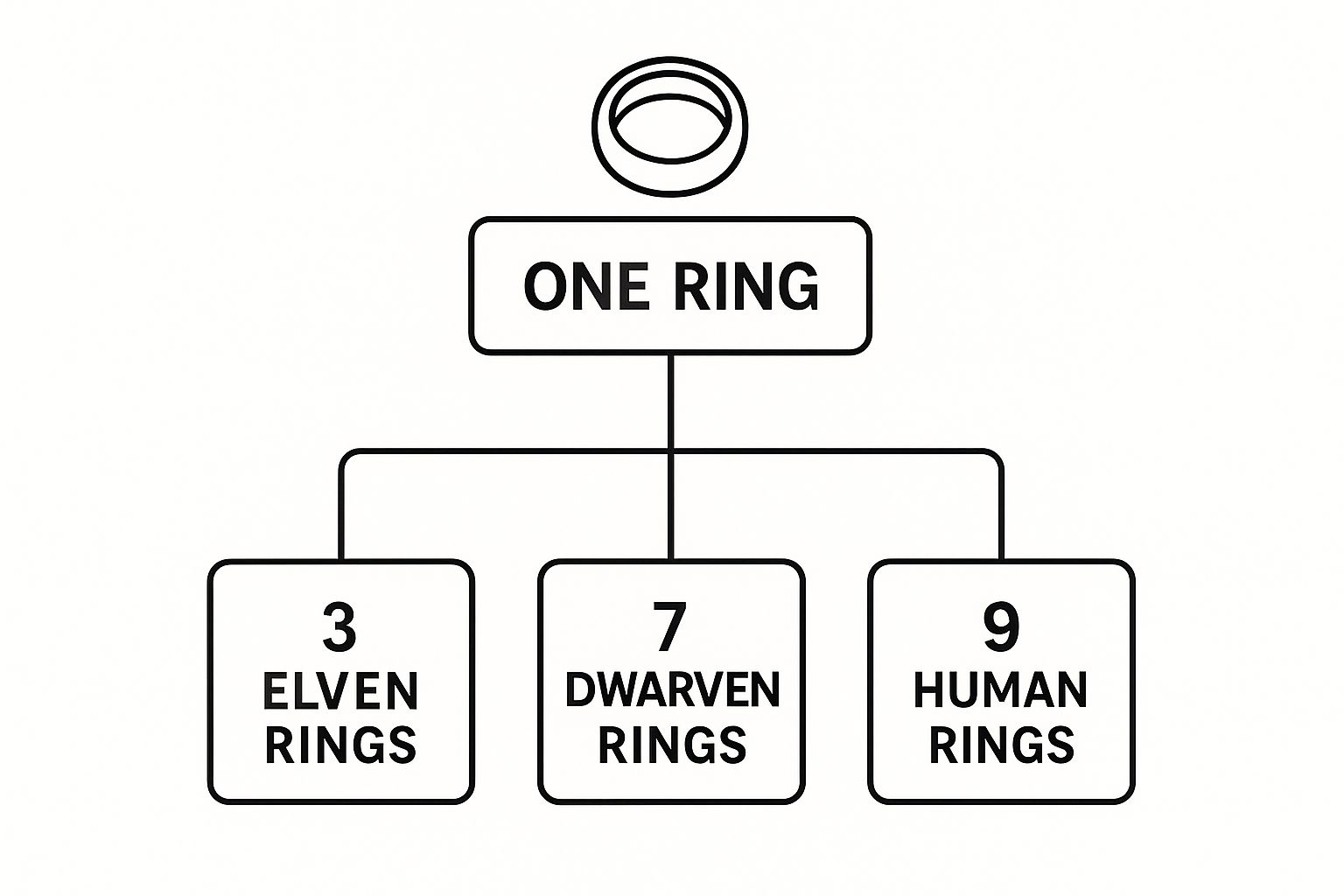
It was a brilliantly simple system. Sauron didn't need to control every king and lord directly; he just needed to control the rings that they depended on. Each lesser ring became a direct conduit for his own will, funnelled through the master ring.
This idea of a powerful object with a devastating drawback is a cornerstone of fantasy gaming. It’s the classic "cursed item" you might find in a dungeon crawl, or that high-risk, high-reward card in a deckbuilder. These items promise immense power, but they always demand a terrible price, forcing players into tense, meaningful choices.
The One Ring is the ultimate example of this design philosophy. It grants invisibility and extends life, yet it constantly corrupts the bearer, twisting their soul towards the will of its master.
This creates fantastic narrative weight. In a game, do you take the cursed sword that grants +5 to hit but drains your life with every swing? Do you play the powerful spell that wins the battle now, but weakens you for the rest of the adventure? These dilemmas, directly inspired by Sauron's masterful corruption, are what make tabletop games so unforgettable. They force us to weigh power against consequence, a theme we've woven deep into the strategic fabric of TerraClash.
For a being like Sauron, Lord of the Rings, defeat is rarely the end of the story. You can destroy his body, as they did in the War of the Last Alliance, but his spirit? That was something else entirely. It clung to Middle-earth like a poison, a corrupting whisper that found its way into the minds of the ambitious and a creeping dread that settled in the hearts of the wise.
This lingering malevolence is what shaped the entire Third Age. For centuries, he was the mysterious Necromancer, a growing darkness lurking in the fortress of Dol Guldur that even the White Council couldn't immediately identify. Later, he became the ever-watchful Eye from Mordor, his will a relentless force directing legions of Orcs, Trolls, and twisted Men against anyone who dared stand free.
It's this sheer persistence that turns a simple antagonist into a true force of nature within a narrative.
Think upon your favourite tabletop campaigns. The best villain—the 'big bad evil guy', or BBEG—is never just the final boss waiting patiently in the last room. A truly great BBEG, in the mould of Sauron, makes their presence felt from the very beginning. Their influence is woven into the fabric of the world itself, tying everything together into one epic story.
Every goblin ambush on a lonely road, every city official taking a bribe, every fearful rumour of war—it should all feel connected, like the reaching tendrils of the villain's grand plan. It’s this approach that makes every small victory the heroes win feel like a genuine blow against a vast, ever-present evil. We see this principle in many of fantasy’s greatest antagonists, from the scheming arch-liches in D&D to the all-consuming Phyrexians in Magic: The Gathering. You can actually see how this plays out in our look at Magic: The Gathering's legendary creatures.
A great villain's power is not just in what they can do, but in the shadow they cast. Their threat should be felt in every dark forest and fearful village long before the heroes ever meet them face-to-face.
The fascination with Sauron’s oppressive, strategic presence is still incredibly strong, especially here in the UK. Search data consistently shows that places like Birmingham, Manchester, and London are global hotspots for all things Tolkien, showing just how deeply the lore of Middle-earth is embedded in our culture. This enduring interest proves just how compelling the archetype of the lingering, patient villain is. You can even discover more insights about this dedicated fanbase in fan communities.
It’s this sense of an overarching, intelligent evil that we find so inspiring. Building a world where every single challenge feels like part of a much larger, epic struggle is fundamental to the kind of strategic experience we want to create with TerraClash.
The shadow of Sauron, the Lord of the Rings, stretches far further than the peaks of Mount Doom. It casts a long, dark silhouette right across the landscape of modern fantasy and gaming. His character is the absolute bedrock of the 'Dark Lord' trope—the foundational evil that so many others have been carved from since.
Think on it. From tyrannical sorcerer-kings in sprawling fantasy novels to the final, world-ending boss in your favourite video game, his influence is everywhere. This legacy is a constant source of inspiration for creators, but it also throws down a gauntlet for today’s game designers. How do you build a villain that feels epic and familiar, but fresh enough to genuinely challenge a new generation of heroes? That’s a question we ponder when creating memorable tabletop conflicts.
Just glance across your game shelf, and you will see his echoes. The classic Sauron themes—insidious corruption, subtle control, and deception on a grand scale—are woven into the DNA of our favourite games. His methods live on in so many memorable antagonists:
Each of these villains borrows a page from Sauron’s playbook. Their power isn’t just about brute force; it’s about their ability to corrupt, to command loyalty through fear, and to patiently enact plans that span lifetimes. They are the ultimate strategic masterminds, a perfect model for any great campaign. Standing united against such a monumental evil is a massive part of what makes the best cooperative board games so compelling.
But even with such a powerful legacy, bringing this archetype to a modern audience isn't always a straight path to success. The recent television series exploring Sauron's rise, for example, found it a real challenge to keep every viewer hooked. According to data on Den of Geek, only about 45 percent of the global audience, including fans in the UK, actually finished the entire first season.
This suggests there's a gap between the immense cultural weight of Tolkien's original story and how its modern retellings are received. It tells us that while we love the idea of a Dark Lord, we crave new, engaging conflicts. That’s a challenge we wholeheartedly embrace when we forge the villains of TerraClash.
And so, our journey into the shadows of Middle-earth comes to a close. But the story of Sauron, Lord of the Rings, leaves behind lessons that are truly timeless. Every great story needs a great villain. Every legendary quest, as any seasoned adventurer knows, needs a legendary foe whose shadow stretches across the entire campaign map.
The sheer depth of the lore, the complex motivations, and the world-shaking stakes that define Middle-earth’s saga are the very ingredients that make tabletop gaming so utterly captivating. These are the sparks that ignite our imagination, whether we’re battling ancient evils in some long-forgotten ruin or marshalling our forces in a tense, strategic deckbuilder.
The spirit of this epic conflict lives on in every game we play. It is this spirit that fuels new creations and inspires developers to forge new worlds for you to conquer, providing fresh battlegrounds for heroes to rise.
It is this very same passion for grand strategy and rich storytelling that drives us to create new adventures. It pushes us to build upon the foundations laid by the masters and offer new puzzles for heroes to solve. If you’re just starting your own journey into these kinds of grand narratives, our guide on D and D for beginners is the perfect place to take those first, crucial steps.
You can print and play TerraClash Lite free, and the Kickstarter for TerraClash Digital is live until 22 November 2026. The world of TerraClash awaits, ready to test your courage and tactical mind against entirely new threats. Get ready to face new challenges, forge your own path, and become part of a new legend.
Even after all this time, whispers and questions about the Dark Lord still echo through the halls of lore. Let us tackle some of the most common ones. After all, understanding your enemy is always the first step to victory.
This question arises often. Was the Great Eye of Sauron simply him staring into one of the ancient Seeing Stones? The lines are a bit blurry here, as Tolkien intended. Sauron absolutely used a palantír—the Ithil-stone—to project his power and ensnare minds like Saruman's and Denethor's. Young Peregrin Took found that out the hard way.
But the Eye was something more. It was a symbol of his sleepless vigilance, a pure manifestation of his will that could actively hunt for the Ring-bearer across the land. Think of it less as a tool and more as a direct, terrifying touch upon the mind. It was a power far beyond simple scrying.
Another excellent query is why Sauron, Lord of the Rings, didn't just stride out onto the battlefield during the War of the Ring. The simple answer? He could not.
Remember, his body was obliterated when Isildur sliced the One Ring from his hand at the end of the Second Age. Rebuilding that kind of powerful physical form took a phenomenal amount of energy, and most of his own innate power was now bound up within the Ring itself.
Without it, he was stuck as a spirit of pure malice—a being of shadow and will. His power was still immense, of course, but he needed the Ring back to regain his full, terrible strength and forge a new body. That's why the Fellowship's quest was such a desperate race against time; every day they faltered was another day Sauron got closer to his goal.
This is perhaps the most fascinating question of them all, especially for storytellers and game masters. Was Sauron just born evil? Not at all.
In the beginning, he was known as Mairon, a Maia of incredible skill who served Aulë the Smith. His driving passion was for order and perfection, a desire to fix the messes of the world. The problem was, this noble goal slowly curdled into a fanatical need for absolute control. He believed only he knew how to create a perfect world, and anyone who disagreed was simply an obstacle.
He did not object to the existence of the world, so long as he could do what he liked with it. His plans, the idea coming from his own isolated mind, became the sole object of his will, and an end in itself.
Herein lies the core of what makes a truly great villain. It is a powerful lesson: evil is not always some cackling monster. Often, it's a good intention that has been twisted and corrupted by pride and a refusal to compromise. That's a potent theme for any storyteller to play with, whether you're writing a novel or crafting your next big tabletop campaign.
The legends of Middle-earth offer a bottomless well of inspiration, but now it is time for a new saga to begin. At TerraClash, we know that every grand adventure is measured by the challenges you face and the stories you create with your allies. It is your turn to shape a world and confront its legendary foes. Your own quest awaits at https://terraclash.co.uk.

