Gather 'round the hearthfire, adventurer, and let us speak of the Grey Pilgrim. We all know the pointed hat, the long staff, and the fire in his eyes, but who is Gandalf Lord of the Rings truly? Here our quest begins, peeling back the layers of the wandering wizard to reveal the divine spirit sent not to rule, but to guide the free peoples against a gathering shadow.
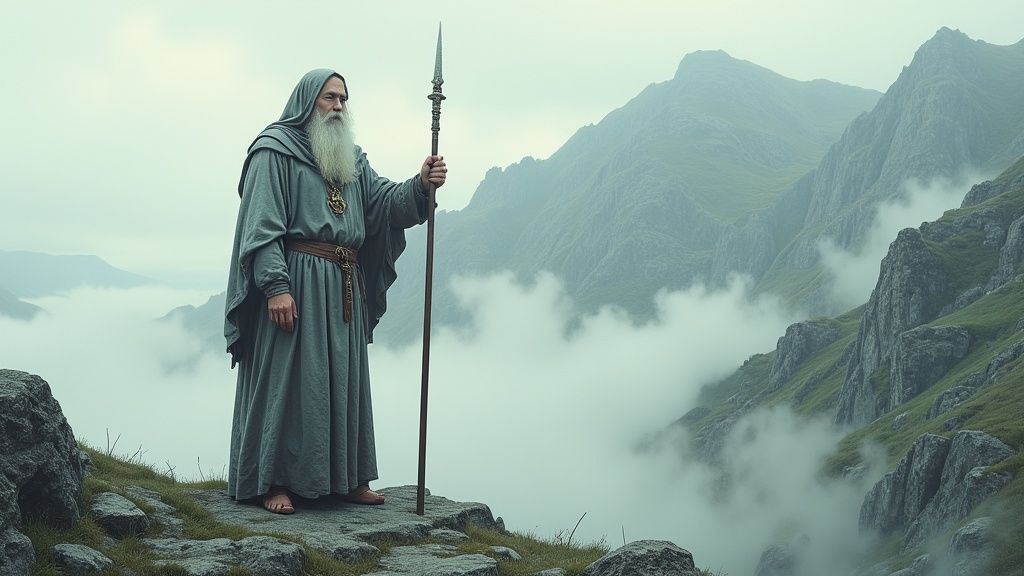
Long before he was Gandalf the Grey, he was Olórin, one of the Maiar from the Undying Lands of Valinor. Picture a council of celestial beings, the Valar, choosing their most trusted champions for a perilous mission into the mortal world. These emissaries, known as the Istari or wizards, were given a subtle but crucial task: to aid those who stood against the encroaching darkness.
Gandalf’s arrival in Middle-earth was deliberately understated. He appeared as little more than a weary, wandering old man in simple grey robes. This disguise was the point, a core part of a sacred vow. He was forbidden from directly matching the Dark Lord's might with his own, a safeguard to prevent him from becoming another tyrant. His task wasn't to be the hero, but to kindle heroism in others.
Think of Gandalf as the ultimate quest-giver in a grand tabletop campaign. He’s that wise NPC whose cryptic words and perfectly timed nudges kickstart entire adventures. He rarely solves problems with a flashy display of magic; instead, he empowers the "players"—the hobbits, men, elves, and dwarves—to discover their own strength and forge their own destinies. His true power lies in his wisdom, his foresight, and his uncanny ability to inspire hope when all seems lost.
He is the master strategist playing the long game, patiently moving pieces across the vast board of Middle-earth. His genius is in understanding that real victory doesn’t come from one mighty champion, but from the combined will of many free peoples.
This kind of character depth, where power is veiled and purpose is everything, is a massive inspiration. Building compelling figures is the heart of any great fantasy game, a principle we've woven into our own deckbuilding adventure, TerraClash. The design of our heroes and villains owes a great debt to this style of storytelling, linking a character's might to the rich lore of the world they inhabit.
Understanding Gandalf’s humble beginnings is the first step to appreciating the true master who shaped the fate of an age.
To truly comprehend the wizard who would steer the fate of Middle-earth, we must look further back than his arrival on its shores. Long before the grey cloak and the pointed hat, he was Olórin, a spirit of wisdom who dwelled in the sublime Gardens of Lórien. He was one of the Maiar, powerful angelic beings who served the Valar—the pantheon of gods who first shaped the world.
Think of the Valar as a council of archangels, watching from on high as a dark shadow, Sauron, began to creep across the mortal world. They knew they could not simply step in themselves; an open conflict involving their kind of power would likely shatter the very lands they sought to protect. A new plan was needed. They decided to send messengers, champions cloaked in mortal flesh to guide and inspire the peoples of Middle-earth, not to rule them.
These chosen champions were the Istari, what we know as the Order of Wizards.
Five of the Maiar were selected for this vital mission and sent across the great sea to Middle-earth. They took the form of old men, their true, immense power deliberately veiled. They were also bound by a strict rule: never reveal their full strength or try to dominate the free will of Men and Elves. Theirs was a mission of influence and wisdom, a subtle game of chess, not a blazing magical war.
The five Istari sent to Middle-earth were:
What's fascinating is that Olórin wasn't the obvious choice to lead. He was humble and even admitted that he feared Sauron. But it was precisely this wisdom—this lack of arrogance—that made him the perfect emissary for the task. He grasped the true danger and the seductive nature of power, a lesson that his superior, Saruman, would one day forget with devastating consequences.
This kind of deep, foundational lore is what gives a character genuine weight. It's the difference between a generic spell-slinger and a legendary figure whose every word and action carries the echo of a much larger story.
This is the sort of depth that makes tabletop adventures and deckbuilding sagas feel so alive and endlessly replayable. When you play a hero's card, it’s not just about the numbers; it’s about calling upon a rich history that rewards players for digging deeper. We're chasing that same spirit of meaningful lore in the world of TerraClash, where every champion has a story just waiting to be discovered. The tale of the Istari proves that real strength isn't always about raw power, but about wisdom, humility, and the courage to face your own fear.
When you think of a wizard, you might picture earth-shattering spells and fireballs lighting up the sky. But that's not really Gandalf's style. His true power isn't about raw destruction; it's about the subtle spark of hope in a dark place, the quiet word that turns the tide of a desperate battle.
With Gandalf Lord of the Rings, magic is more an art of influence, wisdom, and quiet command. He certainly wields light and fire, but more often than not, they are tools to light a path or drive back shadows, not to level a city. His real mastery is in his uncanny foresight and his incredible gift for inspiring courage in others. He is the ultimate support character, making everyone around him stronger.
What many did not realise was that Gandalf carried one of the three Elven Rings of Power. He was the keeper of Narya, the Ring of Fire.
Do not let the name fool you; this was not a weapon for hurling flames. Its magic was far more profound. Narya’s entire purpose was to kindle hope and strengthen resolve, inspiring people to stand up against tyranny and despair. It essentially supercharged Gandalf's natural ability to embolden his allies, turning a shaky shield wall into an unbreakable line of defiance.
This incredible artefact was a cornerstone of his power, allowing him to subtly shape events across Middle-earth. For 17 years before the War of the Ring even began, he was constantly on the move, using his wisdom—and the ring's influence—to piece together Sauron’s dark designs. To dig deeper into Gandalf's long watch and the influence of Narya, Wikipedia offers a fantastic resource.
This image perfectly captures the essence of Gandalf's power. It’s not about brute force; it’s the dawn of hope arriving at the darkest hour.
Here, we see the wizard as a beacon. His very presence is enough to rally the exhausted defenders of Helm's Deep.
This approach places him in stark contrast with his counterpart, Saruman. While Saruman craved knowledge to dominate and control, hoarding power for himself, Gandalf used his wisdom to uplift and empower. Saruman’s story is a classic cautionary tale of how a lust for raw power corrupts. Gandalf, on the other hand, shows us that true strength is found in making those around you stronger.
Any who have played a strategy card game know this lesson well. A single, powerful card might look impressive, but a card that buffs your entire field? That can be unstoppable. It's the difference between a clumsy, brute-force attack and a masterfully executed combination.
This philosophy of interconnected abilities and strategic support is something we’ve woven into the very fabric of our game, TerraClash. Understanding how abilities create powerful synergies between characters is the key to mastering the unique spells of our world.
To better understand the wizard's capabilities, it helps to see where his powers actually come from. Is it him, or his gear?
| Ability | Description | Source |
|---|---|---|
| Inspiring Courage | The ability to instil hope and bravery in others, even in the face of overwhelming odds. | Narya, the Ring of Fire (Amplifier) / Innate Maiar Nature (Core) |
| Pyrokinesis | Control over fire and light, used for both defence (blinding foes) and utility (lighting paths). | Wizard's Staff (Focus) / Innate Maiar Nature |
| Foresight & Wisdom | A deep understanding of the world and a powerful intuition about future events. | Innate Maiar Nature |
| Telekinesis | The power to move objects with his mind, often subtle but demonstrated in key moments. | Innate Maiar Nature |
| Enhanced Durability | As an Istari, he possessed resilience and a lifespan far beyond that of mortals. | Innate Maiar Nature |
| Swordsmanship | A highly skilled swordsman, wielding the Elven blade Glamdring with deadly proficiency. | Training & Experience |
This breakdown shows that while artefacts like Narya and his staff were crucial, the real wellspring of Gandalf’s power was his own divine nature as a Maiar. His tools did not give him power; they helped him focus and channel what was already there.
Every great adventure needs a guide, and in The Lord of the Rings, Gandalf is the ultimate storyteller—the perfect Dungeon Master. His task isn't to be the hero who slays the dragon. It is to set the scene, raise the stakes, and give the true heroes the nudge they need to find their own greatness. His genius is in how he guides the story without ever truly controlling it, ensuring every choice the characters make feels like it matters.
It all begins with a simple ring in a hobbit's pocket. For years, Gandalf has a nagging feeling about Bilbo's little magic trinket, but he doesn't just snatch it away. No, he embarks on a long and dangerous hunt for answers, digging through forgotten scrolls and tracking down Gollum to piece together the horrifying truth. Only then does he lay it all before Frodo, not as a command, but as a choice that will decide the fate of their world.
You can truly see Gandalf’s artistry at work during the Council of Elrond. He is not there to bark orders like a king. He is more like a master weaver, pulling together fragile threads of hope from every corner of Middle-earth. He lays out the evidence about the One Ring, reveals Saruman's shocking betrayal, and then allows the debate to play out.
He understands you cannot force a fellowship into existence; it must be chosen. His role is to create the space for that choice to happen.
This is the moment that defines his role. He gets the party together, points them towards the mountain of doom, and then takes a step back. Now, it is up to the players—Frodo, Aragorn, and the rest—to take the lead. If you seek to kick off your own grand adventures, finding creative ways to unite a group of heroes is half the battle. You can find some fantastic inspiration in these D&D campaign ideas to get your own creative fires burning.
Gandalf's purpose in the narrative is never clearer than in the Mines of Moria. When the Balrog appears, a demon of the ancient world, he knows this is a fight for him alone. This is not the Fellowship's burden to bear. His sacrifice is a brilliant narrative turn, deliberately removing the group's safety net and forcing them to stand on their own two feet. By 'dying', he gives the others the space they need to grow into the heroes they were meant to be.
And his return as Gandalf the White? That is storytelling perfection. He does not just come back from the dead; he is reborn, stronger and with a clearer mission. But even then, he doesn't ride in to fix everything. He acts as a catalyst. He breaks Saruman's hold over King Théoden, but he doesn't take command of Rohan's armies. He empowers Théoden to become the king his people desperately need.
Gandalf's approach is the very soul of a great game master. He lays down the challenge, offers a bit of crucial advice, and then trusts his players to figure out the rest. He knows that a story where one all-powerful character solves every problem isn't much of a story at all.
This is the exact philosophy we have poured into crafting the world of TerraClash. It is a game built to test more than just your deck; it is designed to challenge your judgement and make your decisions count, ensuring every victory is one you have truly earned.
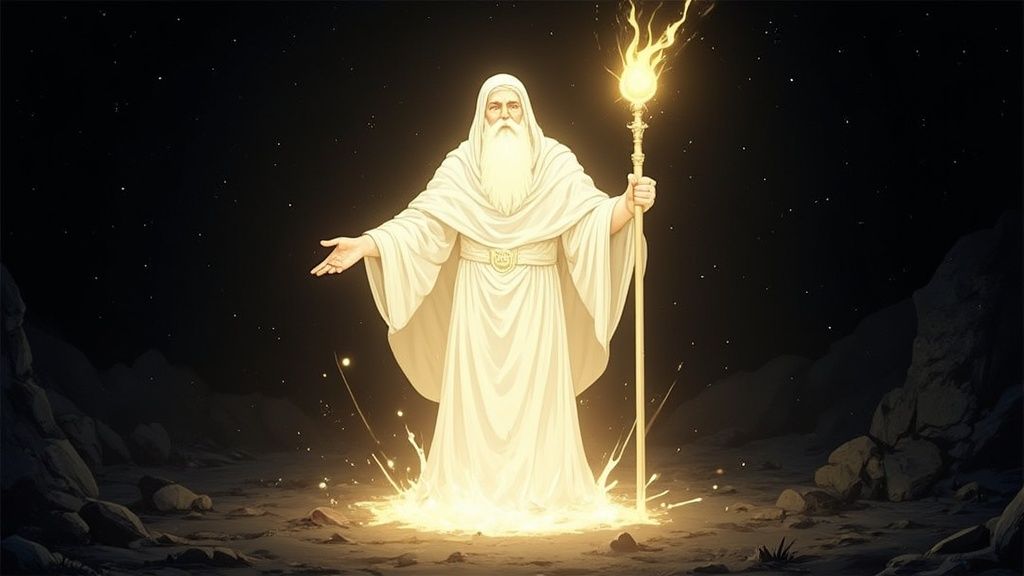
Emerging from Tolkien’s misty prose, Gandalf has strode straight into the heart of British life. More than a mere character, he embodies an enduring magic that resonates across the United Kingdom—a nation that once voted The Lord of the Rings its favourite novel.
This bond stretches beyond simple admiration. In Birmingham, where Tolkien wandered as a youngster, the clash of factories and the hush of open fields breathed life into both Mordor’s shadows and the Shire’s rolling hills. It’s as if the English landscape itself whispered ideas that grew into Middle-earth.
As the archetypal mentor, Gandalf laid down the template for every guiding wizard that followed. His calm counsel and unwavering courage echo through novels, artwork and tabletop adventures alike. If you’ve ever sketched a map in watercolours or rolled a die by candlelight, his presence hovers like a comforting lantern in the dark.
His appeal spans generations. One moment a grandfather passes on a dog-eared paperback, the next a teenager is hatching a quest that will last until dawn. This shared devotion forges friendships that outlast any single story.
Cities where this fascination runs deep include:
You can discover fascinating insights into the UK’s Tolkien fandom.
Gandalf stands as a pillar of modern fantasy—a reminder that the greatest adventures lie not in battles won, but in the wisdom gained and the friendships forged.
That spirit of collective wonder fuels today’s tabletop gaming scene. It’s the hush before a dice roll, the spark of a new narrative. Here at TerraClash, every card invites you into an unfolding tale—where heroes rise, legends are written and your own epic is waiting to begin.
It’s incredible to think how far the wizard’s shadow has fallen, stretching right out of Middle-earth and into our own world. Gandalf has become more than just a character; he’s an icon of wisdom, quiet strength, and the kind of mentorship that helps others find their own courage.
His very name, which Tolkien borrowed from the Old Norse for ‘wand elf,’ is now shorthand for a trusted guide. You see echoes of the archetype he perfected everywhere—in countless stories, video games, and even in the most unexpected corners of the business world.
This influence isn't just a surface-level nod, either. Take the UK investment fund named 'Narya Capital', a direct reference to Gandalf’s Ring of Fire. Their goal? To embody the wizard's spirit by kindling hope and potential in new ventures. It's fascinating to see how Gandalf's name has appeared in surprising places, as detailed on thebump.com.
The symbolism of Gandalf lord of the rings is now deeply woven into the fabric of modern culture. He stands for the idea that real power isn't about domination, but about inspiring others to rise to the occasion and achieve their own greatness. It's a powerful reminder that characters born from fantasy can leave a very real mark on our world.
Great lore does not merely reflect the world; it has the power to shape it. The wizard’s journey reminds us that the spark of courage, when fanned by wisdom, can ignite a fire that holds back the darkest shadows.
This is the very essence we aim to capture in the world of TerraClash. Every hero and creature is far more than a set of stats on a page; they're a piece of a much larger, unfolding legend. We’ve filled our world with figures whose stories touch on these timeless themes, creating a rich tapestry for you to explore.
For a peek at the creatures awaiting your command, feel free to consult our detailed bestiary of the world of TerraClash.
Even the most dedicated loremaster finds themselves pondering the mysteries of Gandalf. He is a complex character, after all. Let's delve into a few of the most common questions that arise.
This is the great riddle, is it not? The simple answer is that he was forbidden. As one of the Istari, Gandalf was sent to Middle-earth with a very specific decree: guide and inspire, but do not take over.
His task was to help the peoples of Middle-earth find the strength to defeat Sauron themselves. If he had simply unleashed his full angelic (or Maiar) power, it would have been like dropping a divine bomb on the problem. It might have worked, but the collateral damage would have been immense, and it risked turning him into the very thing he was fighting against – a new dark lord ruling through power.
Think of Gandalf the Grey as the wizard in disguise. He was cloaked in humility, appearing as a wandering old man so he could advise and nudge things along without causing a panic. It was all part of the mission.
But after his epic battle and fall against the Balrog, he was sent back, fundamentally changed. Gandalf the White was his true power, unveiled. The restrictions were loosened, and he returned with greater authority, ready to step into Saruman's role as the leader of the forces of good. He was no longer just a guide; he was a commander.
Not at all. He was deeply suspicious of Bilbo's "magic ring" for a long, long time – over 60 years, in fact. He knew something was amiss, but he had no idea it was Sauron's master Ring.
It took him decades of painstaking research, poring over ancient scrolls in the archives of Minas Tirith and hunting down the creature Gollum, to finally piece the puzzle together. This slow, methodical quest truly shows you what Gandalf is all about: not just raw power, but incredible patience and wisdom.
Your own legend awaits, adventurer. The battlefield is being prepared, and the heroes are gathering. You can print and play TerraClash Lite free, and the Kickstarter for TerraClash Digital is live until 22 November 2026. Follow our quest at https://terraclash.co.uk.

