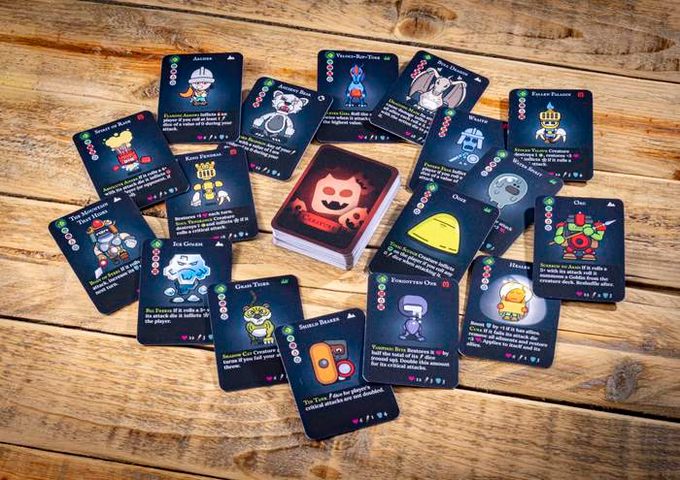
Hark, adventurer! You seek the arcane knowledge of how to build a magic deck, a weapon of wit and will that can dominate the field of battle. Forget the novice's folly of cramming in every mighty beast and flashy spell. The first, and most sacred, step is to forge a core idea—a grand strategy that will guide every choice you make on this epic quest.
Before you even think of shuffling a single card, you must have a plan. A legendary deck, much like a grand saga, tells a story on the battlefield. You are the storyteller. What tale will you spin?
Will you be the general of a relentless horde, flooding the board with creatures to smash through your opponent's defences? Perhaps you fancy yourself a cunning archmage, controlling the flow of battle with a web of spells, countering every move until your rival is left with naught but despair. Or maybe you are drawn to forbidden power, patiently assembling the pieces for a game-winning combination that erupts in one brilliant, devastating turn.
This decision, adventurer, is the very soul of your deck. It is the blueprint from which your legend will be built.
Often, the surest path is to anchor your strategy to a single, powerful figure. Think of the legendary heroes and villains from the grand tales of fantasy; their unique abilities shape the entire narrative. In deckbuilding, these champions are not just powerful cards; they become the very heart of your strategy, much like a legendary Warlock's pact in Dungeons & Dragons or the unique faction leaders in board games like Scythe.
For inspiration, it is wise to study the different archetypes of Magic: The Gathering legendary creatures. Seeing how those decks are built around a central hero can spark brilliant ideas for your own creation.
Once you have your strategy, it becomes the sacred filter for every card you consider. Building an aggressive creature deck? That slow, ponderous spell, no matter how potent it seems, is likely a distraction. Weaving a web of control? You can safely ignore that small, fleeting creature that cannot block or disrupt your foe's machinations.
A deck without a core concept is like a fellowship without a quest—a collection of powerful individuals wandering aimlessly. A unified strategy ensures every card, from the humblest land to the mightiest dragon, works toward a single, glorious purpose.
Nailing down this identity early is the most critical step. It is the foundation upon which all else is built. It makes your card choices clearer, turning the overwhelming task of choosing from thousands of options into a focused mission.
This ancient wisdom holds true, whether you're battling in a well-known universe or preparing for a new world like TerraClash. Just as a great D&D character needs a backstory to guide their actions, your deck needs a core concept to guide its path to victory. This is what transforms a random pile of cards into a finely tuned weapon, ready for the challenges that await in any tabletop adventure, especially one designed for ages 12 and up.
Feel the pulse, Planeswalker: mana is the lifeblood of every deck. It fuels your incantations and summons your creatures. If your mana curve is flawed, even the most powerful archmage will find themselves staring at a hand full of spells they cannot cast.
Through countless campaigns, I have learned that a balanced mana curve is the cornerstone of consistent victory. It allows you to seize the early advantage and still command the battlefield in the final, decisive turns. Most seasoned mages agree on 24–26 lands in a 60-card deck, a sacred number that typically ensures you can summon power from the earth from turns one through six.
Focusing only on high-cost spells is a fool's gambit, for you will hand the tempo to your opponent before your champion even steps onto the field. Conversely, an aggressive deck filled only with one-cost minions may find its assault faltering just as the midgame battle begins in earnest.
That is why many of us rely on probability over mere guesswork. In the competitive arenas of the UK, arcane mathematics shows that including at least nine one-drop cards in a 60-card deck gives you roughly a 14% chance to draw one in your opening hand. For those who wish to delve into these ancient runes, you can find the full breakdown on Eternal Central.
Vaster battlefields, like those in the Commander format, demand even greater consistency. There, you will often see warlords commanding 35–40 lands to support their grand, multiplayer schemes.
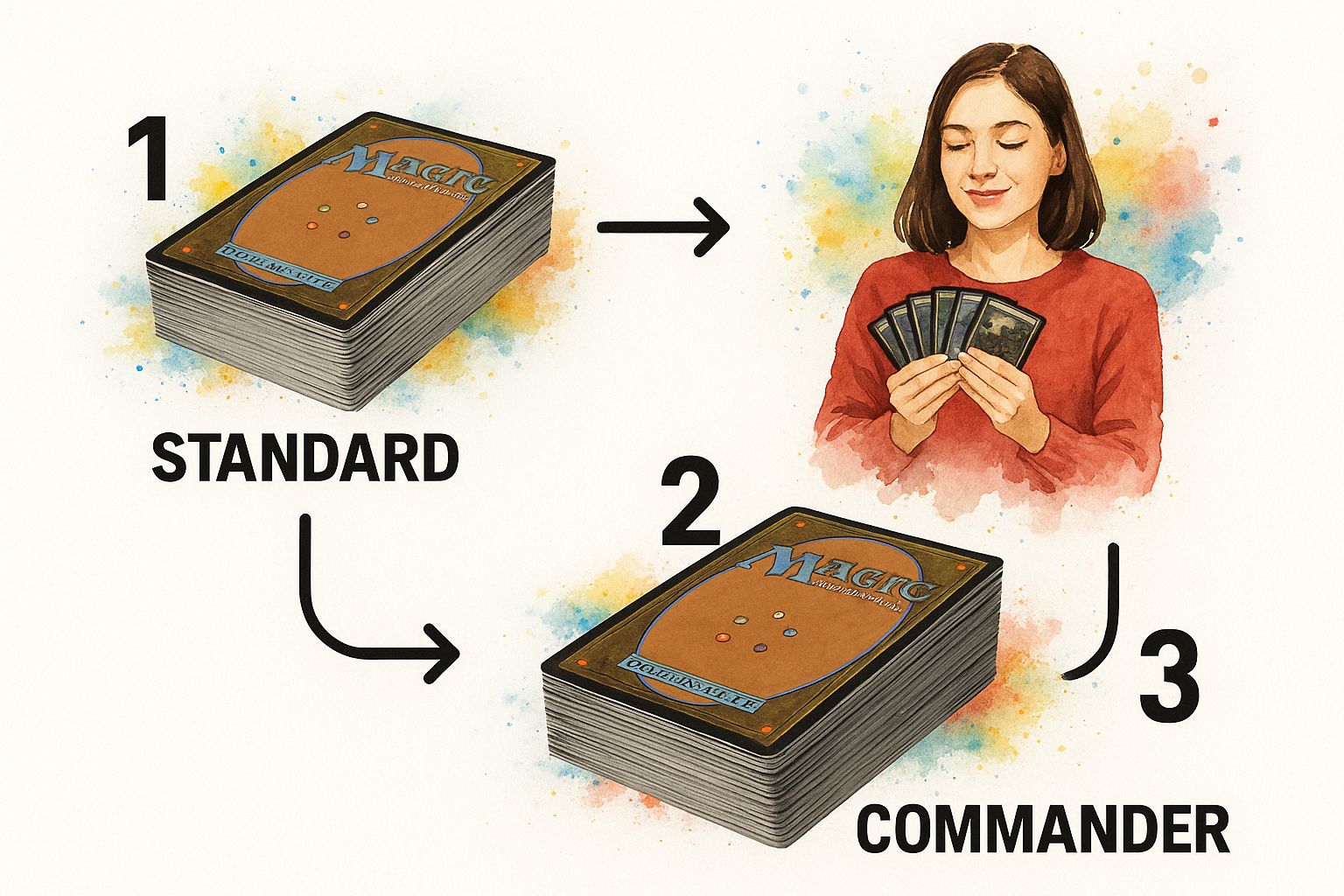
This ancient chart reveals how mana costs are spread in Standard decks versus Commander builds. Standard decks centre around 24 lands, while Commander builds increase that to 37 lands to keep the arcane energies flowing.
Picture this: your quest begins with two one-cost minions and three two-cost allies emerging in your first five turns. Such relentless pressure can carry you straight into a midgame onslaught.
By turn four or five, you desire mana left over to hold up a devastating removal spell or a crucial counter. And should you find yourself flooded with lands or struggling for any, take it as an omen—a red flag for your mulligan decisions.
For a deeper lesson on how a single powerful enchantment like Blood Moon can twist your mana base, explore our detailed guide on the Blood Moon Magic Card. There you will find practical sideboard tips and chronicles of real-game scenarios.
Consistency in your mana curve transforms a scatter of spells into a coherent battle plan.
Here is the ritual I follow when tuning a deck: experiment with one change at a time and chronicle how it influences your results.
Even the most veteran adventurers of TerraClash uncover fresh insights when they fine-tune their mana curves.
A pile of powerful cards is not a deck. It is but a dragon's hoard, impressive but inert. A true deck, the kind that forges legends, is an intricate web where every single thread works in concert with the others. This, my friend, is the magic of synergy.
Think of it as an adventuring party. A hulking Barbarian is a mighty force, no doubt. But pair that Barbarian with a Cleric who can grant them divine fury, and you have suddenly created a champion that can cleave through your opponent's entire army in a single turn. The two cards together are worth far more than they are apart.
This is the mindset you must embrace. You are not merely collecting the strongest individual spells; you are building an engine. A single goblin may be a minor nuisance. But what if that goblin, when it enters the fray, allows you to search your library for another of its kin and place it into your hand? Now you are not just summoning a creature; you are preparing your next two turns. That is how you build an unstoppable tide.
So, how does one find these hidden connections? Begin by reading your scrolls—truly reading them. Look for the subtle phrases that hint at a deeper power.
Does one of your creatures grant a boon to all others of its tribe? That is your sign to muster an entire army of that type. Have you a spell that becomes cheaper for every artefact you control? That is the heart of an artefact-heavy strategy right there. You are seeking the hooks that let you chain one card's effect into another, like the clever engine-building of board games such as Wingspan or Everdell.
This is not a new art. Deck-building games like the classic Dominion are forged upon this very principle. You do not just acquire cards that grant you victory points; you acquire cards that let you draw more cards, so you can play more actions, so you can acquire even better cards. It is all about creating a self-fuelling machine of victory.
In any great card game, you are trying to build a similar engine that can:
When a deck has true synergy, you can feel it. Every draw feels like the perfect piece of a grand prophecy, slotting in to make everything you already have on the board even stronger. It is a wondrous thing to behold.
Of course, to spot these potential combinations, you must know what you seek. Understanding the different roles that creatures, spells, and enchantments play is fundamental. If you are unclear on these basics, a good primer on the different MTG card types can truly open your eyes to the strategic possibilities.
This ancient wisdom is at the very heart of what makes a deck great in any card game, from the venerable classics to the new legends being forged, and it will be absolutely essential in the world of TerraClash. As you begin to ponder the kind of deck you wish to command in this new realm, think like a grandmaster, not just a collector.
Do not be distracted by the flashiest fireball or the biggest behemoth.
Instead, seek the enchanted gauntlet that makes your warrior stronger with every blow they land. Find the clever incantation that not only weakens your foe but also lets you draw a card. That is the true secret to crafting a deck that feels like an extension of your own will—a legendary weapon worthy of song.
So, you are ready to construct your first deck. Before you start slinging spells, you must understand the fundamental laws that govern the game. Every card game, from a chaotic skirmish at the kitchen table to a high-stakes tournament, has a set of rules for deck construction.
These rules are not meant to stifle your creativity. Far from it. They are the foundation that makes the game fair, balanced, and thrilling. Think of them as the basic principles of spellcraft—they provide a structure, and it is within that structure that true genius shines.

The first truth you must grasp is that different ways to play—called "formats"—have different laws. A deck built for a casual game with comrades will look very different from one designed for a competitive tournament.
Let's take a common example from the world of trading card games, which often informs the structure of new games like TerraClash. A competitive deck for the UK Standard format in Magic: The Gathering is a fine benchmark. Players must construct a deck of exactly 60 cards. No more, no less.
Within that 60-card limit, you are permitted to have up to four copies of any single card (with the exception of basic lands, which provide your energy or 'mana'). This "four-of" rule is crucial; it prevents mages from simply stacking their deck with one overpowered spell and forces strategic variety. If you are curious how this works in practice, sites like Draftsim offer great insights into MTG Standard deck construction that can be applied to many games.
This strict framework is what turns a pile of cards into a finely tuned war machine.
Before we journey deeper, here is a quick summary of the typical rules you will encounter.
| Rule Component | Requirement | Strategic Implication |
|---|---|---|
| Main Deck Size | Minimum 60 cards | Ensures consistency and reduces the chance of running out of cards. |
| Card Limit | Maximum 4 copies of any non-basic land card | Promotes diversity in card choices and prevents overly powerful, repetitive strategies. |
| Sideboard Size | 0 to 15 cards | Allows you to adapt your deck between games to better counter an opponent's strategy. |
| Mana Sources | Typically 23-25 lands in a 60-card deck | Critical for ensuring you can consistently cast your spells throughout the game. |
Mastering these numbers is the first step towards building a deck that not only works but wins.
Now, let us speak of one of the most strategic arts in competitive play: the sideboard. This is a separate cache of up to 15 cards that sits outside your main deck. Between games in a best-of-three match, you can swap cards from your sideboard into your main deck.
This is your ace in the hole. It is how you adapt on the fly.
Your sideboard is your toolkit for solving problems. Facing an opponent with legions of flying creatures? Swap in your anti-air spells. Battling a sorcerer who keeps shattering your artefacts? Bring in your cards that offer protection.
A well-built sideboard shows you have thought not just about your own strategy, but about the challenges you are likely to face. It is a testament to your preparation and foresight, and it is often what separates a good player from a great one.
Whether you're gearing up for your first local tournament or simply building a TerraClash deck to play with friends, these core principles—deck size, the four-card limit, and the strategic sideboard—are your starting point. They are the universal language of deck builders everywhere. Master these, and you are well on your way.
Let us be honest, adventurer: forging a legendary weapon often costs a dragon's hoard of gold. When you are just starting out, building a powerful magic deck can feel much the same. It is easy to gaze upon the rarest, most powerful cards and feel your coin purse weep. But a massive budget is not the only path to victory. Not by a long shot.
This is where the true alchemy of deckbuilding comes into play. Certain cards become legendary treasures because of their raw power, their scarcity, or how they dominate the top tables at grand tournaments. Learning to navigate this market is a skill in itself—a way to gain the most power for your coin.
Wise deckbuilding is not just about seizing the most expensive cards you can find. It is about understanding why a card is powerful and if you can replicate that effect for less. I have witnessed countless battles won by a common or uncommon card with a clever effect that completely outmanoeuvred a flashy, expensive mythic rare because it simply fit the strategy better. A true master deckbuilder sees the potential others overlook.
To give you a real-world example, just look at the cost of competitive decks for games like Magic: The Gathering here in the UK. A top-tier Standard deck can easily set you back £350 to over £600. It's not uncommon for the most essential cards in those decks to cost £20-£40 a piece. You can get a sense of the current deck prices and trends on IGN. Knowing these figures helps you appreciate just how valuable it is to find more affordable, yet effective, alternatives.
The most powerful resource you have is not the gold in your purse, but the strategic mind you bring to the table. A clever, well-built deck can absolutely triumph over a more expensive one.
It is a common trap to chase the most expensive "meta" cards, believing they are a shortcut to victory. But more often than not, victory comes from a different path entirely—one built on shrewd choices and surprising combinations.
So, how do you construct something formidable without emptying the royal treasury? You begin by focusing on synergy over the price of any single card. Think of it this way: a well-coordinated fellowship of commoners working in perfect harmony will almost always defeat a disorganised rabble of expensive, powerful loners that do not work together.
Here are a few secrets I have gathered over the years for the frugal spellcaster:
Building a deck is a puzzle. It is a test of your own ingenuity and foresight. This philosophy is something we are weaving right into the fabric of TerraClash. We believe that a player's skill and creativity should decide the outcome of a match, not how much money they have spent. As you prepare for new adventures, keep that lesson in your heart.
All that theory is but whispers on the wind. A blade is not truly tested until it rings against another. Your deck is the same. You have painstakingly chosen every card, balanced your mana, and dreamt up clever synergies, but the real quest starts now. It is time for the trial by fire.
This is where the true magic happens: playtesting. It is the crucible where your grand ideas are either forged into a winning strategy or burned away, leaving behind the hard-won lessons of what truly works in the heat of battle.
You will quickly learn the truth of your creation. That combo that looked so deadly on paper? It may prove a fraction too slow against a swift, aggressive foe. That one common card you almost dismissed might turn out to be the unsung hero of your deck.
Do not fear defeat. Every loss is a lesson, a scrying glass showing you exactly where the cracks in your strategy lie.
The first test begins before you have even played a single land. The mulligan—knowing when to keep your opening hand or cast it back for a smaller, hopefully better one—is a skill that defines experienced players. Your opening hand sets the tone for the entire duel.
When you gaze upon those first seven cards, you must be brutally honest with yourself:
Learning to take the risk of a smaller but more functional hand is one of the toughest, yet most important, skills to master.
Once the game is afoot, your deck will face all manner of challenges. How does it handle a swarm of cheap creatures? Can it fight through a storm of counter-spells? You must throw it against every kind of foe to see how it holds up.
This is where your sideboard comes into play. It is your secret weapon between games. Facing down a deck that leans on one massive enchantment to win? Time to bring in your specialised removal. Is your opponent using their graveyard like a second hand? Sub in the cards that shut that dark magic down.
A great sideboard is not just a collection of extra cards; it is a toolbox full of specific answers. It shows you have thought not just about your own plan, but about how to disrupt everyone else's.
This entire process—duelling, learning, tweaking, and duelling again—is how you turn a good deck into a great one. You will adjust your mana, swap out a creature here and there, and fine-tune your sideboard until the deck just feels right. It becomes an extension of how you think.
It is the path every master strategist walks, and it is exactly how you will prepare for the battles waiting in the world of TerraClash. Through these trials, a pile of cards becomes something legendary.
The skills you have just learned are the very ones you'll need to conquer the battlegrounds of TerraClash. We're building a game where smart deckbuilding and tactical skill are what truly matter. To be one of the first to join the fray, follow our journey to Kickstarter!
Discover the world of TerraClash and prepare for adventure!