Gather 'round, traveler, and listen well. To command the swirling energies of the multiverse, you must first master the arcane arts that give them form. Within the grand tapestry of Magic: The Gathering, all power flows from the seven core card types: the legions you command, the spells you weave, and the very ground upon which you wage your epic duels. These are Creatures, Lands, Artifacts, Enchantments, Instants, Sorceries, and Planeswalkers.
Before you dare shuffle your grimoire of spells, heed this wisdom: not all magic is cast in the same mold. Some incantations linger upon the battlefield, their presence a persistent echo that shapes the flow of battle. Others are fleeting, brilliant flares of power that vanish as quickly as they appear. This is the first, most crucial truth you must grasp when learning about the diverse MTG card types.
At the highest level of wizardry, every card aligns with one of two grand philosophies. You have your Permanents, which remain bound to the battlefield, and your Spells (Instants and Sorceries), which are momentary bursts of pure will.
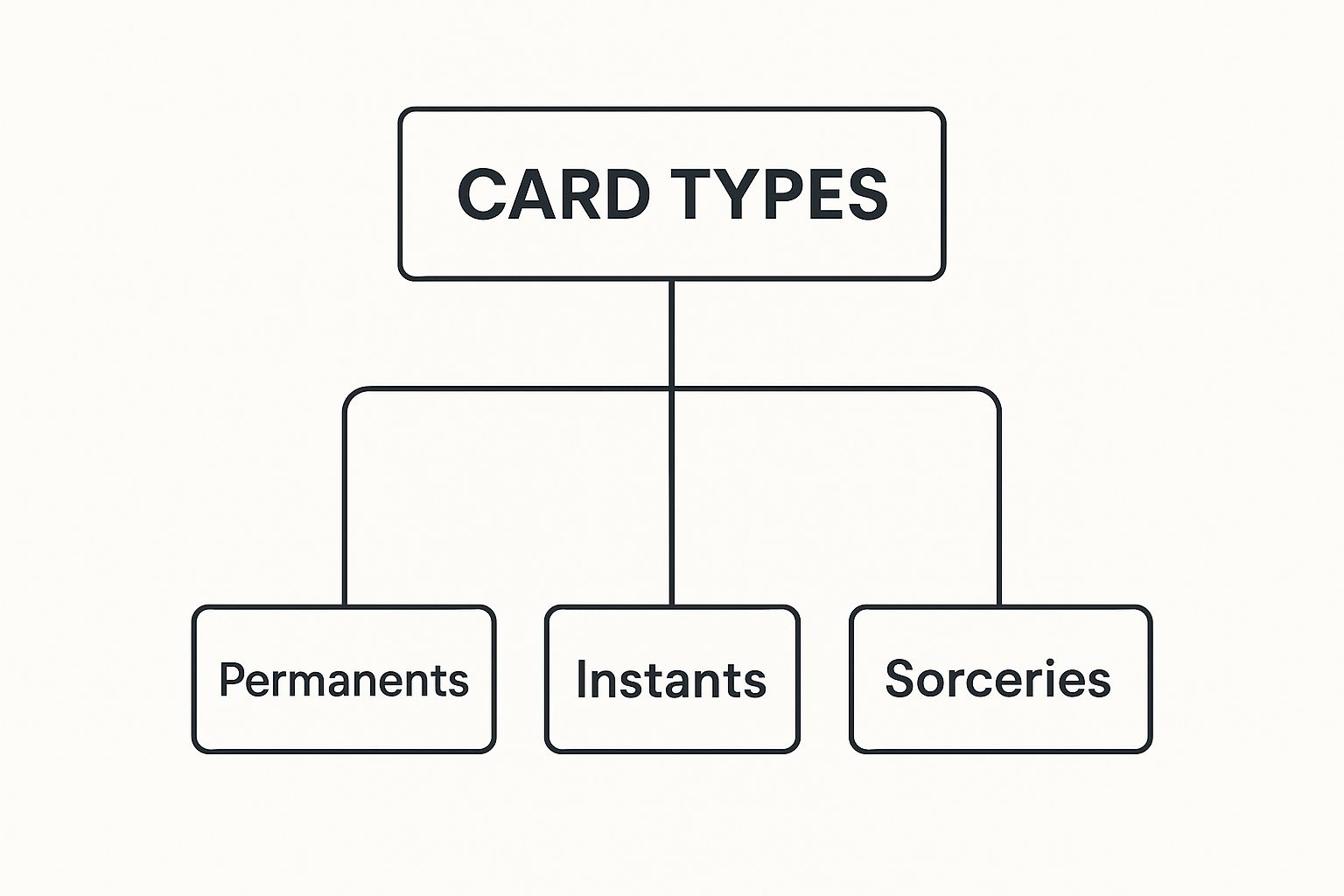
This simple dichotomy is the very bedrock of strategy in Magic, a principle shared by many of the great deck-building sagas. It dictates when your power can be unleashed, how your rival can counter your schemes, and ultimately, how you will etch your legend into the annals of victory.
Imagine each card as a thread in a grand, mystical tapestry. Your strategy is the pattern you weave, and the card types are the vibrant hues and textures you command.
To grasp the scale of this cosmic library, know that as of early 2024, there are over 27,000 unique MTG cards scattered across these seven types. This incredible diversity is why the game remains a living, breathing entity, much like the ever-evolving campaigns in Gloomhaven or the narrative richness of Tainted Grail. For a deeper look into this vast armoury, consult this overview of Magic's card count.
To become a master, you must learn more than what each card does. You must feel how its type influences the rhythm of the duel. A well-timed Instant is a cunning parry; a mighty Sorcery, a crushing, decisive blow.
To aid you on your quest, here is a sacred scroll that breaks down the role of each of the seven core card types.
| Card Type | Primary Function | When It Can Be Cast |
|---|---|---|
| Creature | Attacks and blocks; the vanguard of your army. | Your main phase, when the battlefield is calm. |
| Land | Channels mana, the lifeblood of your spells. | Your main phase, once per turn. |
| Artifact | Wields ongoing effects or activated abilities. | Your main phase, when the battlefield is calm. |
| Enchantment | Imposes powerful, persistent laws upon reality. | Your main phase, when the battlefield is calm. |
| Instant | A fleeting effect you can cast in a blink of an eye. | Anytime you have priority, even amidst your foe's turn. |
| Sorcery | A powerful incantation, requiring focus and time. | Your main phase, when the battlefield is calm. |
| Planeswalker | A legendary ally with multiple loyal abilities. | Your main phase, when the battlefield is calm. |
Consider this your foundational knowledge. Every deck you forge, every battle you wage, will be a unique saga woven from these seven pillars of power.
Every mage knows that slinging spells is but one facet of the art of war. True victory often requires soldiers on the ground. In Magic, your Creature cards are your army, the very heart of most strategies and your primary means of overwhelming your foe. They are the loyal knights, the ravenous beasts, and the cunning assassins who enact your will upon the battlefield.
Gaze upon the bottom-right corner of any creature, and you will find two numbers of great import: power and toughness. Think of them as might and resilience. Power is the damage it inflicts in combat; toughness is the punishment it can endure before being sent to the graveyard. The clash of these numbers is the thunderous song of battle in Magic.
Of course, a creature is more than mere numbers; it possesses an identity, a lineage. And that is where subtypes grant them their true power.
From the disciplined legions of Soldiers to the chittering swarms of Goblins, creature subtypes are a cornerstone of the game's lore and strategy. They forge powerful bonds known as tribal synergies. A mighty Goblin Chieftain, for instance, does not merely fight for himself; his warcry grants strength and speed to every other Goblin under your command. This is how you transform a motley crew into a cohesive, world-shattering host.
A single wolf is a threat, but a pack is a calamity. So too with your creatures. Forging a deck around a single tribe allows you to unleash spells and enchantments that empower your entire army at once, creating a tidal wave of force to crush all who oppose you.
Furthermore, many creatures bear keyword abilities—innate skills that grant them an edge in combat.
Mastering the combination of these keywords with potent tribal themes is a path to countless victories. To gain an early advantage, you can study the art of one of combat's deadliest abilities in our guide on how First Strike works in Magic.
Beyond the brutal clash of flesh and steel, there lies a deeper, more enduring magic. This is the realm of Artefacts and Enchantments, where power is not merely summoned, but bound to the world itself.
Think of Artefacts as the legendary relics you unearth on your quests—sentient swords, mana-focusing crystals, and clockwork titans. They could be a humble signet ring that channels power, or a world-bending monolith that warps time. Often forged without colour, they can be wielded by any mage, making them versatile tools for any Planeswalker's arsenal.
Alongside them are the Enchantments. These are not physical objects, but weaves of pure magic that alter the very laws of the game. They lay persistent effects upon the battlefield, rewriting the rules of the duel to favour their caster.
An Artefact is a tool of power you command. An Enchantment is a law of reality you impose. One is a sword in your hand; the other, a curse upon the land. Both are essential for long-term dominion.
Learning to weave both into your grand strategy is the key to building an unassailable board state that your opponent cannot hope to shatter.
Enchantments typically manifest in two forms, each serving a distinct strategic purpose. Understanding this distinction will allow you to subtly dominate the battlefield from the shadows.
The most potent artefacts become legends whispered across the planes, their power reflected in their immense value. It is no mere chance that many of the most expensive MTG cards ever forged—like the infamous Black Lotus or the unique The One Ring—are artefacts. With The One Ring recently commanding a price of £2.1 million, it is clear how these relics shape the game. You can discover more about these legendary MTG cards and the tales that make them so coveted.
Any archmage will tell you that true power lies not just in what spells you cast, but when you unleash them. Your non-permanent spells—those that blaze into reality and then fade—are your primary tools for controlling the tempo of the duel. They come in two distinct flavours: Sorceries and Instants.
Consider Sorceries your grand, epic rituals. They are powerful, deliberate acts of magic, like conjuring a meteor swarm to cleanse the battlefield or raising an army of the dead from the cold earth. Because such magic requires immense focus, you may only cast Sorceries during your own turn, when the chaotic energies of battle are momentarily calm.
Instants, by contrast, are your reflexive, quick-draw spells. They are bursts of magic you can unleash in a heartbeat, granting you the power to react and adapt to your foe's schemes. Herein lies the true mental contest, for you can cast an Instant at nearly any moment—even amidst your opponent's most calculated maneuver.
The timing that separates these two arts is paramount, and it all revolves around a core magical concept known as "the stack". Imagine the stack as a vortex where spells and abilities queue, awaiting their moment to resolve.
A perfectly timed counter-spell that negates your opponent's game-winning creature; a sudden surge of strength to your blocker to turn the tide of combat; a final, searing bolt of lightning to snatch victory from the jaws of defeat. These are the glorious moments for which Instants were created.
Learning the rhythm of the game means knowing when to channel your mana into a mighty Sorcery, and when to leave it shimmering, a silent threat of the Instant you hold in your hand. It is a subtle art, but it is often what distinguishes a mere apprentice from a true archmage.
You have now learned of the core arts, the card types you will encounter in nearly every clash across the multiverse. But the planes are vast and strange, holding magics that defy simple classification. These are the esoteric cards that bend the very rules of the game and can completely reshape your understanding of what is possible.
Think of these as unique scenarios or epic events—a pivotal battle that engulfs an entire plane, a nefarious scheme you enact over several turns, or a treacherous dungeon you must delve. They are not your everyday spells, but when one appears, all know the story is about to take a dramatic turn.
One of the most vital concepts you will encounter is the Legendary supertype. This is not a card type in itself, but a special designation that can be applied to any permanent. It signifies that the card represents a unique individual, place, or object from the annals of lore. A true legend.
Because of this, a simple but unyielding rule governs them: you may only control one Legendary permanent with the same name at any time. Should you summon a second, the "legend rule" forces you to choose one to remain, sending the other to the graveyard. This rule makes these cards feel truly momentous, forcing you to build your strategy around these epic, story-defining centrepieces.
Think of a legendary creature not as a mere warrior, but as the protagonist of your tale. Their presence on the field warps the narrative, demanding an answer from your foe and guiding your path to glory.
Over its long history, Magic has introduced other fascinating card types like Battles, Planes, and Dungeons. Dungeon cards, in particular, resonated deeply with players who cherish the classic tabletop RPG experience, reminiscent of exploring the Tomb of Horrors. You can always learn more about the full range of card types if you wish to venture deeper into this arcane knowledge.
These unique cards are a testament to the boundless creativity of the multiverse, a quality found in all the best collectible card games. They challenge you to think beyond simple combat and embrace the grand, chaotic story unfolding with every draw.
So, you've journeyed through the seven arcane arts and unravelled the secrets of Magic's card types. What you've truly discovered—the strategic depth, the joy of building a thematic army, the rich, emergent stories—is the heart and soul of countless fantastic tabletop sagas.
If delving into MTG card types has ignited your passion for tactical combat and epic world-building, then your grand adventure is far from over.
We poured our own love for these very ideas—the thrill of outwitting an opponent, the satisfaction of a well-crafted deck—into creating TerraClash, our own indie game that will soon launch its campaign on Kickstarter. It is a chance to be a founding hero in a new universe, helping to shape its destiny from the very first day.
Heed the call, adventurer. The spirit of community and creation that makes this hobby a legend thrives when we champion new quests and support indie creators. Let us build new worlds together.
But this summons is not just for our quest. We revere the entire pantheon of tabletop games! For any hero hungry for their next challenge, we have charted a course to some of the best deck-building games that we believe capture that same spark of arcane genius.
Go forth! Explore new realms, discover amazing indie projects like Frosthaven or the upcoming Arydia, and keep the flame of adventure burning bright.
Here lie the answers to queries I hear most often, from fresh-faced apprentices to grizzled archmages. Even the wisest among us sometimes requires a moment to consult the ancient scrolls.
Think of the card type as the card's fundamental essence. Is it a Creature? A Land? An Artefact? This defines its core function and the ancient laws that govern it.
A subtype, however, adds the rich lore and, more importantly, unlocks deeper tactical dimensions. 'Creature' is the type, but its 'Goblin' or 'Elf' subtype is what allows it to benefit from powerful tribal warcries. It is from subtypes that so many grand strategies are born.
Ah, the eternal conundrum for every artisan of the deck! There is no single, perfect formula, but a wise starting point for a standard 60-card grimoire is 24 lands. This ensures roughly 40% of your deck can channel the mana you require, preventing your power from sputtering out.
Of course, this is but a guideline. A swift, aggressive deck filled with low-cost creatures might thrive with as few as 20 lands. A patient, controlling deck that aims to cast cataclysmic spells may require 26 or even more to fuel its ambitions.
The true answer is revealed through trial by fire. Test your creation, observe how your opening hands feel, and adjust the flow of mana until you find the perfect balance for your deck's unique rhythm.
Indeed! The multiverse is filled with wondrous and sometimes terrifying hybrids. The most common you shall face is the 'Artefact Creature', a being of both forged metal and living flesh. It is subject to any spell that affects either type, a source of both great strength and potential vulnerability.
You will also encounter 'Enchantment Creatures' from the god-touched plane of Theros, or even 'Land Creatures' that can awaken to join the fray. These multi-type cards are paragons of versatility, enabling flexible and often surprising strategies.
If you yearn for the thrill of strategic combat and the allure of deep fantasy worlds, your next great quest awaits. TerraClash is a new deck-building game forged for tacticians and explorers. You can heed the call for our Kickstarter and discover more at https://terraclash.co.uk.