Greetings, Planeswalker, and welcome to the forge. Before you can command the battlefield, you must craft a weapon worthy of your spirit—your deck. Assembling a formidable deck is not merely about gathering sixty powerful cards; it is an act of creation, a ritual where you choose a core philosophy, an archetype, that will illuminate your path to victory.
This is your first true trial. Will you be a whirlwind of righteous fury, a patient manipulator of fate, or a cunning trickster weaving illusions? Your choice of archetype is the very bedrock upon which your legend will be built. This sacred principle echoes in the creation of all great tabletop worlds, from the sprawling dungeons of Dungeons & Dragons to the nascent realms of adventures like TerraClash, where a single, powerful idea gives birth to an entire universe of strategy.
Every Planeswalker possesses a style as unique as their spark. Consider how you approach a challenge. Do you prefer a swift, decisive strike, overwhelming your foe before they can muster a defence? Or are you the type to sit back, weaving an intricate web of control, patiently dismantling every threat until your final, unstoppable blow lands? Your own nature is your truest guide here.
You will find yourself drawn to one of three primary paths, each with its own mystical flavour and rhythm:
This enchanted diagram breaks down the core concepts of each major MTG archetype, showing their strategic goals through simple, distinct icons.
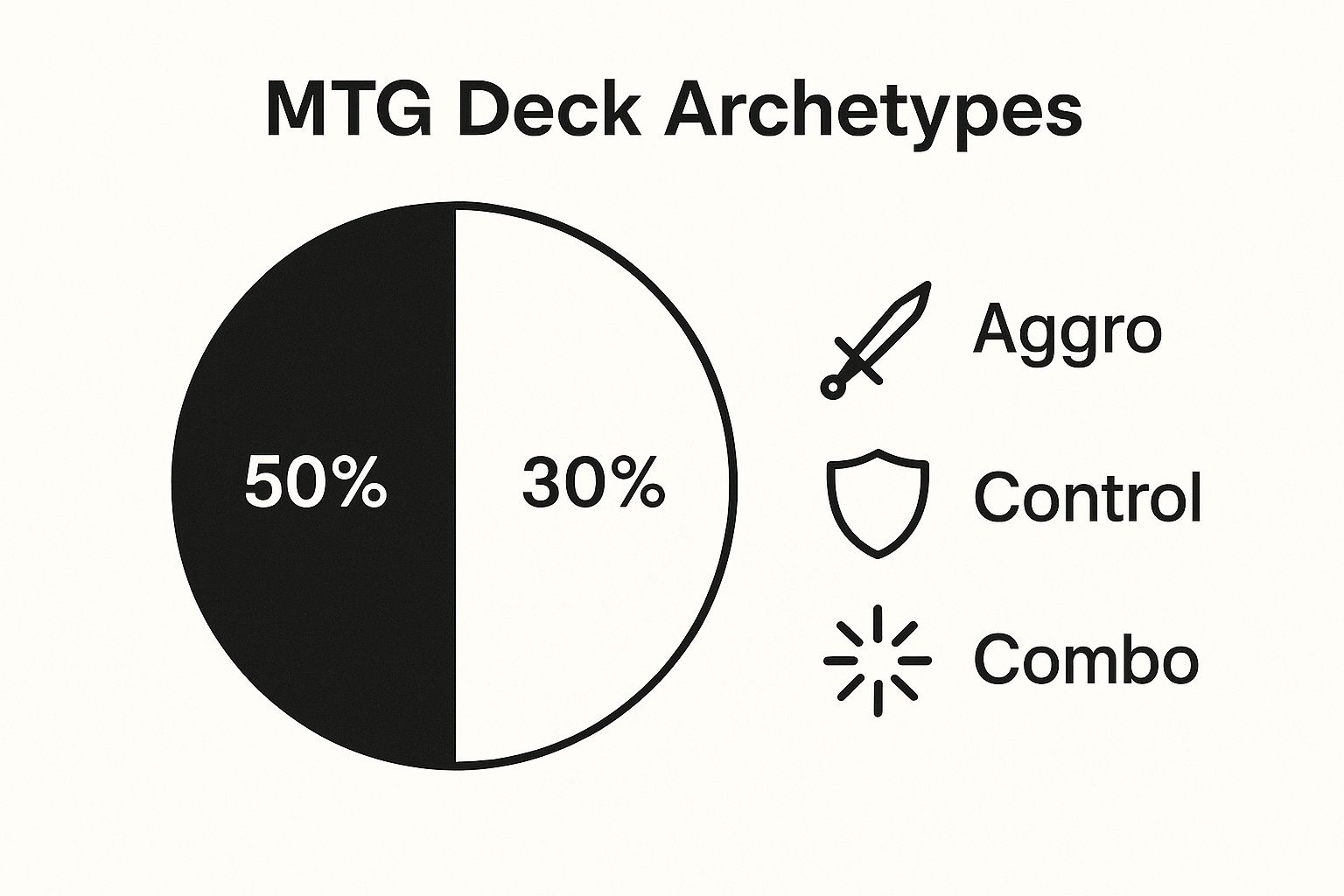
Seeing the paths laid out like this reveals the fundamental differences in approach—raw offence, calculated defence, or intricate synergy. It is the first step in aligning your spirit with the right foundation.
Before we delve deeper, consult this table—a magical census, mapping the core philosophies that power the multiverse.
| Archetype | Primary Goal | Playstyle Flavour | Suited For Planeswalkers Who... |
|---|---|---|---|
| Aggro | Win quickly with early-game pressure | Relentless and aggressive | Love proactive plays and despise waiting for the opportune moment. |
| Control | Survive early, dominate late | Patient and reactive | Enjoy out-thinking their opponent and controlling the flow of battle. |
| Mid-range | Adapt to the opponent's strategy | Flexible and resilient | Desire a bit of everything and enjoy making critical decisions each turn. |
| Combo | Assemble a game-winning combination | Unpredictable and explosive | Love solving arcane puzzles and achieving a brilliant, unforeseen victory. |
This table should give you a sense of where your destiny lies. Do not fret if you are unsure; the truest way to find out is to play and experiment.
A wise Planeswalker always studies the chronicles of past battles. Knowing what strategies are popular and successful can grant you a serious advantage. Here in the UK, the competitive scene has its own distinct flavour. Scrying into major tournament data reveals that mid-range and aggro strategies have consistently been top performers.
For instance, during the 2024–2025 season, Dimir mid-range and Gruul aggro decks each made up about 14% of the competitive field, making them the two most popular choices. This tells us that UK mages favour proactive decks that can apply pressure but also have the flexibility to adapt. If you are curious to see how these metagames evolve, there are great scryers who offer detailed analysis of the UK MTG meta on YouTube.
Choosing an archetype is not just about picking powerful cards; it's about choosing a philosophy you can execute flawlessly under pressure. Your deck should feel like an extension of your own strategic mind.
This idea of forging a strategic identity is what makes tabletop gaming so enthralling. If the deep lore and tactical choices here make your spirit stir, you might enjoy exploring other fantasy card games that offer rich, narrative-driven gameplay. Just like finding the right MTG archetype, discovering a new game that resonates with you is all part of the grand adventure.
You have your grand strategy mapped out. Now comes the ritual: picking the very cards that will bring your plan to life. This is less about summoning the biggest, baddest monsters and more like casting heroes for an epic saga—every card must play its part perfectly. A truly great deck hums with synergy; it is not merely a pile of powerful, disconnected artifacts.
A brilliant place to start, a piece of wisdom passed down through generations of mages, is the 'rule of nine'. It is a beautifully simple deck-building guideline.
The idea is to choose nine key spells or creatures that are absolutely central to your quest. Then, you include the maximum of four copies of each.
Why? Consistency. It is the secret ingredient to victory. Including four copies of your most vital cards makes it far more likely you’ll draw them when fate demands it. It transforms your deck from a chaotic mess into a reliable war machine, game after game.
With the rule of nine as your framework, it is time to fill those slots. This is the true art of deck building, a delicate dance between raw power and what your strategy truly needs to function.
It’s easy to be mesmerized by flashy, game-ending dragons or epic spells. And yes, you absolutely need ways to seal your victory. But those cards are dead weight in your hand if you do not survive the first few turns. Your army needs its humble foot soldiers just as much as its mythic heroes.
Ensure you prioritize creatures and spells you can cast early. They are your first line of defence against an aggressive foe and your first move in the struggle for control of the board.
No matter how clever your plan, your opponent will summon threats. This is where removal spells become your most trusted allies. Think of them as your emergency incantations: the direct-damage spells, the creature-slaying hexes, the counterspells that stop a problem before it can manifest.
You need a good measure of removal in your deck. A variety of answers means you can deal with whatever is thrown at you, whether it’s one gigantic monster or a whole swarm of smaller ones. Building a deck without removal is like entering a dragon's lair without a shield—you are leaving yourself utterly exposed.
A single, well-timed removal spell can completely alter the flow of battle. It's the ultimate power move, letting you gaze upon your opponent's greatest threat and simply say, "Begone."
This entire process of balancing threats, answers, and support cards is not unique to Magic. It is a fundamental principle of grand strategy in almost any game, from tabletop wargames like Warhammer to roleplaying epics. New games on platforms like Kickstarter often find their legend by how well they master this core concept of resource management.
Getting your head around all the different card options can feel like deciphering an ancient tome at first. To help make sense of it all, our guide on the different MTG card types is a fantastic resource. It breaks down what each card does, helping you see how every piece fits into your grand design. Every card you choose is another soldier for your cause, so make each one count.
Let us speak of the absolute lifeblood of your deck, the one force that dictates the flow of every single game you’ll ever play: the mana curve. Honestly, if you cannot command your mana, you are lost in the Blind Eternities. This is the secret language that separates a deck that wins by chance from one that consistently dominates.
Think of your deck as a magical engine. A bad mana curve is a sputtering, clunky contraption. It leaves you staring at a hand full of amazing, powerful spells you cannot cast while your opponent is busy overwhelming you. A smooth, well-oiled curve, on the other hand? That’s an engine roaring to life, letting you deploy threats turn after turn, from the first land drop to the final, game-winning play.
This entire challenge of managing your resources is one you’ll find in almost any great strategy game. It's that same satisfying puzzle you get in grand board games like Scythe or Gloomhaven. Every top-tier deckbuilding game, from the titans of the industry to exciting new projects on Kickstarter, is built upon this exact same foundation.
So, what does a "good" mana curve actually look like? The classic shape is a bell curve, or a gentle wave. You need a solid number of one and two-cost spells so you are never idle in the early turns. The true heart of your deck should crest around the three and four-mana spots—this is where your core strategy usually ignites. From there, it should taper off with just a handful of powerful, high-cost finishers to close the tome on the game.
Let me offer a couple of visions from the multiverse:
Ultimately, the archetype you chose at the start of your journey will sculpt the final shape of your mana curve.
The simplest way to see your curve is to lay it out before you. Take all the non-land cards from your deck and physically sort them into columns by their mana cost. One-drops here, two-drops there, and so on. This simple ritual instantly reveals the rhythm of your deck. Is there a glaring void at the two-mana slot? Are you top-heavy with expensive spells that will merely clog your opening hand?
A well-built mana curve doesn't just let you cast your spells; it dictates the entire pace of the game. It allows you to be proactive, to seize tempo, and to force your opponent to react to your plan, not the other way around.
This balancing act between resources and power is a universal truth in the tabletop world. Whether you're counting action points in a dungeon crawl or spending influence in a sprawling board game, the principle remains the same. Some of the most compelling indie games find new ways to test this skill, which is why it's always wise to keep an eye on passionate creators and their budding projects.
When you're first learning how to build an MTG deck, mastering the mana curve is one of the most powerful skills you can learn. It’s what turns a pile of cards into a cohesive, deadly machine. So, spend time here. Tweak it. Playtest it and feel the flow. Your future victories depend on it.
A blade is not truly sharp until it has been tested in fire. You have assembled your spells, chosen your creatures, and mapped your mana. But that stack of sixty cards is not yet a weapon—it is pure potential, a prophecy waiting to be fulfilled. The real trial begins now, in the heat of battle.
This is what we call playtesting. It is the only way to breathe life into your creation and see how it performs against a real, thinking opponent. That first game with a new deck is a moment of pure discovery. You get to witness your grand strategy unfold, sometimes in a glorious victory, other times in a spectacular failure. Do not fear defeat; every loss is a lesson etched in stone.
The greatest insights often come from seeing your deck through your opponent’s eyes. Find a friend, a fellow mage you trust to give you a proper challenge and, more importantly, honest counsel.
After you've played a few matches, discuss the duel. Ask them what they feared most, which of your cards disrupted their plans, and where they saw a weakness to exploit. Their perspective is a priceless scrying mirror. You might believe your game-winning dragon is the heart of the deck, but they might reveal it was actually a cheap, two-mana creature that completely dismantled their strategy.
This feedback loop is crucial for refining your deck. It is a process that transforms a pile of good cards into a finely-tuned machine, ready for any challenge.
Of course, a sparring partner cannot always be summoned at a moment's notice. When that happens, the digital realms are your greatest ally. Platforms like MTG Arena let you test your creations against a vast variety of decks and strategies, at any hour of the day. It is an incredibly efficient way to gather intelligence, letting you play dozens of games to see how your deck fares against the current metagame.
This hybrid approach, mixing paper and digital testing, has become a cornerstone of modern deckbuilding. It's no surprise that participation in UK MTG tournaments continues to grow, partly because these digital tools make it so much easier to refine our lists. In fact, around 45% of UK players now admit to building and testing their decks online before ever sleeving them up for a local game night.
A deck is never truly finished; it is always evolving. Playtesting is not a single event, but a continuous ritual of refinement, observation, and adaptation. Embrace this cycle, for it is the path to true mastery.
As you play, pay close attention to the omens of your games. Keep a mental (or physical) log of your observations.
Be ruthlessly honest with yourself. If that powerful, game-changing card—like one of the many awesome Magic The Gathering legendary creatures—is constantly stranded in your hand because you cannot afford its cost, it may have to be banished, no matter how magnificent it is.
This is how you learn to build a deck that doesn't just look good on paper but performs with deadly consistency on the battlefield. The crucible awaits.

Any apprentice can sleeve up sixty powerful cards, but true mastery is revealed in what happens between the games. Your main deck is your game plan, your core strategy. But your 15-card sideboard? That is your secret weapon, your grimoire for adapting to whatever your opponent summons against you.
Think of the sideboard as your specialist toolkit. It’s where you keep the silver bullets, the counter-charms, and the tide-turning spells designed to dismantle specific strategies you expect to face. Building a good one is all about anticipating the local meta.
Do you expect a sea of aggressive goblin decks? A slow, controlling wizard who counters everything? Or perhaps that one trickster who always brings a bizarre combo deck that wins out of nowhere? Each of these challenges requires a different answer, and those answers lie within your sideboard.
Before you even consult your sideboard, you face the first crucial decision of the game: the mulligan. It is that heart-stopping moment when you gaze upon your opening seven cards and must decide if they are worthy. It is a difficult choice, for every time you shuffle them back for a new hand, you begin with one less card.
But heed this warning: keeping a poor hand is almost always a death sentence. A hand with no lands, or all lands, or one that cannot make a meaningful play for the first three turns is a recipe for disaster. Having the courage to mulligan a mediocre hand into a potentially great one can be the difference between a swift demise and a hard-fought victory. This kind of risk-reward calculation is a massive part of what makes deckbuilding games so captivating.
This decision has changed much over the ages. The "London Mulligan" rule, adopted in 2019, truly shook the foundations. Now, you always draw back up to seven cards and then place a number of cards from your hand on the bottom of your library equal to how many times you've mulliganed. This made it far less punishing. In fact, data from UK tournaments showed the average mulligan rate shot up from around 15% to nearly 25% as players felt more confident seeking a stronger start. If you’re interested in the details, you can always learn more about Magic The Gathering's evolution and its changing laws.
A well-timed mulligan is an act of foresight. It is an acknowledgement that the first battle is not against your opponent, but against fate itself. Win that first battle, and you set the stage for total victory.
So, you know you need a sideboard, but what goes into it? It is not about jamming in fifteen "good cards." It is about creating a cohesive plan to shore up your main deck's weaknesses and exploit your opponent's.
You must identify the common threats in your format and have a plan for each. Here is a quick guide to get you thinking along the right lines.
| If Your Opponent Plays... | Their Strategy Is Likely... | Consider Sideboarding... |
|---|---|---|
| Many small, fast creatures | Aggro | Cards that clear the board (board wipes) or spells that grant you life. |
| Powerful artefacts or enchantments | Synergy/Enchantress | Spells that can destroy non-creature permanents. |
| A single, game-winning creature | Reanimator/Control | Targeted removal, counterspells, or graveyard hate to stop them from bringing it back. |
| Many counterspells and removal | Control | Uncounterable threats or cards that provide value even when countered. |
Ultimately, these choices are the final, masterful brushstrokes on your deck's masterpiece. They show you’ve thought not just about your own game plan, but about how you will dismantle all others. It’s this deep, strategic planning that players who enjoy complex games with rich fantasy lore will truly appreciate. It is what elevates a good deck to a great one.
Every deck builder, from a fresh-faced apprentice to a grizzled archmage, hits a wall now and then. It is part of the sacred process. Below are some of the most common questions that arise when you are deep in the alchemical trenches, trying to perfect that 60-card list.
This is the classic question, and for good reason. The truth is, there is no single magic number, but the long-standing rule of thumb is an excellent place to begin: 24 lands in a 60-card deck. Think of this as your baseline.
From there, you must tune it to your deck’s specific quest. If you're running a blisteringly fast aggro deck that tops out at three mana, you can easily get away with 20-22 lands. The goal is to draw threats, not more mana, in the mid-game. On the flip side, a slow, methodical control deck that needs to hit its land drops every single turn to cast game-winning bombs will feel much more comfortable with 25-27 lands. The only way to know for sure is to play many games and see what feels right. Are you getting mana-screwed too often, or are you flooding out? Let your playtesting be your oracle.
Absolutely. In fact, some of the most creative and powerful decks are born from such constraints. You do not need a tome full of chase rares to win games; what you need is a cohesive strategy.
Start by exploring the power of 'commons' and 'uncommons'. Many of the best utility spells and efficient creatures in the game are not rare at all. Your focus should be on building a deck with powerful synergy, where the whole is far greater than the sum of its parts. A deck full of cheap cards that all work towards a single, focused goal will almost always beat a pile of individually powerful but clunky rares. Trying a format like 'Pauper' (which only allows commons) is fantastic practice for this. It truly forces you to learn that a grand vision, much like the indie game campaigns you see on Kickstarter, comes from passion and smart design, not just a massive budget.
A powerful strategy is worth more than a dozen rare cards. A well-oiled machine built from common parts will always outperform a disjointed collection of legendary relics.
Here is a small secret, whispered among the wise: a deck is never truly done. It is a living, breathing thing that you should constantly be tweaking and refining based on what you’re playing against and what you’re learning.
That said, a deck can be considered 'battle-ready' when it consistently executes its main strategy. It's ready when you have a solid plan against the most common threats you expect to face. When your playtesting shows you're winning more than you're losing and, crucially, you feel confident in your sideboarding choices, then you know you've forged something solid. It’s that feeling of knowing what to take out and what to bring in between games without hesitation. But always remember, the metagame is constantly shifting. A true master is never afraid to take their creation apart and rebuild it to be even better.
Inspiration is everywhere, if you know where to look. The obvious first stop is scrying the winning decklists from major tournaments. See what the pros are doing, analyse their card choices, and try to understand why their decks work so well. Online forums and deckbuilding websites are also treasure troves of creativity, where players share everything from competitive lists to wild, experimental brews.
But do not look only within the game itself. The best ideas can come from the most unexpected places. The lore of a great fantasy novel, the tactical decisions in another tabletop game, or even the unique mechanics in a new indie game can spark a brilliant idea. The creators behind new worlds, like the team building TerraClash, are always drawing from a deep well of influences to create something fresh and exciting. Do the same. You might just stumble upon a strategy nobody has ever seen before.
If the art of forging your own path and mastering deep strategies resonates with your spirit, the world of TerraClash awaits. Discover a new tabletop adventure where every campaign is a unique journey. You can learn more about this quest at https://terraclash.co.uk.