Hark, adventurer, and listen close. For there are whispers in the taverns of a spell, a crimson enchantment that can turn an opponent's carefully constructed kingdom of lands into a pile of worthless, smouldering rock. This incantation is known as Blood Moon. It is a legendary piece of cardboard in the grand game of Magic: The Gathering, notorious for its brutally simple edict: all non-basic lands become Mountains.
Picture this, if you will. Your rival, a sorcerer of great ambition, has spent their first few turns meticulously weaving a powerful mana base. They have shimmering dual lands forged in mystical planes, ancient temples pulsing with power, and a web of fetch lands ready to summon any colour they need. Their entire grand design relies on this diverse tapestry of mana.
Then, you invoke the Blood Moon. Suddenly, that intricate masterpiece crumbles to ash. Their potent lands are now just simple Mountains, spewing forth red mana they cannot possibly wield. Their game-winning spells are trapped in their hand, inert and uncastable. That, friend, is the sublime power of the Blood Moon. It is not an enchantment of brute force, but of absolute, suffocating control. It is the great equaliser, a card that punishes greedy mana bases and rewards the clever, streamlined warband.
This is why Blood Moon has been a cornerstone of ancient and modern formats for ages. It attacks the very foundation of what makes most high-level strategies tick: their precious resources.
The spell's simple line of text conceals a truly profound impact upon the realm of battle. By extinguishing the abilities of every non-basic land, it pulls off several devastating manoeuvres at once. To grasp these is the first step to truly mastering its arcane power.
To aid your studies, here is a quick scrying of what the Blood Moon is truly doing when it descends upon the table.
This ancient scroll breaks down Blood Moon's core functions, giving you a vision of its strategic role.
| Card Aspect | Strategic Implication | Most Effective Against |
|---|---|---|
| Mana Fixing Denial | All non-basic lands produce only red mana, the colour of raw, untamed power. | Armies wielding 3 or more colours (e.g., "5-Colour Soup," Jund, Control). |
| Utility Land Neutralisation | Abilities on lands like the necromantic Field of the Dead or the artificer's Urza's Saga are silenced. | Mages reliant on specific locales for their path to victory or value. |
| Tempo Disruption | Foes cannot summon their spells on schedule, slowing their assault to a crawl. | Midrange and Control strategies that need precise colours at specific moments. |
As you can see, its strength is its versatility as an instrument of disruption.
The true power of the Blood Moon lies not in what it creates, but in what it takes away. It is a lesson in strategic scarcity, forcing opponents to play the game entirely on your terms.
This design philosophy—forging single cards that can completely alter the state of play—is what makes tabletop gaming such an incredibly compelling chronicle. It rewards shrewd deckbuilding and tactical timing, a concept that sits at the heart of all the different MTG card types. Blood Moon isn't just an enchantment; it's a declaration of war on your opponent's entire strategy.

Every truly iconic Magic card has a saga behind it, a history that weaves through the game's long and storied past. For Blood Moon, that story begins long ago, in the grim, shadowed world of The Dark. When it first appeared, it was seen as an oddity—a quirky enchantment for players who truly relished vexing their opponents.
But as the world of Magic grew, so too did the legend of the Blood Moon. Decks became more and more ambitious, with mana bases stretching across three, four, or even five colours, all held together by a fragile web of non-basic lands. Suddenly, Blood Moon wasn't just a niche curiosity. It was the great equaliser, the ultimate leveller of planes.
It became a pillar of formats like Modern and Legacy, a constant, looming threat that warped how mages constructed their very grimoires. For decades, the mere possibility of a Blood Moon has forced players to respect the humble power of a simple Mountain or Island. It is the cornerstone of "prison" strategies, which aim to lock an opponent out of the game by systematically stripping away their resources until they have nowhere left to turn.
Blood Moon's journey from a strange bulk rare to a format-defining powerhouse is truly a story about the evolution of the game itself. As non-basic lands grew more potent and complex, Blood Moon's simple, brutal effect became ever more relevant. It's a classic tale you see in all manner of fantasy lore, from the One Ring of Tolkien to the forgotten spells of ancient wizards: a straightforward, elegant solution to an increasingly complicated problem.
The Blood Moon magic card isn't just a relic; it's an active force that continues to shape the competitive meta. Here in the UK, its presence is felt in every major tournament. Looking at UK Modern event data from 2015 to 2024, it's clear that at its peak, roughly 8-12% of top-performing decks ran either Blood Moon or its on-a-stick version, Magus of the Moon. You can delve into similar data and witness its impact for yourself over on MTG Goldfish.
A well-timed Blood Moon does more than alter the board; it alters the narrative of the game. It is a story of control, of simplicity triumphing over complexity, where the battlefield is rewritten under a crimson sky.
This legacy of control is what makes cards like Blood Moon so compelling. While it's a unique enchantment, the idea of a single card completely defining the flow of a game is something Magic does brilliantly. If you're fascinated by the kind of powerful, game-warping characters that create these moments, you should explore our guide on the most iconic Magic The Gathering legendary creatures. This isn't just a history lesson; it's the tale of how one enchantment became a legend.
To truly comprehend the Blood Moon, you must see it for what it is: a weapon of subtle, crushing control, not brute force. Think of it less like a fireball and more like an act of magical terraforming. You are turning a complex, multi-coloured world into a simple, crimson landscape—one that only you are prepared to navigate.
When Blood Moon enters the fray, it completely rewrites the rules of the game. Its text is deceptively simple: "Non-basic lands are Mountains." But that one sentence can bring an opponent's entire strategy to a grinding halt. It’s a masterclass in resource denial, a core concept you see in all sorts of grand tabletop sagas, like shutting down an opponent's production in Scythe or claiming key territory in Terraforming Mars.
This diagram shows just how central the card is to mana disruption and how that feeds into the broader 'prison' archetype.
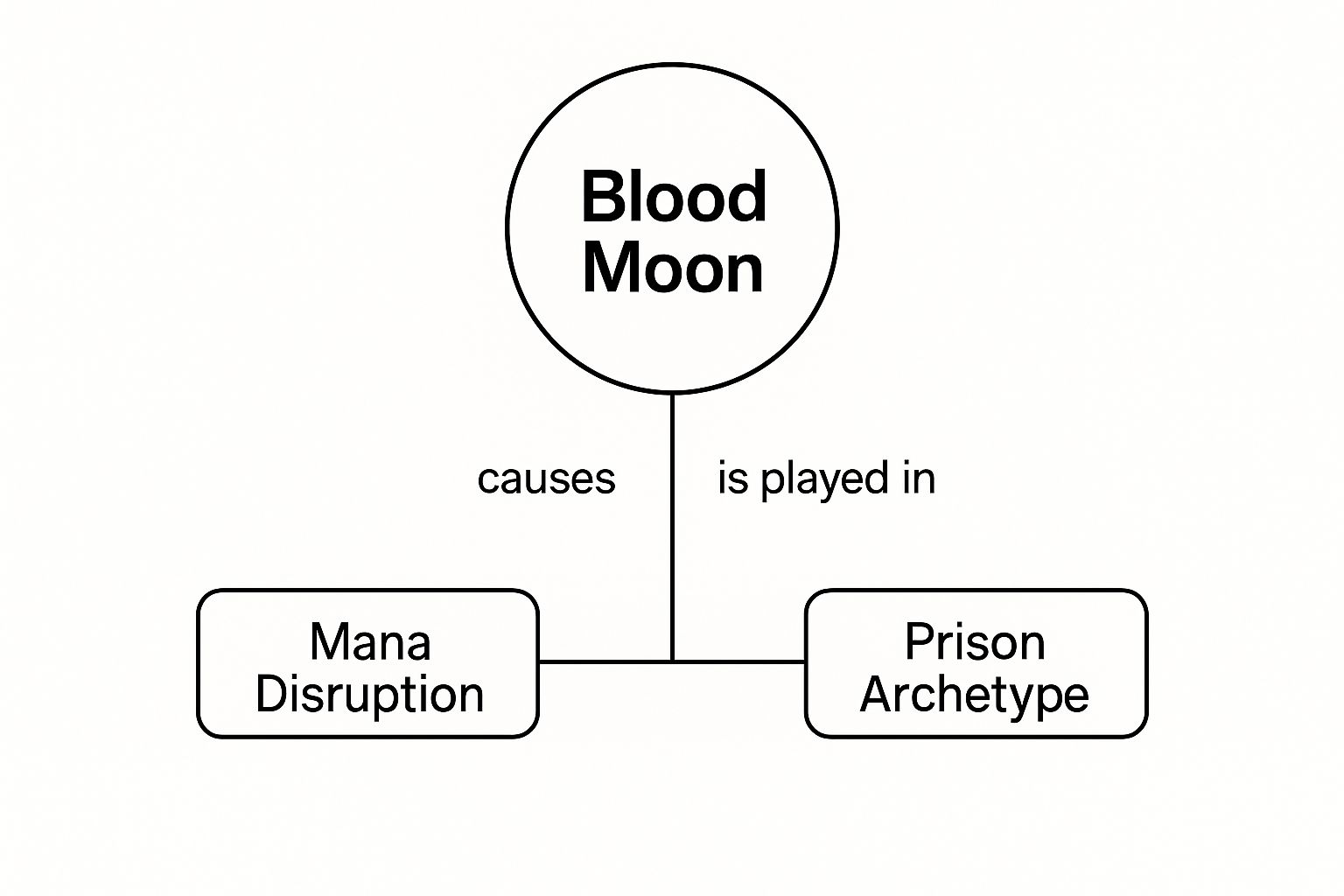
You can see how Blood Moon acts as the lynchpin, directly enabling a strategy that chokes an opponent's resources and locks them out of the game entirely.
Blood Moon’s primary quest is to assault an opponent's mana base. Any deck running a greedy mix of three, four, or even five colours is immediately in its crosshairs. All those carefully assembled dual lands, tri-lands, and shock lands suddenly become vanilla Mountains, unable to produce the specific colours they desperately need.
Take a land like Raugrin Triome. It’s designed to conjure three different colours of mana. Under a Blood Moon, it just becomes a Mountain. It loses its other land types, its cycling ability vanishes, and it can only tap for a single red mana. This strategic strangulation is the very heart of Blood Moon's power.
But it’s not just about corrupting colours. Blood Moon also strips the unique abilities from powerful utility lands. These lands are often the hidden engines of top-tier decks, providing value that goes way beyond simple mana production.
Under the crimson glow of the Blood Moon, a mighty fortress becomes a simple hill, a sacred temple a barren rock. All grand designs are laid low, reduced to the fundamentals of earth and fire.
This is where the card becomes truly devastating. It can shut down entire game plans with surgical precision. To see just how powerful this effect is, let's break down how Blood Moon transforms some of the game's most common and powerful non-basic lands.
| Land Type | Original Function | Effect Under Blood Moon | Strategic Impact |
|---|---|---|---|
| Fetch Lands | Sacrifice to search the library for a land (e.g., Windswept Heath). | Becomes a Mountain. The sacrifice ability is gone. | Mana fixing is completely shut down. The opponent cannot find their colours. |
| Creature Lands | Pay mana to animate the land into a creature (e.g., Lair of the Hydra). | Becomes a Mountain. The animation ability is removed. | A key threat is neutralised, and the opponent loses a potential attacker or blocker. |
| Value Lands | Generate unique value, like creating tokens or tutoring (e.g., Urza's Saga). | Becomes a Mountain. All chapter abilities are erased. | The deck's primary value engine is turned off, crippling its entire game plan. |
| Dual/Tri Lands | Tap for two or more different colours of mana (e.g., Hallowed Fountain). | Becomes a Mountain. Taps only for red mana. | Multi-colour decks are starved of the specific mana they need to cast their spells. |
Understanding these interactions is everything. You must learn to see not just the lands an opponent has on the board, but what they shall become once your enchantment resolves. Timing is crucial. Casting Blood Moon at the right moment can transform it from a good play into an absolute game-winner, seizing control and leaving your opponent utterly powerless.
Wielding a Blood Moon is like commanding a force of nature, but one cannot unleash that kind of power recklessly. It needs a proper home, an army that is ready to fight under a crimson sky. This enchantment isn’t a solo act; it is the heart of a well-oiled machine, the cornerstone of a grand, ruinous strategy.
You don't just jam a Blood Moon magic card into any old grimoire and hope for the best. The entire construction of your library must be attuned to its reality-bending frequency. You must build your deck to thrive in the world you're about to create—a world of stark, simple mana where only your game plan can flourish.
This means your own mana base must be as solid as a dwarven fortress. You’ll want to lean heavily on basic lands, as they are completely immune to the moon's potent magic. Fetch lands are your best friends here, grabbing those vital basics before the moon rises and transforms the battlefield.
One of the most feared homes for a Blood Moon is a strategy whispered about as 'Ponza'. This is no subtle approach. It is a full-frontal assault on your opponent's ability to even play the game. Ponza decks pair the sweeping mana denial of Blood Moon with the surgical strikes of land destruction spells.
Picture it: first, you cast Blood Moon, turning all their fancy, multicoloured lands into simple Mountains. Then, with spells like Pillage or Stone Rain, you start blowing those up too, leaving your opponent with nothing but dust. While they're crippled, you're using mana dorks like Arbor Elf and enchantments like Utopia Sprawl to power out massive threats way ahead of schedule.
The Ponza mage is a warlord, razing the very earth their opponent stands upon. They don’t seek a fair fight; they seek to ensure their opponent cannot fight at all.
This philosophy of combining destructive effects is a potent one. Finding clever card combinations that create an effect far greater than their individual parts is often the key to true mastery. If this tactical style of construction calls to your spirit, you might find your calling among the best deck-building games being crafted by today's cleverest designers, with many amazing campaigns to support on platforms like Kickstarter.
A completely different school of thought is the 'Blue Moon' strategy. Where Ponza is all brute force and aggression, Blue Moon is methodical, patient, and calculating. These mages use Blood Moon not as a battering ram, but as an impenetrable fortress wall.
While the opponent struggles under the crimson glow, completely locked out of their colours, the Blue Moon player calmly draws cards, counters the few spells their opponent manages to cast, and sets up a decisive finishing blow. They are perfectly happy to wait, protected by their lunar shield, until the moment victory is absolutely guaranteed.
These archetypes are just two of the main paths you can walk. From the sideboards of lightning-fast burn decks to strange new concoctions, Blood Moon offers its power to anyone wise enough to build around its restrictions. The key, as with any great weapon, is not just the card itself, but the entire armoury you build to support it.
The greatest mages I have known have one thing in common: they understand that timing is everything. It’s not just about what spell you cast, but when you cast it. Blood Moon is the perfect example—a card with the power to completely lock an opponent out of the game, but it's a weapon you keep hidden in your sideboard, waiting for the perfect moment to strike.
Learning to spot that moment is a skill you develop over countless duels. You are, in essence, scouting your opponent in game one. Watch their lands closely. Are they playing a dazzling array of three, four, or even five different colours? Are they relying on special utility lands to execute their master plan? These are the portents. They are showing you just how fragile their mana base is, and how easily it can all come crashing down under a crimson sky.
Some strategies just fold to this kind of mana denial. Once you learn to recognise them, you'll know exactly when to reach for your secret weapon after game one.
This dance of strategic adaptation—sizing up your opponent and tweaking your deck between games—is one of the most rewarding parts of competitive play. It’s a core element we’ve always loved, and it’s something that inspires a lot of modern game design.
An apprentice who just slams a powerful card without thinking is just going through the motions. A true master waits, watches, and reshapes the entire game with one perfectly timed play.
For example, the creators behind the Kickstarter project TerraClash are forging a "Campaign Cache" system that lets you swap cards between battles. It captures that same feeling of out-manoeuvring your opponent, which is exactly what makes a simple blood moon magic card one of the most feared sideboard cards ever printed. Keep an eye out for their campaign, launching very soon!
Even after all these years, the Blood Moon still vexes even seasoned adventurers. Its effect seems so simple on the surface, but the way it interacts with the complex land bases of modern Magic can get pretty tricky. Let us clear up some of the most common questions that arise when that red moon rises.
Getting these little details right is what separates a decent Blood Moon player from a great one. It's how you turn a powerful enchantment into an absolute back-breaker.
Nay, it leaves basic lands completely untouched. All those Mountains, Islands, Swamps, Plains, and Forests your opponent controls will work just fine. This is the whole point, really. Your deck should be built with enough basics to operate smoothly while your opponent's fancy, multi-coloured mana base crumbles into ruin.
This is a crucial lesson. Once Blood Moon hits the board, a fetch land like Polluted Delta is just a Mountain. It loses all its abilities, including the one that lets you sacrifice it to search for another land. Its text box is effectively blank. So, if you have fetch lands, make sure you crack them before you call down the moon.
Timing is everything with this card, which is why it holds its value so well. Over in the UK, a regular non-foil copy from Wilds of Eldraine is sitting around £7.57. That consistent price tag shows you just how much of a powerhouse it remains in competitive formats. If you're curious about its price history, you can always track the trends on MTGStocks.com.
While its effect is powerful, its true strength is found in knowledge. It is a card that rewards a deep understanding of the battlefield and the strategies you are most likely to face.
This is why mastering the Blood Moon is really about mastering the metagame you're playing in.
The kind of strategic, game-warping gameplay that cards like Blood Moon create is what drives innovation in the grand halls of tabletop gaming. If you're looking for a new adventure with deep tactical gameplay and a fresh fantasy world, you should prepare yourself for TerraClash. It’s a deck-building experience where every game tells a new story. You can see what it's all about by visiting them at https://terraclash.co.uk.

