Quick answer: Most RPG classes fit four roles: the fighter who takes the hits, the rogue who strikes from the shadows, the spellcaster who controls the fight, and the healer who keeps everyone standing. D&D 5e has 12 classes in the Player’s Handbook (barbarian, bard, cleric, druid, fighter, monk, paladin, ranger, rogue, sorcerer, warlock and wizard), plus the artificer. For a first character, the fighter is the easiest to learn.
Hark, adventurer, and gather 'round the hearth. A grand saga awaits, and at the heart of every legend are its heroes. The soul of every hero? Their chosen path, their archetype—the very essence of rpg character classes. Think of them as the sacred roles within any fellowship: the unyielding Tank, the life-giving Healer, the storm-unleashing Damage Dealer, and the ever-wily Support.
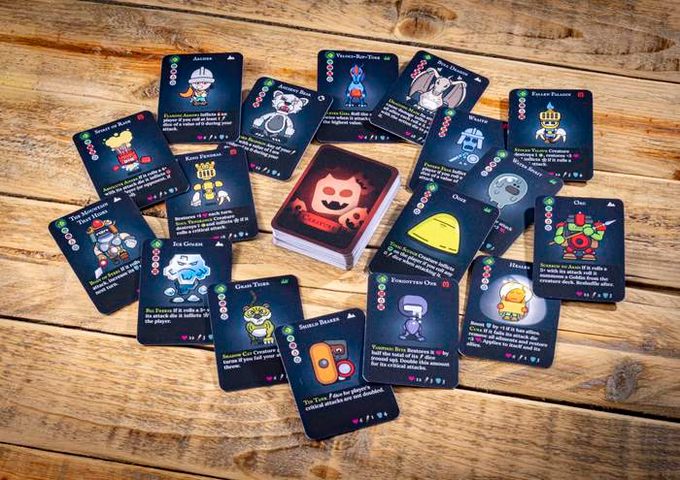
These roles are more than a mere title upon your character sheet; they are the compass that guides your journey through shadow and light. They define how you shall face down peril and, ultimately, how you will carve your name into the annals of history. This guide is your grimoire, casting a mystic light upon these essential roles and revealing how timeless fantasy concepts are reborn in the tabletop games of today. We shall delve into the arcane arts of party synergy, granting you the wisdom to forge legendary heroes in any realm, from classic RPGs to modern deckbuilding quests like TerraClash.
Every great tale requires its key players. In the world of tabletop RPGs, these players are defined by their archetypes. These are not just a list of skills; they represent the very soul of a character, bestowing upon them a clear purpose on the battlefield and a place within the fellowship.
Whether you are a fresh-faced neophyte to the world of dice and dungeons or a grizzled campaigner, grasping these core roles is the first step on any epic quest. For any who are just setting out, you may learn more of the fundamentals in our complete guide to https://terraclash.co.uk/d-and-d-for-beginners/.
These core archetypes provide a framework, a starting point from which countless unique heroes can be born. They are the reason a party has what it takes to survive, from the steadfast protector who shields the vulnerable to the heavy-hitter who brings down colossal beasts.
This sacred map breaks down the fundamental party roles, showing just how interconnected the Tank, Healer, and Damage Dealer archetypes truly are.

As you can see, each role is distinct, yet all depend upon one another. Together, they form a balanced trinity of offence, defence, and recovery—the secret lore behind a successful party dynamic.
Now, let us briefly illuminate what each of these pillars brings to the adventuring table.
This table is a swift reference to the fundamental roles that form the backbone of any successful quest, outlining their primary function and strategic purpose upon the field of battle.
| Archetype | Primary Role | Core Objective |
|---|---|---|
| Tank | Defensive Protector | Absorb damage, control enemy positions, and protect weaker allies. |
| Healer | Restorative Specialist | Mend wounds, cure ailments, and keep the party fighting fit. |
| DPS (Damage) | Offensive Striker | Inflict maximum damage to eliminate threats as quickly as possible. |
| Support | Strategic Enabler | Buff allies, debuff enemies, and control the flow of combat. |
Think of these as the essential ingredients for a balanced fellowship. While you can mix and match, having these foundations covered gives you the greatest chance of overcoming whatever darkness the world throws at you.
Let us speak plainly, for while game mechanics are important, RPG character classes are truly about the story. They are the vessels for the fantasy tropes we know and love, allowing us to step into the boots of the noble knight, the wise wizard, or the shadowy rogue. That connection to classic fantasy is what makes them so thrilling to embody.
The best character classes feel less like a collection of abilities and more like a genuine calling. They give players a clear identity and a purpose within the world, turning a game into a truly immersive narrative experience.
A grand way to find your footing is to look to the heroes you already cherish from popular actual play sagas. One can find all manner of creative inspiration in the ether, like a pattern for Taako from The Adventure Zone, which shows how a beloved character can spark creativity that transcends the game table itself.
The principles behind these classes are timeless. They have echoed through decades of tabletop history and are now finding new life in modern games. Deckbuilders like TerraClash take these core ideas—protection, healing, and damage—and cleverly translate them into strategic, card-based combat. It proves that the heart of these archetypes can thrive in any system. Your class isn't just your role in a fight; it is the beginning of your legend.
Imagine a lone mountain standing firm against a raging storm. That, right there, is the heart and soul of the Tank. They are the guardians, the protectors, the steadfast anchor in the swirling chaos of battle. Their duty, noble and absolutely crucial, is to plant themselves between their comrades and whatever horrors crawl out of the darkness, taking every blow so that others do not have to.
When you ponder RPG character classes, this archetype is often the first to come to mind. You likely picture the classic knight in shining plate mail, shield raised against a dragon's fiery breath. But the Tank is so much more than a walking fortress. It can be the roaring Barbarian, whose sheer grit and battle fury make them a force of nature, their very presence on the field a direct challenge to the foe.
The true secret to their power is controlling the flow of battle itself. In the gamer's tongue, we call this managing threat or aggro. A great Tank does not just passively soak up damage; they actively command the enemy's attention, pulling focus and deciding who shall face their wrath. It is less about brute strength and more about a strategic art form.
At its core, playing a Tank is about battlefield manipulation. You create safe pockets for your more fragile teammates, intercepting a charging beast or physically blocking a doorway. This ensures the glass cannons in your party can do their job without being shattered. It takes more than a massive health pool; it demands sharp tactical awareness and cunning positioning.
Think of it like a grandmaster of chess. Every move is calculated to protect the king and control the board. The Tank plays the game in much the same way, which is why it is one of the most mentally rewarding RPG character classes to truly master.
This entire philosophy of strategic defence is the backbone of so many brilliant co-op tabletop games. If you've ever delved into a perilous scenario in Gloomhaven, you know that victory often depends on the Cragheart or Brute being in just the right spot to take a massive hit. That one move buys the Spellweaver the time she needs to unleash a spell that turns the tide. It is a beautiful, dangerous dance of calculated risks and unbreakable defence.
"Standing your ground when everything is trying to obliterate you isn't just about toughness; it's a profound strategic choice. A true Tank understands that wherever they stand, that's the line the enemy will not cross."
Ultimately, being a Tank isn't just about surviving. It is about creating the conditions for your entire team to triumph. It is a proactive role, shaping the fight from the very first clash.
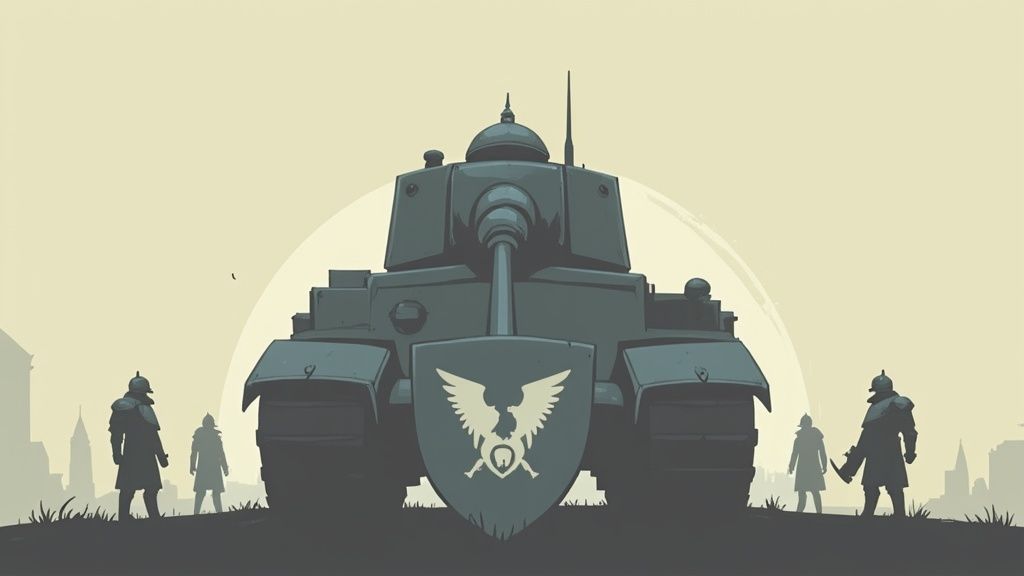
This timeless archetype has found a fantastic new life in the world of modern deckbuilding games. The spirit of the guardian isn't just a miniature on a map anymore; it is woven into the very cards you draw. A well-played defensive card can be just as game-changing as a massive attack, completely shutting down an opponent's great gambit.
The core idea is exactly the same, whether you're rolling dice or playing cards. Consider a game like Slay the Spire. The Ironclad’s ability to stack up absurd amounts of Block is a perfect digital translation of the classic Tank. Every defensive card you play is another layer of steel, a strategic pause that sets you up for a crushing counter-attack.
We wanted to capture that same strategic depth in TerraClash. The guardian archetype isn't just about one big "block" card. It is about crafting a deck that can consistently ride out the storm, control the tempo of the match, and create the openings you need to seize victory. The unyielding mountain stands tall, even when it's just ink on cardboard. It proves that the heart of the Tank is a universal concept—it is about being the unbreakable shield.
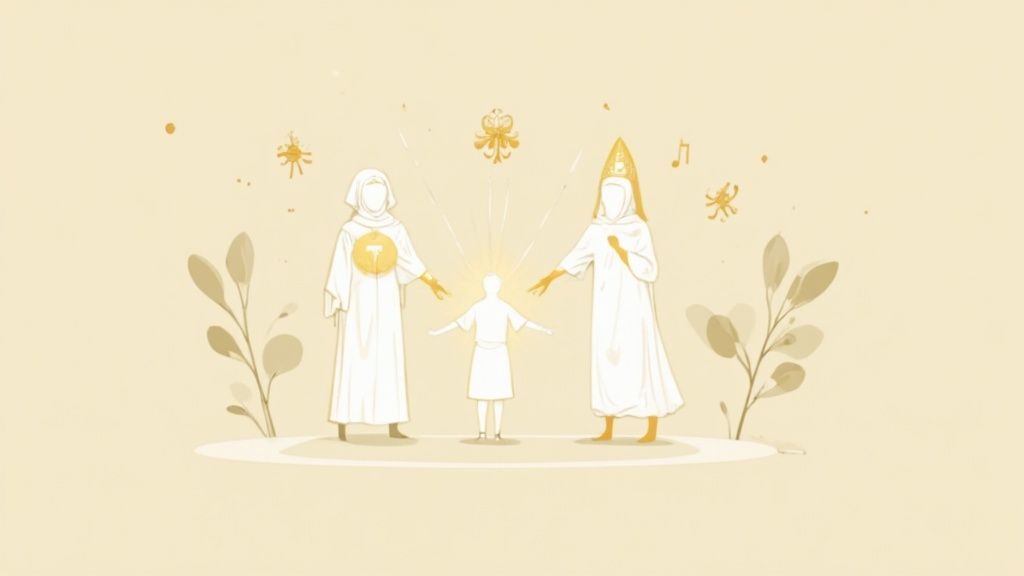
It is easy to be mesmerised by the flashy spectacle—the warrior's thunderous blow or the sorcerer's screen-clearing fireball. But raw power is not everything. True, lasting strength often comes from the quiet chant that knits bone back together, or the stirring war-cry that transforms a rout into a rally.
This is the domain of the Healer and the Support roles, the true unsung heroes of any adventuring party. They are the RPG character classes that pull the strings from the back lines, subtly manipulating the flow of battle. These aren't just characters; they are the artists who can turn a desperate, losing fight into a masterpiece of a victory, all without throwing a single punch.
When you hear "Healer," you likely picture a pious Cleric, hands glowing with divine energy, mending a fallen comrade's wounds with a whispered prayer. And you are not wrong. They are the ultimate safety net, the reason a party can stare down impossible odds and push through. Without a healer, every single fight is a roll of the dice.
But their duty is so much more than just playing catch-up with damage. Playing a Healer is a masterclass in resource management. Every healing spell is a calculated risk. Do you use your most potent prayer now to save the Tank, or do you hold it in reserve, knowing something even nastier is about to strike? It is this constant tactical juggling act that makes the role so incredibly compelling.
The best Healers are practically clairvoyant. They learn to anticipate the damage before it even lands, reading the battlefield to know who is vulnerable and when the boss is winding up for its ultimate attack. They are the guardians of the party's life force, and they take their duty very seriously.
The Support role is a more abstract, a subtle art form. While they might have a healing spell or two up their sleeve, their true power lies in making their allies better and their enemies much, much worse. This is the realm of the charismatic Bard, whose song can give the whole party an edge in combat, or whose demoralising shanty can make a formidable foe fumble at the worst possible moment.
These characters are the ultimate force multipliers. They control the battlefield with a whole toolkit of tricks that can completely reshape an encounter:
A skilled Support player doesn't see a chaotic brawl; they see a symphony, and they are the conductor. They know the perfect moment to bolster an ally or trip up an enemy, orchestrating a flawless performance that ends in victory.
This intricate dance of boons and banes has been taken to incredible new heights in modern indie board games. A game like Spirit Island, for example, elevates the support concept to a god-like level. In it, you don't just fight invaders; you manipulate the very environment to empower the native islanders. It is a perfect example of how these supportive RPG character classes have evolved into deep, strategic powerhouses.
This whole philosophy translates beautifully into modern deckbuilding games. In a game like TerraClash, playing a healing or support deck is not just about having a single "heal" card. It is about building a finely tuned engine where your entire deck is designed to empower other cards, control the tempo of the game, and simply outlast your opponent through clever tactics rather than brute force.
Your deck might be packed with cards that let you draw more options, protect your life total, or dismantle your opponent's strategy piece by piece. Just as a well-timed potion can save a hero in Dungeons & Dragons, a perfectly played support card can be the pivot upon which the entire match turns. Understanding the value of items like a D&D healing potion grants you a fantastic insight into the kind of resource management that defines this playstyle.
Whether through divine magic or a perfectly pitched anthem, the Healer and Support classes are the true heart of any resilient party, proving that sometimes the greatest strength is the power you give to others.
Every adventuring party needs its spearhead—that decisive force that smashes through enemy lines and ends the fight with pure, overwhelming power. This is the realm of the Damage Dealer. Whether you call them a Striker or simply DPS, this is the archetype that brings the thunder.
They are the heroes who live for the thrill of the fight, their devastating blows echoing through dungeon halls. Picture the sharpshooting Ranger, picking off key targets from the shadows. Imagine the ferocious Barbarian, wading into the fray with a battle cry and an insatiable thirst for conflict. Or perhaps the arcane Sorcerer, twisting raw chaos into spells of terrifying destruction. It is this variety within a single core concept that makes rpg character classes so endlessly fascinating.
Wielding great power means walking a razor's edge between triumph and disaster. For the Damage Dealer, the stakes are always high, but the rewards are even higher. Their job isn't just to hit hard; it's to hit smart. It is a tactical dance of positioning, choosing the right target, and knowing the perfect moment to unleash hell.
A seasoned Striker understands that their own defences are usually paper-thin. They are the classic glass cannon—capable of shattering any obstacle, but just as easily shattered themselves if caught out of position. This is why their synergy with the party's Tank and Support is non-negotiable. The Tank creates the opening, and the Damage Dealer pours through it with ruthless efficiency.
This constant hunger for new ways to bring the pain is as old as the hobby itself. Back in the early 1980s, when Dungeons & Dragons was shaping the UK's burgeoning role-playing scene, polls in the legendary White Dwarf magazine revealed players were desperate for more specialised rpg character classes. They wanted to move beyond the basics and find unique abilities to bring to the table.
At its heart, playing a Damage Dealer is all about controlling the momentum of a fight. The goal is to eliminate threats before they can overwhelm the party, making every combat encounter shorter and deadlier. This demands a sharp eye for the battlefield and a keen understanding of enemy weaknesses.
A great Damage Dealer knows exactly which tool to pull from their arsenal. Do you focus all your energy on the necromancer hiding in the back, or do you clear out his skeletal minions first? These decisions are the lifeblood of the role. The complexity of these choices is part of their appeal; a wizard, for instance, must think about how their spells will interact with an enemy's defences. If you're curious about the nitty-gritty, our guide on how to calculate a spell save DC in 5e gives a fantastic look into that tactical depth.
The Striker is the party's exclamation mark. They punctuate the end of a conflict with a final, definitive statement of power, turning a hard-fought battle into a legendary victory.
This high-risk, high-reward gameplay is perfectly captured in modern tabletop games, especially deckbuilders. In TerraClash, the spirit of the Damage Dealer lives on in decks built around powerful, game-ending combinations. The process of crafting your hand to set up that one perfect, devastating turn feels just like a rogue waiting in the shadows for the perfect moment to strike. The thrill is the same, whether you're rolling dice or playing the final card that seals your victory.
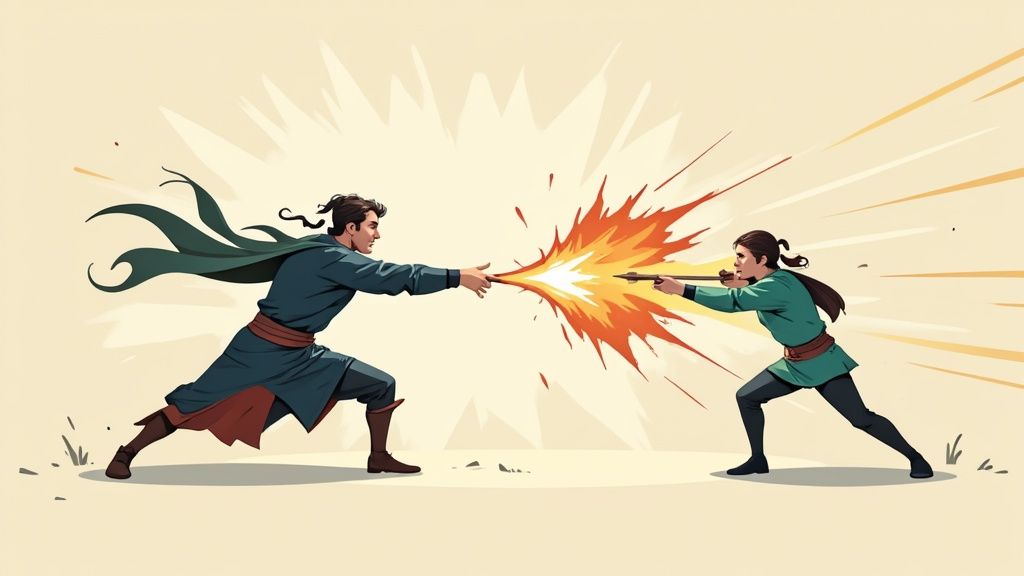
The classic paths of the Warrior, Mage, and Rogue are well-trodden for good reason. They are the foundations upon which countless legends have been built. But let us be honest, the most memorable heroes rarely stick to the map. The best stories are about those who dared to wander off the path, blurring the lines between the established rpg character classes.
Welcome to the world of the hybrid hero. This is where holy power and cold steel become one, where shadow and spellfire dance together. These are the characters who refuse to be put in a box, their skills a unique tapestry woven from different disciplines.
Have you ever considered the Paladin? They are clad head-to-toe in plate armour, yet they can call upon divine light to mend a wound just as easily as they can swing a warhammer. Or what about the Arcane Trickster, a classic rogue whose daggers are just one part of a toolkit filled with mind-bending illusions and phantom sounds? These incredible concepts all spring from one powerful question: "What if?"
Modern tabletop games have truly leaned into this spirit of invention, moving away from the rigid class structures of old. Many systems now give you the freedom to customise your character down to the finest detail. This means you can build someone whose abilities are a genuine reflection of their personal history, not just a carbon copy from a rulebook. After all, a character's backstory should shape their skills just as much as any game mechanic.
This idea of mixing story with mechanics isn't exactly new, either. The classic tabletop game Pendragon, first published way back in 1985, did a masterful job of weaving a character's virtues and vices directly into what they could do. It moved past simple fantasy roles to focus on the more nuanced social and historical figures from Arthurian legend, where a knight's honour was as real a statistic as their strength. This approach helped pave the way for a more complex view of character design, a topic you can dive into by exploring the history of roleplaying game theory.
Creating a hybrid class is about so much more than just cherry-picking the "best" abilities from different skill trees. It's about crafting a cohesive identity where every single skill tells a piece of your hero's story.
A hybrid class is a declaration that your character is more than just a single role. They are a living, breathing individual whose journey has granted them a unique set of skills, making them truly one-of-a-kind.
This spirit of player-driven creativity is what guides so much of modern game design. It is all about empowering you to break the mould and build heroes that are truly yours. It's this exact same freedom we champion in card games like TerraClash, where the deck you build is your hero's story. By mixing and matching cards, you aren't just picking a strategy; you are defining who your champion is, forging your own unique path to victory with every draw.
A single hero might make for a good story, but a party of heroes? That is the stuff of legends. The real magic in role-playing games happens when different rpg character classes come together, their skills meshing to create something far more powerful than any one of them could be alone.
Think of this part of our guide as your grimoire for party composition. It's about more than just picking strong characters; it's about building a team that works like a well-oiled machine. We will look at why that classic combination of a tough Tank, a sharp-eyed Healer, and a hard-hitting Striker is so often the key to emerging triumphant.
There's a reason the traditional party setup has stood the test of time. It is a beautiful, self-correcting system. Each role shores up the weaknesses of the others: the Tank takes the hits, the Healer patches everyone up, and the Damage Dealer lands the killing blows. It's a dance of teamwork you see in countless co-op board games, where you simply cannot win unless everyone plays their part.
But the road to victory is not always so straightforward. While a balanced team is a reliable and powerful choice, sometimes the most memorable victories come from throwing convention out the window and trying something a little different.
The most legendary parties are not just a collection of roles, but a fellowship of characters whose abilities complement one another on a deeper level. Their synergy turns a difficult battle into a flawless performance.
Picture this: a team made up entirely of stealthy Rogues and Rangers. They do not smash down the fortress gates; they slip through the shadows like ghosts, achieving their goal before a single alarm is raised. Or what about a coven of mages, unleashing a blistering storm of arcane power that overwhelms the enemy before they can even draw their swords?
These specialised groups prove there is more than one way to tackle a problem. They succeed by doubling down on a single, overwhelming strength. It is a high-risk, high-reward strategy that demands flawless coordination, because the usual safety nets just aren't there. If one person falters, the whole plan can fall apart.
This very idea is at the heart of modern deckbuilding games. You rarely win with a single 'super' card. The goal is to build an engine, a deck where each card you play sets up the next, creating a chain reaction of complementary effects that your opponent cannot possibly stop.
In our own game, TerraClash, building your deck is exactly like assembling an adventuring party. Will you build a balanced force, ready for whatever comes your way? Or will you craft a specialised team, designed to pull off one perfect, game-winning combo? The choice, adventurer, is yours.
Every adventurer has questions when they begin their journey. Let's tackle some of the most common ones whispered around the tavern fire, so you can step onto the battlefield with confidence.
Think of this as the wisdom passed down from one veteran traveller to another. It's time to clear the fog and get you ready for the quests ahead.
When you are just setting out, it is best to keep things simple. I always recommend the Fighter or Barbarian archetypes for new players.
Why? Because their game plan is wonderfully direct. You hit things, and you learn the ropes of combat without juggling a massive spellbook or complex abilities. They are a fantastic way to get a feel for the fundamentals—like positioning and teamwork—before you dive into the deep end.
Absolutely not! In fact, some of the most memorable characters I have ever seen have been a mix of different rpg character classes. This is usually called "multiclassing," and it is where the real creativity begins.
It lets you build a hero that truly feels like your own. Maybe your Rogue picked up a few monk-like fighting styles from a secluded monastery, or your bookish Wizard found a hidden talent for healing. Blending classes lets your character's story shine through in their skills.
The most compelling characters are rarely defined by a single label. They are a mosaic of their experiences, and their abilities should reflect that journey. A hybrid class is a testament to a life lived outside the ordinary.
Listen, the classic "holy trinity"—Tank, Healer, and Damage Dealer—is a classic for a reason. It works. A balanced party is dependable and can handle almost anything thrown its way.
But is it the only way? Not by a long shot. An unconventional party, like an all-mage coven that incinerates everything in sight or an all-stealth squad that bypasses guards entirely, can be devastatingly effective. It all comes down to communication and smart strategy. If you can cover each other's weaknesses, any group can become legendary.
It is interesting to see how these ideas are even being used outside of gaming. A growing educational trend uses tabletop RPGs to teach history. A recent study found that 67% of educators using this method focus on character creation to help students grasp different societal roles. It just goes to show how powerful rpg character classes can be for seeing the world from a new perspective. You can read more about how they are used to build empathy and historical understanding on acm.org.
Your own legend is waiting to be written. These principles of teamwork, strategy, and identity are the very soul of TerraClash. It's time to forge your path, build your deck, and show the world what kind of hero you are.
Begin your adventure at https://terraclash.co.uk.
TerraClash is a fantasy card and dice game for 1 to 6 players. Pick a hero, explore the lands, fight creatures and take on a final boss, solo or with friends.
TerraClash Lite is free to print and play. The full print and play game has 10 heroes and 194 cards, and the Kickstarter for TerraClash Digital, the game in your browser, is live until 22 November 2026.