Quick answer: The variant human is an optional human from the 2014 Player’s Handbook. Instead of +1 to every ability score, you get +1 to two different scores, proficiency in one skill and a feat at level 1, plus Common and one extra language. Few other races get a feat that early, which is why it is so popular. The 2024 Player’s Handbook drops it: the standard human now gets an Origin feat, and ability score increases come from your background.
Hark, adventurer, and listen close. In the sprawling realms of Dungeons & Dragons, some heroes are defined by ancient bloodlines or divine gifts. Then there are those who walk a different path: the variant human. This is not merely another choice on a character sheet; it is a declaration of intent, a hero forged from pure, focused potential.
What makes them so special, you ask? It is a single boon, a whisper of fate: a free feat, granted at the very start of their grand quest.
Gather 'round the fire, and let me share a truth I've witnessed at countless gaming tables. While an elf might draw upon centuries of grace and a dwarf upon ancestral stubbornness, the variant human steps onto the stage with a singular, exceptional talent already honed. They are the embodiment of raw, focused ambition.
This is not the path for a common farmhand who simply stumbles upon a sword. This is for the hero whose entire saga is shaped by one pivotal choice before the first d20 ever strikes the table.
The true power of the variant human is the freedom it bestows upon you, the storyteller. That level 1 feat is the cornerstone of your entire character's design, allowing you to create a hero with both mechanical bite and a clear purpose right from the outset.
Consider this. It is the difference between a fighter who is merely strong, and a fighter who, from day one, is a deadly polearm master, keeping foes at bay. It is the core thrill of D&D made manifest – the joy of bringing a unique vision to life.
Choosing that feat is like selecting a key card in a deck-building game; it dictates your entire strategy from the start. That same spirit is behind TerraClash, a fantasy card and dice game for 1 to 6 players that you can print and play free.
The variant human is a blank canvas, yet you have already been given the master's first, defining brushstroke. It is a way for a player to declare, "This is who my character is," and have the rules to prove it from level one.
Consider this scroll your map to unlocking that potential. We shall delve into why this choice is a true powerhouse, exploring both the mechanical advantages and the rich roleplaying hooks that spring forth from that one crucial decision.
Forget starting as a nobody. Your tale begins with a spark of greatness, ready to be fanned into a legendary flame.
Let us now examine the arcane script that makes the Variant Human such a formidable choice. Unlike the standard human, who receives a touch of everything, the Variant Human is a master of specialisation. It is the perfect path for a player who holds a clear vision for their hero from the very beginning.
At its core, the Variant Human option grants you three key boons. First, you may place a +1 into any two different ability scores, letting you fine-tune your most vital statistics. You also gain proficiency in one skill of your choosing, a welcome extra to round out your character's expertise.
But the true game-changer, the feature that bards sing of, is the bonus feat at level one. This single choice is what makes the Variant Human one of the most popular and powerful options in the entire game.
So, how does this path compare to that of the Standard Human? It is a classic tale of breadth versus depth.
The Standard Human receives a +1 to all six ability scores, which makes for a very well-rounded character who is rarely found wanting. The Variant Human, on the other hand, trades that general competence for a massive spike in power in one specific area, right from level one.
Here is a quick comparison to make the choice clearer:
| Feature | Standard Human | Variant Human |
|---|---|---|
| Ability Score Increase | +1 to all six scores | +1 to any two scores |
| Skill Proficiency | None | One of your choice |
| Feat | None | One feat at level one |
| Languages | Common and one extra | Common and one extra |
As you can see, the decision truly boils down to what you value most. A Standard Human might be slightly better across the board, but a Variant Human with the right feat can be absolutely exceptional at their chosen role.
Imagine a Cleric beginning their journey with the War Caster feat – their concentration becomes as solid as a mountain from their very first healing spell. Or think of a Fighter who grasps Polearm Master and immediately becomes a whirlwind of attacks, controlling the battlefield before the first quest is even finished. This is much like playing a trading card game; sometimes, that one killer card you place in your deck defines your entire strategy.
The question you must ask yourself is this: do you wish to be good at many things, or an absolute master of one from the very beginning? The Variant Human is a bold gambit, but one that often leads to legendary results.
It’s no surprise that this level of customisation resonates so strongly. The tabletop gaming community thrives on this kind of strategic character building. We love crafting unique heroes, and that whole process starts with fundamental choices like this.
For a deeper dive into creating your character from scratch, be sure to check out our full guide on how to make a Dungeons and Dragons character.
So, you have chosen the path of the Variant Human. A wise choice. Now comes the true moment of truth. That free feat you gain at level one? That is not just a mechanical bonus; it is the cornerstone of your character's identity. It is the decision that defines who they are before they have even thrown their first punch or cast their first spell. This single choice is where a collection of stats begins to feel like a true hero.
Think of it as a branching path at the very start of your adventure. This flowchart helps to visualise that first, crucial decision point: do you take the well-rounded Standard Human path, or do you specialise right out of the gate with the Variant?
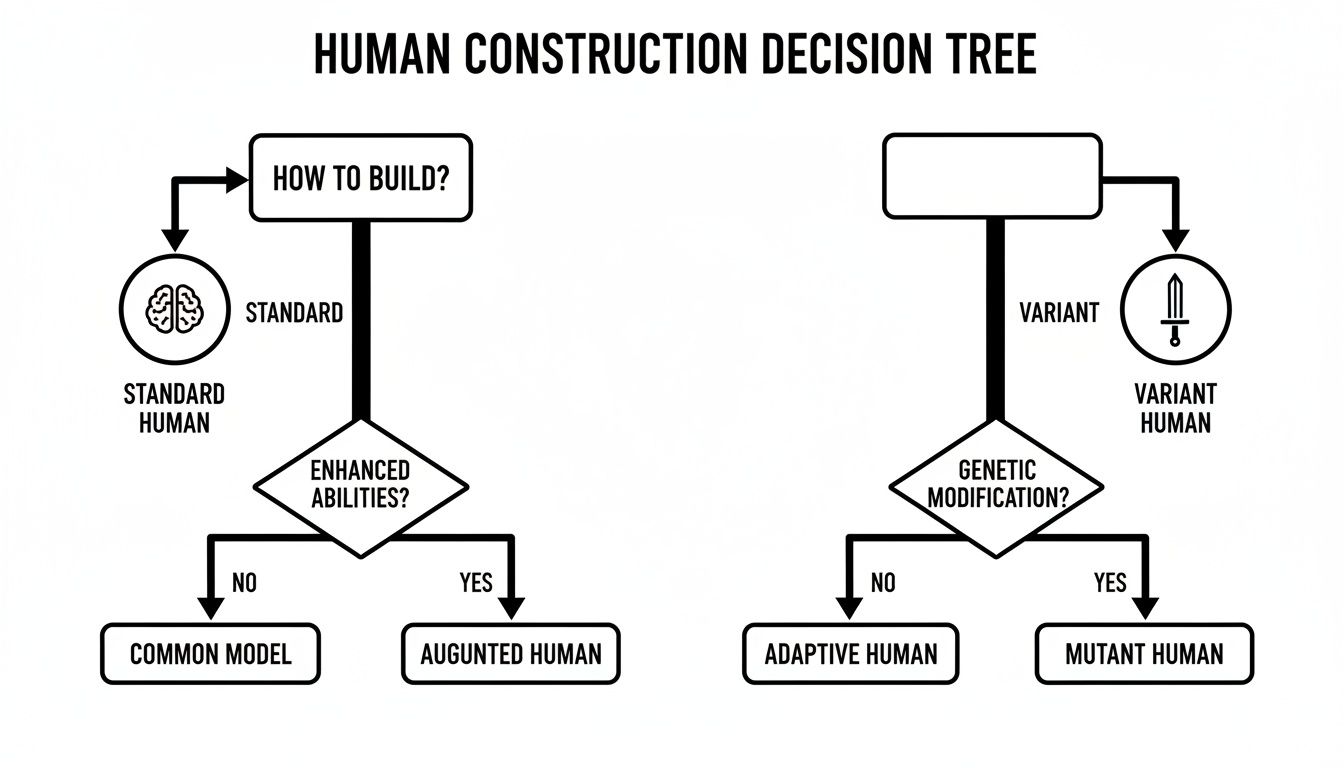
Each path leads to a very different kind of hero. One is a jack-of-all-trades, the other a master of one. Neither is wrong, but choosing the Variant means you've decided to plant your flag early.
If your character was born for the clash of steel and the roar of battle, some feats simply sing. They are not just combat options; they are declarations of intent, a personal fighting style made manifest.
Choosing one of these is like your opening move in a grand strategy game. It sets the tone for your entire combat style and tells everyone at the table exactly what you are all about.
Magic is a raw, untamed force. These feats are how you gain a better grip on it. For any spellcaster, the right feat at level one can be the difference between a spell fizzling out and a moment of campaign-defining glory.
Your first feat is the seed from which your legend grows. Will it be a seed of unyielding strength, cunning intellect, or miraculous luck? The choice is entirely yours.
Casters live in constant fear of losing their concentration. Feats are the best insurance policy. War Caster is practically essential for anyone planning to cast spells within spitting distance of an enemy, ensuring a stray arrow doesn't break your most powerful enchantment. Likewise, Resilient (Constitution) grants a massive boost to those crucial concentration saves, making your magic far more reliable when the chaos of battle ensues.
Think of it as laying the foundations for a great tower. The stronger the base, the higher you can build.
Of course, not all heroes solve their problems by hitting them. Sometimes, a sharp mind, a convincing lie, or just a ridiculous amount of good fortune is the most powerful weapon of all.
This is the real magic of the Variant Human. You step into the world on day one already a specialist. You are not just another adventurer; you are the Sentinel who protects the party, the impossibly Lucky rogue, or the Sharpshooter who can end a fight from a hundred paces. Your story starts here.
Now, let us turn to the most exciting part. This is where the theorycrafting truly begins, where we see how a single choice at level one can define your entire character's destiny. Picking a feat is not just about grabbing a cool ability; it is about finding that perfect spark of synergy with your class, creating a hero who feels powerful and focused right from the start.
It is much like building a deck for a card game. You are not just picking good cards; you are seeking combinations that work in harmony to create something far greater than the sum of its parts. That same thrill of finding a game-winning combo is what we aim for here.
For anyone who plans to make their mark with a blade, bow, or crushing hammer, the Variant Human is a dream come true. That starting feat gives you a massive head start, letting you specialise in your chosen fighting style before you've even thrown your first proper punch.
Fighter with Polearm Master: An absolute classic for a reason. A Fighter with a glaive or halberd is already a threat, but grant them Polearm Master? Suddenly, they become a walking zone of control. Enemies cannot even get close without being struck, turning you into a defensive lynchpin for the entire party.
Barbarian with Great Weapon Master: This is how you create an absolute monster. A Barbarian's Rage already adds a significant amount of extra damage. Combine that with the high-risk, high-reward power-attack from Great Weapon Master, and you are not just hitting enemies—you are cleaving them in two.
Ranger with Sharpshooter: If you wish to embody the ultimate archer, this is the way. Sharpshooter allows a Ranger to ignore cover and shoot from incredible distances without penalty. You will be dropping arrows on foes from another post code, long before they even know you are there.
These pairings do more than just make you effective in a fight; they grant you a clear identity from your very first session.
If you are playing a spellcaster, your magic is everything. But one unlucky hit can make you lose concentration and watch your most powerful spell dissolve into nothing. The Variant Human offers the perfect solution: an insurance policy from level one.
A class provides the vessel, but the starting feat provides the soul. It is the fusion of these two elements that breathes true life into your hero, giving them a distinct purpose and an undeniable edge from the moment their story begins.
Think of a Cleric or Paladin wading into the thick of battle. Taking War Caster is a game-changer. That advantage on concentration checks means your Bless or Spirit Guardians will remain active, turning you from a vulnerable caster into an unshakeable pillar of divine power.
Likewise, a fragile Wizard or Sorcerer can gain a huge boost from Resilient (Constitution). Not only does it bolster your hit points, but proficiency in Constitution saving throws is the single best way to protect your concentration. If you wish to delve deeper into the nuts and bolts of spellcasting, our guide on understanding Spell Save DC in 5e is a great next step.
The love for this kind of deep character customisation is a huge part of what drives the TTRPG hobby's growth. It's a testament to how many of us love the strategic depth that choices like the Variant Human bring to the table.
To get your gears turning, here is a quick look at some of the most potent and popular builds that all hinge on that crucial level-one feat.
| Class | Recommended Feat | Primary Ability Scores | Role |
|---|---|---|---|
| Fighter (Battle Master) | Polearm Master | Strength, Constitution | Battlefield Controller, Striker |
| Barbarian (Zealot) | Great Weapon Master | Strength, Constitution | High-Damage Striker |
| Paladin (Vengeance) | Sentinel | Strength, Charisma | Tank, Striker |
| Ranger (Gloom Stalker) | Sharpshooter | Dexterity, Wisdom | Stealthy Archer, Scout |
| Rogue (Assassin) | Alert | Dexterity | First-Strike Specialist, Scout |
| Cleric (Twilight) | War Caster | Wisdom, Constitution | Frontline Support, Healer |
| Wizard (Chronurgy) | Resilient (CON) | Intelligence, Constitution | Controller, Utility Caster |
These are but starting points, of course. The true beauty of the Variant Human is that it opens up countless possibilities to bring your unique character concept to life.
Theory is one thing, but seeing it in action is where the magic truly happens. Let us move past the abstract and look at how that level one feat choice can shape a character's entire identity.
We shall now explore two very different heroes. Both are variant human 5e characters, but they could not be more distinct. Their stories showcase just how flexible this option truly is, creating legends from a single, pivotal decision right at the start.
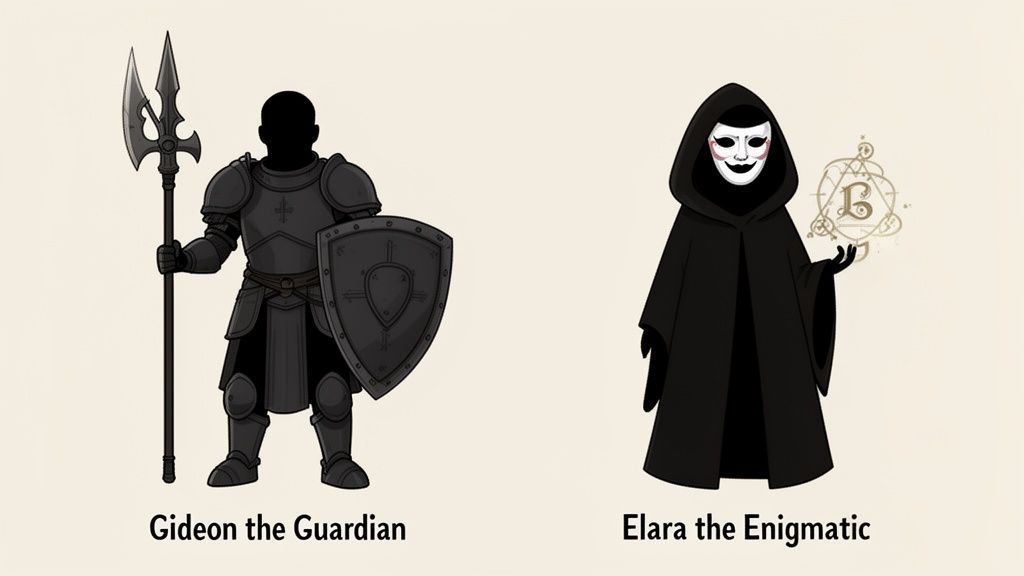
First up is Gideon, a Paladin who lives to defend the innocent. This build is all about mechanical efficiency on the battlefield. He is designed to be a literal wall between his friends and the monsters trying to tear them apart.
Gideon’s choice of the Sentinel feat defines his entire playstyle from the get-go. He is not just another fighter; he is a strategic anchor for the whole party. The moment he hits an enemy, they stop dead in their tracks. If a creature next to him even thinks about attacking someone else, Gideon gets a free swing. He is an expert at shutting down the biggest threat and controlling the flow of a fight.
Now, let us meet Elara. She is a Warlock whose power lies not in her fists, but in her words. This build is geared towards intrigue, mystery, and social manipulation, showing that strength comes in many forms.
A feat is more than a rule; it is a narrative promise. It is the first chapter of your character’s story, declaring to the world what makes them truly exceptional.
Elara’s game is all about subtlety. To build a character with this kind of depth, it can be truly helpful to look at established story structures; understanding archetypes in mythology is a great starting point for inspiration.
The Actor feat is the soul of Elara's character. It allows her to perfectly mimic the speech of others and gives her an edge when trying to pass herself off as someone she's not. She will not be on the front lines, but she will be the one walking into the villain's fortress disguised as a trusted lieutenant. Her battles are won with whispers and lies in crowded halls, not with swords in muddy fields.
Gideon and Elara perfectly illustrate the two sides of the variant human coin. One is a powerhouse optimised for combat, while the other is a rich character built for storytelling. Both are incredibly effective and compelling, and it all started with that one feat choice at level one.
So, our deep dive into the arcane rules and creative possibilities comes to an end, but this is truly just the start of your own story. The variant human is a remarkable choice, a blank canvas that offers a level of customisation and an immediate taste of power that very few other options in Dungeons & Dragons can honestly compete with.
Think back to its greatest advantages: that early specialisation, the way it allows you to bring your character concept to life right from the get-go, and its sheer, unadulterated versatility. If I can leave you with one final piece of advice, it is this: build the hero you wish to play. It does not matter if you are chasing the most powerful build or a character with a rich, story-driven heart – the variant human can be the perfect starting point for either.
As you head out on your next adventure, remember that the greatest tales often spring from a single, imaginative choice. This is not just true for D&D; you see it in the ever-changing worlds of indie games too. This love for strategic depth is booming, with players of all ages loving the kind of customisation that makes a variant human 5e build feel so unique.
Your character sheet is just the first page of an epic tale. The variant human lets you write a killer prologue, setting the stage for the legend you’re about to become. Let that first feat be the ink that writes your story.
This creative spark is what fuels countless new legends. For those always on the hunt for new realms to conquer, think about exploring and backing creators on platforms like Kickstarter, where new worlds are being imagined every single day. And if you are just setting out on your D&D journey, our guide to the Dungeons and Dragons Roleplaying Game Starter Set can help you take those crucial first steps.
Now, go and be legendary.
Every table has its debates and every player has questions when crafting a new character. Let us clear up some of the common talking points I have heard over the years about the ever-popular variant human.
This is the big one, is it not? I have seen DMs ban them and players who swear by them. Calling the variant human "overpowered" really depends on how you look at it. Their power is all at the start – getting a feat at level one is a massive head start that makes them feel incredibly strong in those first few sessions.
But it is a trade-off. As the campaign rolls on, other races start unlocking really cool, potent abilities that the variant human simply will not get. Its power tends to even out over a long adventure, so whether it feels "broken" often comes down to the kind of game you are playing.
Hold your horses! The variant human is actually an optional rule right there in the Player's Handbook. That means it is always, and I mean always, up to the Dungeon Master.
While most DMs I know are happy to allow it, you absolutely must check with yours before you get your heart set on a build. Some DMs prefer to stick to the core rules, or maybe they have a specific world-building reason why it would not fit their campaign. A quick chat before session zero saves a lot of hassle.
A feat at level one is a powerful tool, but it's the player's creativity that truly defines a character's strength. The best choice is always the one that brings your unique hero to life at the table.
A brilliant question! The variant human is fantastic for building characters who solve problems with their minds or their charm, not just a sword. A well-chosen feat can turn a non-combat character into the party's secret weapon.
Feats like these help you build a hero who wins the day with quick thinking and a sharp eye, proving that not all battles are won with brute force.
The strategic depth of building a character in D&D mirrors the thrill of crafting a winning hand in a deck-building game. Discover a new world of adventure at https://terraclash.co.uk.
TerraClash is a fantasy card and dice game for 1 to 6 players. Pick a hero, explore the lands, fight creatures and take on a final boss, solo or with friends.
TerraClash Lite is free to print and play. The full print and play game has 10 heroes and 194 cards, and the Kickstarter for TerraClash Digital, the game in your browser, is live until 22 November 2026.

