Ever heard of Magic: The Gathering? Even if you've never played, you've probably seen the name. So, what exactly is it? At its core, MTG is a head-to-head strategy game where you and your opponent are powerful wizards, known as Planeswalkers, slinging spells and summoning monsters in a fantastic duel. Your goal is simple: knock your opponent's life from 20 down to zero before they can do the same to you.
It's a game of wits, bluffs, and brilliant tactics, all wrapped up in a rich fantasy world.
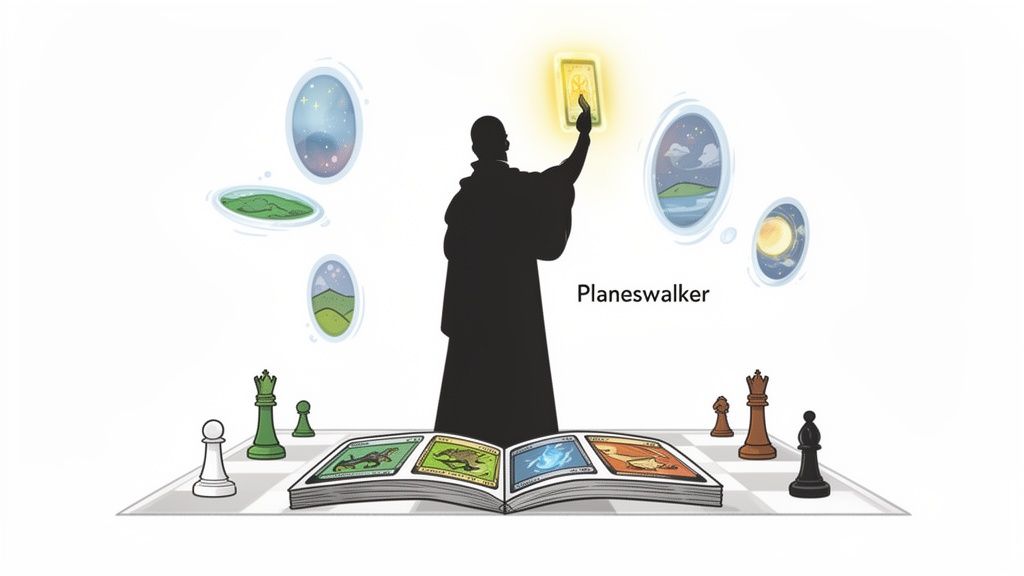
Magic has been around since 1993, the brainchild of Richard Garfield, and it has since become a true global phenomenon. A great way to think about it is like a game of chess, but with one crucial difference: you get to design all your own pieces. Every game is a fresh puzzle, a clash of wills where you’re constantly trying to out-think your rival while pushing your own grand strategy forward.
The real magic of the game? The sheer, staggering variety. With well over 20,000 unique cards released over the years, the possibilities are practically endless. You could build a deck that swarms the battlefield with an army of goblins, or maybe you'd prefer a more cunning approach, using illusions and counter-spells to control the game and slowly drain your opponent's hope. This freedom to build and tinker is what keeps players coming back for more.
One of the best parts of Magic is the community. It’s a game that brings millions of people together, from friends battling it out on a kitchen table to pros competing for glory in massive global tournaments. It’s a shared language of strategy, a reason to trade, talk shop, and build friendships over a love for the game.
Now, if you're coming from other tactical card games, the basic idea of managing resources and playing units will feel pretty familiar. The strategic depth is a massive draw, but if you're after that same feeling of a tactical duel in a much shorter timeframe, you might want to check out a game like TerraClash™ Grimoire. It delivers that same spirit of outwitting an opponent but boils the action down into a satisfying 10 - 15 minute game. If you're keen to see how different games tackle this formula, diving into other popular fantasy card games can be a real eye-opener.
Ultimately, Magic is a game of choices. Every card you play, every attack you make, is a decision that ripples across the battlefield, guiding you towards victory or defeat.
This guide is here to pull back the curtain on the rules, show you the different ways to play, and give you a clear roadmap for starting your own adventure in the world of Magic. If you're ready to take your first step into a larger world, we'll show you the way.
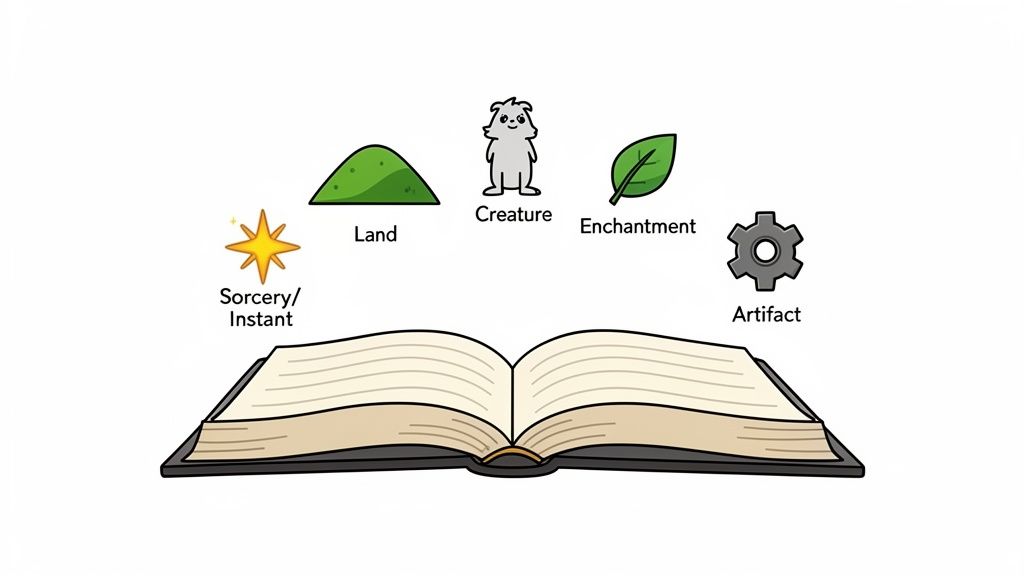
Think of every Magic deck you build as your own personal spellbook. It's your unique collection of magical tools, all chosen to outwit and overpower your opponent. Getting a grip on the different card types is the first real step towards becoming a seasoned planeswalker. There are five core types, and each one has a specific job to do in your grand strategy.
The absolute foundation of any deck is Lands. These aren't spells; they're the raw resources you need to do anything. You can play one per turn, and you "tap" them to generate mana, the magical energy that fuels every other card in your hand.
Without a solid base of lands, even the most fearsome dragons and devastating spells are just pretty pictures in your hand. It's a simple, elegant system that dictates the rhythm and flow of every single game.
Once you've got some mana, you can start bringing your spells to life. The most common card you'll be casting is a Creature. These are your soldiers, your beasts, your wizards, and your monsters—the forces that fight for you on the battlefield.
Every creature has power and toughness (shown as two numbers like 2/2). Power is how much damage it deals in a fight, and toughness is how much it can take before it's sent to the discard pile (what we call the graveyard). They're your main way of chipping away at your opponent's life total while also defending your own.
Then you have your one-shot magical effects: Sorceries and Instants. Both are powerful spells that do their thing and then go to the graveyard, but the big difference is timing.
Sorceries: You can only cast these during your main turn when the coast is clear. Think of them as big, telegraphed rituals—unleashing a massive fireball to clear the board or pulling a fallen creature back into the fight.
Instants: Now these are the secret sauce of Magic. Instants give you incredible flexibility because you can cast them at almost any time, even in the middle of your opponent's turn. This opens the door for surprise ambushes, last-second saves, and clever counter-spells that can completely throw a spanner in their plans.
That ability to react with an Instant is what makes the game so dynamic. It’s no surprise that a card like Heroic Intervention, which can save your whole team from disaster, is found in over 830,000 registered decks—its power comes from playing it at the perfect moment.
While creatures and one-off spells are the bread and butter of your strategy, some magic is designed to stick around. That's where Enchantments and Artifacts come in.
Unlike a Sorcery or Instant, these cards stay on the battlefield, providing ongoing effects that can bend the rules of the game in your favour. An Enchantment might give all your creatures a permanent boost, while an Artifact could be a magical sword that turns a single warrior into an unstoppable champion. For a deeper look, check out our complete guide to the different MTG card types.
Think of it this way: Creatures are your army, Sorceries and Instants are your tactical strikes, and Enchantments and Artifacts are the long-term fortifications and equipment that support your war effort.
Figuring out how to balance these five card types is the true art of deckbuilding. It's a strategic puzzle of threats, answers, and resources that defines so many great card games. If that style of tactical thinking gets your brain buzzing but you wish the pace was faster, TerraClash™ Grimoire might be right up your alley. It delivers a similar thrill of outmanoeuvring an opponent but packs the whole duel into an intense 10 - 15 minute showdown.
Have a look at the Kickstarter campaign to see the action for yourself, or visit the official Grimoire page to learn more.
To a newcomer, a game of Magic can look like a chaotic whirlwind of cards flying onto the table. But once you're in the driver's seat, you realise there's a steady, predictable rhythm to it all. Every turn follows the exact same sequence of steps, creating a natural flow of gathering power, making your move, and then facing the consequences.
Getting a feel for this turn structure is your first big step toward becoming a proper player. Once the phases click, the game’s incredible depth starts to feel a lot less intimidating. Let's break down what a turn actually looks like, piece by piece.
Your turn kicks off with what's called the Beginning Phase, which is really just three quick moments. First, the Untap Step: you simply turn all your sideways (tapped) cards upright again. Any lands you used for mana or creatures that attacked last turn are now refreshed and ready to go.
Next comes the Upkeep Step. This is a brief window where certain card abilities might fire off automatically. You might have an enchantment that says, "At the beginning of your upkeep, you gain 1 life," for instance. It's a moment for passive effects to do their thing.
Then comes the best part: the Draw Step. You draw the top card from your library. This simple action is the heart of the game's drama. Is it the land you desperately need? The game-winning dragon? Or just another card that won’t help? The suspense is real.
With a new card in hand, you move into your first Main Phase. This is your command centre, the time to put your plans into action. You've got a couple of key things you can do here.
First, you can play one Land card from your hand. This is one of the golden rules of Magic—only one land per turn. This limitation is what sets the game's pace, forcing everyone to build up their resources gradually instead of playing their biggest threats on turn one.
Second, using the mana from your lands, you can start casting spells. This is where you summon creatures to fight for you, cast powerful Sorceries, or place Enchantments and Artifacts on the battlefield to set up for future turns.
A player’s Main Phase is where the game is truly won or lost. The decisions you make here—which creature to play, which spell to hold back—are what pave the road to victory.
Alright, time for some action. The Combat Phase is where your creatures get to earn their keep. As the active player, you decide which of your ready (untapped) creatures you want to send into the fray to attack your opponent.
It's then up to your opponent to react. They can use their own untapped creatures to block your attackers, leading to a clash on the battlefield. Or, they can choose to take the damage straight to their life total. This tense back-and-forth of attacking and blocking is a brilliant tactical puzzle all on its own.
After the dust from combat settles and any defeated creatures are sent to the graveyard, you get a second Main Phase. It works exactly like the first one. It’s a perfect opportunity to play a creature to replace one you lost in the fight, or to play a spell that bolsters your defences for your opponent's upcoming turn.
Finally, you reach the End Phase. This is a final clean-up step, and it also serves as one last chance for either player to cast fast-acting Instants before the turn officially passes. Your opponent then takes over, starting their turn right back at the Untap Step. This complete cycle is the heartbeat of every game of Magic.
The deep, phase-based strategy of Magic is what has kept players hooked for decades, but it does mean games can take a while to play out. If you love this kind of tactical thinking but are short on time, TerraClash™ Grimoire captures a similar strategic feel but packs it into a brisk 10 - 15 minute duel. You can find out more on the official Grimoire page or help bring the game to life by checking out the Kickstarter campaign.
One of the best-kept secrets about Magic is that it’s not really a single game. It’s more of a game system, with dozens of different ways to play called “formats.” Each format has its own rules about which cards are allowed and how you build your deck, which means there’s a perfect fit out there for just about everyone.
The world of formats is split into two big camps: Constructed and Limited.
Think of Constructed like this: you're a master brewer, painstakingly crafting your deck at home from your entire collection before you even get to the game table. In Limited, everyone shows up empty-handed and has to build a deck on the spot from a shared pool of cards. It’s all about thinking on your feet.
Let's dig into some of the most popular formats to see which one calls to you.
Constructed is where your personality as a player truly shines. The deck you sleeve up is your masterpiece, a direct reflection of your strategy, your favourite colours, and your personal style. It's the ultimate form of self-expression in the game.
Standard: This is Magic's premier competitive format, and it’s always changing. Standard only uses cards from the last couple of years of releases, so the 'meta' is constantly shifting as new sets arrive and old ones rotate out. If you love solving a constantly evolving puzzle, this is for you.
Commander (EDH): Without a doubt, Commander is the king of casual play. It’s a multiplayer brawl where you build a 100-card deck around a legendary creature—your "Commander"—and battle it out with a table of friends. It's less about winning quickly and more about politics, wild board states, and creating memorable stories.
Modern: Want to play with more powerful cards without diving into the game's entire 30-year history? Modern is your sweet spot. It uses cards printed from 2003 onwards, creating a fast, powerful, and incredibly diverse format. Mastering a Modern deck takes real dedication, but the rewards are immense.
The deep strategy of building, testing, and perfecting a deck is a huge part of what makes Magic so addictive. It's a game within the game.
If that sounds like your cup of tea but a 45-minute match feels like a bit much, you’ll find that same strategic spark in TerraClash™ Grimoire. It captures the brilliant feeling of outsmarting your opponent with clever card choices but packs a complete, satisfying game into a fast-paced 10–15 minute duel.
You can get a better look by visiting the official TerraClash™ Grimoire page or by checking out the game's launch on its Kickstarter campaign.
On the other hand, Limited formats level the playing field. It doesn’t matter if you own thousands of cards or just started yesterday. Here, it’s all about your fundamental skills: evaluating cards, spotting synergies, and building a solid deck from a random pool of options.
The most common way to play Limited is called Draft. You sit down with seven other players, everyone gets three booster packs, and the fun begins. You open a pack, pick one card you want, and pass the rest to the person on your left. You keep doing this, receiving packs from your right, until all the cards have been picked.
In a Draft, every pick is a gut-wrenching decision. Do you take that powerhouse rare, even if it’s not in the colours you’ve started collecting? Or do you take a less exciting but reliable creature that fits your strategy? It's a fantastic mental workout.
Once the drafting is done, you build a 40-card deck from your pile of chosen cards and play a mini-tournament. It’s a true test of your ability to adapt and build on the fly. Another popular Limited format, Sealed, gives you six packs and challenges you to build the best deck you can from that pool alone.
No matter which format you end up loving, the core turn structure remains the same. It's the engine that powers every single game of Magic.

The flow from your Begin Phase, through your Main Phase, and into Combat is the universal heartbeat of the game. Each format just gives you a different set of tools and a different canvas to paint on. Discovering which one feels like home is one of the most exciting parts of the journey.
Alright, so you've got the basics down – the cards, the flow of a turn, and the different ways people play. But the biggest question remains: where on earth do you start? A game with a 30-year history can look like a mountain to climb, but honestly, getting into Magic has never been more straightforward.
Your first step as a budding Planeswalker isn't about dropping a load of cash; it's about making one simple choice. Do you want to start in the digital world or with physical cards in your hands?
For anyone wanting to just dip their toes in the water, MTG Arena is a fantastic choice. It's the official digital version of Magic, it's completely free to start, and you can play it on your PC, Mac, or phone.
Frankly, its tutorial is brilliant. It doesn't just throw rules at you; it walks you through real gameplay scenarios, so you learn by doing. Arena is an amazing way to get a feel for the game’s rhythm and see how different cards work together, all without spending a penny. You'll get free starter decks, earn new cards just by playing, and you can test your new skills against people from all over the world.
But what if you're like me and the tactile shuffle of a real deck is part of the appeal? The path is just as clear, and you don't need to dive into buying hundreds of random booster packs. Just look for a product called a Starter Kit.
These boxes are built from the ground up for new players. They usually come with:
Starter Kits are a fantastic, cheap way to get a proper feel for the game with balanced decks that are fun to play right out of the box. Once you're comfortable and want to start tweaking things, our guide on how to build your first MTG deck is a great next step.
Playing at the kitchen table is a great start, but so much of Magic's soul is in its community. Making a trip to your local game store is a massive part of the experience. These places are the heart of the hobby – welcoming spots where you can meet other players, trade for that one card you need, and join in casual events like the classic Friday Night Magic.
Don't be nervous about walking in. In my experience, store owners and the regulars are almost always excited to help a newcomer find their feet. It's truly the best way to find opponents and become a part of the game's massive, global fellowship.
While the deep strategy and community of MTG are second to none, the time commitment can be a real factor. If you love that tactical duel feeling but need something much quicker, a game like TerraClash™ Grimoire might be just what you're looking for. It delivers a similar strategic punch but in a lightning-fast 10 - 15 minute package. You can take a look at the Kickstarter campaign or head to the official Grimoire page to see more.
We’ve all been there. You get hooked on a game like Magic: The Gathering for its incredible strategic depth. The careful dance of managing resources, the chess-like placement of creatures, and that constant mind-game you play against your opponent – it’s a brilliant, rewarding feeling. But let's be real, that depth often demands a serious chunk of your time. A single game can easily stretch to 45 minutes or more.
What if you could get that same strategic thrill, that same core duel experience, but condensed into the time it takes to have a coffee? If you’re a strategy fan whose schedule is a bit tight, we’d like to introduce you to TerraClash™ Grimoire. It’s a game built from the ground up for people who love to think tactically but need the action to start right away.
Anyone who gets a kick out of MTG's fundamental loop will find that TerraClash™ Grimoire feels immediately familiar. You're still building up your power, reacting to what your opponent throws down, and plotting your own course to victory. Those satisfying, crucial decisions about when to commit your forces and how to best use your abilities are still at the heart of it all.
The difference is, the entire experience has been fine-tuned for a much quicker tempo. The rules are straightforward and quick to pick up, so you can jump straight into the good stuff without a long setup. This focus on speed squeezes a complete, satisfying strategic duel into just 10 - 15 minutes.
It’s the perfect answer for anyone who craves that intellectual challenge but wants a game they can play a few rounds of in a single evening, not just a single match.
The core of any great card game is making choices that matter. TerraClash™ Grimoire is all about serving up those high-impact decisions in a fraction of the time, making every single turn feel important.
To give you a better sense of how these two fantastic card games feel at the table, it helps to look at them side-by-side. Here's a look at the key differences in gameplay feel and time commitment.
| Feature | Magic: The Gathering | TerraClash™ Grimoire |
|---|---|---|
| Average Game Time | 30-60+ minutes | 10-15 minutes |
| Pacing | A gradual build-up over many turns | Fast-paced, with immediate action |
| Complexity | High, with many intricate rules and phases | Low barrier to entry, easy to learn |
| Strategic Feel | A long, epic war of attrition and planning | A quick, intense tactical skirmish |
As you can see, it's a choice between a grand, strategic war and a fast, brutal skirmish. Both are incredibly rewarding, but one fits a busy lifestyle a lot more easily.
If this blend of deep strategy and rapid-fire pacing sounds like your cup of tea, we’d love for you to learn more. You can explore the game in detail on the official TerraClash™ Grimoire page.
Even better, you can be a part of bringing this game to life. Head over to the Kickstarter campaign and help us build a new community for lovers of fast-paced strategy.
It’s completely normal to feel a bit overwhelmed when you first look at a game with three decades of history. Everyone starts somewhere, and a few common questions always seem to pop up. Let’s tackle them head-on so you can get shuffling and playing with confidence.
That’s the big one, isn’t it? The honest answer is: it only has to be if you want it to be. You can start playing for free right now by downloading MTG Arena on your PC or phone. It has a fantastic tutorial and gives you a bunch of free decks to get a feel for the game.
If you’re after that real-card feel, the "Starter Kits" are your best friend. They’re cheap and come with two complete decks, so you and a mate can start slinging spells straight away. Sure, the top-end competitive scene can get pricey, but the heart of the game has always been about outsmarting your opponent, not out-spending them.
Some of the best games of Magic you’ll ever play will be on a kitchen table with a pile of cheap cards. It's the strategy that makes it brilliant, not the price tag.
The five colours – White, Blue, Black, Red, and Green – are the soul of the game. Each one has its own personality and way of winning, and understanding them is your first step to becoming a master deckbuilder.
The real magic happens when you start mixing them. A Red-Green deck might combine fast attacks with huge creatures, while a White-Blue deck could be a nightmare of control and defence. This is where your creativity truly shines.
Not at all! While the art and stories are incredible, the engine running it all is pure strategy. At its core, Magic is a game of resource management, calculated risks, and out-thinking your rival. Many people love it for the same reason they love chess or poker—it’s a deep, competitive mental workout.
The only thing to keep in mind is that a proper game of Magic can sometimes take a fair bit of time. If you love the thrill of building a deck and duelling an opponent but need something that fits into a lunch break, a game like TerraClash™ Grimoire might be right up your alley. It captures a similar strategic depth but packs it all into a fast-paced 10-15 minute match. It's a fantastic choice for anyone who craves that tactical challenge but is short on time.
Curious to see a strategy game that respects your time? Check out the TerraClash™ Grimoire on our official Grimoire page or join our community and help bring the game to life by visiting our Kickstarter campaign.

