Ready for a Legendary Game Night? Let's Deal the Cards
A good game night is a British tradition, but finding the right game can be a quest in itself. Forget endlessly scrolling through options; we've curated the ultimate list of card games drinking fans will adore. From timeless classics that get the whole table talking to strategic challenges that test your bluffing skills, there's something here for every mood and every gathering. This guide is your one-stop resource for turning a casual get-together into a truly memorable event.
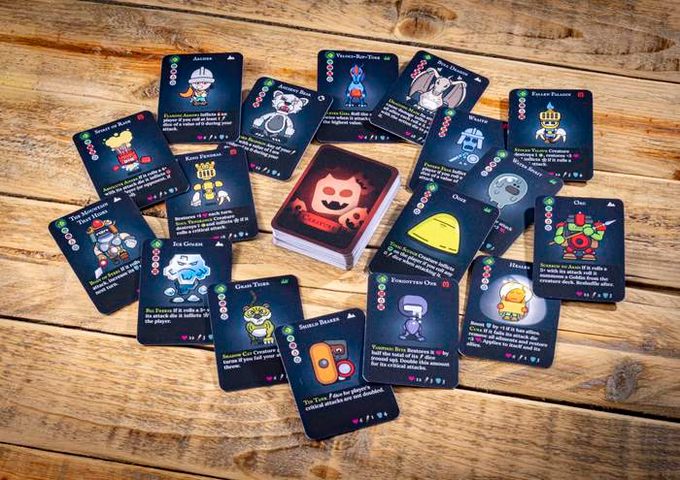
We’ll guide you through clear rules, clever variations, and even show you how modern fantasy games are joining the party. You’ll learn how to adapt complex strategy games into something more relaxed and social, making them perfect for a party setting. For instance, fast-paced deck-builders like TerraClash™ Grimoire, which offers thrilling 10-15 minute matches, can be easily modified for social play. If you're curious about a game that combines quick thinking with fantasy themes, you can explore the Grimoire page or check out its upcoming Kickstarter campaign.
This listicle isn't just about rules; it’s a complete toolkit for your next game night. We’ll provide quick-reference summaries, ideal player counts, and non-alcoholic alternatives to ensure everyone feels included. To ensure your legendary game night is truly unforgettable, consider exploring a wider selection of the best party games for adults beyond just cards. So, gather your mates, pour your favourite tipple, and prepare for an unforgettable evening. Let the games begin.
If you've ever been to a university party or a casual get-together in the UK, you’ve likely encountered the reigning monarch of social drinking card games: Kings Cup. Its enduring popularity comes from its simplicity and incredible adaptability. All you need is a standard 52-card deck, a large central cup (the 'King's Cup'), and a group of willing participants.
Players take turns drawing a card from a fanned-out circle around the cup. Each card value corresponds to a pre-determined rule, from simple actions like "2 is for you" (pick someone to drink) to more involved mini-games. The true genius of Kings Cup is that no two games are ever the same. The rules are a living document, evolving with each group's unique sense of humour and inside jokes. This flexibility will feel familiar to anyone who enjoys strategy games where house rules can shape the entire experience.
The game's structure is wonderfully straightforward. A card is drawn, a rule is declared, and an action is completed. The game builds tension with each card, especially with the Kings. The first three players to draw a King must pour some of their drink into the central King's Cup. The unlucky soul who draws the fourth and final King must drink the entire concoction.
Key Insight: The game's magic lies in its customisable rules. Before starting, take five minutes to agree on your set. This avoids arguments and lets you tailor the experience, whether you're aiming for sheer chaos or a more structured game night. Writing them down is a pro-move.
This customisation allows for incredible creativity. We’ve seen groups create fantasy-themed versions where card rules are tied to character actions like casting a spell (make a rule) or drinking a potion (take a drink). The core mechanic of drawing a card to trigger an event is a simple, fast-paced system that creates constant engagement, not unlike the quick turn-based action in card games like the TerraClash™ Grimoire, where each card play can dramatically shift the game's momentum in a 10-15 minute match. For a deeper dive into the fundamentals that make these games so engaging, you can explore more about how to play card games.
Often confused with its royal cousin Kings Cup, Circle of Death (or Ring of Fire, depending on where you play) offers a subtly more intense and suspenseful take on the classic "draw a card, follow a rule" formula. It’s a staple at university socials and gaming conventions, known for its ability to quickly unite a group through shared challenges. The core components are the same: a deck of cards, a group of friends, and drinks at the ready.
The game begins with the cards spread face-down in a continuous circle around a central cup or bottle. Players must draw a card without breaking the circle. Each card triggers a rule, similar to other social card games drinking, but the tension comes from the 'ring'. The player who breaks the circle must drink the contents of the central vessel. This simple physical challenge adds a layer of dexterity and nerve to the proceedings, making every draw a high-stakes moment.
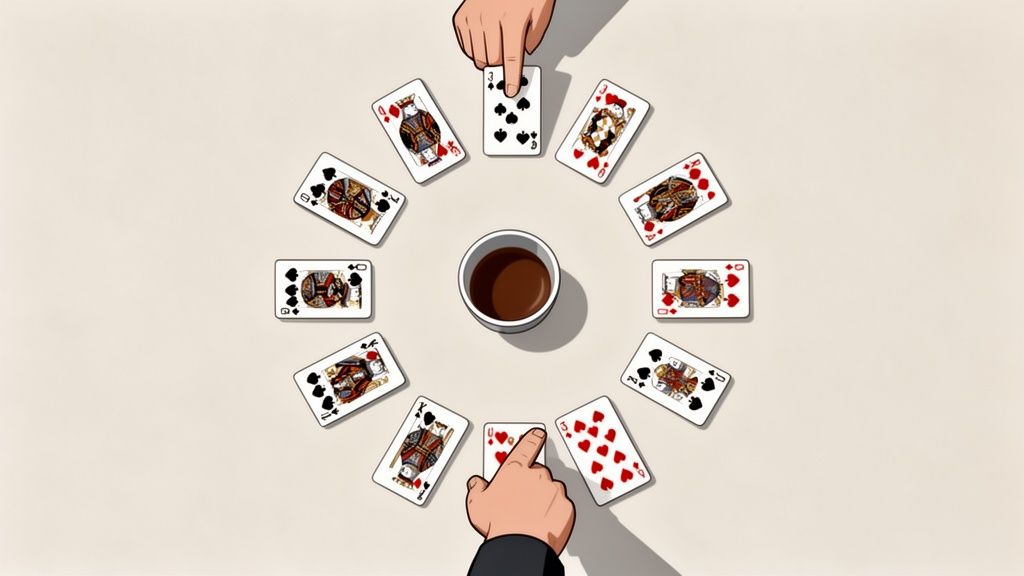
Gameplay is cyclical and simple. A player draws a card, announces its rule, and the group complies. The actions can be anything from rhyming words to making another player drink. The core appeal is its dynamic flow; one moment you're safe, the next you're faced with a difficult challenge triggered by a random card draw. This randomisation of consequences feels familiar to anyone who enjoys campaign-based games where encounters are drawn from a shuffled deck.
The real fun begins when groups adapt the rules. Tabletop gaming communities often use it as a warm-up, theming the rules to match the main event. For example, drawing a Jack could mean "Dungeon Master's Choice," allowing the game master to invent a rule on the spot. This shares a similar fast-paced nature with games like TerraClash™ Grimoire, where a single card play can completely alter the strategic landscape in a matter of seconds.
Key Insight: The unbroken circle is the heart of the game. Emphasise this rule from the start. The collective gasp when someone's hand trembles and nudges a card out of place is a core part of the experience. Using a large, stable surface is essential.
This element of physical skill combined with luck of the draw makes Circle of Death a standout. Its fast pace ensures no one is left waiting for long, creating a continuous cycle of engagement perfect for getting a game night started. If you enjoy quick-fire mechanics and strategic adaptations, be sure to check out the TerraClash™ Grimoire Kickstarter campaign for another game that delivers rapid, rewarding gameplay.
Almost everyone knows the rules to Uno, which makes its drinking game variant one of the easiest to introduce to any group. Drunk Uno takes the classic, colour-matching card game and injects it with a healthy dose of chaotic fun by attaching drinking penalties to its action cards. It’s the perfect icebreaker for casual game nights or as a light-hearted interlude between more intense tabletop campaigns, blending familiar strategy with unpredictable social consequences.
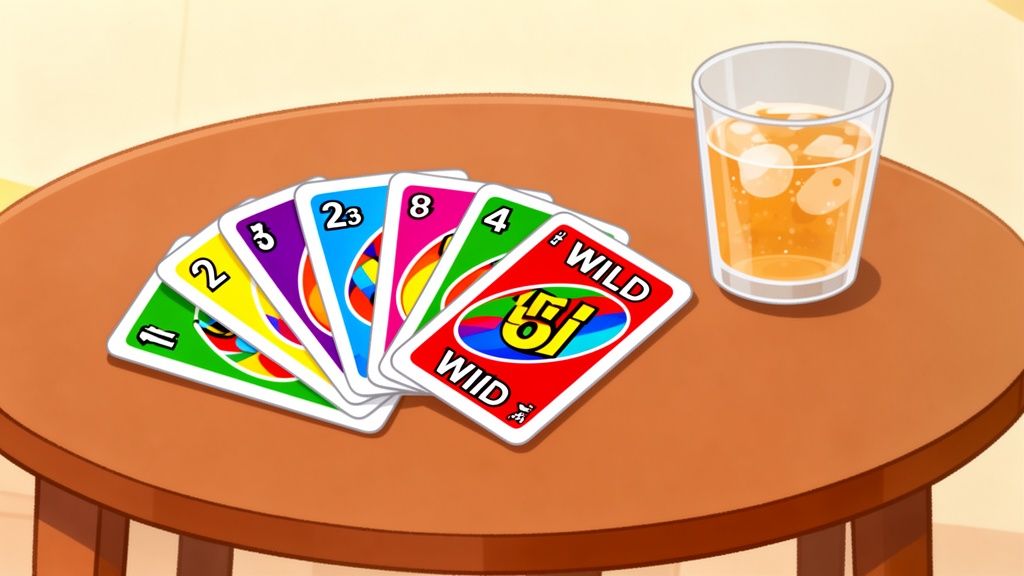
This game thrives at university gatherings and gaming cafés, where its quick setup and universally understood rules allow players to jump straight into the action. The core gameplay remains the same—match the previous card by colour or number—but now, playing a Skip, Reverse, or Draw Two card carries an extra kick. This simple modification turns a family-friendly favourite into a premier choice for card games drinking, keeping everyone engaged and on their toes.
The beauty of Drunk Uno is its straightforward rule integration. Before starting, the group agrees on what each action card means. A Draw Two might mean the next player drinks twice, a Skip could force the skipped person to drink, and a Wild card might let you create a new rule. The game escalates naturally as hands get smaller and the final "Uno!" shout looms, creating moments of high-stakes hilarity.
Key Insight: Establish your drinking rules clearly before the first card is played. A common house rule is that if someone forgets to shout "Uno!" and gets caught, they must take a penalty drink. This small addition adds another layer of focus and fun to the game.
The rapid, turn-based nature of Uno, amplified by these drinking rules, creates a dynamic experience. The game's momentum can shift in an instant with a single card play, a feeling that fans of fast-paced strategy games will appreciate. It shares this quick-fire energy with games like the TerraClash™ Grimoire, where a 10-15 minute match is filled with constant action and reaction. For those looking to explore more accessible games, you can find a great list of easy to learn card games that are perfect for any game night.
Moving away from intricate rules and into the realm of pure stamina, we have Centurion. This isn't a game in the traditional sense; it’s a marathon. The premise is brutally simple: participants must take one shot of beer, every minute, for 100 minutes. There are no cards, no complex rules, just you, a timer, and a test of sheer endurance.
Centurion is the stuff of legend at university parties and competitive drinking events, where the challenge is less about outsmarting opponents and more about conquering your own limits. The atmosphere it creates is unique, starting with casual conversation and slowly transforming into a shared struggle against the relentless clock. While it lacks the strategic depth of other drinking games, its appeal lies in its raw, communal test of fortitude.
To begin, all you need is a timer (a phone app or even a dedicated YouTube video works perfectly), plenty of beer, and a shot glass for each player. When the first minute starts, everyone takes a shot. When the second minute starts, you do it again, and so on, for one hundred gruelling minutes. The game becomes a mental battle as much as a physical one, as participants fight the urge to quit.
Key Insight: Safety is paramount with a challenge this intense. Centurion should only be attempted by experienced drinkers who are fully aware of their limits. Always have food available, ensure water is on hand for hydration, and make participation completely voluntary. No one should ever feel pressured to continue.
The real drama of Centurion unfolds organically. Alliances are formed, motivational speeches are given, and the group collectively wills each other to the finish line. This shared experience creates a powerful sense of camaraderie. While it doesn't involve drawing cards, the constant, timed actions create a rhythmic intensity surprisingly similar to the fast-paced nature of games like TerraClash™ Grimoire, where every second in its 10-15 minute game time counts towards victory.
For those who enjoy a bit of competitive hierarchy mixed with their social drinking, Scum is a brilliantly structured game of strategic card shedding. Also known by more colourful names like 'Shithead' or 'President', its appeal lies in a dynamic ranking system that changes every round. Players battle to get rid of their cards first, establishing a pecking order from the President down to the lowly 'Scum'.
This game is a staple in university gaming societies and tabletop clubs, often used as a fantastic icebreaker or a filler game between longer sessions. The core loop is simple: play a card (or set of cards) that is equal to or higher than the previous play. If you can't play, you must pick up the entire discard pile, a painful setback that can quickly send you tumbling down the social ladder.

The game begins with players trying to empty their hands. The first to do so becomes 'President' for the next round, while the last is the 'Scum'. In subsequent rounds, the President gets the Scum's best cards in exchange for their worst, creating a compelling power dynamic. Drinking penalties are naturally layered on top, with the Scum often bearing the brunt of the duties, like refilling drinks or taking a penalty sip for their low status.
The strategic depth comes from knowing when to play your high cards and when to hold back. This constant calculation of risk versus reward will feel familiar to players of fast-paced tactical games. Much like the quick turn-based combat in TerraClash™ Grimoire, every decision in Scum matters. A single misplay can lead to a disastrous turn, forcing you to pick up a huge pile of cards and sealing your fate for the round.
Key Insight: To avoid one player getting hammered, balance the drinking penalties. Instead of making the Scum drink constantly, give the President powers like assigning drinks or creating rules. This keeps the game fun and prevents anyone from having a truly miserable time.
For groups in fantasy gaming communities, re-theming the ranks adds another layer of fun. Titles like Peasant, Knight, Lord, and Dragon King can replace the standard names, making the experience more immersive. This focus on hierarchy and quick, impactful turns is a core reason Scum remains one of the most engaging card games for drinking.
"Most Likely To" is less about card mechanics and more about social dynamics, acting as a hilarious X-ray into your friend group's perceptions. It’s the perfect ice-breaker or late-night game for a group that already knows each other well. All you need are some creative questions and a willingness to see who your friends think is most likely to perform a certain action.
The game thrives on its simplicity and the conversations it sparks. Players take turns asking a question starting with "Who is most likely to...?" followed by a scenario, like "...join a fantasy RPG campaign?" or "...secretly be a dungeon master?" On the count of three, everyone points to who they think fits the bill. The person with the most fingers pointed at them takes a drink. It's a fantastic game for social gatherings, team-building for gaming groups, or themed parties.
The game's beauty is in its low-stakes, high-reward fun. There's no complex strategy or deck management; the only resource is your knowledge of your friends' personalities. It’s brilliant for filling the gaps between longer, more involved games or for winding down an evening. The game can be played with pre-made card decks or, for a more personal touch, with questions improvised on the spot.
Key Insight: The real fun comes from tailoring the questions to your group. Before playing, create a list of fantasy-themed questions. Think: "Most likely to collect tabletop miniatures," or "Most likely to rage-quit a board game." This personal touch makes the game infinitely more engaging and ensures the humour lands perfectly.
This focus on quick, personality-driven rounds creates a rapid, engaging pace that keeps everyone involved. While it doesn't use a deck in the traditional sense, the turn-based nature of asking questions and getting an immediate result feels similar to the fast-paced action of modern card games. You could even use a blank deck of cards to write your custom questions on, adding a physical element to the experience. For players who enjoy quick rounds and impactful turns, this game shares a similar rhythm with fast-paced titles like the TerraClash™ Grimoire, where a single card play can define a 10-minute game.
While not strictly one of the classic card games drinking, Thunderstruck has earned its place in the hall of fame through sheer, unadulterated musical chaos. This game requires no cards, no dice, and minimal setup, making it the perfect impromptu activity for any gathering with a speaker. Its legendary status comes from one source: AC/DC's iconic track, 'Thunderstruck'.
Players gather in a circle, press play, and brace themselves. The rules are brutally simple. When the first player hears the word "thunder," they must start drinking their beverage. They cannot stop until the word "thunder" is sung again, at which point the person to their left immediately takes over the drinking duties. This continues throughout the song, creating an unpredictable and often hilarious relay of endurance. It's a game of pure reaction and timing.
The game's appeal lies in its suspense. The gaps between each "thunder" are erratic; some are mercifully short, while others feel like an eternity, leaving one unlucky participant to drink continuously. The shared experience of anticipating the next trigger word creates a powerful sense of camaraderie and collective tension. Everyone is focused on the music, waiting for that key moment to pass the metaphorical baton.
Key Insight: The magic of Thunderstruck is its adaptability. Don't just stick to the original. Create a playlist with different trigger-word songs. A fantasy-themed night could use songs with the word "dragon" or "magic", adding a layer of thematic fun to the proceedings and keeping everyone on their toes.
This focus on a single, repeating trigger that dictates the action is a brilliant way to create fast-paced engagement. It shares a surprising amount of DNA with quick-turn games where one key action can change everything. For instance, in a rapid-fire card game like the TerraClash™ Grimoire, a single spell card can reverse a player's fortune in seconds, much like a sudden "thunder" can shift the drinking responsibility. If you're a fan of these high-energy mechanics, you might consider backing the game on Kickstarter to experience that adrenaline rush firsthand.
For those who believe a good card game is as much about reading your opponents as it is about the cards in your hand, Cheat (or BS/Bullshit, depending on the company you keep) is a must-play. This game transforms a simple deck of cards into a high-stakes psychological battlefield. All you need is a standard 52-card deck and a group of friends who don’t mind a bit of playful deception. It’s a staple at casual gaming nights and even finds its way into social hours at fantasy conventions as a great ice-breaker.
The objective is simple: be the first to get rid of all your cards. Players take turns placing cards face-down in a central pile, announcing what they've played (e.g., "three Queens"). The catch is, you don't have to tell the truth. Any other player can call "Cheat!" if they suspect a bluff. This blend of strategy, bluffing, and social deduction makes it one of the most engaging card games drinking can be paired with.
Gameplay proceeds in ascending rank, starting with Aces, then Twos, Threes, and so on. On your turn, you must discard one or more cards face-down and declare them as the required rank. If someone challenges you and you were telling the truth, they must pick up the entire discard pile. If you were lying, the pile is yours to collect. When alcohol is introduced, penalties are added: drink if you're caught cheating or if you make a false accusation.
Key Insight: The beauty of Cheat is its balance of risk and reward. Deciding when to bluff and when to challenge is a delicate dance. Keeping accusations light-hearted is crucial; the goal is fun, not to start a genuine argument. A good house rule is to establish a 'safe word' or gesture if things get too intense.
The constant mental gymnastics of tracking cards and reading tells sharpens your strategic thinking. This focus on predicting your opponent's moves is a core skill in more complex strategy games like TerraClash™ Grimoire, where outmanoeuvring your rivals is key to victory in its fast-paced 10-15 minute duels. To get better at this kind of tactical play, you can explore more on how to improve your decision-making skills.
For those who enjoy a game with structure, progression, and a healthy dose of social hierarchy, Presidents and Assholes (also known as Scum or Capitalists) is a must-try. This game isn’t just about the luck of the draw; it's about climbing the social ladder, round after round. The goal is to get rid of your cards first, securing a higher rank for the next game, while those left holding cards are relegated to the bottom.
This classic has found a home in tabletop gaming clubs and fantasy conventions, where the role-playing aspect of ranks adds a thematic layer. The game starts with everyone on equal footing, but as players shed their cards, a hierarchy is established: President, Vice-President, Citizens, and the unfortunate Asshole. Higher ranks gain advantages, like receiving the best cards from lower ranks, while the Asshole has the menial task of shuffling and dealing. Adding drinking rules based on rank makes this one of the most strategic card games drinking can offer.
The game's appeal is in its satisfying loop of social climbing and strategic card shedding. Players must follow the lead card played (e.g., a single, a double, a triple) with a higher-value card of the same type. The person who gets rid of all their cards first becomes the President for the next round. The game's flow, where players must constantly one-up each other, feels similar to the strategic back-and-forth of a fast-paced game like the TerraClash™ Grimoire, where outplaying an opponent's move is key to victory.
Key Insight: The game thrives on continuity. Keep a ranking sheet across multiple game nights to build a running narrative of who's on top and who's fighting their way out of the gutter. This turns a simple game into an ongoing saga of glory and redemption.
To add a thematic touch, rename the ranks to fit your group's interests, like Kings/Queens, Lords, Merchants, and Peasants for a fantasy setting. The game perfectly blends skill-based card play with the social dynamics of the assigned roles, creating memorable moments and plenty of good-natured ribbing. For those interested in quick-turn card game mechanics, you can learn more about how to play card games that share this engaging pace.
While not strictly a card game, Flip Cup has earned its place in the pantheon of drinking games through sheer, unadulterated energy and teamwork. It’s a game of speed, dexterity, and synchronisation that transforms any gathering into a competitive spectator sport. All you need is a long table, some plastic cups, your drink of choice, and two teams ready for a fast-paced relay race.
The game is a pure test of motor skills under pressure. Teams line up on opposite sides of a table, each player with a cup filled with a set amount of drink. On "go," the first player on each team chugs their drink, places their empty cup on the edge of the table, and must successfully flip it upside-down using only their fingertips. Once they succeed, the next player in line can begin. The first team to have all its members finish their drink and flip their cup wins.
The beauty of Flip Cup is its chaotic simplicity. The game demands no complex rules or strategy, just quick reflexes and a steady hand. It's the ultimate ice-breaker, forcing immediate camaraderie as teammates cheer each other on. The tension builds with each flip, as a single player's struggle can cost their team the entire round, making every moment count. This focus on rapid, sequential actions creates a frantic pace that’s surprisingly similar to the quick-fire turns in games like the TerraClash™ Grimoire, where every second matters and a single play can turn the tide of the game.
Key Insight: The secret to a good Flip Cup game is creating evenly matched teams. Before you start, try to balance the groups by perceived skill or just mix everyone up randomly. This prevents one team from dominating every round and keeps the competitive spirit alive for everyone involved.
The game’s physical nature offers a refreshing change of pace from more cerebral card games drinking. It gets people on their feet and interacting directly, making it perfect for breaking up a long night of sitting around a table. It's a fantastic, high-octane interlude that resets the energy in the room.
| Game Title | 🔄 Implementation complexity | ⚡ Resources & pace | 📊 Expected outcomes | 💡 Ideal use cases | ⭐ Key advantages |
|---|---|---|---|---|---|
| Kings Cup | Low to medium — simple base rules, complexity rises with house rules | Standard 52‑card deck + cup; variable game length and pace | High social interaction, creative moments, unpredictable length | Casual parties, tabletop warm‑ups, themed game nights | Extremely customizable; minimal equipment |
| Circle of Death (Ring of Fire) | Low — preset card actions; variants add complexity | Deck + central pile; fast, cascading plays | Energetic, unpredictable chain reactions | Parties, gaming meetups, pre‑session warmers | Fast‑paced, high group engagement |
| Drunk Uno | Low — follows familiar Uno mechanics with added penalties | Uno deck; quick rounds, moderate tempo | Mix of strategy and social drinking, moderate unpredictability | Casual game nights, cafés, quick party sessions | Low learning curve; strategic and social balance |
| Centurion (100 Shots) | Very low rule complexity but high logistical/health complexity | Timer/app + many drinks; fixed long duration (100 min) | Endurance challenge, strong group achievement, high health risk | Extreme challenge events (not recommended for casual play) | Clear structure; memorable group feat |
| Scum (Shithead/Karma) | Medium — ranking and sequence mechanics require learning | Standard deck; moderate to long rounds depending on players | Strategic card sequencing, ongoing social hierarchy | University clubs, filler game between longer sessions | Strong strategic depth and replayability |
| Most Likely (Most Likely To) | Very low — discussion and voting based | Minimal (cards or none); variable, often moderate pace | Social bonding, humor, personality insights | Icebreakers, social hours, themed parties | Inclusive and highly customizable question sets |
| Thunderstruck | Very low — timing tied to music cues | Speaker + song; rhythm determines tempo and randomness | High‑energy, music‑driven bursts of participation | Parties, nightlife, DJ events, themed sessions | Immersive via music, minimal prep |
| Cheat (BS/Bullshit) | Medium — bluffing rules and challenge timing | Standard deck; quick rounds with social tension | Strategic deception, dramatic interactions | Warm‑up at gaming clubs, social game nights | Teaches deduction and bluffing; highly social |
| Presidents and Assholes | Medium to high — rank progression and special rules | Standard deck; longer sessions with many players | Competitive narratives, shifting social status | Regular groups, conventions, ranked series play | Ongoing progression and social dynamics |
| Flip Cup | Very low — simple relay mechanics | Plastic cups, table, drinks; very fast and physical | Team excitement, clear winners, spectator appeal | Large parties, team competitions, convention socials | High energy, teamwork, spectator‑friendly |
We’ve journeyed through a deck full of possibilities, from the anarchic chaos of Kings Cup to the strategic bluffing of Cheat. You’ve seen how a simple pack of 52 cards, or even a colourful deck of Uno, can become the centrepiece of a memorable gathering. These card games for drinking are more than just an excuse to pour a round; they are frameworks for connection, laughter, and a healthy dose of competitive spirit.
The true magic lies in their adaptability. You now have the tools to tailor each experience, whether you’re introducing a non-alcoholic variant for an inclusive afternoon or adding house rules to Presidents and Assholes that will be talked about for years. The key takeaway is that you are the master of your game night. By understanding the core mechanics, player counts, and moods of these games, you can curate an evening that perfectly suits your crowd.
The best drinking card games are not about who drinks the most, but about who creates the most memorable moments. They are social engines, designed to get people talking, laughing, and engaging with one another on a level that typical party chatter rarely reaches.
As we've explored, many of these party staples share fundamental DNA with more complex tabletop games. The quick thinking needed for Scum, the social deduction in Most Likely To, and the turn-based actions in Circle of Death all serve as a fantastic primer for deeper strategic experiences. If you find yourself enjoying the rapid-fire rounds and the tactical outmanoeuvring of your friends, it might be a sign that you're ready to explore a new kind of challenge.
This is where the world of modern strategy card games beckons. Imagine taking the fast-paced energy you love from these classics and channelling it into a rich, fantasy world filled with powerful spells and mythical creatures. This is precisely the experience offered by games like TerraClash™ Grimoire. It captures that same quick-play excitement, with games lasting just 10-15 minutes, but layers it with the satisfying depth of deck-building, character abilities, and head-to-head tactical combat. It’s the perfect next step for when the party winds down, but the desire for friendly competition remains.
Think of it as the evolution of your game night. You’ve mastered the art of the party game; now you can apply those skills to a new arena. The core principles remain the same: understand the rules, read your opponents, and make your move. Whether you’re declaring a new rule in Kings Cup or casting a decisive spell in a fantasy duel, the goal is to create an engaging and unforgettable experience. So, shuffle the deck, gather your friends, and prepare for your next adventure, whatever form it may take.
Ready to take your game night to the next level with a blend of quick-fire fun and strategic depth? TerraClash offers a unique fantasy card game experience perfect for those who love the fast pace of party games but crave more tactical gameplay. Discover the world of TerraClash and see how your card-playing skills translate to an epic magical battle.