Greetings, brave soul. To be a master strategist, a true champion of the tabletop, is not a matter of sorcery, but of mastering the decisive moment. It is the sacred art of surveying the battlefield, weighing the tangled threads of fate, and acting with the conviction of a king—whether you face a dragon in its lair or a challenge in your own realm.
Consider the grandest tabletop sagas you have ever undertaken, from the sprawling dungeons of Gloomhaven to the arcane duels of Magic: The Gathering. Every epic quest begins not with the first step, but with the first choice. This is your call to arms—a chance to hone the most formidable weapon in your arsenal: your mind.
In a game like TerraClash, a single card played at the opportune moment can shift the tides of battle entirely. So too in life. A single, well-forged decision can alter the course of your grand adventure.
Let this guide be your enchanted map. We shall delve into the arcane lessons hidden within our favourite games, forging decision-making skills that echo far beyond the cardboard battlefield. The trials you overcome across the board are more than mere games; they are a crucible for heroes.
Learning to make choices of consequence is no secret art, reserved only for wizards and warlords. It is a practical skill, one you build through practice, observation, and a spark of courage. Picture it thus:
Deckbuilding is the art of prophecy. When you construct a deck, you are not merely gathering powerful artifacts. You are weaving a cohesive strategy, scrying the possibilities of turns yet to come, and preparing for threats that still lurk in the shadows. Every card you select is a micro-decision, a single verse in your epic of victory.
Resource management is a test of wisdom. Every gold piece spent in a deep campaign or every mana crystal channelled in a duel teaches a vital lesson. You learn to balance the needs of the now against the ambitions of the morrow—a skill absolutely essential for navigating life’s more labyrinthine paths.
Anticipating your rival’s gambit is true foresight. The greatest champions do not simply react; they anticipate. They study their foe, recognise the patterns in their play, and make educated divinations about what is to come. This is the very heart of strategic thinking.
In the grand theatre of life, just as in the tense arena of a card game, your success hinges on the quality of your choices. Each decision is a thread you weave into the tapestry of your destiny.
This power to analyse and predict is not merely useful for claiming victory in a game. In realms across the world, the ability to render sound judgment is an incredibly valuable skill. One report, for instance, revealed that over 1.5 million leaders and seers already use data to inform their decisions, proving how critical this is for any successful enterprise.
Honing these skills does not just aid your personal quests; it helps fill great voids across countless guilds and kingdoms. You can discover more insights about the demand for skilled decision-makers in the UK to see the grander picture.
Prepare to transform how you face every challenge. Let us journey into the art of the decisive moment.
To make choices that echo through the ages, whether in a high-stakes game or in your own life's story, you must understand the architecture of a legendary decision. I have found that every solid choice rests upon four ancient pillars. Think of them as the sacred principles that turn a novice adventurer into a seasoned champion. We see their shadows in all our favourite tabletop quests.
First stands the Pillar of Perception. This is the gift of seeing the entire battlefield, not just the small skirmish before you.
Envision a veteran player gazing over a Wingspan or Everdell board. They are not merely counting their own berries and twigs; they are tracking every rival's potential stratagem, what cards lie in the meadow, and the overall flow of the game. That is true perception—understanding the full context before you even consider your next move.
Next, we have the Pillar of Foresight. This is your personal scrying pool, allowing you to anticipate what your rivals might conjure before they even cast the spell.
It's that tense mental duel you engage in during a game of Dominion. You aren't just buying cards for your own treasury; you are attempting to decipher the engine your opponent is building and actively working to counter it. Foresight isn't about reacting to what is happening now; it's about shaping what will happen three turns hence.
The third pillar is that of Risk and Reward. You must be able to weigh the potential for glory against the very real possibility of doom.
This is a skill you sharpen every time you dare to play a game like Clank!. Do you delve deeper into the dragon's lair for that last glittering artifact, knowing you make more noise and risk utter annihilation? Or do you play it safe and make a desperate run for the exit? A master strategist instinctively knows which risks are worth taking.
Finally, we arrive at the Pillar of Adaptation—knowing when to cast your grand plan into the fire because the winds of fate have shifted.
This is a lesson learned the hard way in any deckbuilding game, including TerraClash. Your perfect strategy, so carefully crafted, can be undone by a single ill-fated draw. A rigid plan is a brittle one. The true path to victory lies in your ability to change your approach on the fly.
To truly master this, you must be aware of the common mental enchantments, or cognitive biases, that can lead you astray. This mystical chart reveals a few of the most potent ones.
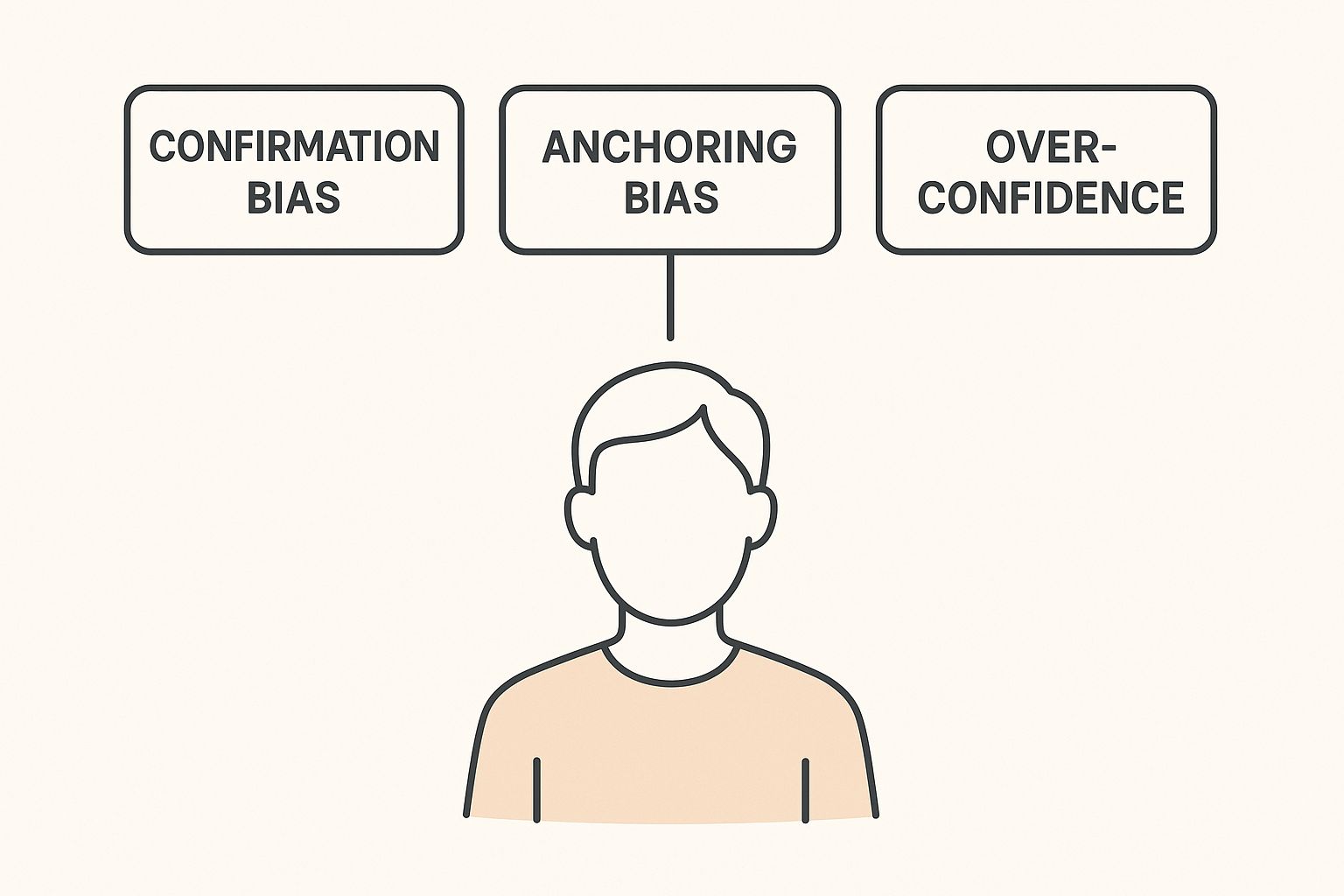
Simply recognising these whispers in your own mind is a monumental first step toward making cleaner, more objective choices.
To bring these arcane concepts into the light, here is a quick chronicle of how these pillars translate from ethereal concepts to familiar game mechanics.
| Pillar | Core Principle | Tabletop Game Analogy |
|---|---|---|
| Perception | Understanding the complete state of play and all available options. | Scanning the entire board in Everdell, noting every worker placement spot and card in the meadow. |
| Foresight | Predicting and anticipating the future moves of your opponents. | Building a counter-deck in Dominion based on the cards your rival is collecting. |
| Risk & Reward | Evaluating the potential upside of an action against its potential downside. | Deciding to press your luck in Clank! to grab more treasure, despite the added danger. |
| Adaptation | Changing your strategy in response to new information or changing circumstances. | Pivoting your build in TerraClash when an unexpected card draw disrupts your initial plan. |
By consciously fortifying these four pillars, you build a mental fortress, ready for any challenge the game—or the world—hurls your way. You can delve even deeper into these chronicles in our guide on how to improve strategic thinking.
When you master these pillars, you aren't just getting better at a game; you're fundamentally learning how to think better. You're forging the mental acuity to see opportunities where others see obstacles and to act with confidence when others hesitate.
🎲 Want to try a solo card and dice RPG tonight? Get TerraClash Lite free: a print-and-play game you can play with ordinary dice.

Any adventurer who has ever constructed a deck, whether for the treacherous spires of Slay the Spire or the strategic duels in games like TerraClash, knows this moment intimately. It is the classic crossroads. In one hand, you hold a powerful, situational card, shimmering with promise. In the other, a humble, reliable workhorse you know will serve you well. This is the Deckbuilder's Dilemma, and it is a powerful mirror for some of life's most critical choices.
This dilemma is a test of your ability to weigh fleeting gains against your long-term quest. That flashy, high-damage spell might win you the next skirmish, but what happens when it clutters your hand against the final lich king? True mastery is not about grabbing the shiniest artifact. It is about building a synergistic engine where every component works towards a clear, victorious purpose.
One of the most profound lessons any deck-builder imparts is the art of the 'cull'—the ritual of deliberately removing weaker, less useful cards from your deck. It feels unnatural at first, does it not? Why would you ever desire fewer options?
The answer lies in the arcane laws of probability. By trimming the fat, you dramatically increase the odds of drawing the powerful, synergistic cards you truly need, precisely when you need them. This sacred principle maps perfectly onto our personal and professional quests. To sharpen your decision-making, you must become adept at knowing what to cast aside.
This means being true to your quest by:
A lean, focused deck is a winning deck. In the same way, a life curated with purpose allows you to make choices with clarity and confidence. This kind of discipline is rooted in the same strategic thinking that defines classic games, a topic we explore more in our guide on how to build a powerful MTG deck.
This process of careful curation has never been more vital. The modern professional world is a constantly shifting battlefield. It is foretold that a staggering 58% of the current UK workforce must learn new skills just to perform their roles effectively. In this age of constant change, adaptability is your greatest weapon, and knowing which skills to 'add to your deck' is crucial for your career.
True strategy is not born from having the most options, but from having the right options. It is found in the careful and deliberate curation of your resources, ensuring every piece works in concert towards a single, triumphant end.
This is where the true magic unfolds. When you start treating your skills, projects, and even your time as a deck you are carefully building, you cease making reactive choices. You begin to execute a grand, proactive strategy. You become the architect of your own victory.
A wise Dungeon Master never reveals the entire map at once, and life rarely shows its hand either. Every truly great decision I have ever witnessed was not a product of blind luck; it was built on a solid foundation of superior information. Before you commit to a move upon the great board, you must master the art of 'scouting the terrain'.
This is your intelligence-gathering phase. In a sprawling strategy game like Scythe or a deep role-playing campaign, you would not charge blindly into the unknown mists. Of course not. You would send out scouts, study the landscape, and probe the enemy's strength. Life’s great choices deserve that same level of care.
The 'fog of war' is a classic concept for a reason. It is that shadowy veil of the unknown that keeps you from seeing the path ahead clearly. To cut through it, you must become your own spymaster, an expert at gathering the right information. This is a crucial skill if you genuinely wish to know how to improve decision making skills.
It all begins by asking better questions. Forget vague pleas like, "What should I do?" Get specific. Delve deeper with inquiries that truly reveal the lay of the land:
This kind of disciplined questioning forces you to organise your thoughts. It takes you from a state of paralysis to one of informed readiness, turning a wild gamble into a calculated move. Much like you'll find in the best strategy board games, your success is often decided by how well you prepare before the first piece even touches the board.
Once you've gathered your intel, you cannot simply let it swirl in your mind like a tempest. You must chart it. Think of mental frameworks as your enchanted maps; they help you spot patterns and connections that others might miss.
Here is a simple but incredibly potent ritual for sorting information. Separate what you have learned into three distinct chests.
By separating what you know from what you assume and what you can't possibly know, you create a much clearer picture of the battlefield. This simple act allows you to build a strategy that’s both strong and adaptable, ready for whatever twists and turns come your way.
This entire approach ensures your choices are far from being mere shots in the dark. They become informed tactical manoeuvres, grounded in the intelligence you have so carefully collected. Now that is the way of a true strategist.
We have all faced it. Staring at the board in a game of Arkham Horror, your turn grinding to a halt because the sheer number of options is a sanity-draining horror. That frozen moment is what the scribes call analysis paralysis, and it is one of the greatest beasts to slay on your quest to sharpen your decision-making skills.
This mental fog rolls in when you are swamped with choices, terrified of picking the wrong one. The stakes can feel monumental, whether figuring out which card to play in a tense TerraClash match or making a pivotal move in your career. The good news? You can absolutely learn to cut through the noise and act.
One of the deepest traps we fall into is the hunt for the single, flawless, ‘perfect’ move. It rarely exists, and the search for it is what keeps you frozen. A much wiser strategy is to aim for a ‘good enough’ decision and make it with confidence. Progress, not perfection, is the rallying cry of the victorious.
So, how do you do that? Try setting an action timer. Truly, give yourself a strict, short deadline to make a call—perhaps just two turns of the hourglass. This simple magic forces you to trust your instincts and commit to a path, stopping you from spiralling into an endless what-if incantation. It’s a brilliant way to train yourself to be decisive under pressure.
Another powerful tactic is to slice a huge, intimidating decision into smaller, bite-sized quests. Instead of facing one colossal choice, you're just tackling a series of manageable steps. It makes the next move feel so much less daunting.
The real art of making good decisions isn't about banishing risk altogether—it's about managing it. Once you accept that no choice is 100% certain, you free yourself from the fear of error and give yourself permission to act.
This ability to think on your feet is valuable far beyond the gaming table. In high-stakes fields like cyber security, for example, making sharp, informed judgements is critical. A 2025 government report on such skills in the UK actually points out a major shortage of professionals who have the analytical grit to make these tough calls. You can read the full report on the UK labour market to see just how in-demand these skills are.
Learning to act decisively is a muscle you can build through games, preparing you for real-world situations where hesitation can have dire consequences. If you fancy starting with something a bit simpler, have a look at our guide to some easy-to-learn card games. They're a fantastic, low-stakes playground for practising these very skills.
Even the most seasoned adventurers know when to seek counsel, especially when the path ahead grows murky. Let us consult the oracle and delve into some of the most common questions that arise on the journey to becoming a sharper, more decisive thinker, using the lessons we've learned around the gaming table.
Deckbuilders and strategy games are, at their core, incredible training grounds for the mind. They are not mere pastimes; they are a mental gymnasium. With every single turn, you are compelled to weigh probabilities, manage your finite resources, and balance a long-term strategy against the immediate needs of the moment.
Think on this. Deciding which card to add to your deck in a game like TerraClash is a brilliant, low-stakes version of deciding whether to invest in a long-term project at work or extinguish the immediate fire on your desk. The art of culling your deck—getting rid of weaker cards to improve your chances—directly mirrors the real-world skill of knowing what to prioritise and what to let go of.
These games build mental fortitude. You become better at gazing upon complex situations and making choices that will bear fruit seasons from now. That is a power you can take directly into financial planning, career moves, or any of life's great choices.
By far, the most common pitfall I have witnessed is letting emotional bias cloud one's judgement. We are all susceptible. It often manifests as ‘confirmation bias’, where you seek only the information that supports what you already wish to believe. Another classic curse is ‘loss aversion’, where the fear of losing something small prevents you from grasping a much greater prize.
It is akin to refusing to sacrifice a weak pawn in a wargame to capture a powerful piece, simply because you have grown attached to it. That is an irrational bond, and it can cost you the entire battle.
The best way to sidestep this is to create a bit of mental distance. Try framing the decision as if you were giving advice to a good friend. This simple trick helps strip away your own emotional stake, leaving you with a much clearer, more objective view of what's really on the line.
You must keep a chronicle of your progress. It is that simple. Keep a journal of your significant decisions. For each one, scribe the situation, the options you weighed, the choice you made, and the reasoning behind it.
Then, after a time—perhaps a month or so—return to your chronicle and review the outcomes. The key here is not to chastise yourself if things did not go perfectly. Luck and chance are always players in the great game. Instead, look at the quality of your process. Did you gather enough information? Did you consider different possible futures? Did you spot any of your usual biases creeping in?
You will begin to see a clear pattern emerge. You will find your decision-making becomes more thoughtful and well-reasoned. That is how to improve decision making skills in the real world. That, my friend, is the true mark of a master strategist.
Your own grand adventure is waiting. TerraClash is a world built on choices, where every card you play and every move you make writes a new chapter in your saga. It's time to put your skills to the test.
Follow the TerraClash Kickstarter journey and be among the first to answer the call!

