Gather ‘round, adventurers. If you've ever sifted through a dusty attic hoard or cracked open a fresh booster pack, you've likely dreamt of finding it: the one card that is more than a mere game piece, but a true artifact of legend. We are on a quest to uncover the rarest card in Magic: The Gathering, and let me tell you, the answer is a riddle wrapped in decades of history, arcane print runs, and pure, dumb luck.
So, where does a loremaster even begin? The title of "rarest card" is a fiercely contested one. You've got contenders from all corners of Magic's history, from one-of-a-kind tournament prizes to bizarre misprints that were never meant to see the light of day.
But should you ask most seasoned collectors, one name consistently rises to the top, whispered with reverence: the Black Lotus from the Alpha set, Magic's very first print run from 1993. It is the original icon, the cardboard king.
Consider this—only about 1,100 copies of each Alpha rare were ever printed. That is all. For a game that now boasts millions of players worldwide, that number is astonishingly small. This incredible scarcity, combined with its game-breaking power, has cemented its mythical status. A pristine, perfectly graded Alpha Black Lotus even sold for a mind-boggling $3 million a few years back. For those of us deep in the UK's Magic scene, it is the ultimate grail.
Understanding what makes a card like this so special is crucial. It’s a concept that echoes through all great tabletop games—from the oldest MTG sets to the latest indie darlings. The balance of power, scarcity, and history is what turns a simple piece of cardboard into a coveted artefact.
A single card can define not just a game, but the entire history of a hobby. These relics are powerful enough to represent the dawn of collectible card games, embodying a time of untamed design and boundless discovery.
If digging into the lore of these powerful cards gets your strategic mind buzzing, you might also enjoy our guide to the best collectible card games, where we explore other universes of strategic combat. Now, let us delve deeper into what makes a card truly rare.
Before we can even think about crowning the single rarest card in Magic: The Gathering, we must be of one mind about what "rare" actually means. It is not as simple as you might think. Like a well-aged wine, a card's scarcity is a complex blend of history, deliberate decisions, and sometimes, pure chance.
Think back to the very beginning of Magic. The earliest sets, like Alpha and Beta, were printed in what we would now consider minuscule quantities. Because of this, any card from that era is a genuine piece of gaming history, its total number forever fixed. This initial low print run is the foundation of all true rarity.
A card's journey from a common pack-filler to a legendary treasure is shaped by several key factors. One of the biggest is a promise made by the game's creators years ago: the Reserved List. This is their solemn vow to never reprint a specific list of powerful, older cards, effectively cementing their numbers for all time.
This diagram breaks down the main ways a card can become exceptionally scarce.
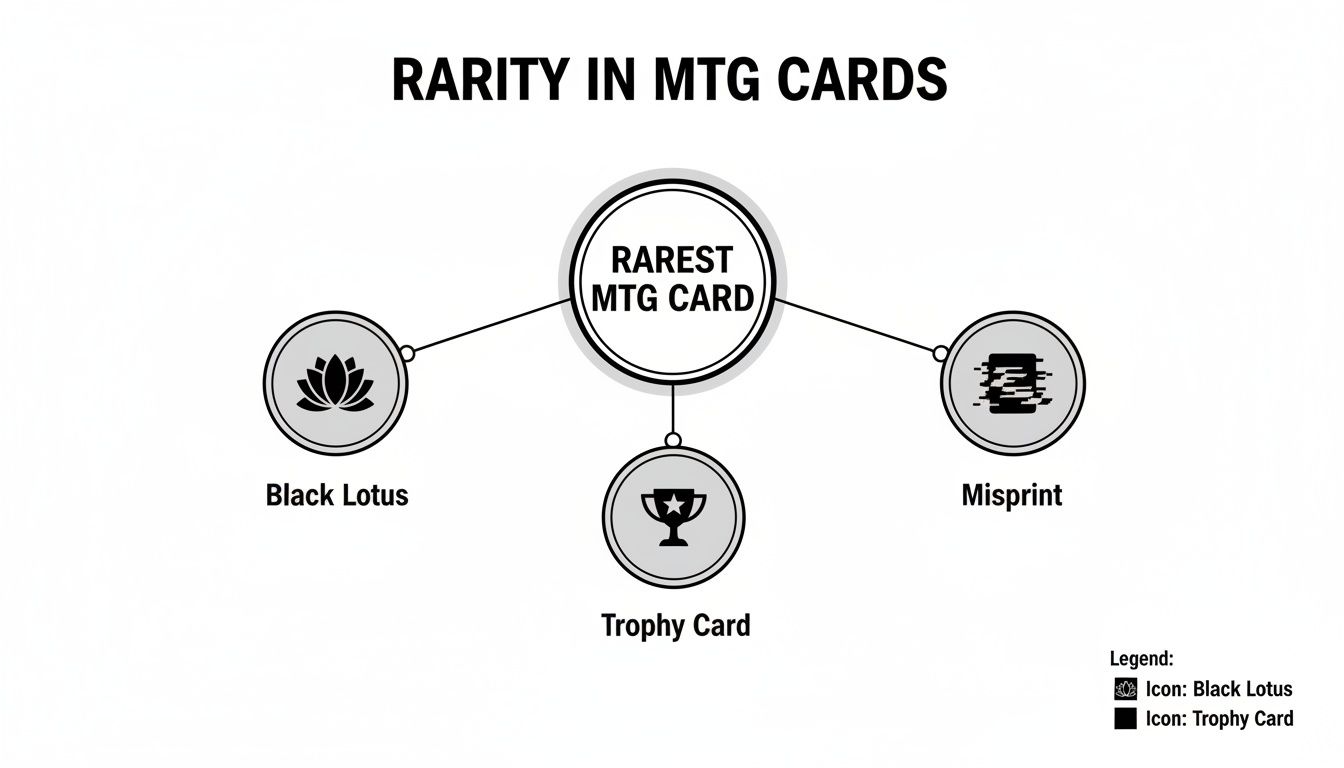
As you can see, it boils down to three main paths: intentionally small print runs, one-of-a-kind trophy cards, and those strange, accidental misprints.
Sometimes, rarity is a reward. Think of promotional cards handed out exclusively to top-tier tournament judges or the actual world champions. These aren’t just cards you play with; they are trophies, tangible symbols of incredible skill and dedication to the game.
Then there’s the wild card: sheer accident. Rarity is not always planned. Misprints and other production foul-ups can lead to bizarre, one-off cards that were never meant to exist. These "happy accidents" often become legends in their own right, their flaws making them utterly unique artefacts of the printing process.
Grasping these foundational concepts is as crucial for a collector as knowing elemental affinities before a climactic battle. It is the lore upon which all legendary collections, and indeed all great card games, are built.
Getting your head around these different flavours of rarity helps you appreciate the story behind each valuable card. If you wish to dig deeper into the game's fundamentals, you can learn more about the various MTG card types in our guide.
The principles that make an item scarce and sought-after are not unique to trading cards, either. To get a wider perspective, it’s fascinating to learn how to value antiques and see the parallels. These core ideas are the bedrock for any collector, whether you're hunting down ancient spells or forging new quests in a game like TerraClash.
Alright, let us step back in time. We are going to open the vault and have a look at some genuine legends from the earliest days of Magic. From the game's very beginning, a handful of artefacts were created with such devastating power that their names are still spoken with a certain reverence. We're talking about the Power Nine.
These nine cards are so ridiculously potent they're banned from almost every official format. They are relics from a wilder, untamed era of game design, and they represent the absolute pinnacle of power.
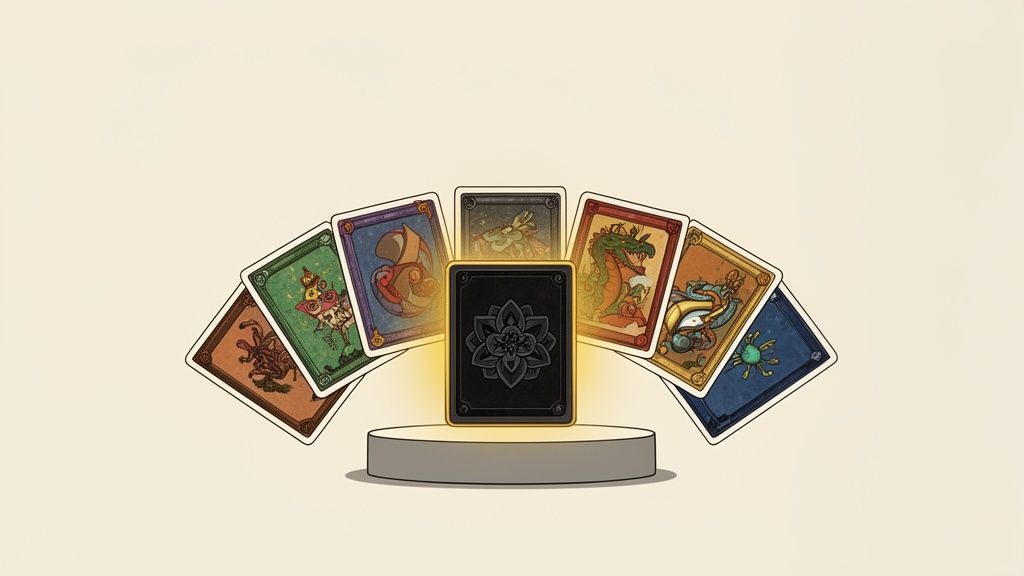
Sitting atop this mountain of power is the undisputed king: Black Lotus. It's a legend for a reason. For zero mana, it gives you a sudden burst of three mana of any colour. That kind of advantage is so massive it can basically win you the game before your opponent has even put down their first land.
Its rarity is a story in itself. It hails from the tiny Alpha print run, where only around 1,100 copies of each rare were ever made. Think about it – for decades, people played with these cards without sleeves, shuffling them, tapping them, and generally treating them like game pieces. This history of countless games means that finding a pristine copy today is like stumbling upon a unicorn. The Black Lotus has transformed from a piece of cardboard into a true historical artefact.
Of course, the Black Lotus is not the only powerhouse in this fellowship. It’s joined by its five cousins, the Moxen: Mox Pearl, Mox Sapphire, Mox Jet, Mox Ruby, and Mox Emerald. Each of these jewels, just like the Lotus, gives you a free shot of coloured mana at no cost. They embody a level of speed and raw power that modern game design has, quite wisely, steered well clear of.
To play a Mox is to tap into a piece of Magic's original, chaotic soul. Alongside the Lotus, these cards are the absolute peak of mana acceleration and raw, unadulterated power.
These artefacts are timeless lessons in how a single card can grant an insurmountable advantage and change the course of history. They remind us that true power often comes from the simplest of sources—a single gem, a forgotten flower.
This idea of a single, game-defining piece is a theme you see in many great tabletop games. For anyone creating their own legends in games like the roguelite deckbuilder TerraClash, the Power Nine are an incredible source of inspiration.
While the Power Nine get all the glory, other Alpha cards are just as scarce. Here in the UK, the Alpha Copy Artifact is another famous Reserved List rarity from 1993, with no more than 1,100 copies ever seeing the light of day. Its ability to clone an opponent's best artefact got it banned, but its collectability comes from that minuscule print run and the iron-clad promise it will never be reprinted. If you fancy a deeper dive into these old treasures, CGC Cards UK has some fantastic articles on print histories worth checking out.
Sometimes, the rarest treasures aren’t born from a grand design, but from a simple mistake. We have looked at cards made rare by intention, but now we venture into the wild world of printing errors—where the production process went a little sideways and created legends. These are the ghosts in the machine, the kinds of cards collectors whisper about.
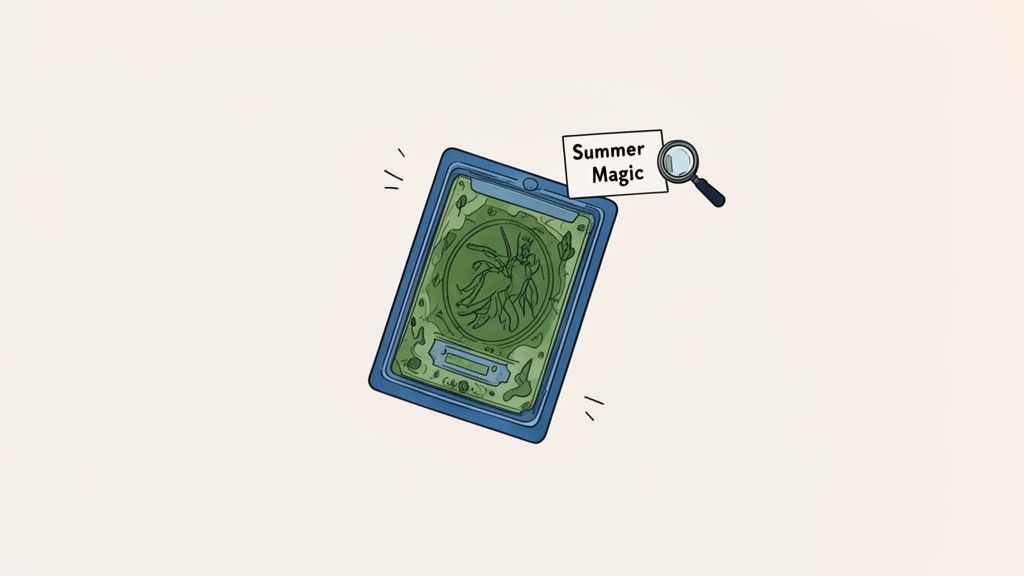
This brings us to the cautionary tale of Summer Magic. Back in 1994, this core set was printed to fix the errors in the Revised Edition. The irony? It was so full of its own problems—wrong art, strange colours, you name it—that Wizards of the Coast ordered the entire run to be recalled and destroyed.
Of course, a few booster boxes slipped through the net. Like phantoms, they escaped their fiery fate and found their way into the world, making the cards inside some of the most sought-after oddities in Magic's entire history.
Out of this phantom set came a true myth. A card that should not exist. We speak now of the infamous Blue Hurricane. It’s a green sorcery that was somehow printed with a bright blue border, a spectacular error that makes it stand out immediately. It is a glitch in the very fabric of Magic.
It is believed that fewer than a dozen of these cards exist anywhere on the planet. Each one is a survivor from a print run that was supposed to be wiped from history, a testament to how true rarity can sometimes come from pure chaos.
A flaw in creation can sometimes become its most celebrated feature. These anomalies remind us that the unexpected twists in our journey often lead to the greatest treasures.
The story of how the Blue Hurricane got out is a fascinating piece of UK Magic lore. Of the few boxes that escaped destruction, a tiny shipment of just 160 was accidentally sent to the UK in 1994. From that small pool came the estimated 10-12 known copies in the world today. That green spell in a blue frame became a collector’s fever dream, with top-graded examples fetching as much as $30,000. You can discover more about the valuable MTG cards and their strange histories that define the collecting scene.
This love for the unexpected is something every tabletop gamer understands. It’s the thrill of a critical dice roll, the pure joy of drawing the one card you need against all odds. It reminds me of the excitement one might get from flipping a random card that completely changes your adventure in a game like TerraClash.
Forget tiny print runs or phantom sets. Now we enter a realm where only a single copy of a card will ever exist. These are not treasures you might stumble upon in a dusty old booster pack; they are the true holy grails of Magic, created not for gameplay but as monuments to greatness. They represent the absolute peak of rarity, where a card becomes a legend in its own right.
These are the trophies handed to world champions or crafted to celebrate historic events. Their stories are deeply woven into personal triumphs and the game's grand history, making them feel less like playing pieces and more like priceless museum artefacts.
Take the card known simply as 1996 World Champion. This unique sorcery was created for that year’s winner, Tom Chanpheng, and even features his likeness immortalised in the artwork. Its text box contains a single, powerful line: "You are the 1996 Magic: The Gathering World Champion". Just one was ever printed, forever encased in a trophy—a singular testament to his victory.
Another such relic is the Shichifukujin Dragon, a majestic and entirely unique card presented to celebrate the grand opening of a major gaming centre in Japan. Its existence is a tribute, a piece of art marking a milestone in the game’s global journey. The power of these cards isn't measured in a duel, but in the stories they represent.
Each of these unique cards is a chronicle, a physical manifestation of a moment in time. They prove that in any great quest, the ultimate prize is to leave your own unique mark on history.
These one-of-one cards are a powerful reminder that rarity goes far beyond mere numbers. It’s about the narrative, the history, and the human achievement behind the cardboard. The desire to forge a unique path and create a personal story is a feeling that resonates with all of us who love tabletop games.
It’s that same spirit of individuality that fuels the creation of new worlds and new legends. When a hero in a game like TerraClash embarks on a quest, they aren't just following a path; they are crafting their own unique story, one card and one dice roll at a time. Much like these singular trophy cards, the greatest adventures are the ones that are entirely your own.
Our grand tour through the world of Magic’s rarest cards brings us to a simple, powerful truth: every collector's journey is unique. It is a personal quest. While most of us will never sleeve up an Alpha Black Lotus, the thrill of the hunt is a magic we all get to experience.
There's a universal joy in discovering a powerful synergy or pulling that one perfect card you've been searching for to complete a deck. It’s the same spark you feel whether you're cracking a booster pack or diving into a fresh roguelite campaign where every card draw writes a new chapter of your story.
So, as you build your collection and sharpen your strategies, keep these tales of scarcity and legend in mind. They're a reminder of the history we're all a part of. For those looking to conquer new worlds and discover new treasures, your next great quest might just be waiting on an indie campaign that carries on this grand tradition of tabletop adventure.
Countless creators are forging new legends on platforms like Kickstarter. It is a fantastic realm to find the next great thing and support passionate designers directly.
For any adventurer who loves the thrill of deckbuilding and discovery, we’ve put together a curated list of exciting indie games to keep an eye on.
| Project Name | Game Type | Campaign Link |
|---|---|---|
| TerraClash | Roguelite Deckbuilding & Dice RPG | Follow on Kickstarter |
Supporting these projects is an adventure in itself, allowing you to champion the next generation of tabletop sagas from the very beginning.
Of course, every great journey needs preparation. Before you set out, you might find our guide on how to build an MTG deck a useful map for organising your own powerful collection. May your path be filled with legendary pulls.
Walk into any gathering of Magic players, and you'll hear the same questions whispered over binders and playmats. Let's clear up some of the most common points of confusion when it comes to the rarest cards in the game.
This is perhaps the most important distinction to grasp. Think of it this way: rarity is a simple numbers game—it is about how many copies of a card actually exist in the world. Value, on the other hand, is about what people are willing to pay, which is driven by demand, a card's power in the game, and its physical condition.
A card can be incredibly rare but worth very little if nobody actually wants it. Imagine a strange old misprint that only has a handful of copies, but it's for an unplayable card. It's rare, but not valuable. Conversely, a powerhouse card like Gaea's Cradle is extremely valuable even though it is not as scarce as others.
The legendary Black Lotus is where these two worlds collide perfectly: it is one of the rarest cards ever printed, and the demand for it is off the charts.
Technically, yes, but the odds are beyond astronomical. Finding an unopened, unsearched booster pack from the early '90s—what we call 'sealed vintage product'—is a collector's quest in itself. These packs are now incredibly expensive artefacts.
The dream of cracking open an old Alpha pack and pulling a Power Nine card is the stuff of legend for a reason. It is less a collecting strategy and more like winning the lottery. While the thrill of possibility is part of the magic, it is not a realistic way to find these cards.
Condition is everything. A 'Gem Mint' Alpha Black Lotus, graded a perfect 10, is a completely different beast from one that's been scuffed up from years of play. In fact, it's exponentially rarer.
Remember, back in the early days, nobody used protective sleeves. Cards were shuffled, played, and traded without a second thought. Finding a pristine, untouched card from that era, three decades later, is like finding a flawless ancient relic.
For anyone serious about collecting, proper storage is non-negotiable. If you want to protect your own treasures, you can find some proven tips for storing collectibles to make sure they last.
Your own epic quest awaits. TerraClash beckons you to forge a new legend, one where every card drawn and every dice rolled writes another chapter in your unique story. Follow the journey and prepare for adventure on the TerraClash Kickstarter.

