Well met, adventurer. Before you can weave spells and command legions across the vast Multiverse, you must first learn its arcane language. The symbols in Magic: The Gathering are the very runes of power, a visual lexicon of strategy that is the key to mastering the craft.
Your quest begins here, with these cryptic markings. They are not mere decoration; every symbol is a vital piece of the grand tapestry, shaping the flow of battle. They reveal everything from the five colours of mana that fuel your incantations, to the very plane a card hails from and the rarity of its power.
Consider this your first grimoire, an introduction to the fundamental runes that will pave your path to victory.
Learning to read the field of battle at a glance is a skill all great champions of tabletop games possess, whether navigating the tactical dungeons of Gloomhaven or embarking on epic Kickstarter sagas like Oathsworn. That same design philosophy, where clear symbols are the heart of the experience, is a core tenet we’ve woven into our own game, TerraClash, crafted for adventurers aged 12 and up.
Hark, for the importance of these glyphs cannot be overstated. They are the game’s shorthand, allowing a Planeswalker to process a complex board state in a heartbeat and plot their next move. A single symbol can tell you:
Mastering these symbols is like learning the notes of a powerful enchantment. Each is a small part of a greater whole, but together they create the beautiful chaos of a well-played game of Magic. This attention to detail applies to every component on the table, and for a closer look at the spells themselves, consult our guide on the different MTG card types you will wield.
If you seek to master Magic, you must first understand what makes its heart beat. At its core, pulsing through every spell and creature, are the five primal forces of mana. These are not just colours; they are entire philosophies, each with a distinct symbol that shapes your path to victory.
Our journey begins upon the sun-drenched plains of White mana, the symbol of order, community, and righteousness. From there, we travel to the cunning isles of Blue mana, the icon of intellect, manipulation, and the endless quest for knowledge.
This scroll gives you a quick rundown of the three main types of symbols you'll see on a card: mana, set, and rarity.
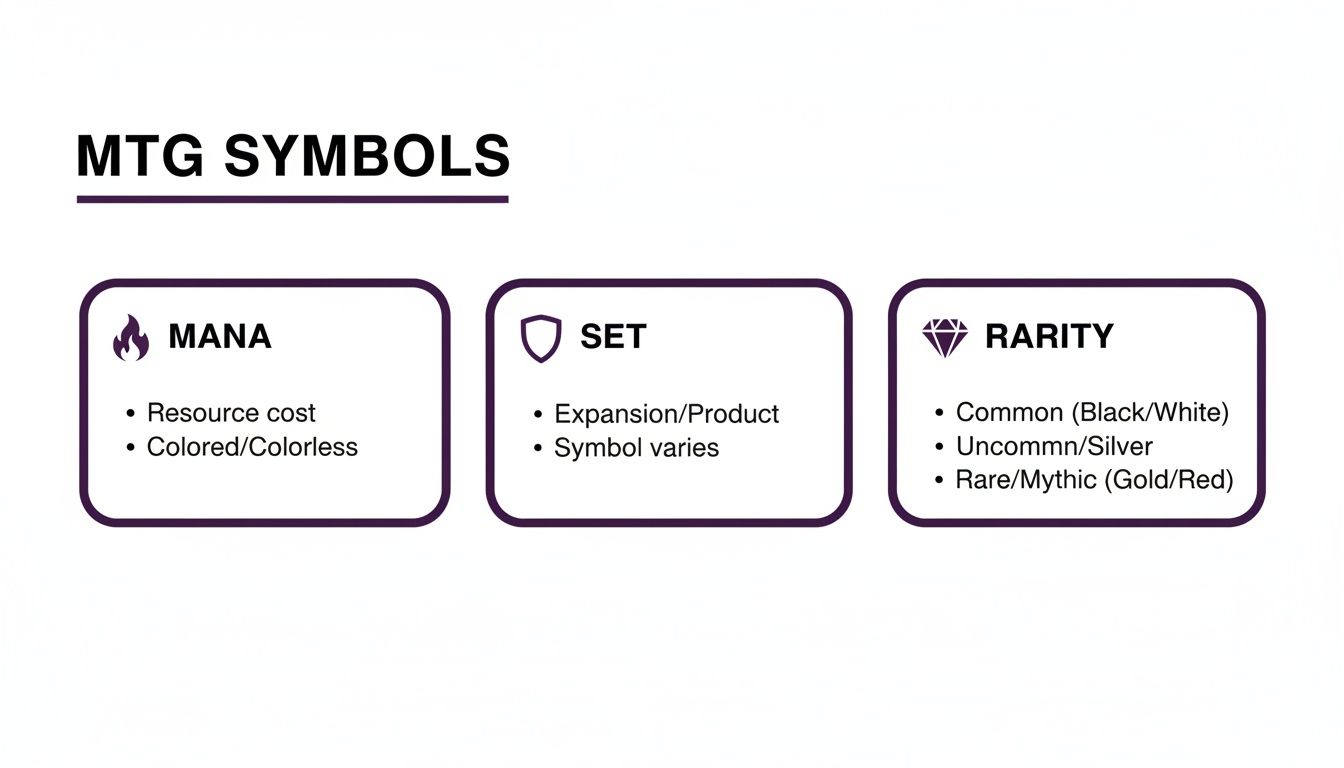
Grasping these three categories is the first step to sizing up any artifact or creature at a glance.
Our path then descends into shadowed swamps, the domain of Black mana. This is the sigil of ambition, decay, and a willingness to sacrifice all for ultimate power. In stark contrast, we then climb the jagged peaks of Red mana, the emblem of chaos, impulse, and raw, untamed emotion. Imagine the fire in a forge or the fury of a dragon, all captured in one glyph.
The cosmic struggle between these forces is what gives Magic its incredible strategic depth. The mana colours you align with will define your entire strategy, a fundamental principle we have embraced in forging the faction identities for our own game, TerraClash.
Finally, we venture into the ancient, sprawling forests of Green mana, the mark of nature, instinct, and ferocious growth. Green is life in its purest form, from the smallest sapling to the most gargantuan behemoth. Each of these five colours offers a unique lens through which to view the battlefield and an entirely different arsenal to command.
Here is a quick reference table to illuminate what each of the five core mana symbols truly represents.
| Mana Symbol | Color | Core Philosophy | Common Mechanics |
|---|---|---|---|
| White | Order, Protection, Community | Life gain, small creature swarms, enchantments, board wipes |
| Blue | Knowledge, Deception, Control | Counterspells, card draw, flying creatures, illusions |
| Black | Ambition, Sacrifice, Death | Creature removal, discard, reanimation, life drain |
| Red | Chaos, Freedom, Aggression | Direct damage (burn), hasty creatures, artifact destruction |
| Green | Nature, Growth, Instinct | Large creatures (fatties), mana ramp, trample, enchantments |
As you can see, a colour's mechanics are a direct reflection of its identity. A Blue mage thinks, a Red mage feels, and a Green mage grows. To truly excel, a Planeswalker must do more than just choose a colour—they must embrace its philosophy. It is the key that unlocks not just victory, but a much deeper connection to the game's rich lore.
Knowing how to blend these symbols is critical. In the UK, Magic: The Gathering symbols have been central to the competitive scene since organised play first began. In fact, data reveals that decks with well-balanced dual-symbol lands make up the top 8 in 62% of UK Modern Challenges. This shows how symbol mastery translates directly into success, a point often discussed by the community. You can delve into these trends yourself on the European Unity League's leaderboards.
Ultimately, these philosophies are universal in the realm of tabletop gaming. Whether you're marshalling the forces of good in a classic board game or building a deck for a new indie Kickstarter project, understanding your faction's core identity is always the first step toward becoming a legend.
So, you have memorised the five colours. A solid foundation, but the Multiverse is a far stranger place than just forests and mountains. Mana flows in twisted, ancient, and sometimes dangerous ways. If you truly wish to elevate your craft, you must understand the more advanced magic the gathering symbols. This is where true deck-building challenges—and untold opportunities—begin.
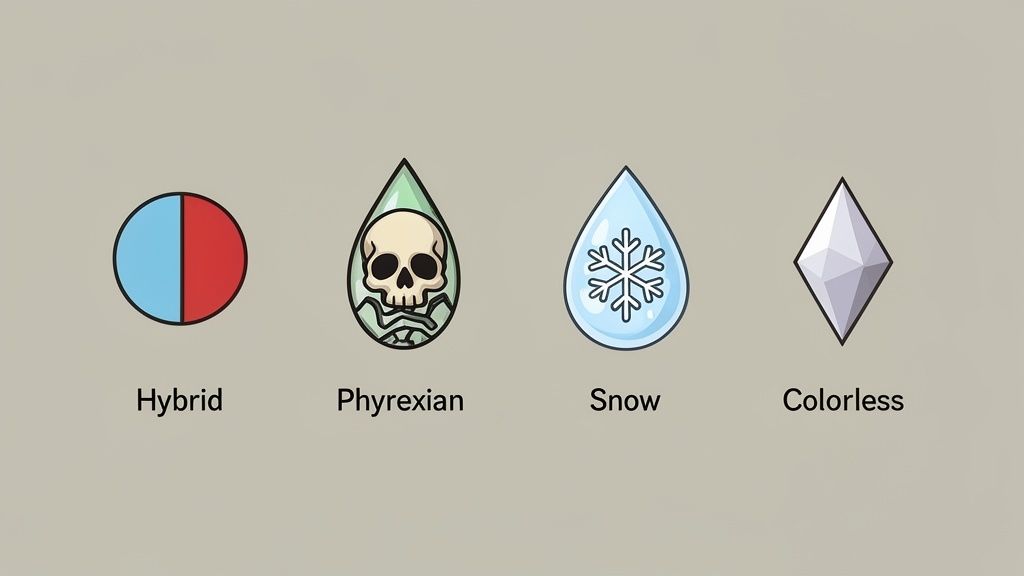
Learning to juggle these complex mana types is what separates the apprentice from the archmage. It opens entirely new strategic pathways and forces you to think differently about the very foundations of your deck.
First, let us examine Hybrid Mana. You will spot these symbols at once—they are split diagonally between two different colours. This design is brilliant, for it gives you options. A cost showing a half-White, half-Blue symbol can be paid with either one White mana or one Blue mana.
This flexibility is a great boon. It means hybrid cards can find a home in a much wider range of decks, helping to smooth out your mana sources and enabling truly creative strategies that blend colour philosophies. Consider the classic card Dovescape. You can field it in a mono-White legion, a mono-Blue conclave, or a traditional Azorius (White-Blue) build. It is all about options.
Now, we tread into darker territory with Phyrexian Mana. This symbol, the distinct Phyrexian insignia overlaid on a coloured background, represents a pact with a truly malevolent force. It is a bargain that offers incredible power, but always at a cost.
You can pay for a Phyrexian mana symbol with one mana of its colour, or you can pay 2 life instead. This allows you to cast game-altering spells ahead of schedule, even when your lands are tapped, by trading your own life force for tempo. It is a razor’s edge to walk; this mechanic can snatch victory from the jaws of defeat, but a single miscalculation can see your own ambition turn against you.
"To wield Phyrexian mana is to walk a razor's edge. It offers you the power to bend the rules of the game, but the price is paid in blood. Master it, and you can achieve victory from impossible situations; miscalculate, and you will be consumed by your own ambition."
There are other, stranger energies out there, too. Snow Mana, for instance, is marked with a snowflake icon. It is a specific type of mana that can only be generated by permanents with the "snow" supertype, like a Snow-Covered Island. Spells demanding snow mana require a true commitment to building your deck around these frozen resources.
And then there is the stark, alien power of Colorless Mana, represented by a diamond symbol (◇). This one confounds many an apprentice. It looks a bit like generic mana (like the number in a circle, ①), but it is fundamentally different. Generic mana can be paid with mana of any colour. A colorless mana cost must be paid with mana that has no colour identity at all. Think of the bizarre energies channelled by the Eldrazi or the ancient power humming within certain artifacts.
These symbols are not just for flavour; they define entire archetypes and have a massive impact on the competitive scene. A great example is the Turbo-Fueled Top 16 at the cEDH UK Championship, where the mastery of complex magic the gathering symbols is on full display. In fact, UK cEDH statistics show that decks using three or more colours have an average win rate of 58% in major tournaments, compared to just 42% for single-colour decks. It truly shows how a deep understanding of your mana base is critical for success. You can see these strategies in action in the UK cEDH Championship video highlights.
Every Planeswalker knows a card is more than just its text. It is a relic, a fragment of a specific time and place in Magic’s sprawling history. That small expansion symbol, tucked away on each card, is your personal chronicle—a key that unlocks the story of its origin. This little glyph instantly tells you if a card comes from the gothic spires of Innistrad or the city-wide guilds of Ravnica.
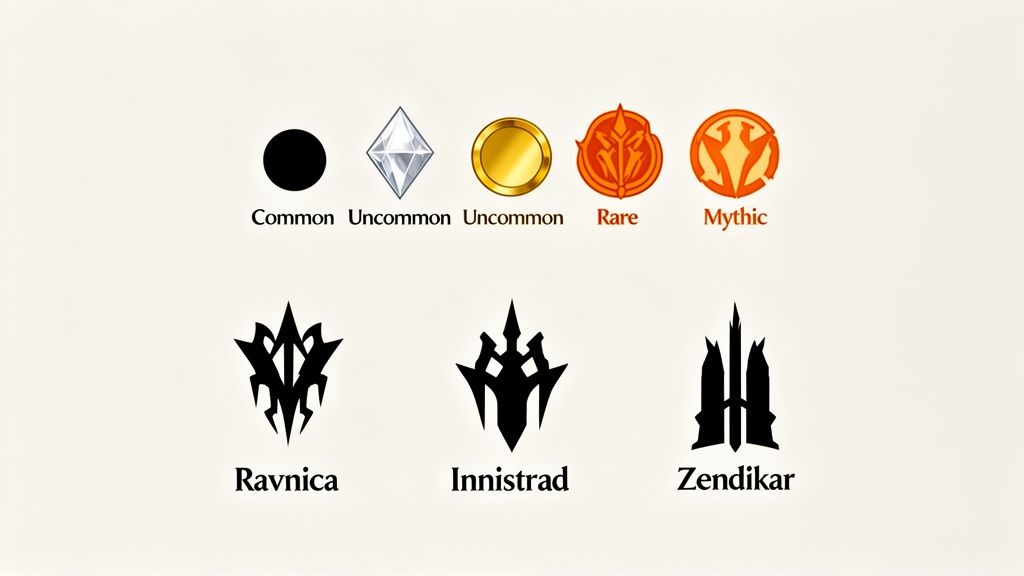
Learning to read these markings feels akin to becoming an archaeologist of the Multiverse. It lets you appreciate the design and narrative that shaped every single card in your collection, connecting you more deeply to the worlds you explore.
Beyond its origin, the expansion symbol also reveals a card’s power and scarcity through its colour. This simple yet brilliant system gives you an immediate sense of a card's role within its set. These rarity levels are a core part of the thrill of opening a new pack and, of course, strategic deck-building.
The hierarchy of rarity is clear and consistent across all modern sets:
This visual shorthand is one of the most elegant pieces of design in the game. It allows players to quickly assess the value and potential impact of their cards at a glance. It is a design principle that has inspired many creators in the tabletop space.
When you begin to understand these magic the gathering symbols, a simple collection of cards transforms into a curated museum of Multiverse history. You can literally trace the evolution of game mechanics and artistic styles just by sorting your cards by their set icons. This deep sense of chronicle and discovery is a celebrated part of the entire tabletop world.
The expansion symbol is a silent storyteller. It doesn't just tell you where a card is from; it whispers of the metagame it was born into, the design philosophies of its time, and the epic tales that unfolded on that particular plane.
This appreciation for history and lore is what binds our community together, whether we're unearthing ancient artifacts in a classic board game or preparing for grand, narrative-driven Kickstarter campaigns like the much-anticipated Frosthaven. At its heart, every game piece tells a story. That is a philosophy we cherish while developing the world of our own game, TerraClash, which we hope will create its own legends for players aged 12 and up.
Beyond the raw power of mana and the history told by expansion symbols, another set of glyphs truly dictates the flow of battle. These are the icons of action—the visual shorthand that tells a creature how to move, fight, and survive. Learning this symbolic language is crucial; it lets you process a complex battlefield with the intuition of a seasoned general.
The most fundamental of these is the Tap symbol, that familiar curved arrow. This simple icon means a card must be turned sideways to activate an ability or declare an attack, showing its power is spent for the turn. It is a universal sign of commitment, a resource used up that you will not get back until your next untap phase. This one little glyph governs the entire rhythm of the game.
As you scan the creatures arrayed for battle, you will spot small icons that grant them incredible advantages. These keyword symbols are the key to unlocking their true potential and understanding the threats they pose. Recognising them in a split second is vital for planning your assault or mounting a solid defence.
A few of the most common combat icons you'll see are:
This design philosophy of clear, immediate iconography is something we hold dear in our own quest to build new worlds. For our game, TerraClash, creating intuitive symbols is paramount to ensuring every battle is both easy to grasp and deeply strategic, welcoming adventurers aged 12 and over to the fray.
To read the board is to understand its symbols. A creature is more than its power and toughness; it is the sum of its abilities. A single well-placed keyword can shatter an opponent's strategy as effectively as the mightiest spell.
Grasping these visual cues is what separates a novice from a master strategist. It is a skill that extends beyond just Magic, applying to countless other tabletop conflicts and deckbuilding sagas you might discover on platforms like Kickstarter. The language of symbols is universal.
The most powerful creatures, of course, often combine multiple abilities, creating truly formidable threats. To see how these icons come together on the most powerful beings, you can explore our guide to the tactics of Magic: The Gathering legendary creatures. Mastering these icons is your next step toward battlefield dominance.
For any who take their spell-slinging seriously, understanding Magic the Gathering symbols transcends mere definition. It is a fundamental part of the game's strategic language. In the high-stakes arenas of Modern, Pioneer, and Commander, these symbols are not just costs; they are a declaration of intent, shaping your entire deck and its path to victory.
The mix of mana symbols you choose is the bedrock of your entire strategy. That simple decision to wield two colours versus three can completely alter your deck's consistency, its raw power, and how well it endures under pressure. This is where Magic shifts from a casual game of summoning beasts into a deep, intellectual puzzle, rivalling the finest strategic board games and even some of the exciting new indie TCGs emerging on Kickstarter.
Think of your mana base as a map of the magical resources you can command. Each symbol is a different territory from which you can draw power. Decks that draw upon a wide array of symbols, like the classic Esper control decks (White-Blue-Black), gain access to a massive toolbox of answers and threats. The trade-off? That power comes at the cost of consistency. Drawing the wrong lands at the wrong moment can quickly lead to your downfall.
Nailing this delicate balance is the secret art of competitive deckbuilding. The greatest mages do not just jam powerful cards into a sleeve; they painstakingly construct a mana base that ensures they can cast their spells on schedule, every single time. It is a game of probability and foresight. If you are looking to get your hands dirty with this, our guide on how to build an MTG deck is a fine place to start your studies.
A Planeswalker's real strength isn't just in the spells they sling, but in the wisdom they use to gather the mana to cast them. In the heat of competition, a perfect mana base is the deadliest weapon you can have.
You can see the tactical importance of mana symbols playing out at the highest levels of the game. Looking at the data from the UK's bustling competitive scene, you will consistently find symbol-diverse decks sitting at the top tables.
For example, a whopping 65% of the top UK Arena ladder climbers in a recent season were on some form of Esper control. They were leveraging the combined strengths of White, Blue, and Black symbols to outmanoeuvre the competition. It paints a very clear picture: in the competitive ecosystem, mana symbols are the engine driving success. You can see these trends for yourself by checking out the latest Player of the Year data.
It is this kind of strategic depth that inspires the creation of new games. Our own project, TerraClash, designed for challengers aged 12 and up, is founded on this very principle: the symbols you wield are what define your journey to becoming a legend.
Every Planeswalker, novice or veteran, stumbles upon a cryptic symbol now and then. Let us clear the fog from some of the most common questions that arise on the journey through the Multiverse.
This is a classic stumbling block for new players, but the distinction is quite straightforward once you grasp it.
Generic mana is the cost you see inside a grey circle with a number in it (like ①). Think of this as the flexible part of a spell's cost. You can pay for it using mana of any type – any of the five colours, or even colourless mana. It is the spell's general energy requirement, and it does not care from where that energy is drawn.
Colourless mana, on the other hand, is the one that looks like a diamond (◇). This is a specific, rigid requirement. You absolutely must pay for it with mana that has no colour. The most common sources for this are the Wastes basic land or powerful artifacts like a Sol Ring. It is best to think of it as a sixth type of mana entirely, not some kind of wildcard you can fill with whatever you have left over.
Getting this right is vital for casting those bizarre and powerful Eldrazi or using the abilities of certain ancient relics. It is a neat bit of flavour, reminding us that not all magic in the Multiverse flows from the five familiar colours.
The little expansion symbol on any modern Magic card tells a story of its rarity with a simple splash of colour. Once you know the code, you can instantly gauge how common or scarce a card is meant to be.
It is a visual shorthand that has been consistent for years:
Heed this warning, though: cards printed before the Exodus set did not have this colour-coding. For those older treasures, you will need to consult an online archive to determine their original rarity.
The tap symbol – that elegant, curved arrow in a circle – is Magic's universal sign for turning a card sideways to show you have used it for the turn. For basic lands, the action of tapping for mana is so fundamental that the symbol need not be printed on the card. We just know that is what you do.
But many nonbasic lands have more complicated activated abilities. Putting the tap symbol right there in the rules text makes it crystal clear that tapping the land is part of the cost to get that specific effect. It separates that ability from any other static effects the land might have, keeping the complex machinery of the game's rules running smoothly. It is a small but vital piece of grammar that ensures everyone is on the same page.
A Planeswalker's true power lies not just in the spells they know, but in their precise understanding of the costs required to unleash them. A single symbol, understood correctly, can be the difference between a calculated victory and a disastrous misstep.
For the dedicated archivist who wishes to identify every card from every era, you are in luck. The community has built some incredible online resources that catalogue every card ever forged.
Websites like Wizards of the Coast's official database, Gatherer, or the fan-favourite powerhouse Scryfall have comprehensive visual libraries of every set symbol. These tools are fantastic, letting you search and filter by expansion, making it dead simple to track down the origin of any card you come across.
The intricate symbols of Magic are a testament to deep, strategic gameplay—a philosophy that inspires creators everywhere, including those of us at TerraClash. We believe a great game speaks through clear, engaging icons that make every choice feel both intuitive and meaningful. If you crave a new world to conquer, with fresh strategies to master, we invite you to follow our quest at terraclash.co.uk as we prepare to launch our own adventure. For more tales of tabletop quests and epic Kickstarter journeys from other creators, consider exploring resources like the Stonemaier Games blog or the latest projects featured on BoardGameGeek.

