Hark, adventurer! Every grand legend begins not with the clash of steel, but with a flicker of an idea, long before you ever touch a die. This is not yet a time for stats or abilities; it is a time for the sacred act of crafting a soul. This is the core story that will guide your hero's every choice in the realms to come.
Set aside the tome of rules for a moment, and let us speak of who your character truly is. Are they a grizzled dwarf soldier, haunted by the ghosts of a forgotten war? Or perhaps a young, wide-eyed elf, their spirit consumed by a thirst for ancient, forbidden lore? This, friends, is the narrative heart that forges unforgettable tales and binds you to the world the Dungeon Master weaves.
This principle of building from a core concept is a universal truth, a magic that echoes across many realms. It’s what makes roleplaying games so compelling, and it translates even to the strategic duels of deckbuilding games, like the forthcoming TerraClash. Consider this: a masterfully crafted deck in TerraClash, much like a hero's arsenal of abilities, is not a mere collection of powerful cards. It is a reflection of a singular strategy, a story told through synergy and cunning, just as your character's skills reflect their past and personality.
So, whence does this spark arise? I always return to three potent pillars of creation: what drives them, what holds them back, and what they secretly yearn for. A hero’s motivation, flaws, and dreams are the arcane runes that grant them life and give them passage to grow. Why do they dare face a dragon's fire? What is their hidden weakness? What quiet hope fuels their spirit in the deepest dark?
This is no mere list of traits; it is a living tapestry where each thread informs the others, weaving a complete and believable soul.
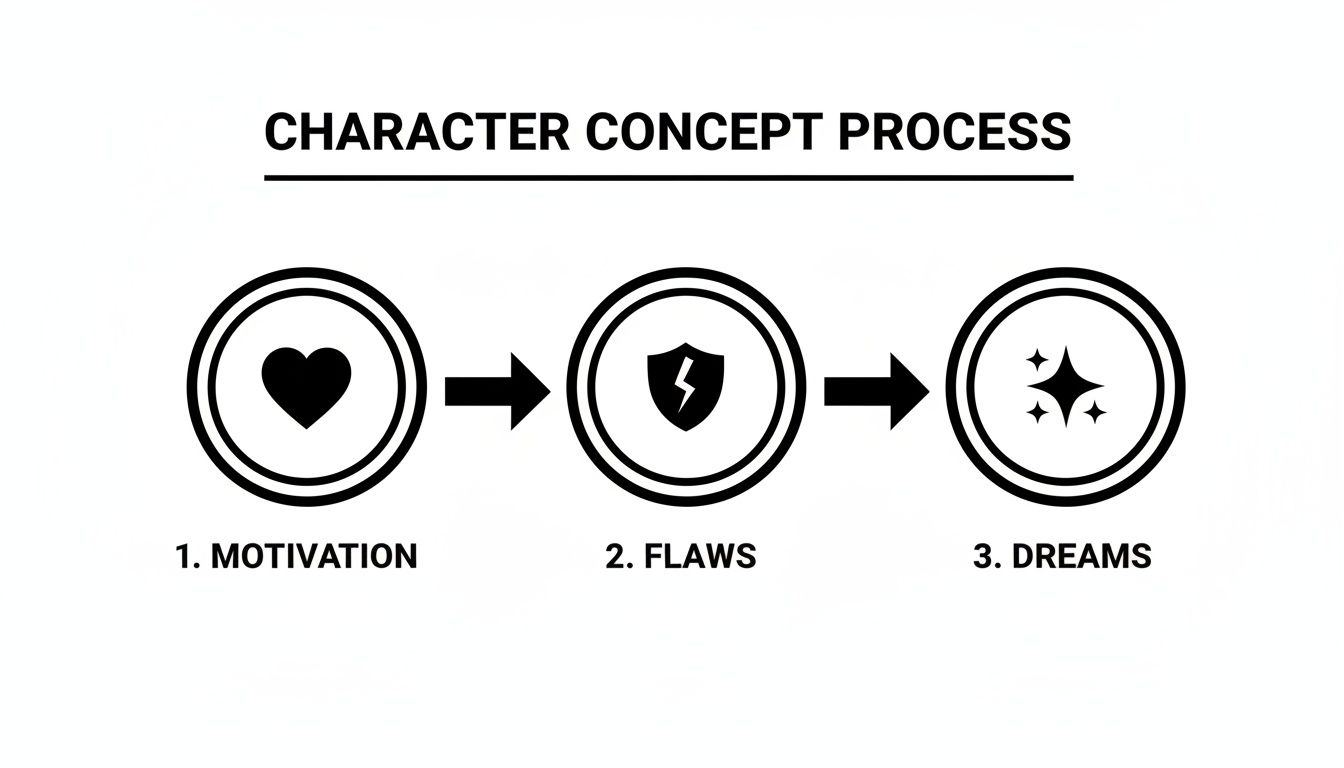
The greatest heroes are a messy, compelling fusion of ambition, vulnerability, and a potent inner fire. Upon this foundation, all else shall be built.
To aid your scrying, let us break down these pillars.
| Pillar | Guiding Question | Example |
|---|---|---|
| Motivation | What unseen force compels them to a life of adventure? | "I must seek the rare Moonpetal herb to break the curse upon my sister." |
| Flaw | What personal shadow or fear complicates their journey? | "A crippling fear of enclosed spaces haunts me, a relic of a childhood mining collapse." |
| Dream | What is their ultimate, long-held goal or secret wish? | "I dream of one day earning enough gold to reclaim my family's ancestral keep from ruin." |
Answering these three questions gifts you more to shape than a hundred scrolls of backstory ever could. It gives your Dungeon Master threads to weave into the campaign's fate and grants you a clear compass for your roleplaying.
"A character is not defined by their armour class or attack bonus, but by the choices they make when the dice lay silent. Their history, their fears, their secret desires—these are the true mechanics of a legend."
Should you feel the well of inspiration run dry, fear not—it befalls even the wisest of us. Sometimes, a simple creative nudge is all that is required. Tools like an AI Character Generator can be a fine scrying pool, offering random concepts to ignite your imagination.
You have it—that spark, that brilliant vision for a hero. Now, it is time to give it form and substance. We must turn from the ethereal realm of daydreams to the hallowed pages of the Player's Handbook, where we shall anchor your concept in the world's mechanics. This is where you shall choose your hero’s Ancestry, Class, and Background—the great triad that truly defines who they are and what they are capable of.
Do not mistake this for merely choosing statistics from a list. Every choice made here must feed back into that original vision, strengthening the saga you are about to unfold. It is a delicate dance between shrewd strategy and grand storytelling.
First, we consider Ancestry. This is the blood in your hero’s veins, their ancient heritage. Are they a Hill Dwarf, unyielding as the mountains of their ancestors? Or perhaps a fleet-footed Wood Elf, a whisper in the deep woods, unseen and unheard?
Choosing an Ancestry is about far more than the abilities it bestows. It fundamentally shapes your character's perception of the world. A Dragonborn might feel the ever-present weight of their mighty draconic lineage, while a Halfling's innate luck could make them infuriatingly optimistic, even in the maw of the darkest dungeon. Ponder how their lineage colours their personal history and their desires.
Your Ancestry is the foundation stone of your character. It doesn't just grant abilities; it frames how the world sees them, and in turn, how they see the world.
This single choice offers a trove of roleplaying opportunities, right from the very start.
Next, you must decide upon a Class. This is your hero's vocation, their calling in the world. It is the essence of what makes them an adventurer. Do you see yourself as a Barbarian, a tempest of pure rage on the battlefield? Or are you drawn to the divine power of a Cleric, a bastion of faith who can mend allies and smite foes?
Your Class is arguably the most significant mechanical decision you will make. It dictates your methods of combat, your access to magic, and the unique tools you possess for overcoming adversity.
Think of these as the timeless archetypes of fantasy lore you know well.
This is a core tenet for players of deckbuilding games like TerraClash. Just as your chosen faction in that game defines your core strategy and the cards at your disposal, your D&D Class is your primary strategic path. It’s a concept familiar to veterans of other great card games, from the mana colours of Magic: The Gathering to the hero powers of Hearthstone.
Finally, no one simply materializes as a level-one adventurer. Your Background breathes life into their past, explaining what they were doing before they began kicking in dungeon doors. Were you a quiet Sage who spent countless years cloistered amongst ancient scrolls? A sharp-witted Urchin who survived on city streets by cunning alone? Or perhaps a noble Knight, bound by a sacred oath?
This choice grants you additional skills and, more importantly, provides wonderful story hooks for your Dungeon Master to weave into the grand narrative. It grounds your hero in the world and offers a solid history to build upon. For more on these core concepts, you might find our look at the classic Dungeons and Dragons roleplaying game starter set enlightening. A character with a true past is one that truly lives at the table.
Every hero etched into memory is defined as much by their flaws as their strengths. Now is the time to bestow upon your character their mechanical spine by determining their six core Ability Scores: Strength, Dexterity, Constitution, Intelligence, Wisdom, and Charisma. These numbers give your character substance in the game, influencing everything from the might of their blows to the power of their persuasion.
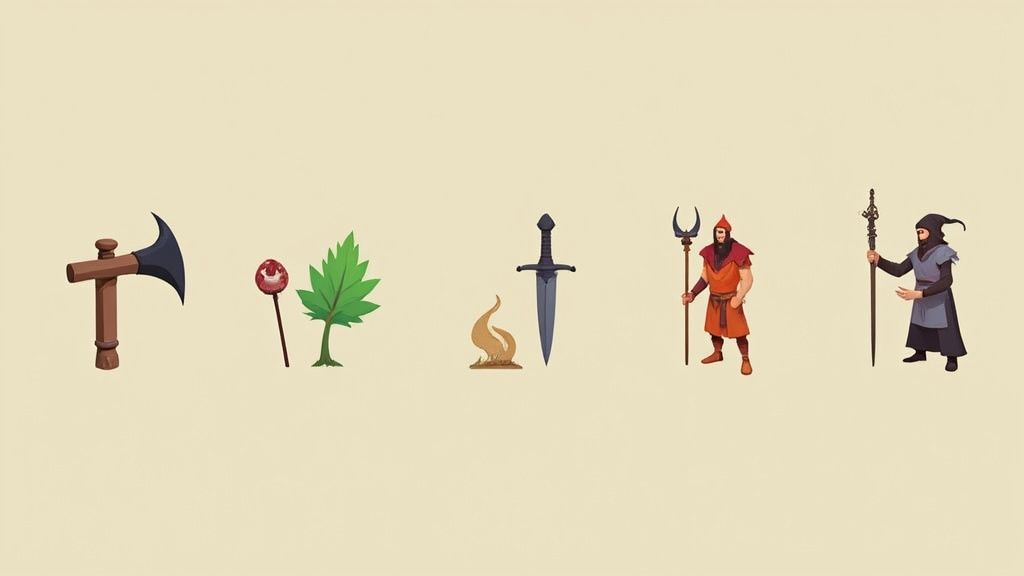
This part of the ritual is more than mere calculation. It is about deciding where your hero shines and, just as crucially, where they fall short. After all, a character is often most compelling when they must overcome a weakness, not simply rely on their greatest strength.
How, then, do you divine these scores? There are a couple of time-honoured methods, and the one you choose speaks volumes about the kind of tale you wish to tell.
There is no right or wrong answer here, adventurer. Do you wish to leave your hero's raw potential in the hands of fate, or do you prefer to be the master architect of their being?
Do not fear a low score! A character with low Strength must learn to solve problems with their wits. One with low Charisma might create wonderfully awkward social encounters. Flaws are not a penalty; they are a roleplaying gift.
This concept of balance is one that players of TerraClash will instantly grasp. A deck filled only with costly, powerful cards is easily countered. True strength lies in a well-rounded hand that can adapt to any stratagem an opponent might employ. In deckbuilding, as in adventure, versatility is king.
Ultimately, assigning your scores is about setting your priorities. A Barbarian obviously needs great Strength, but if you neglect Constitution, you will be a glass cannon. A Wizard requires that sky-high Intelligence, but a decent Dexterity score might just be what keeps them alive when the goblins' arrows fly. Think of your class, but do not forget the character behind the statistics.
Very well. Your hero has a past, a calling, and raw potential. But let us be candid—no adventurer worth their salt strides from the tavern with naught but good intentions. It is time to equip them for the perils that await, choosing the tools of their trade and the first sparks of their power.
This is no mere shopping trip. Every item, from the gleam on a freshly honed longsword to the collection of curiosities in a burglar's pack, speaks to who they are. A city-bred Bard will not carry the same gear as a grizzled Ranger who was raised in the wild. Consider this starting equipment as the trusted tools that have seen your character through to this day.
If you are playing a character who communes with the arcane, this is where the true magic begins. Selecting your first cantrips and spells is a momentous decision; it defines your character's magical signature from the outset. Are you drawn to the raw, destructive power of a Fire Bolt, or do you prefer the subtle, clever manipulation of Minor Illusion?
Your first collection of spells should be a versatile toolkit. You will want a mix of options that can aid in a fight, solve a confounding puzzle, or shield your comrades. A well-placed Sleep spell can neutralize a pack of goblins without a single sword being drawn, while Detect Magic can unveil secrets that would otherwise remain shrouded.
A spellcaster's grimoire is a direct reflection of their soul. It is a curated collection of answers to questions the world has not yet dared to ask. Choose wisely, for these first incantations will shape your destiny.
This kind of careful curation is a skill found in many other grand games. For our TerraClash players, this is much like building your first deck. You are not just throwing in the largest, most spectacular cards; you are constructing a balanced hand that can adapt to whatever your opponent may play. A good spellbook and a good deck share a common spirit. It is the same strategic foresight needed to succeed in beloved games like Gloomhaven or the deckbuilding classic Dominion.
Let us face it, the age of quill and parchment is fading for many of us. Digital tools have profoundly changed how we forge and manage our characters. Platforms like D&D Beyond are practically standard issue for many adventuring parties, especially those who gather across the digital ether.
It just goes to show, whether it is a spellbook bound in dragonhide or a glowing tablet, a prepared adventurer is a successful one.
So, the ink is dry upon your character sheet. You have divined the numbers, chosen your equipment, and all is in its place. But now, the true ritual begins. This is where we take that collection of statistics and rules and breathe true life into it, transforming a piece of paper into someone you can truly become at the table. This is the real magic of Dungeons & Dragons.
This final step is about finding the soul behind the proficiencies. It is about taking those small notes on ideals, bonds, and flaws and turning them into the moral compass that guides your character's every action. These are not mere flavour text; they are the very heart of your hero and the reason for all they will do.
How does your character truly act? Is your Barbarian loud and boisterous, their voice a thunderclap across the tavern? Or is your Rogue quiet and clipped, a habit learned from a life spent hugging the shadows? Consider the small details: their posture, a nervous tic when they are bluffing, or the particular flourish they use when drawing their sword.
These minute details are what make a character memorable. They shape your interactions with the world and grant you a true presence. The goal is to build someone you are genuinely excited to portray, whose triumphs feel like your own, and whose setbacks sting just as deeply.
A character sheet tells you what a hero can do. Their personality, their fears, and their hopes tell you what they will do. The gap between those two is where the story lives.
Stepping into a character's mind and making choices from their perspective is a skill that transcends the gaming table. It is much like in TerraClash, where your deck defines your faction, but your playstyle—how you react under pressure and plot your moves—is what truly defines you as a player. If you wish to sharpen those instincts, we have a guide on how to improve decision-making skills that may aid you.
To show you how all these elements can align in the great cosmos, let us gaze upon a few quick-start concepts. Consider these as sparks to ignite your own imagination, showing how a simple fusion of Race, Class, and Background can immediately conjure a compelling hero.
| Concept Title | Race/Class Combination | Core Motivation |
|---|---|---|
| The Oathbound Sentinel | Mountain Dwarf / Paladin (Oath of Devotion) | "My clan was betrayed from within. I will restore our honour, even if I must stand alone against the encroaching darkness." This character is gruff, loyal to a fault, and secretly mourns the family they lost. |
| The Seeker of Forbidden Whispers | Tiefling / Warlock (The Great Old One) | "A voice from beyond the stars offered me knowledge in exchange for service. I crave its secrets, but I fear what it demands in return." They are curious, unsettlingly calm, and perpetually haunted by their pact. |
| The Gilded Ghost | Halfling / Rogue (Thief) | "I was once a street urchin, but I stole from the wrong noble. Now I seek a legendary treasure to buy back my life and secure a future for my old crew." This character is nimble, charmingly audacious, and fiercely protective of the downtrodden. |
See how each of these immediately presents you with a story to tell? They have clear goals, inherent conflicts, and a unique lens through which they view the world. That, right there, is the heart of the game—the story you are all about to weave together.
Even the most seasoned story-weavers have questions when they sit down to conjure a new character. It is a grand process, and it is easy to become lost in the details. Let us address some of the most common queries that arise, whether you are a fledgling adventurer or a veteran of many campaigns.
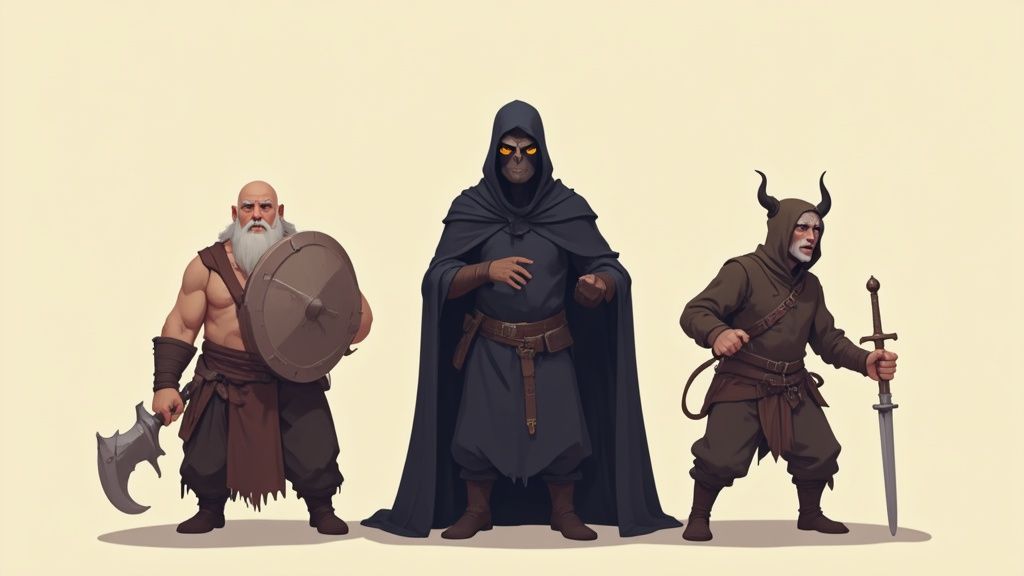
One of the first challenges is divining your character's core strengths and weaknesses. Truthfully, there is no single "best" method to set your ability scores—it is all about finding the path that fits the saga you and your Dungeon Master wish to tell.
This is always a Session Zero conversation to have with your Dungeon Master. Each method brings a different flavour to character creation, so it is wise to be on the same page.
Just be sure to consult with your Dungeon Master first. They will know which method best suits the kind of tale they are weaving.
To choose a class you will cherish for an entire campaign, look beyond the damage numbers. Ponder the role you wish to play. What sounds truly exciting to you, week after week?
Do you wish to be the unshakeable defender, the shield behind which your party rallies? A Fighter or Paladin might be your calling. Or would you rather be the ultimate support, weaving magic and inspiration to help your allies shine? You sound like a Bard or Cleric.
Perhaps you are drawn to the raw, reality-bending power of a Wizard or Sorcerer, or the cunning thrill of striking from the shadows as a Rogue. Read through the descriptions and choose the fantasy that genuinely captures your spirit.
A class isn't just a list of abilities; it's the core of your character's story. Playing a character you find genuinely cool will always be more satisfying than playing the "most powerful" build.
That is not a problem—it is the launchpad for a magnificent character! D&D is an incredibly flexible system, and some of the most memorable heroes are born from thinking outside the box.
If your concept does not neatly fit a standard class, your first port of call should be your Dungeon Master. More often than not, you can simply "re-flavour" an existing class to match your vision. A warrior who channels ancestral spirits could easily be a Barbarian, just with a different narrative spin. Your Dungeon Master is your greatest collaborator in this creative act, and they will usually be thrilled to help you bring a unique idea to the table.
The fundamentals of hero creation—defining an identity, balancing strengths, and committing to a playstyle—are universal truths in the world of tabletop gaming. It's a process we're passionate about at TerraClash, where every deck you build tells a story, much like a character sheet. Our game is designed for heroes aged 12 and up, ready for a new challenge. As we prepare for our own grand quest, we invite you to learn more about our world and how to forge your own path at https://terraclash.co.uk.
Explore other fantastic indie worlds on Kickstarter, like the cooperative adventure of Gloomhaven or the strategic depth of Root. The realms of imagination are vast and ever-growing.

