Hark, adventurer, and welcome! You stand at the threshold of the Multiverse, a swirling cosmos of countless planes, each brimming with untold magic and fearsome creatures. You are a Planeswalker, a mage of immense power, and this world of tactical card duels is yours to command. Fear not the arcane symbols and ancient rules, for this guide shall be your first spellbook, your trusted grimoire on the path to mastery.
Your quest is simple: use the mana drawn from the very lands around you to cast devastating spells, summon loyal creatures, and reduce your opponent's life from 20 to 0. But the paths to victory are as varied as the stars in the sky.
As your guide through these mystical arts, think of me as your Dungeon Master, ready to reveal the secrets of this legendary game. We shall embark on this quest together, deciphering the ancient arts of mana, spellcasting, and battlefield tactics, turning complex lore into simple, actionable wisdom.
Your training will cover all the essentials a fledgling mage needs to know. We shall explore:
The wisdom you are about to glean is not confined to one realm. The core principles of Magic echo across countless tabletop sagas. Once you have mastered these fundamentals, you will possess the skills to conquer other deckbuilding adventures, from timeless classics like Dominion to thrilling new indie campaigns that emerge from the creative forges of Kickstarter. Keep an ear to the ground for whispers of a new realm, TerraClash, for the skills you learn here will serve you well in the battles to come.
To ensure your initiation is a smooth one, this grimoire is structured with clear, step-by-step instructions. For a deeper understanding of this teaching method, you can consult these effective methods for teaching complex topics with visual step-by-step instructions.
Now, quiet your mind and steady your hand. Your grand adventure into magical warfare begins. Let us turn the first page.
Every incantation you utter, every beast you summon, begins as a single card held in your hand. Consider it a magical blueprint, a fragment of immense power awaiting a Planeswalker like you to breathe it into existence. To command this power, you must first learn its language.
Let us begin at the top.
In the top right-hand corner, you will find a combination of symbols and numbers – this is the mana cost. It reveals the precise magical energy you must channel from your lands to cast the spell. Each symbol represents one of the five colours of magic, and each colour is a philosophy unto itself.
Below the art lies the card type line. This crucial inscription tells you what the card is and when its power may be unleashed. Is it a Creature that will fight at your side? A Sorcery, a grand, singular effect cast only on your turn? Or a cunning Instant you can spring upon an unsuspecting foe? Grasping these distinctions is a vital part of your training, and you can learn of the various MTG card types in our detailed guide.
Below the card type rests the text box, where the true magic resides. This space contains the card’s special abilities, its rules, and often a snippet of lore that breathes life into the world. These abilities are what make a dragon truly legendary or a humble goblin surprisingly devious.
Some abilities are common keywords—arcane shorthand like Flying (can only be blocked by other creatures with flight) or Trample (excess combat damage strikes the player). Others are unique, battle-altering rules that can turn the tide when your opponent least expects it.
Consider the text box the card's soul. It is the essence of a creature's spirit or the true nature of a spell. From here, endless strategic combinations are born, making every duel a fresh arcane puzzle to solve. This principle of unique card abilities is a cornerstone of all great deckbuilding games, from the high fantasy of Gloomhaven: Jaws of the Lion to the strategic depth of Arkham Horror: The Card Game.
Finally, should you gaze upon a creature card, you will see two numbers in the bottom right corner, separated by a slash, such as 3/3. These are its Power and Toughness.
The first number is Power, the amount of damage it inflicts in combat. The second is Toughness, the damage it can endure before it is vanquished and sent to the graveyard (your discard pile). A 1/5 creature may not strike with force, but it can stand as a formidable bastion.
Mastering these elements is your first great trial as a Planeswalker. It is a fundamental skill that transcends Magic; it will grant you a significant advantage in any deckbuilding game you choose to explore, including TerraClash.
To truly grasp mana costs and deckbuilding, one must understand the philosophy behind each of Magic's five colours. Each possesses a distinct identity that shapes its spells and strategies.
This table shall serve as your guide:
| Color | Represents | Typical Strategy |
|---|---|---|
| White | Order, Law, Community, Purity | Raising a vast army of smaller creatures, shielding them with enchantments, and mending wounds. |
| Blue | Knowledge, Deception, Control, Intellect | Thwarting an opponent's spells, drawing upon vast reserves of knowledge, and manipulating the flow of battle. |
| Black | Ambition, Death, Sacrifice, Power | Destroying enemy creatures, raising minions from the grave, and trading life for ultimate power. |
| Red | Chaos, Freedom, Impulse, Aggression | Attacking with relentless fury using swift creatures and unleashing torrents of direct damage. |
| Green | Nature, Growth, Instinct, Strength | Summoning colossal beasts of overwhelming might and crushing the opposition with raw force. |
Many an apprentice begins by aligning with one or two colours that speak to their spirit. Are you a patient tactician who prefers to control the battlefield? Blue may call to you. Do you favour a swift and merciless assault? Red's chaotic path awaits. As your power grows, you will learn to weave colours together, creating decks of even greater might and versatility.
A duel in Magic is not a chaotic flurry of spells. It follows a distinct rhythm, a structured sequence that brings order to the maelstrom of battle. Understanding this flow is a crucial step toward becoming a skilled duelist. Envision your turn as a short saga with a clear beginning, middle, and end.
Your turn always commences with the Beginning Phase. It is a moment of renewal. First, you Untap all you have expended—your lands are ready to channel mana once more, your creatures refreshed for battle. Immediately following this is your Draw step, where you draw a single card from your library. This is the moment you gain new resources, perhaps finding the very answer you seek.
With a new card in hand, you enter your first Main Phase. This is your primary opportunity to shape the battlefield. You may play a land (remember, but one per turn!), summon creatures to bolster your forces, cast potent sorceries, or lay cunning enchantments and artifacts. It is a time for preparation and enacting your grand design.
Next comes the most dramatic moment: the Combat Phase. Here, your creatures clash in glorious battle, a process divided into clear steps:
After the dust of combat settles, you are granted a second Main Phase. This is a strategic moment often overlooked by novices. Here you may cast spells you held in reserve, perhaps a new creature to fortify your defenses after an assault. The most brilliant maneuvers often occur in this post-combat window.
This infographic breaks down what you're looking at on the cards you'll be playing during these phases.
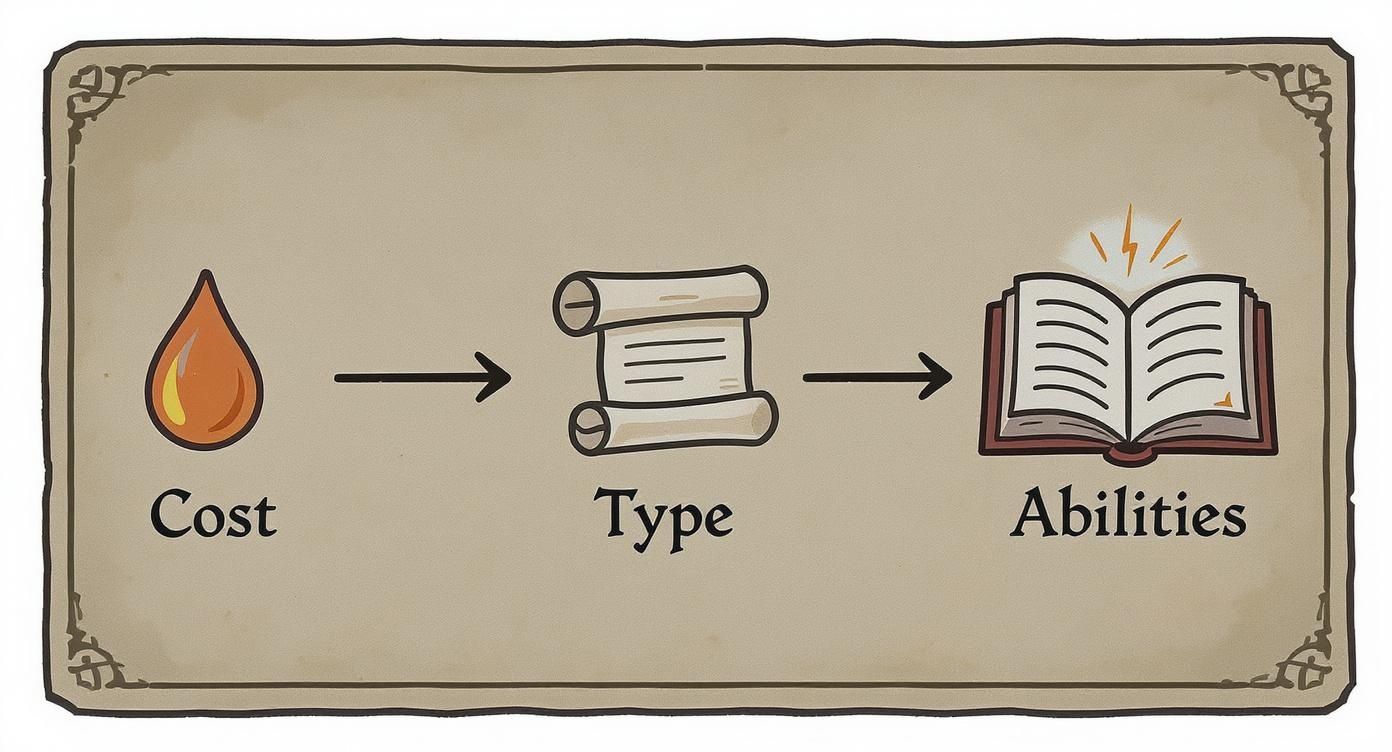
Knowing how to read a card's cost, type, and abilities at a glance is crucial for making smart decisions during your turn.
Your turn concludes with the End Step. This is a final moment for clean-up, where certain effects trigger and players have one last chance to cast instant-speed spells. This entire sequence—Untap, Draw, Main, Combat, Main, End—is the fundamental pulse of every game.
Learning this structure is not merely a Magic lesson; it is a core concept woven into the fabric of nearly every deckbuilding game. The cycle of refreshing resources, gaining new options, and having dedicated phases for building and attacking is a foundational skill. Once it is second nature in Magic, you will find yourself well-prepared for other tabletop adventures, like those found in the fantasy worlds of Mage Knight or the forthcoming realm of TerraClash.
A Planeswalker is only as potent as the spells they command. Your deck is your spellbook, your armoury, and your legion combined. Now that you understand the cards and the flow of a duel, it is time to forge your first weapon. This is where your unique style as a mage will truly begin to manifest.
For neophytes, the journey begins with a classic 60-card deck. This is no arbitrary number; it is the optimal balance for drawing the right mixture of lands and spells when fate hangs in the balance. Stray too far from this count, and you risk your strategy crumbling at the whim of an ill-fated draw.
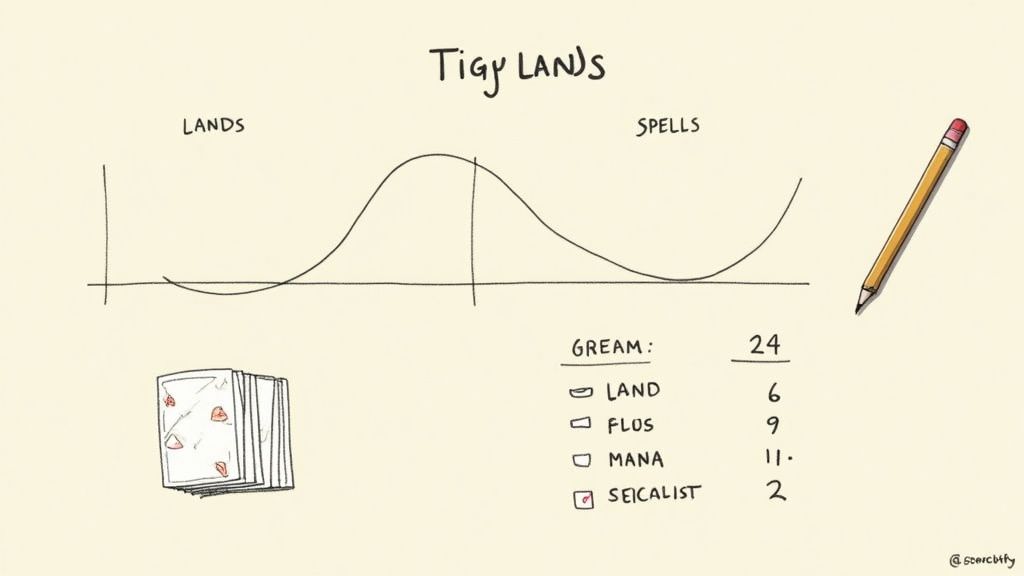
Within those 60 cards, you must find a crucial balance. Most starting decks adhere to a simple, time-honoured ratio. A fine starting point is approximately 24 land cards and 36 other spells (your creatures, sorceries, instants, and so forth). This division helps ensure you consistently draw the mana you need without being flooded by useless lands in the heat of battle.
Grasping this resource-to-action ratio is a fundamental skill in all deckbuilding games, whether you are managing galactic resources in Star Realms or preparing for the tactical challenges of TerraClash.
As you begin to assemble your cards, you will naturally gravitate towards a particular strategy, or what mages call an "archetype." Think of it as choosing your preferred school of magic. Do you wish to overwhelm your opponent with brute force, or do you prefer to outwit them with cunning machinations?
Here are three classic archetypes, perfect for a new mage's grimoire:
"Your deck is an extension of your will. It should not only be powerful but also reflect the way you think. Choosing an archetype that resonates with you is the first step towards true mastery."
The competitive scene is always a fascinating tapestry of these strategies. Watching high-level tournaments is a brilliant way to see how master Planeswalkers interpret these classic game plans. For a glimpse into these epic clashes, you can explore detailed tournament analysis on YouTube.
If you feel the call to begin crafting your own spellbook, we have prepared a more detailed scroll to guide your hand. Peruse our step-by-step walkthrough on how to build your first MTG deck from scratch.
The Multiverse is vast, offering countless arenas in which to test your might. As a newcomer, one of your first choices is to decide which battlefield best suits your temperament. Selecting your preferred way to play, or "format," is a key step in your journey.
Allow me to guide you through the most popular arenas, so you may find a community and a contest of wills that resonates with your spirit.
Imagine a competitive landscape where the very laws of engagement are in constant flux. Old strategies fade into legend as powerful new spells emerge with each new season. This is the essence of Standard. It is a dynamic format that permits only cards from the most recent sets.
This ever-shifting meta is a constantly evolving puzzle, making it a brilliant training ground for those who enjoy a challenge that never grows stale. You will learn to adapt, to see the potential in new cards, and to constantly refine your strategies as the world changes around you.
If you seek a contest that is more epic in scale and convivial in spirit, then you must experience Commander. Known also by its elder name, Elder Dragon Highlander (EDH), this is a multiplayer free-for-all. Each player crafts a unique 100-card deck, with no duplicates save for basic lands, all built around a single legendary creature who serves as their commander.
Commander is less about ruthless victory and more about spectacular plays, shifting alliances, and forging unforgettable sagas with your fellow players. It is a format that celebrates creativity and self-expression, where the true prize is the shared story of chaos and glory that unfolds.
This format is a theatre of alliances, betrayals, and wild, unpredictable moments, making it a beloved choice for players who seek a more narrative-driven game night. The skills you hone here—negotiation, long-term planning, and threat assessment—are invaluable in other grand strategy games, from Twilight Imperium to the tactical card game, TerraClash, which is suitable for adventurers aged 12 and up.
For those who wish to practice their craft at any time, the digital realm of MTG Arena awaits. Since its inception, Arena has become the gateway for countless new Planeswalkers. It offers a free, guided path to learning the game's sometimes-complex rules.
It has also forged a dedicated global community. Recent chronicles show that the number of monthly active players remains robust, with a strong following across the world. If you are curious about the ebb and flow of this digital player base, you can discover more about MTG Arena's player statistics.
Once you are comfortable wielding the power of a Planeswalker, you will soon realize that the skills you have acquired—strategic thinking, resource management, and the art of synergy—are not exclusive to Magic. They are a universal language that unlocks a whole universe of other tabletop games.
Whether you are delving into dungeons with friends in a cooperative fantasy game like Gloomhaven or facing off in another competitive card game, the core principles are often remarkably similar. This is a golden age for new tabletop experiences, with brilliant creators bringing their visions to life on platforms like Kickstarter. You could be present at the very genesis of the next great legend.
Should the thrill of competition ignite your spirit, know that there is a well-trodden path from casual games to grand tournaments. The player community is vibrant and active, with many journeying to test their mettle at events across the continent.
This path is less daunting than it may appear. Systems like the European Unity League offer a clear way for new players to measure their progress. By earning points at events, you can see how you rank among your peers. It is a fine motivator and a true testament to your growing skill. You can even see how the national leaderboards are shaping up as we speak.
This structure fosters a powerful sense of community. There is no feeling quite like seeing the lessons learned from your first humble deck pay off against other skilled mages.
Once you are fluent in Magic's fundamentals, you will begin to see its influence everywhere. For instance, understanding the unique power of a legendary creature is a key concept in many games. If you wish to delve deeper into this lore, we have an entire tome dedicated to Magic The Gathering's legendary creatures.
And as your collection of cards begins to rival a dragon's hoard (a noble pursuit we all understand), you will require a method to keep it organized. This is a common challenge for collectors, and thankfully, great digital tools exist for tracking your valuable card collections.
Learning Magic is not just about mastering a single game. You are building a foundation that will prepare you for all manner of future quests, including exciting titles like the indie deckbuilder TerraClash. Your adventure is only just beginning.
It is natural for questions to swirl like autumn leaves when one first steps into the Multiverse. Here are some common queries from new apprentices, answered plainly.
For a standard duel, your grimoire must contain exactly 60 cards. While you may technically include more, adhering to the minimum is almost always the wisest course—it increases the likelihood of drawing your most powerful spells when you need them most.
Other formats have different rules. The popular multiplayer saga, Commander, for instance, requires a 100-card deck.
For a straightforward path, Green is often an excellent choice. Its philosophy is simple: summon immense, powerful creatures and overwhelm your opponent with nature's might. It is direct, effective, and deeply satisfying.
But in truth, the "best" colour is the one that resonates with your soul.
Tapping is the physical act of turning a card sideways to signify it has been used for the turn. You will tap lands to summon mana or tap creatures to declare them as attackers. A tapped card cannot be used again until the dawn of your next turn when you 'untap' all of your cards.
Think of tapping as a card "expending its essence" for the turn. It is a fundamental part of the game's resource management, forcing you to make crucial choices about what to commit to your own plans versus what to hold ready to defend against an attack.
It can be a treasure-intensive pursuit, but it need not be. You can begin your journey for free in digital realms like MTG Arena, which is a superb way to learn the ancient rites without spending a single gold piece. For physical cards, many affordable, pre-built starter decks can set you on your path.
The cost truly depends on how deep into the competitive world you wish to venture. You can have a marvelous time playing casually with friends on a very modest budget.
The wonderful truth of learning Magic is that the skills you acquire – resource management, strategic planning, building synergies – are the very same ones you will use in other deckbuilding games. You can print and play TerraClash Lite free, and the Kickstarter for TerraClash Digital is live until 22 November 2026. It is a whole new world of fantasy card gaming waiting to be explored, with a Kickstarter campaign launching soon. You can prepare for its arrival at https://terraclash.co.uk.
For more tales of tabletop adventures and news on exciting indie projects, explore other Kickstarter campaigns like the much-anticipated Wyrmspan or the cooperative challenges of Frosthaven.

