Gather 'round, adventurer, for you seek to walk the path of the counter-mage. It is a subtle art, a discipline where a single whispered word, a fleeting gesture, can unravel an opponent's grand masterpiece right before their eyes. Welcome, initiate, to the world of Magic: The Gathering counterspells—the elegant craft of saying 'no' at the perfect moment.
Consider this guide your personal grimoire, the key to understanding the swirling, chaotic currents of the stack and feeling the absolute thrill of snatching victory from the jaws of defeat. We shall look upon these spells not as simple acts of negation, but as razor-sharp instruments in a much grander strategy. The road to mastery is paved with cunning, foresight, and a deep respect for the arcane forces that bind our games together.
The very notion of a counterspell is a cornerstone of what makes tabletop sagas like Magic so compelling. It is that raw moment of interaction where one player’s carefully laid plan smashes head-on into another's iron will. This is a duel of minds as much as it is a duel of cards.
To truly command this kind of power, you must first grasp its fundamental principles. It is not enough to merely possess the scroll; you must know precisely when to read from it. This is the kind of sacred knowledge that transcends a single game, forming a strategic foundation you can carry into countless other fantasy worlds and grand campaigns.
Before we journey deeper, let us establish the core concepts. Think of these as the three pillars holding up the entire discipline of counter-magic. Mastering them is essential if you wish to control the flow of a game.
Here is a summary of the fundamental concepts every spellcaster must grasp to wield counterspells with precision and power.
| Pillar | Core Principle |
|---|---|
| Timing | Knowing the exact moment to intervene is everything. Too early is a waste; too late is a regret. |
| Threat Assessment | You cannot stop every spell. The trick is learning to discern a mere nuisance from a game-ending cataclysm. |
| Resource Management | Your mana is your lifeblood. Spend it recklessly, and you leave your defenses wide open. |
These pillars do not exist in a vacuum. This timeless mechanic has inspired countless tabletop games, influencing the very design of new adventures. In our own saga, TerraClash, the spirit of this tactical spell-clashing is woven right into the fabric of the game. By exploring the deep legacy of Magic: The Gathering counterspells, we are not just sharpening our skills for one game—we are preparing our minds for the next grand campaign.
The true power of a counterspell isn't what's written on the card. It's the silence it creates. It’s that pause your opponent takes, that hesitation before they cast their biggest threat, always wondering if you’re holding the answer. That fear is your invisible weapon.
This back-and-forth, this dance of spell and counter-spell, is exactly what makes deckbuilding games so endlessly fascinating. It is a language spoken across countless kitchen tables, a shared experience connecting players through moments of brilliant foresight and nail-biting risk.
Now, prepare your mind, for our journey into this arcane art is just beginning.
Before you can nullify an opponent’s spell, you must first comprehend the arena where these magical duels unfold: the Stack. Do not think of it as a physical place. Instead, picture a swirling, invisible waiting room for spells. As soon as a spell is cast, it does not simply happen; it goes onto the Stack, hovering there for a moment.
This pause is everything. It is the window of opportunity where all players may react. This is precisely where you, the wily mage with a hand full of instants, make your move. When you cast one of your prized Magic The Gathering counterspells in response to your opponent's action, you add another spell to that magical waiting room.
The Stack abides by one simple, unbreakable rule: 'last in, first out'. Imagine stacking ancient tomes. The last tome you place upon the pile is always the first you remove. Spells on the Stack work in precisely the same way.
This timing is the secret to making your countermagic work. Because you cast your counterspell after your opponent's, it rests atop the Stack. Therefore, it resolves first. If your counterspell succeeds, their spell is simply plucked from the Stack before it ever had a chance to manifest. Poof. Gone.
Grasping this concept isn't just about memorising rules; it's about learning the rhythm of reactive play. It allows you to think two steps ahead, to anticipate your opponent's grand designs, and to set up those game-winning moments you'll recount for ages. You will begin to see how all manner of abilities and triggers interact, a skill you can sharpen by familiarizing yourself with the different MTG card types.
To master the Stack is to master the pause between action and consequence. It is in that fleeting moment that entire games are won or lost. An apprentice sees a spell being cast; a master sees an opportunity materialising.
The infographic below captures the core ideas you need to get this flow of strategy, timing, and foresight just right.
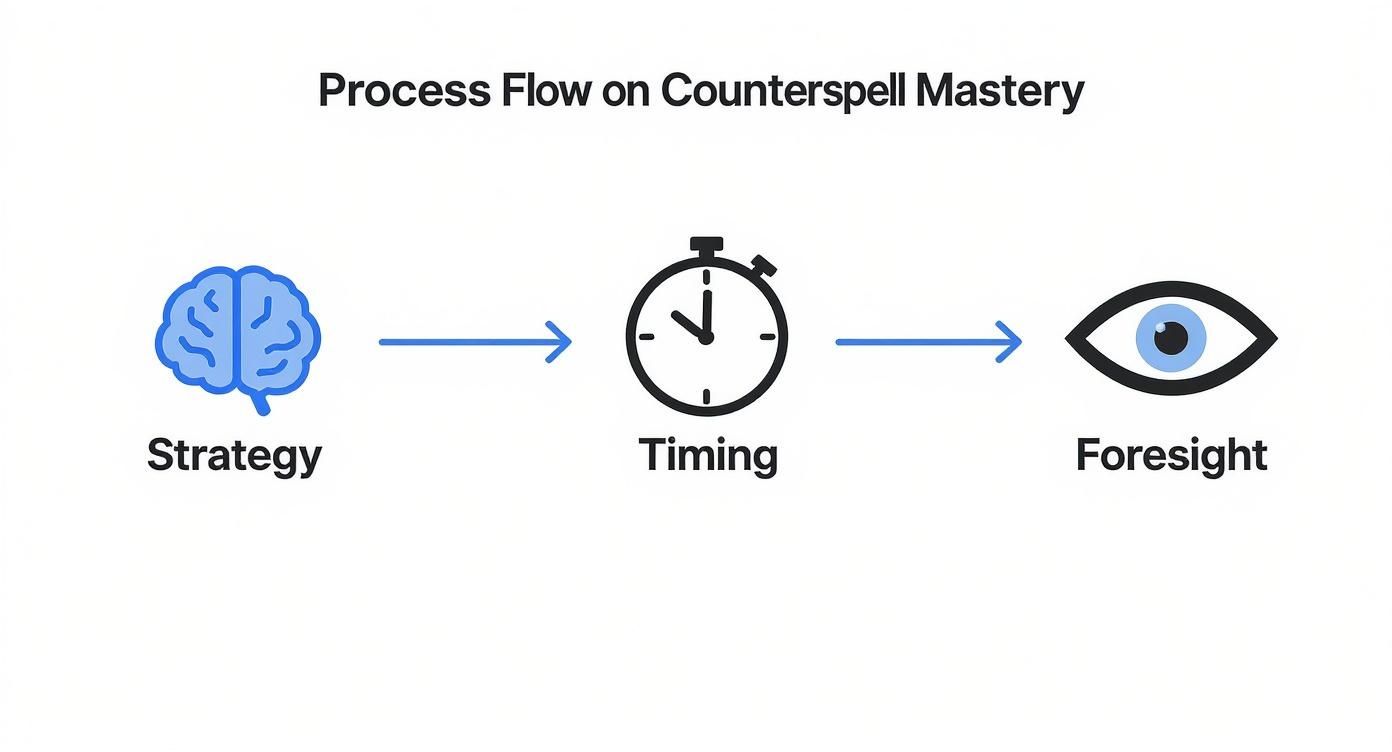
As you can see, true mastery is a cycle. A sharp strategy lets you pick the perfect moment, which only works if you have the foresight to divine what your opponent is attempting to do next.
Let us walk through a classic moment. Your opponent taps all their mana and summons a massive, game-ending dragon. That dragon spell goes onto the Stack. But you are ready. In response, you cast a simple Counterspell. Your instant now sits atop their dragon spell.
Since no one else acts, the Stack begins to resolve from the top down. Your Counterspell goes first, targeting their dragon. It resolves, and their creature spell is countered—it is sent straight to the graveyard without ever touching the battlefield. The threat is gone before it was ever real.
This back-and-forth, this dance of action and reaction, is what makes games like Magic—and our very own TerraClash—so incredibly compelling. It is a battle of wits where a quick mind often decides the victor.
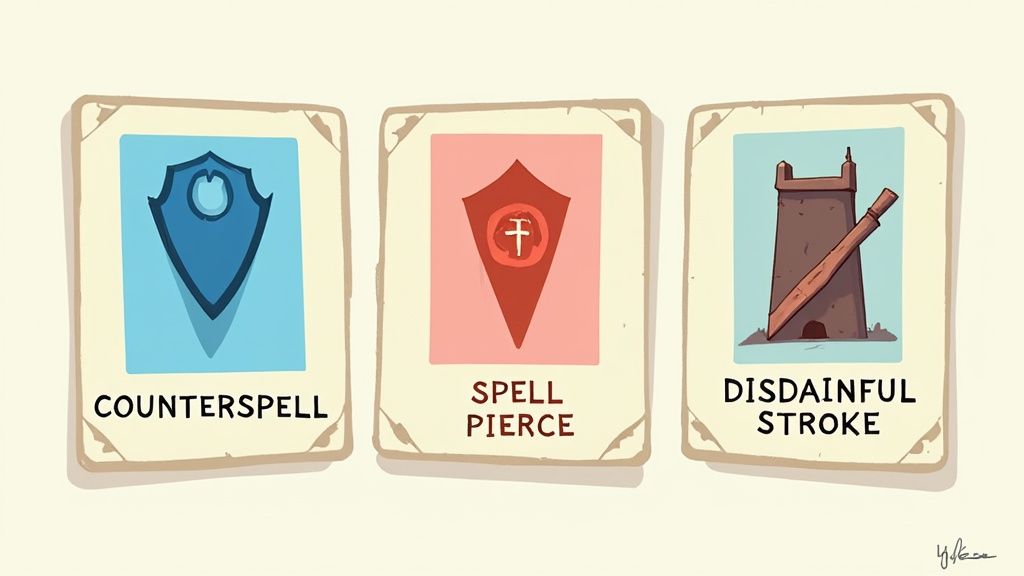
Not every "no" is the same. Magic’s long history is filled with countless ways to negate a spell, and each one has its own flavour, cost, and tactical niche. Some of these spells are so legendary they’ve defined entire eras of the game, becoming the cornerstones of championship-winning decks.
Let us take a walk through this gallery of iconic Magic the Gathering counterspells. We will examine what makes them tick, from the brute force of the original Counterspell to the surgical strike of a well-timed Spell Pierce. Each has its place in a skilled mage's toolkit.
On one side, you have the catch-all, unconditional counters. The classic Counterspell is the perfect example. For just two blue mana, you may tell your opponent’s spell, "You shall not pass." It is pure, reliable, and gives you the certainty needed to shut down a game-ending threat, no questions asked.
Then you have the conditional counters. These are often cheaper and are all about tempo and seizing an early advantage. A card like Spell Pierce is a fantastic example. It costs a single blue mana to counter a noncreature spell unless its caster pays an extra two mana. It is brilliant for tripping up an opponent in the early turns when they are tapping all their mana to enact their game plan.
A sorcerer’s choice reveals their strategy. A cheap, conditional counter is a dagger for the early duel, designed for speed. An expensive, unconditional one is the greatsword, held back for the final, decisive blow.
This is the constant dilemma every control player faces. Do you opt for early-game efficiency to stay ahead, or do you bank on late-game insurance to seal the deal? This kind of strategic depth makes spell-slinging games so thrilling, and it is a design philosophy we've poured into our own game, TerraClash.
Counterspells have been a fundamental part of Magic since its inception, and they remain as crucial as ever in competitive play. Here in the UK and across the globe, a look at the top decks shows that control strategies live and die by their choice of countermagic.
For example, analyses of recent tournament data show just how popular certain spells are. The incredibly efficient Spell Pierce was found in 100% of tracked Standard decks that ran counterspells. Meanwhile, Disdainful Stroke, prized for its ability to handle big, costly threats, appeared in 45% of relevant decks. These numbers truly show how players select specific Magic The Gathering counterspells as tools for specific jobs. You can find more insights about which counterspells are dominating the scene in recent deck data.
Getting to grips with this arsenal doesn't just make you a better Magic player; it gives you a deeper appreciation for the delicate dance of spellcasting in any fantasy setting. It’s a lens that helps you understand everything from popular digital card games to the next exciting tabletop project on Kickstarter.

Wielding Magic the Gathering counterspells is less about playing a card and more about playing your opponent. It is a psychological tightrope walk. When do you make your move? Which spell do you permit, and which one absolutely must be stopped before it can manifest? This is the core puzzle you must solve when you command a control deck.
The first skill every budding control mage needs is threat assessment. You must learn the difference between a real problem and simple bait. It is a classic novice's mistake to counter the first thing an opponent plays. A seasoned player, on the other hand, waits patiently, clutching that counterspell until the true lynchpin of their opponent's plan is revealed.
You must get into the habit of asking one crucial question: "Does this spell win them the game?" If the answer is no, it is often best to let it resolve. Save your magic for the spell that truly stands between you and victory.
Of course, spotting the danger is only half the task. You also need the resources to deal with it. This is where the fine art of mana management comes into play. Every turn you hold up mana for a potential counterspell is a turn you are not advancing your own game plan. It is a calculated risk you must constantly weigh.
Leaving two blue mana open does more than just prepare you for a threat; it sends a message. It is a silent warning shot across the bow, a clear signal that you are ready for anything. Often, just the threat of a counter is enough to make your opponent second-guess themselves, forcing them into awkward or inefficient plays as they try to draw it out. That psychological pressure is where the true power of a counterspell lies.
The greatest counterspell is the one you never have to cast. The possibility of denial can be more potent than the act itself, forcing your opponent to play around a threat that might only exist in their mind.
This constant mental arithmetic—balancing your own board development against what your opponent might do—is what makes the game so deep. It is a fundamental skill that turns a simple card game into a genuine contest of wits. Getting this balance right starts with your deck; you can learn more about how to build an MTG deck that supports this strategic style.
Before you unleash that counter upon the table, take a breath and run through this mental checklist. It will help sharpen your instincts and guide your decisions:
This kind of strategic depth, this constant battle of foresight and resource management, is what makes tabletop games so compelling. It's an element we’ve put at the heart of our own deckbuilding adventure, TerraClash, where every single spell and reaction can completely change the course of the game.
The elegant dance of spell and counter-spell is a cornerstone of strategic gaming, a thrilling mechanic that echoes far beyond the planes of Magic. You can feel its influence woven throughout the rich tapestry of tabletop and deckbuilding games, from grand fantasy epics to fiercely competitive card duels. It is this shared heritage that truly connects us as players and creators.
Look at many of the indie designers and grand Kickstarter campaigns, and you will see similar threads of reactive strategy woven into their own worlds. That core concept—tactical spellcasting and direct player interaction—is what gives these games their soul. It is a pillar of what makes our own game, TerraClash, feel so dynamic and engaging. When we appreciate this shared language of strategy, we celebrate the innovation that makes our community so special.
This spirit of interaction is present in many of the best collectible card games available today. While each game puts its own spin on negation, the thrill of a well-timed 'no' is a universal joy for players. These mechanics are a testament to the timeless appeal of deep, strategic fantasy adventures. It is no surprise that enthusiasts often explore other realms, and you can find many great gifts for D&D players that celebrate this shared passion for tabletop worlds.
The cultural impact of Magic the Gathering counterspells among UK players is particularly deep. Ask around, and you will hear many cite them as frustrating yet deeply rewarding cards. In fact, a UK community survey found that over 70% of competitive players identified blue counterspells as their favourite form of interaction for expressing skill. This regional preference for reactive, control-based gameplay truly highlights the intellectual appeal of the 'mind game', where timing and psychological pressure are just as important as the cards in your hand.
The beauty of a counterspell is that it creates a story. It is the moment a hero's ultimate attack is parried, the instant a villain's grand scheme is foiled. This single act of denial becomes a legendary moment remembered long after the game is over.
Ultimately, this fundamental concept—the ability to interact directly with an opponent's plan—is what elevates a game from a simple pastime to a true battle of wits. It is the heart of what makes tabletop gaming a profoundly rewarding and endlessly replayable experience for adventurers everywhere.
Every seasoned spell-slinger was once a nervous apprentice, and the path to mastering countermagic is paved with questions. Over the years, I have heard the same queries echo through local game shops and tournament halls. Let us clear the air on some of the most common points of confusion.
Consider this a field guide for the aspiring control mage. It is here to give you quick, practical answers that will build your confidence before you sit down for your next match.
Without a doubt, it is patience and threat assessment. The greatest mistake I see new players make is instinctively countering the very first spell their opponent plays. It feels powerful, but it is often a waste of precious magic.
A true control player waits. They hold onto their mana, watch the board develop, and pinpoint the one spell that could completely dismantle their opponent's game plan. It is not about countering everything; it's about countering the right thing. Always ask yourself: "Is this spell a game-winner for them?" If not, you should probably let it resolve and save your counter for a true haymaker.
Oh, absolutely. This is where the game becomes truly interesting. It leads to what we affectionately call a ‘counter war’, and it is one of the most thrilling moments in Magic. When your opponent targets your spell with a counter, their counterspell goes onto the stack just like anything else.
Before it resolves, you get a chance to respond. You can throw your own Magic the Gathering counterspell right back at theirs, creating a chain of reactions. This tense little dance is a pure test of skill, timing, and nerve, and it can easily decide the outcome of a crucial turn.
A counter war is a duel of pure will, where each spell cast is a declaration of intent. The victor is not always the one with the most powerful spell, but the one with the clearest foresight and the steadiest hand.
It is this kind of back-and-forth, this tactical, reactive gameplay, that we fell in love with. In fact, it's the very spirit we've aimed to capture in our own game, TerraClash, where out-thinking your opponent is everything.
Playing against a "draw-go" control deck can feel like trying to punch a ghost, but it is far from impossible. You just have to change your approach. One effective tactic is to overload them by casting several important spells in a single turn, forcing them to choose their poison. Alternatively, look for spells that simply cannot be countered—some cards have that text written upon them!
Another route is to play their game. Build up your resources quietly until you have enough mana to cast a major threat and have your own counterspell or protection spell ready for their inevitable response. It becomes a subtle game of cat and mouse, baiting out their answers and knowing the perfect moment to strike.
Your own grand adventure awaits. The world of TerraClash is filled with strategic depth, where every spell and reaction matters. Prepare to forge your legend and discover a new realm of tabletop excitement by following our journey. Sign up for updates on our Kickstarter!

