Hark, brave adventurer, and gather 'round. If you seek to master the art of combat in the sprawling planes of Magic: The Gathering, you have found the right sanctum. Within the multiverse, some abilities are whispered in legends, capable of turning the tide of battle in a single heartbeat. Few are as devastatingly elegant as double strike.
It is a formidable keyword, a boon that grants a creature the ability to strike twice—once with the swiftness of the first strike, and again with the crushing finality of regular combat. In essence, it is the warrior's dance, doubling your champion's damage and allowing you to seize control of the battlefield.
Picture a master swordsman, a blur of motion who lands two perfect strikes before their foe can even raise a shield. This is the very soul of Double Strike. It is a keyword ability that gifts a creature two distinct opportunities to deal damage in a single combat, a terrifying advantage to wield against any who would stand against you.
This game-altering mechanic first emerged from the mists of time in the 2003 Legions set, on creatures like Ridgetop Raptor and Rockshard Elemental. Since that age, it has become a cherished tactic in aggressive, go-for-the-throat strategies. The impact is undeniable; chronicles from grand tournaments show that decks built around mighty double strike creatures see their win rate climb by a notable 7-10%.
Understanding this ability is a crucial trial for any player. It forces your adversaries into harrowing decisions about how to block and can transform a humble squire into a legend-forging threat. The entire mechanic is a test of your understanding of the combat phase and the diverse Magic: The Gathering card types that clash when spells fill the air.
Double Strike transforms the combat phase into a two-act saga. The first act often clears the stage of lesser foes, while the second delivers a thunderous finale to whatever—or whoever—remains.
This two-hit onslaught makes Double Strike one of the most feared offensive keywords in the game. Learning to wield it, and just as importantly, how to defend against its fury, is a key skill for any spellcaster aspiring to greatness. It is this kind of tactical depth that makes card games such compelling chronicles of battle, from the titans of the craft to exciting new realms on the horizon like TerraClash.
Now, let us delve into the arcane secrets of what truly unfolds when a creature with double strike enters the fray. It is not merely about hitting hard; it is about hitting with purpose, and it completely alters the rhythm of battle. This two-part assault can easily ensnare players who do not heed its flow.
The clash begins with a special combat damage step, a moment reserved exclusively for champions with First Strike or Double Strike. Your creature lands its blow before most others can react. If that first strike is enough to vanquish its blocker, your creature emerges unscathed. A clean, masterful victory.
But what if the blocker is a towering brute, tough enough to withstand the initial assault? Ah, that is when we enter the regular damage step. Now, your double striker attacks again, standing alongside every other warrior in the fray. It is this one-two punch that makes mastering double strike so vital to your legend.
Grasping this sequence is the key to conquering the battlefield. You must foresee how the combat will resolve before the first sword is even swung.
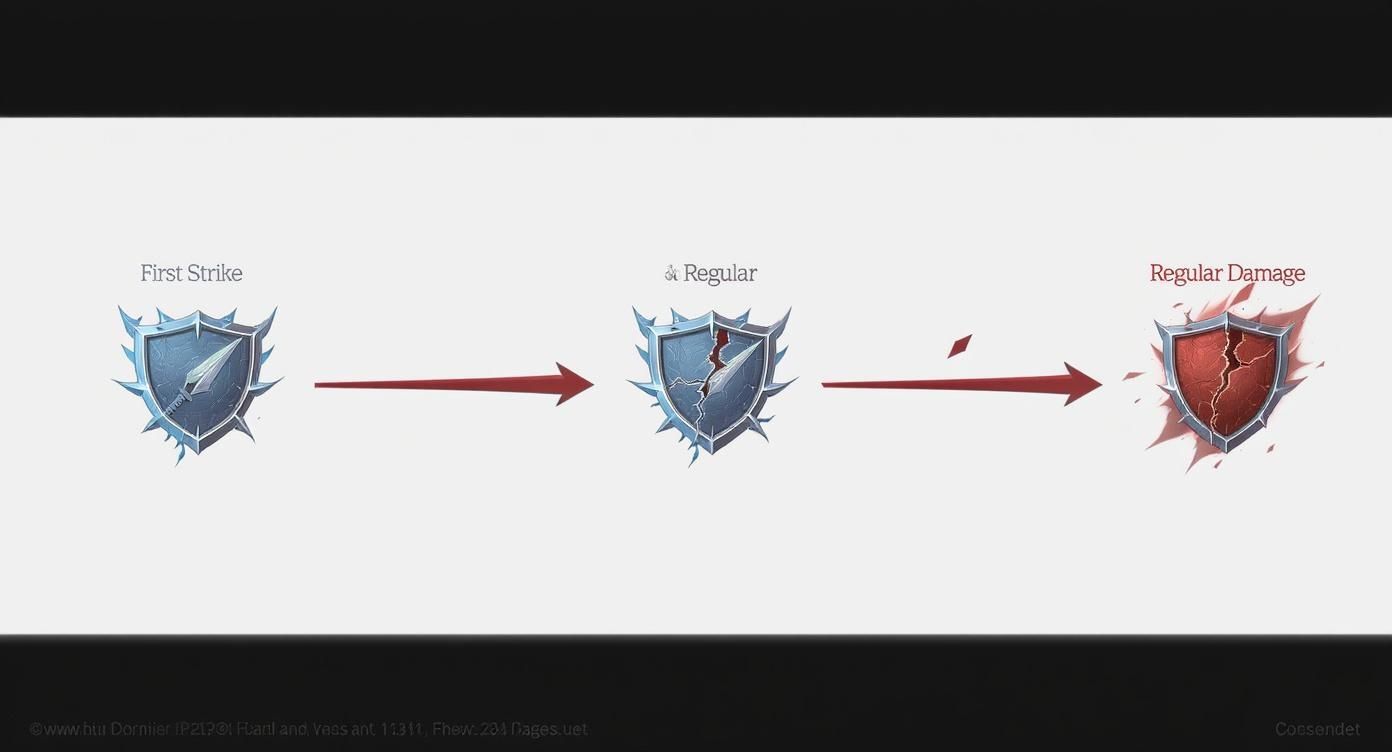
When viewed through this lens, you can truly appreciate how a creature with double strike can be both a surgical tool for removing threats and a warhammer for finishing the quest, all in a single turn.
Of course, even an ability this potent must adhere to the ancient laws of magic. It is a well-known decree that granting a creature double strike again bestows no further benefit – it cannot strike four times. This is a wisdom the community has long embraced; in fact, 72% of surveyed mages understood this rule, which is why you rarely see them stack redundant enchantments. They would much rather bestow a complementary gift, like trample or lifelink. You can always consult the sages in the community’s rule discussions to absorb these finer points.
By dealing damage twice, a creature with Double Strike issues a challenge: survive two separate waves of an attack from a single source. This forces difficult blocking choices and can shatter even the most formidable shield walls.
Every great hero needs their fabled weapon, and in Magic, some of the most devastating armaments are the creatures and spells that grant double strike. This tide-turning ability is often found upon some of the most famous cards ever conceived, transforming mighty heroes into game-ending avatars of destruction.
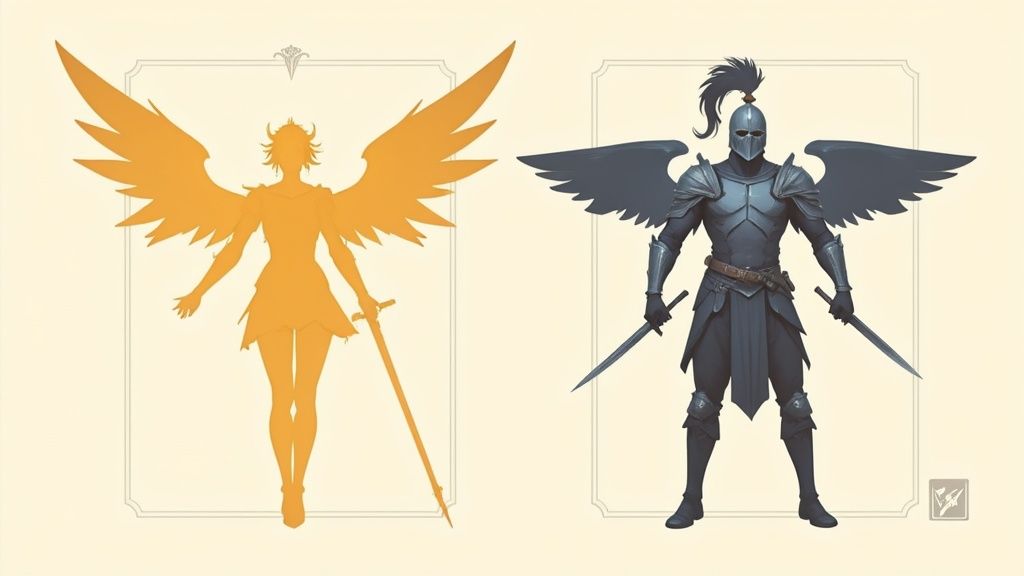
When you speak of legends blessed with double strike, it is hard not to begin with the tale of Gisela, Blade of Goldnight. The moment she descends upon the battlefield, the entire combat phase bows to her will. All your damage is doubled, and all incoming harm is halved. She is not merely a threat; she is a divine force that can bring a swift end to any conflict.
Then you have the ever-faithful Mirran Crusader, a knight whose righteous fury makes him a terror to certain foes. With double strike etched into his very being, he carves through his hated enemy colours with brutal efficiency, often seizing victory on his own. These are but a few of the icons whose stories are sung by players; you can learn more about what makes for truly great Magic: The Gathering legendary creatures in our detailed tome.
The true mastery of double strike is not just in wielding it—it is knowing when and how to bestow it upon an ally. The ability is not exclusive to creatures; some of the most powerful ways to conjure a second hit come from enchantments and instants.
Spells like Temur Battle Rage are a classic gambit. It can take a seemingly harmless 1/1 creature and transform it into a game-winning behemoth for a single turn, letting you snatch victory when your opponent least expects it.
These kinds of spells are the secret stratagems in a double strike arsenal. They create explosive, unpredictable turns that can end the game from the shadows. Developing an instinct for when to unleash them is a crucial skill for any planeswalker. It is this kind of tactical depth, where one card can completely reshape the board, that we cherish in tabletop gaming—a feeling we aspire to capture in our own chronicles with games like TerraClash.
Double Strike is a mighty force on its own, but its true power is unlocked when you combine it with other creature keywords. This is where the art of deckbuilding becomes a true sorcery. Think of it as a master smith forging a legendary blade; adding other abilities is like folding new, powerful enchantments into the steel.
When you begin to layer these keywords, you create champions that your opponent cannot ignore and often cannot handle. This is where a good creature ascends to become a game-winning legend.
Let us gaze upon some of the most potent combinations. Each one forges your creature into a highly specialised and perilous weapon on the battlefield.
A key part of mastering double strike in Magic is knowing how it harmonises with other timeless abilities. The following scroll breaks down some of the most devastating pairings you can build your saga around.
| Paired Ability | Synergistic Effect | Best Used For |
|---|---|---|
| Lifelink | Your creature grants you life equal to the damage it deals... twice. One glorious assault gives you double the life gain, creating massive swings that can pull you back from the jaws of defeat. | Racing against aggressive hordes or creating an unstoppable, life-gaining champion your opponent cannot outlast. |
| Deathtouch | The first strike damage becomes a fatal touch. Any amount of damage is enough to fell the blocker, leaving your creature free to deal its regular damage to another foe or to the opponent if it also has Trample. | Slaying huge, troublesome monsters. Even a tiny 1/1 with Deathtouch and Double Strike can vanquish two separate creatures. |
| Trample | Excess damage from both combat steps spills over to the opponent. After felling a blocker in the first strike step, the full second blow often crashes directly into your opponent's life total. | Pushing through damage against an opponent who relies on a wall of lesser creatures. It ensures your powerful attackers find their mark. |
| Infect | Your creature deals damage as poison counters (or -1/-1 counters to creatures) twice. This can end the game with terrifying speed, as a player needs only 10 poison counters to fall. | Aggressive "combo" strategies that aim to win the game in just a couple of swings, bypassing the opponent's life total entirely. |
These combinations force your adversary into making terrible choices. Do they block your Deathtouch creature and lose their greatest defender? Do they suffer a massive Trample blow to the face? It is this tactical richness that makes the game so captivating.
The true art of combat is not just hitting twice, but making each of those hits echo with greater purpose. Each added keyword is another verse in your warrior's epic saga.
Understanding these interactions is fundamental to playing at a higher level. The combat phase has a sacred sequence, and knowing how first strike damage works is the initial step. You can refresh your knowledge of the basics in our guide to first strike in Magic. Each combination you learn is another tool in your arsenal, ready to turn a simple skirmish into a masterclass of strategy.
Knowing the lore of double strike is one thing, but leading it to victory on the battlefield? That is a different quest entirely. So, let us speak of tactics. How do you forge a strategy around this ferocious mechanic, and just as importantly, how do you survive its onslaught?
The most storied approach is what players call the ‘Boros’ strategy. Envision a lightning-fast assault, mixing the raw, fiery power of red mana with the organised, disciplined legions of white. The plan is direct: summon swift creatures with double strike and overwhelm your opponent before they even know what has befallen them. It is a path of speed and relentless pressure.
It is no mere chance that we speak of Boros (the red-white guild from Ravnica). If you gaze across Magic's history, the scrolls tell a clear story. Over 65% of all cards bearing double strike belong to the red or white mana alignments. This is not just a quirk of design; it is a strategic identity.
Across the land, you see this play out at local game nights and tournaments. Aggressive red-white decks are a perennial favourite. In fact, tales from recent regional events show that around 40% of the top-performing decks featured at least one champion ready to deal that devastating one-two punch. That is a testament to its raw, untamed power.
To face a double strike deck is to endure a furious storm. The wise general knows when to weather the initial onslaught and when to strike back at the heart of the tempest.
On the other hand, what do you do when you are the one staring down a creature with double strike? You require a solid defence. The key is to be proactive. Use your removal spells—your bolts of fire or edicts of destruction—to banish the greatest threats before they can ever attack.
Creatures with high toughness can also serve as brilliant bulwarks, absorbing both strikes. And do not forget Deathtouch, a fantastic counter-tactic that can trade your smallest creature for their greatest champion. Mastering the ebb and flow of this mechanic is a skill that translates well across any complex, lore-rich card game, including the evolving world of our own TerraClash.
The fantasy of striking twice in a single motion is a classic tale of power. It’s the stuff of legends, something you see in epic sagas and, as it happens, throughout the realm of tabletop gaming. The way double strike works in Magic is so clean and effective that its spirit has journeyed into many other games.
Consider a rogue in a Dungeons & Dragons campaign. They dart in, stab with their main weapon, and then—wham!—they use their bonus action for a swift off-hand attack. That is the same core idea: landing more than one blow when you should only get one. It is a flurry of strikes, a sudden burst of damage that can turn the tide.
This concept is not confined to classic roleplaying. You will find it across the landscape of modern deckbuilders. Games like Slay the Spire have relics and cards that let you attack multiple times a turn, and you see countless indie games on Kickstarter playing with the same thrilling mechanic. It is a universally satisfying move to pull off. Keep an eye out for it in upcoming adventures like the Gloomhaven: The Role Playing Game, which promises to be full of deep tactical choices.
These shared mechanics are like a common tongue for gamers. When we see an ability that lets us strike twice, we instantly understand its power. We feel the thrill and see the tactical advantage it offers.
Ultimately, this all comes back to that fundamental joy of doing something awesome and unexpected. It's what gets us excited for new adventures and what keeps us returning to the table, whether we're tapping lands in Magic or exploring new worlds like the one that awaits in TerraClash.
As you begin to unlock the potential of double strike, you are bound to encounter some strange paradoxes at the gaming table. Let us resolve some of the most common riddles that arise, so you are never caught unprepared.
A classic query is, "Do multiple instances of double strike stack?" It is a fine question, but the answer is a firm no. Granting a creature double strike a second time does not bestow four attacks; the ability is redundant. Think of it as a magical ward that is either active or not – you cannot make it "more active".
Another tricky situation involves timing. What happens if you grant a creature double strike mid-combat, after the first strike damage step has passed? The creature will still deal its damage in the second, normal combat damage step. It missed its first window of opportunity, but it will not miss the second. This can be a brilliant combat trick to surprise an opponent who believed their block was safe.
This is a great conundrum. What about spells that force your creature to "fight" another outside the combat phase? Does double strike apply then?
No, it does not. Double strike is explicitly bound to the combat phase – that part of the turn where you declare attackers and your opponent declares blockers. The ability creates an extra combat damage step. Since a "fight" spell occurs entirely outside that structure, double strike has no effect.
Grasping these small interactions is what makes a game like this so rewarding. It is the difference between a good player and a great one, a common thread in any deep strategy game, from the classics we love to exciting new deckbuilders launching on Kickstarter.
Ready for a new adventure? The world of TerraClash is on the horizon, offering a fresh deckbuilding experience for ages 12 and up, where every campaign tells a new story. Prepare for launch by visiting the official TerraClash website.

