Gather ‘round the hearth, adventurer, for tonight we speak of legends. You have wandered into a realm where the true titans of the Multiverse hold court. Here, we delve deeper than mere spells and armies; we speak of the heroes, villains, and gods who command them. In the grand tapestry of Magic: The Gathering, these are the legendary creatures—the named, one-of-a-kind champions who stand at the very heart of the saga.
These are not just potent cards in your arsenal. They are the storied champions and cunning tyrants who breathe life into the game, allowing us to weave entire strategies around their epic tales.
Draw your chair closer, for we are about to part the veil and explore what makes Magic: The Gathering an echo of the greatest fantasy sagas. Beyond the crackle of spells and the thunder of summoned beasts, you find the legends. These are the beings whose names resound with power and dread across the countless planes of existence.
The very notion of a singular, named champion is a classic fantasy trope, a cornerstone of the finest tabletop adventures. Think of the unique heroes in a sprawling campaign like Gloomhaven or the distinct faction leaders in other grand deckbuilding quests. They grant our strategy a face, our cause a champion, and our game a story worth telling.
In the world of Magic, a legendary creature is far more than a powerful piece on the board; it is the heart of a saga you forge with every card you play. Their gravitas is inscribed into the game's core rules, governed by a simple but profound principle that ensures their uniqueness.
This special status transforms the game, turning a simple match into a dramatic duel between iconic personalities. For any tabletop general, understanding these figures is the first step toward a much deeper level of play. They are the living embodiment of their worlds, a direct connection to the rich fantasy lore that has enchanted players for decades.
When you command a legend, you become a chronicler of their story. Your deck is their army, your spells are their will, and every duel is a new chapter in their epic.
Consider this guide your grimoire for understanding these titans. We shall illuminate:
Consider this your initiation into a much larger world of strategy and storytelling. It is a world whose echoes you will find in many other great tabletop campaigns, including new adventures stirring on the horizon, waiting to be discovered.
To truly command legendary creatures, you must first comprehend the singular rule that governs their existence. Imagine you are assembling a fellowship for an epic quest; you might recruit a powerful knight, a cunning rogue, and a wise wizard. What you cannot do is bring two identical heroes, both named 'Sir Reginald the Bold'. This is the essence of the legend rule in Magic: The Gathering.
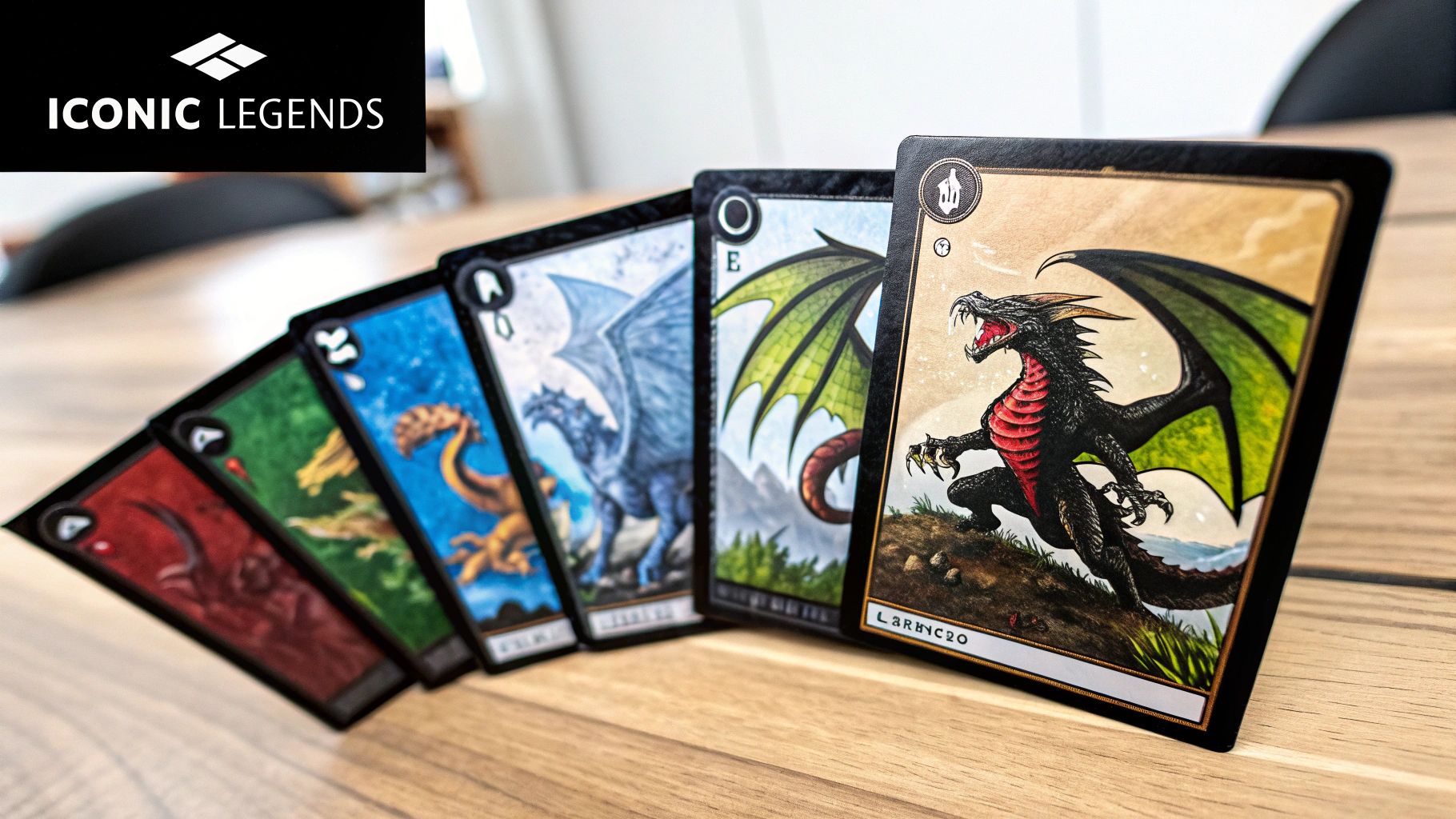
This simple decree states that a player cannot control two or more legendary permanents with the exact same name at the same time. Should a second one enter the battlefield under your command, you must immediately choose one to keep and send the other to your graveyard. It is a clever enchantment that ensures these figures feel genuinely one-of-a-kind.
But this is no mere restriction; it is a wellspring of deep strategy. It transforms the summoning of your champion from a simple act into a true tactical puzzle. Do you deploy your hero early to apply pressure, or hold them in reserve for the perfect, game-winning moment?
Picture a general deciding when to commit their most decorated champion to the fray. That is you, every time you consider playing a legend. Let's say you already command 'Ghalta, Primal Hunger' and you conjure a spell that creates a token copy. The instant that copy appears, the legend rule awakens. You will briefly have two Ghaltas, forcing you to choose which remains. While one must depart, the very act of the new one arriving might trigger a powerful "enter the battlefield" ability, letting you turn a limitation into a cunning advantage.
This core principle applies to all legendary permanents, not just creatures. You can delve deeper into the full spectrum of Magic The Gathering card types in our detailed guide. Mastering this concept is vital for mastering the game’s intricate dance.
The legend rule is not about what you cannot do; it is about making your choices resonate with purpose. Each legendary summons is a declaration, a pivotal moment that can shift the tides of battle. It forces you to think not just of power, but of timing.
This unique mechanic has shaped how decks are forged and battles are won for decades. Here in the UK, Magic's flame has burned ever brighter, with legendary creatures becoming the heart and soul of countless competitive decks since the first major UK tournament back in 1999.
British players, in particular, seem drawn to the Commander format, where a chosen legend literally leads your army. This format truly illuminates the deep strategic gameplay the rule fosters. This flavourful limitation is a massive part of why these characters feel so important, adding a narrative weight to every match that few other tabletop games can replicate.
Every legend has a story, a saga whispered across the planes. To truly command these titans, you must know their tales. We do not merely recite statistics; we open the grimoire to reveal the sagas behind the most iconic Magic: The Gathering legendary creatures. These are the stories that shape the battlefield.
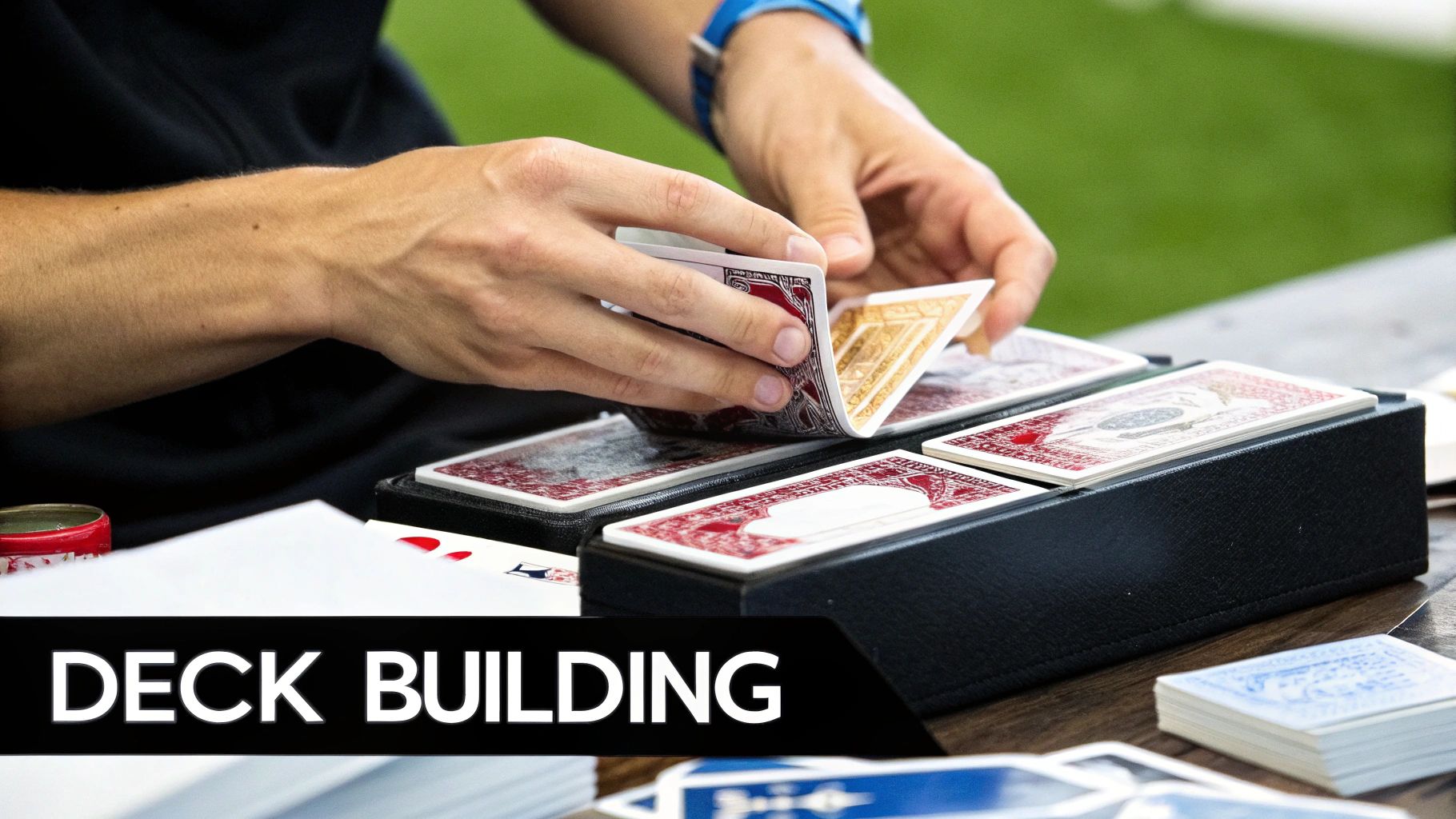
From noble heroes to world-ending dragons, the lore behind these figures is as potent as their abilities on the card. Understanding their motivations grants you a deeper appreciation for their mechanics. It can even spark new, flavourful deckbuilding ideas that feel as though you are genuinely leading an army from a grand fantasy epic.
Few names inspire such pure dread as Nicol Bolas. As one of the original Elder Dragons, his story is a millennia-spanning epic of ambition, betrayal, and a relentless quest for godhood. His cards capture this perfectly, often featuring abilities that strip your opponent's hand and mind, leaving them utterly helpless before his overwhelming power.
When you play a Nicol Bolas card, you are not just summoning a great dragon. You are invoking a master manipulator whose schemes have toppled empires. His very presence on the board is a constant threat, a promise of devastation that forces your rivals to react or be consumed.
Urza, Planeswalker, is a figure of brilliant genius and profound, soul-crushing tragedy. His feud with his brother Mishra spiralled into a catastrophic war that scarred the plane of Dominaria for generations. He is the ultimate artificer, a master of magical machines and ancient relics.
His legendary creature cards are a testament to that vast intellect, often focusing on manipulating artifacts and generating immense amounts of mana. Building a deck around Urza is like stepping into his workshop; you assemble powerful contraptions and unlock game-winning combinations, embodying a character whose creations could both save and shatter worlds.
The greatest legends are more than their power and abilities. They are reflections of epic fantasy archetypes—the scheming tyrant, the flawed hero, the noble protector. Their stories give weight to every move you make.
🎲 Want to try a solo card and dice RPG tonight? Get TerraClash Lite free: a print-and-play game you can play with ordinary dice.
Not all legends stand alone. The crew of the skyship Weatherlight represents a different kind of power: unity. Led by heroes like Gerrard Capashen and the steadfast golem Karn, this diverse fellowship stood against ancient evils, proving that courage and camaraderie could challenge even the darkest forces.
Each crew member is a powerful legendary creature in their own right, and their abilities often synergise beautifully.
These icons show how a single card can be a portal into rich fantasy lore. It's a design philosophy that echoes through the best tabletop games, where commanding a unique champion with a real backstory makes every decision more meaningful. This same spirit of leading storied heroes is at the heart of many new adventures waiting to be discovered, including quests launching very soon on platforms like Kickstarter.
So, you have chosen your champion. You have found a legendary creature whose story speaks to you, a hero to lead your forces into glory. But even the greatest legend needs an army. Now comes the true art: forging a Commander deck that transforms a stack of cards into a powerful, cohesive force.
This is not just about cramming your 100-card deck with the most powerful spells you possess. It is about synergy. It is about finding allies, artifacts, and sorceries that work in concert with your commander, making them shine. Think of your commander as the heart of a great war machine; every other card should be a gear or piston, all working together to make the whole contraption sing a song of victory.
Victory is rarely a straight path. Your commander's abilities will naturally guide you toward a certain style of play, a grand strategy that dictates how you will dismantle your opponents. Each of these archetypes brings a unique flavour to the table, offering a different way to tell your legend's story.
Here are a few classic paths to consider:
True deck-building mastery comes from understanding how these core strategies appear in all manner of fantasy card games. A well-built deck tells a story—a narrative of power and conquest played out one card at a time.
This chart offers a glimpse into how legendary creatures are spread across the colour identities, highlighting the vast deck-building possibilities that await.
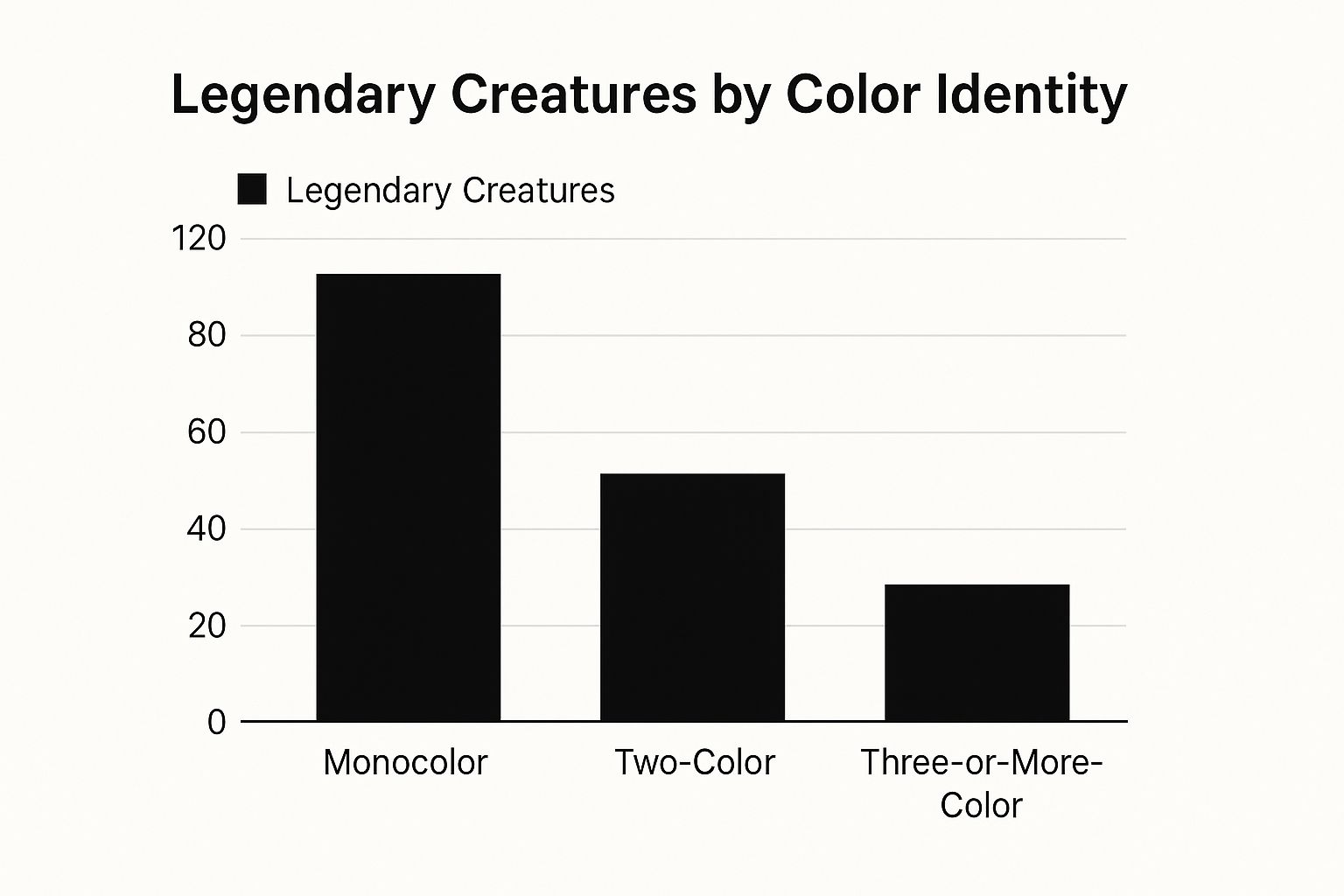
As you can see, two-colour combinations provide a fantastic sweet spot, offering a great balance of focused power and strategic flexibility.
To grasp how central legendary creatures are, one need only look at the competitive scene. Tournament data from recent UK events shows that decks built around these iconic figures consistently make up 15-20% of the top-performing lists. It’s not just the pros, either; a recent survey found that 62% of UK players prefer decks with at least one legend, drawn in by their unique abilities and compelling stories.
Building a Commander deck is like being a dungeon master for your own adventure. Your commander is the protagonist, and the 99 other cards are the supporting cast, magical items, and plot twists that make their story legendary.
To give you a clearer picture, let us break down how these strategies translate into real deck archetypes.
| Archetype | Core Strategy | Strengths | Example Commander |
|---|---|---|---|
| Voltron | Power up a single commander for one-hit-knockout attacks. | Fast, decisive, and hard to stop once it gets going. | Uril, the Miststalker |
| Control | Dictate the pace of the game with counters and removal. | High resilience, dominates the late game, disrupts opponents. | Grand Arbiter Augustin IV |
| Swarm | Overwhelm opponents with a massive number of creatures. | Recovers quickly from board wipes, immense board presence. | Krenko, Mob Boss |
| Combo | Assemble a specific combination of cards for an instant win. | Can win out of nowhere, bypasses traditional combat. | Niv-Mizzet, Parun |
| Stax | Restrict everyone's resources to slow the game to a crawl. | Excellent at shutting down faster strategies, creates lock-outs. | Brago, King Eternal |
| Group Hug | Help all players, aiming to win through politics or alternate means. | Politically powerful, often underestimated until it's too late. | Kynaios and Tiro of Meletis |
This table is but a starting point, of course. Many commanders can be built in multiple ways, and the true joy is finding a style that resonates with your own spirit.
Ultimately, your deck should be a true reflection of its leader. Whether you command a cunning dragon, a noble knight, or a mysterious planeswalker, every card you choose helps bring their epic saga to life on the battlefield.
The magic of commanding a single, mighty champion is not confined to the Multiverse. Far from it. This idea of a legendary figurehead—a character with a name, a story, and unique powers—is the very heart and soul of grand fantasy gaming. It is a thread of narrative gold woven into the fabric of the greatest tabletop quests, and you can hear the echoes of Magic the Gathering legendary creatures in the halls of many other beloved realms.
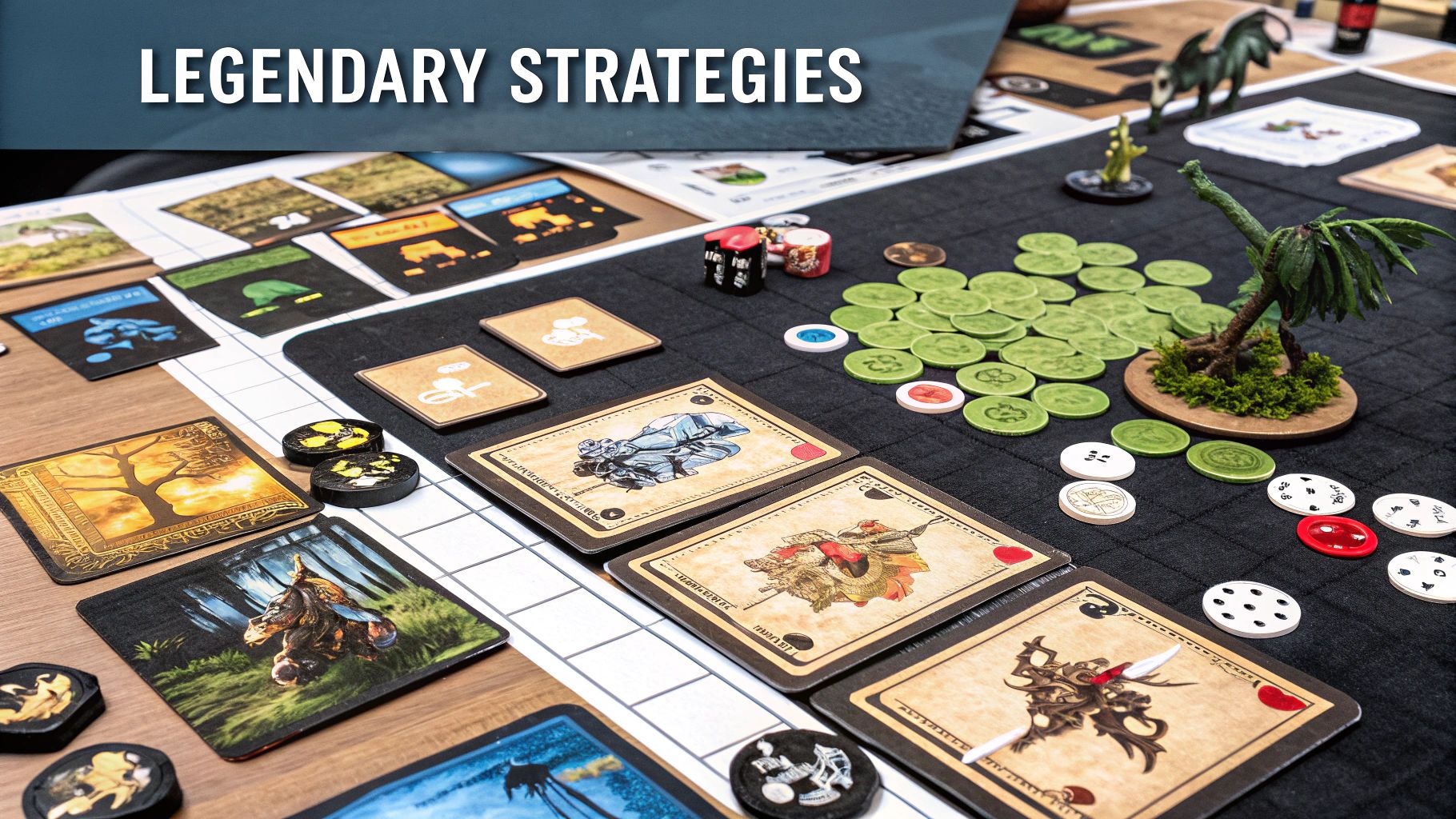
Consider the sprawling campaign of Gloomhaven. Each player steps into the boots of a unique adventurer, complete with their own history and a deeply personal quest. The moment you retire one character to unlock another feels just like swapping out a commander; your entire perspective on the adventure shifts. This creates a powerful bond with your character, making every victory feel earned and every setback sting a little more.
This same spirit is alive and well in the world of deckbuilding. Countless games place you in charge of a faction or hero whose special abilities shape your strategy from the very first card you draw. If you delve into the best deck-building games, you will discover a rich tapestry of unique leaders and champions, each demanding a different approach to achieve victory. It is a design philosophy that proves time and again that placing character and story at the centre of strategy is a winning formula.
It is not just the established giants who answer the call to adventure. A new generation of creators is forging their own worlds, and platforms like Kickstarter are teeming with fresh-faced legendary champions. These projects are often born from a raw passion for tabletop gaming, bringing novel mechanics and untold stories to the table that push the boundaries of what a card or board game can be.
Backing one of these campaigns is like becoming a patron to a new hero, helping to bring their saga to life. You get to be part of the game’s story from its very inception and watch a new legend take shape.
In every box, a new world waits. In every deck, a new champion slumbers, ready for you to awaken their tale. The greatest adventures are those we help create.
This vibrant indie scene is where you will find the next generation of tabletop epics. These games capture that same enchanting spirit of leading a one-of-a-kind champion against incredible odds. They offer new realms to explore, new alliances to forge, and new legends to command.
It is in this very fellowship of creators that our own quest, the TerraClash campaign, will soon begin. We invite you to lead a champion in a world that will be shaped by your choices. Keep your eyes on the horizon, adventurer—a new legend is coming.
Even after years at the gaming table, some of Magic's rules can feel as enigmatic as an ancient scroll. Legendary creatures, with their own special laws, are often at the centre of this confusion. So, let us consult the oracle and clear up some of the most common questions.
Think of this as your final briefing before you lead your own legendary heroes to victory.
Yes, absolutely! The famous ‘legend rule’ is quite specific in its wording. It only awakens when you control two or more legendary permanents with the exact same name.
This means you can absolutely assemble your own fellowship of heroes. Feel free to have the hulking ‘Ghalta, Primal Hunger’ stomping beside the angelic ‘Lyra Dawnbringer’. As long as their names are different, your board can be filled with as many unique champions as you can summon.
Nothing at all! The legend rule only cares about the forces you command. It is a personal restriction, not a battlefield-wide one.
So, if both you and your opponent call forth ‘Jodah, the Unifier’, both can remain. The sparks will surely fly, but the game continues. The rule only prevents a single player from controlling two legends of the same name.
While any legendary creature can technically lead your deck in Commander, not all are forged for the mantle of leadership. A truly great commander often has an ability you wish to use time and again, or one that defines your entire deck-building strategy from the outset.
Some legends are content to be part of the 99-card legion, playing a vital supporting role. The best commanders are those that grant you a clear, powerful, and exciting plan from the moment you reveal them.
A commander is more than a card; it is a promise. It is the central pillar around which you build your saga, the champion whose tale you have chosen to tell.
Here is where the weave of magic gets interesting. Let us say you control a legendary creature and then create a token that is a perfect copy. For a fleeting moment, you will command two legends with the same name. The legend rule will immediately compel you to choose one to keep and send the other to your graveyard.
But this is not always a misfortune! It can be a clever strategic gambit. For instance, if your creature has a powerful "enters the battlefield" ability, creating a temporary copy allows you to trigger that effect a second time. You gain the value, even if the clone is destined to fade.
The call to adventure echoes across countless worlds, adventurer. If the thrill of commanding a unique champion and forging a deck to tell their story stirs your soul, then a new quest awaits. TerraClash is a deckbuilding game where you lead heroes through a world shaped by your choices. Prepare to begin your own legend.
Discover the world of TerraClash and ready yourself for our Kickstarter campaign!

