Hark, adventurer, and draw near. The path to legend begins not on the battlefield, but with a quill, parchment, and a spark of imagination. Creating your first Dungeons & Dragons character is a sacred rite of passage. It is the moment you breathe life into a hero—or a scoundrel—who will soon walk, talk, and fight in a world woven from pure fantasy.
This guide is your cryptic map through that process. Step by step, we shall turn that glimmer of an idea into a fully-fledged adventurer, ready for whatever trials the Dungeon Master conjures from the shadows. Our journey starts with the six numbers that define the very essence of your character's being.
Behold your character sheet. It lies bare, a blank slate awaiting your command. Fear not its emptiness. Every legendary hero, from the mightiest barbarian to the most cunning wizard, began in this very place. Think of this process not as filling a form, but as a sorcerer moulds clay. The choices you make now will sculpt your character's strengths, their fatal flaws, and the saga they are destined to live.
The foundation of any D&D character rests on six core ability scores. These are not mere numbers; they are the raw measure of your champion's physical and mental prowess. They dictate the force of their blows, the speed of their feet, their resilience against harm, and the sharpness of their mind.
These six stats are the engine of your character, the very stars that govern their fate. They influence nearly every dice roll you shall make, from landing a critical blow with a greataxe to weaving a convincing lie to a city guard. To grasp their meaning is to take your first true step into the arcane arts of creation.
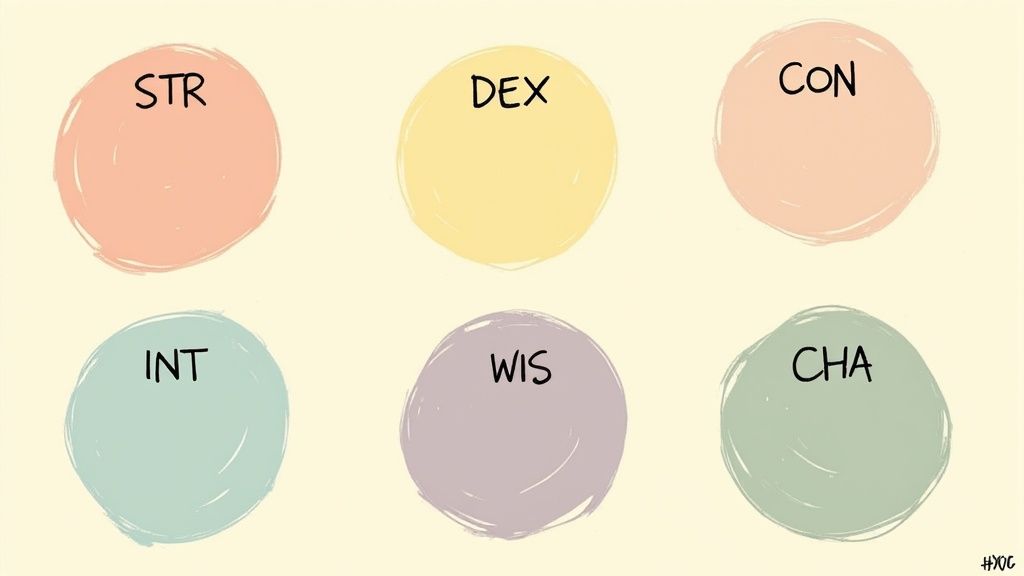
The core scores are:
Every choice here sends ripples through your character's destiny. A Fighter with sky-high Strength is a terror on the battlefield, but if their Intelligence is low, they might be easily outwitted by a goblin's simple trap. This balancing act is what makes characters feel real and compelling, much like crafting a deck in a great card game where every card must have a purpose.
Your ability scores are the narrative DNA of your character. They don't just tell you what your hero can do; they whisper clues about who they are. A high Charisma, low Wisdom Paladin might be a noble, well-intentioned fool, while a high Intelligence, low Strength Wizard must rely on wits, not brawn, to survive.
This creative ritual has seen a massive surge of late. In the UK, interest in D&D skyrocketed by 85% during the pandemic as people sought new ways to connect and tell grand stories. This has brought a whole new host of players to the table, both virtual and physical. The Player's Handbook itself notes that the combinations of race, class, and ability scores offer thousands of unique paths to heroism. You can read more about this surge in the RPG community on EN World.
To make this clearer, here is a quick breakdown of what each ability score does and which classes draw their power from it.
| Ability Score | What It Measures | Primary Classes |
|---|---|---|
| Strength (STR) | Physical power, brute force, athleticism. | Barbarian, Fighter, Paladin |
| Dexterity (DEX) | Agility, reflexes, finesse, stealth. | Monk, Ranger, Rogue |
| Constitution (CON) | Health, stamina, and vital force. | Important for all classes! |
| Intelligence (INT) | Reasoning, memory, and analytical skill. | Artificer, Wizard |
| Wisdom (WIS) | Awareness, intuition, perception, insight. | Cleric, Druid, Ranger |
| Charisma (CHA) | Force of personality, persuasion, leadership. | Bard, Paladin, Sorcerer, Warlock |
As you can see, your choice of class is deeply entwined with these scores. We will delve soon into how you actually assign numbers to these stats, but for now, you are already beginning to see how a hero takes form. This is the first, most vital step in answering the ancient question of how to make a Dungeons and Dragons character.
With the core concept of your character simmering in the cauldron of your mind, it is time to choose their form and fate. The two greatest choices you shall make now are your character's Ancestry (often called Race) and their Class. This is where your hero truly begins to take shape, moving from a vague notion into a being with a history, a culture, and a distinct set of talents.
Think of it less like filling out a form and more like choosing a champion from a pantheon of legends. What manner of hero do you wish to be? Will you be a stoic Dwarf, hailing from a fortress carved deep within a mountain, known for a resilience as unyielding as stone? Or perhaps a graceful Elf from an ancient, sun-dappled forest, with a connection to magic that flows in your very blood?
This is but a small taste of the classic fantasy folk you might meet—or become.
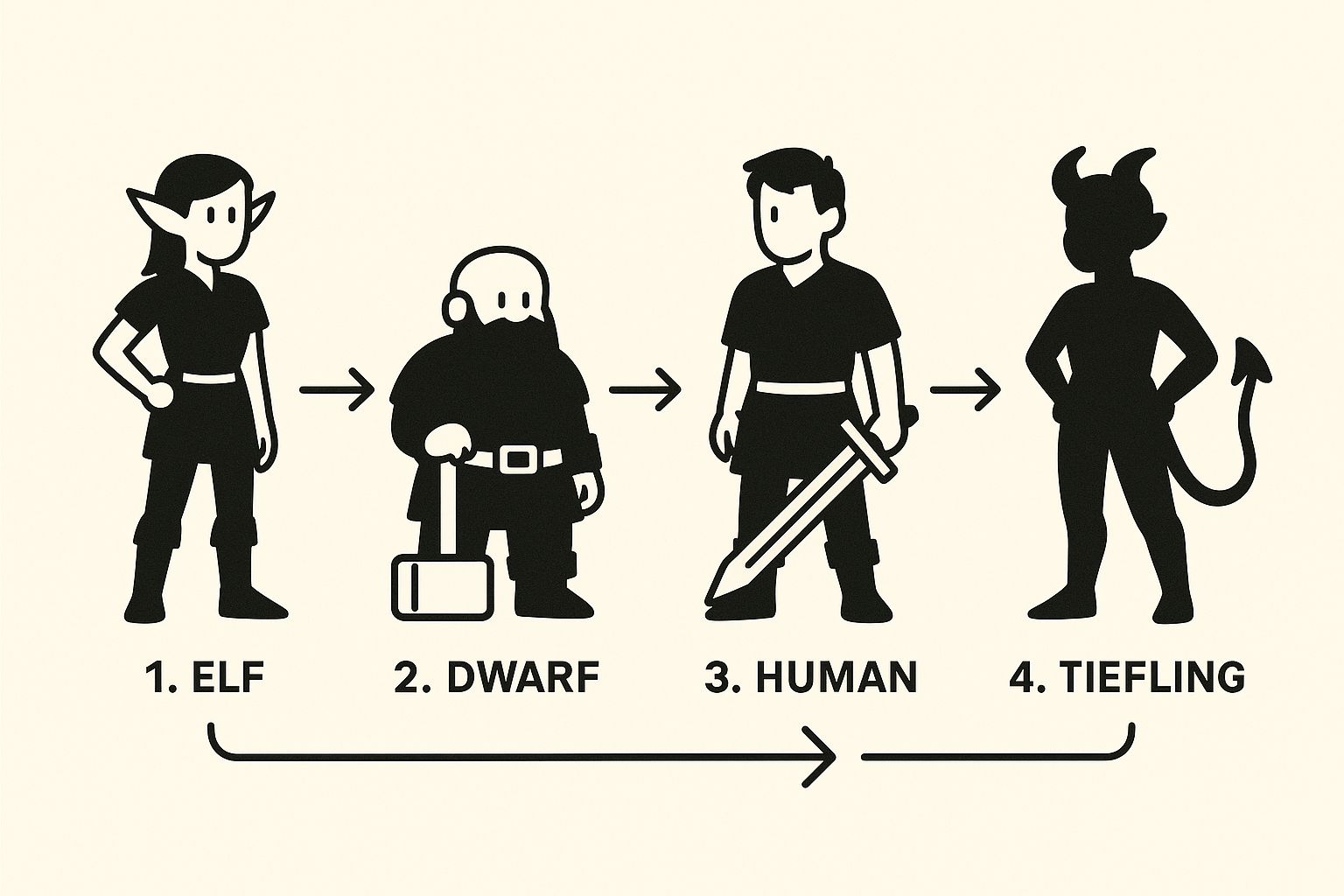
Each of these silhouettes represents a story just waiting for you to tell it, from the sturdy Dwarf and versatile Human to the otherworldly Elf and mysterious Tiefling.
Choosing an ancestry is about so much more than your character's appearance. It bestows upon them a set of innate abilities, cultural quirks, and usually, enhancements to their ability scores that reflect their people’s natural strengths. A Mountain Dwarf, for instance, receives a bonus to both Strength and Constitution, marking them as a natural frontline warrior.
To stir your imagination, here are a few of the classics from fantasy lore:
But I implore you, do not feel confined by these archetypes! A hulking Half-Orc who would rather be in a library than a battlefield, or a nimble Dragonborn who thrives in the shadows as a rogue—these are the characters whose tales are sung by bards for generations. The goal is to find a combination that excites your spirit.
Remember, adventurer: your ancestry is your heritage, but your class is your destiny. The first tells you where you come from; the second tells you where you are going. The interplay between the two is where the most compelling legends are born.
So, you know who you are. Now, what do you do? Your class is your adventuring profession, the set of skills you’ve honed through rigorous training, esoteric study, or raw, untamed talent. It dictates how you fight, the abilities you command, and ultimately, your role within your adventuring party.
Are you a disciplined Fighter, a master of every weapon and suit of armour? Or a studious Wizard, who unravels the very fabric of reality through arcane knowledge? Perhaps you are a devout Cleric, acting as a conduit for your god’s power to mend allies and smite foes.
Every class offers a completely different path through the game's challenges. A Barbarian might solve a locked door with a greataxe, whereas a Rogue would favour a set of lockpicks and a whisper of stealth. This choice is the single greatest factor in defining your day-to-day gameplay.
If this all feels a touch overwhelming, securing a Dungeons and Dragons RPG starter set is a brilliant way to learn the ropes. They come with pre-made characters that do a fantastic job of showing you how these combinations work in practice.
Often, you'll find that your ancestry and class go hand-in-hand. An Elf's natural Dexterity makes them a perfect Ranger or Rogue. A Dragonborn's raw Strength and fiery breath weapon feel right at home in the powerful Paladin class.
But sometimes, the most memorable characters are born from contrast. What story lies behind the Dwarf who turned away from the forge to embrace the chaotic magic of a Sorcerer? What trials did a Tiefling, born of a fiendish bloodline, have to overcome to become a holy Cleric?
Answering these questions is the true magic of making a D&D character. It is how you turn a pile of stats into a living, breathing person, ready to make their mark upon the world.
Right, we have sculpted the core of your character—their ancestry and their calling. Now it is time to give them the tools of their trade. A hero is not just a collection of stats; they are defined by what they can do and what they carry. These next choices add the fine details, bringing your character to life both on the battlefield and in the quiet moments of exploration.
This is where you decide if your hero is a sharp-eyed scout, a silver-tongued negotiator, or a silent shadow moving through the night. It is also where you will arm them for the dangers that lie ahead. Think of it like assembling your deck for a card game—the gear and skills you choose can define your entire strategy, much like in the fantasy game, TerraClash.
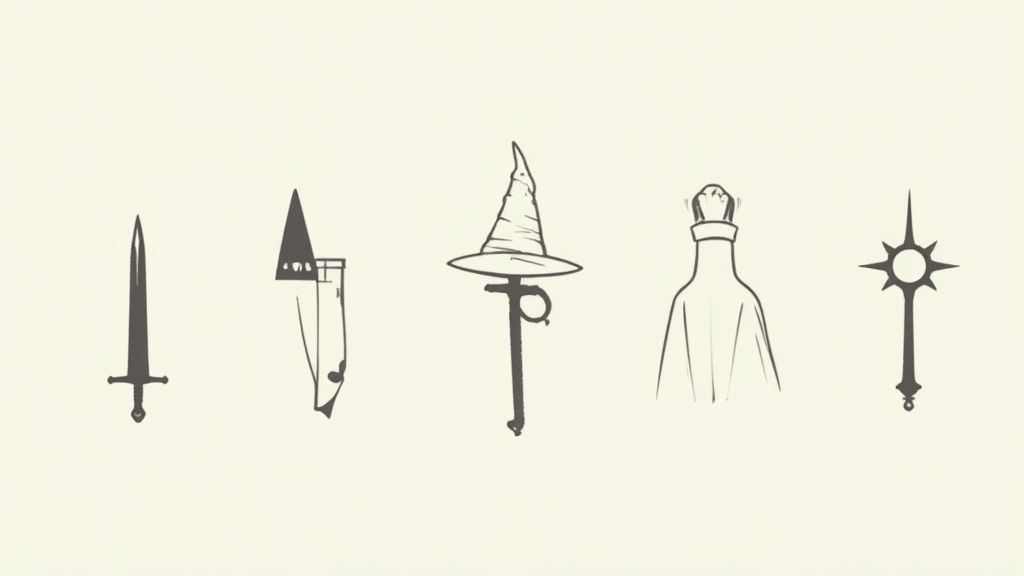
Every character in D&D is gifted in certain areas, and we call this proficiency. Think of it as focused training. When you're proficient in a skill, you add your proficiency bonus (a number that grows as you gain power) to your dice rolls. It makes success in that task far more likely.
Your class and background will offer a list of skills to choose from. A scholarly Sage background, for instance, might make you proficient in Arcana and History. On the other hand, a streetwise Urchin is far more likely to have a knack for Sleight of Hand and Stealth. This is your chance to truly specialise.
Here is a glimpse at what a few key skills represent:
Try to connect these skills to your character's story. It is only natural that a Ranger who grew up in the wilderness would be proficient in Survival. A Bard who has performed in every tavern from here to Neverwinter? They would naturally excel at Performance.
Do not just choose skills based on what seems most powerful. Weave them into your hero's backstory. A Fighter with proficiency in Persuasion isn't just a brute with a sword; they are a respected captain of the guard. A Wizard with a surprising talent for Acrobatics might have run away to join a circus before discovering their magical gifts.
This kind of customisation is what makes roleplaying so magnificent. It’s a desire for unique builds that you see in digital RPGs popular with UK gamers, too. Take a game like Dungeons & Dragons Online—it has a massive character creation system that mirrors the tabletop experience, with a vast array of skills and feats. Many UK players point to this flexibility as a key reason for its lasting appeal, building a community that values creative, tactical thinking. You can learn more about this beloved online D&D experience on MMO Population.
Your final task here is to equip your hero. Both your class and background will grant you a starting package of equipment, often with choices between different weapons and armour. These are not just about the numbers; they reflect your character's identity and style.
Does your Paladin march into battle clad in gleaming plate armour, a mighty warhammer held high? Or is your Rogue more at home in supple leather armour, with a shortsword at their hip and a pair of daggers tucked into their boots?
As you select your gear, consider these things:
| Equipment Type | Key Consideration | Example Scenario |
|---|---|---|
| Weapons | Do you prefer one devastating blow (greataxe) or two swift strikes (two shortswords)? Do you wish to be in the thick of the fray or fight from a distance (longbow)? | A Barbarian might choose the greataxe for its immense damage, perfectly reflecting their reckless fighting style. |
| Armour | Heavy armour offers the best protection but makes sneaking a challenge. Light armour keeps you agile and swift. | A nimble Monk will rely on their unarmoured defence, while a Cleric on the front lines will desire the best shield and heavy armour they can find. |
| Adventuring Pack | The pack you choose (Explorer's, Diplomat's, etc.) gives you a bundle of useful items like rope, torches, and rations. | An Explorer's Pack is a wise choice for a dungeon-delver, providing all the basics for survival in the dark places of the world. |
These items are your character's first tools for survival in a perilous world. Choosing them is a critical part of learning how to make a Dungeons and Dragons character that feels real and prepared for anything. You have now given them the skills and the gear to go forth and face their destiny.
You have built the bones of your hero. You have chosen their ancestry, answered their calling, and determined their stats. Their skills are sharp, their pack is full. Now for the most magical part—giving them a soul. Without a story, a character is but a collection of numbers on a page. It is the backstory that breathes life into them, turning a generic Fighter into a disgraced knight on a quest for redemption, or a Wizard into a runaway apprentice clutching a stolen, forbidden tome.
Your character’s history is their compass. It is what guides their choices, fuels their ambitions, and whispers their deepest fears in the dead of night. This is the heart of your hero, and truly, it is the greatest gift you can give your Dungeon Master.
The Player's Handbook gives you a brilliant head start on this with Backgrounds. Options like Acolyte, Criminal, Noble, or Soldier do more than just grant a couple of extra skill proficiencies; they give you a narrative hook. Each one comes with suggested Personality Traits, Ideals, Bonds, and Flaws. These are not mere flavour text—they are roleplaying gold.
Think of these four pillars as the recipe for creating an actual person, not a flawless hero. These are the threads your DM will gleefully pull to weave your character into the grand tapestry of the campaign.
These elements give you instant depth and create hooks for truly memorable roleplaying. A character whose Bond is "I will do anything to protect the temple where I grew up" is practically handing the DM a pre-written adventure on a silver platter.
To truly flesh out your hero's past, you must think like a storyteller. Do not fret, you need not write a novel. Simply answering a few key questions can build a surprisingly rich foundation.
Try starting with these:
A backstory need not be some grand epic of war and betrayal. Sometimes, the most compelling heroes come from humble beginnings. A baker's son who picks up a sword to defend his village can be every bit as engaging as a prince avenging his stolen throne. The key is to make it personal.
The best backstories are those that tie directly into the campaign world. This part is a collaborative effort with your Dungeon Master. Before you set your history in stone, have a chat with them. Ask about the world’s geography, its major powers, and any recent events of note.
Maybe your rogue was a former member of the infamous Shadow Syndicate your DM has created for the setting. Perhaps your cleric worships a local deity whose temple just so happens to be a major location in the starting town. Weaving these details into your past makes your character feel like a real, breathing part of the world from the very start. It’s this sort of narrative depth that we love in all great fantasy games, from sprawling RPGs to strategic deck-builders, where every hero has a clear place in a larger story.
By putting some thought into your backstory, you’ve done much more than just check a box in how to make a Dungeons and Dragons character. You've created a person. Someone with hopes, fears, and a real reason to fight. You've forged a legend in the making, ready to step out of the shadows of their past and into the light of adventure.
Your character's soul is forged, their story is taking shape. Now it is time for the final ritual—the crucial numbers and magical choices that breathe life into the concept you've built. For anyone dabbling in the arcane, this is also when you crack open your spellbook and decide which incantations will define your path.
This isn't just a list; it is a strategic choice, like building a perfect hand for a high-stakes card game. Every spell must have a purpose. This is where you decide: are you a sorcerer who calls down fire from the heavens, a cleric of soothing light, or a wizard of cunning illusions?
If magic is your calling, your character sheet has a special section awaiting your command. First up are your cantrips—these are the simple, at-will spells you can cast without a second thought. They do not consume your magical energy, so think of them as your signature tricks, the magic that has become second nature.
Next, you must consider your prepared spells. These are the heavy hitters, the more potent magic you have on call each day. To cast them, you spend spell slots, which are like reservoirs of magical power. Once you use a slot of a certain level, it is gone until you take a long rest and replenish your energies.
This is the core challenge of playing a spellcaster—managing your resources. It forces you to think tactically in every encounter. Do you unleash your most powerful spell now, or hold it back for an even greater threat you suspect is lurking just around the corner? This is the kind of strategic thinking seen in the best tabletop games, from classic wargames to modern deckbuilders.
A spellcaster's list is their personal grimoire, a direct reflection of their mind and spirit. A practical wizard might favour utility spells like Mage Hand and Detect Magic. In contrast, a battle-hardened cleric might prepare a litany of healing and smiting prayers. Pick spells that aren't just powerful but feel right for the hero you've created.
Whether you're slinging spells or swinging swords, the final step is to determine the numbers that will keep you alive when battle is joined. These are your defences, your very lifeblood quantified on the page.
Here are the core stats you need to determine:
If you are a spellcaster, you will also need to work out your Spell Save DC. This number determines how hard it is for enemies to resist your magic. Getting a handle on these mechanics is crucial, and you can delve into the nitty-gritty with our detailed guide on calculating your Spell Save DC in 5e.
Finalising a character sheet is where you really see veteran players in their element, often reaching for well-worn copies of older rulebooks. The Player's Handbook (PHB) is the cornerstone for these rules, but its 2024 update interestingly saw lower initial sales in the UK than its 2014 predecessor, with fewer than 4,000 copies sold at launch. It seems many UK players prefer sticking with familiar editions, a testament to the community's passion for established lore and house rules over adopting every new revision. You can read more about these fascinating sales figures and community trends. This dedication to personalising the game, much like building a unique deck of cards, is what makes the tabletop world so rich and enduring.
With these last details in place, your character is complete. They are no longer just an idea but a living, breathing person, ready to step into the world. Your journey in learning how to make a Dungeons and Dragons character is over, but their adventure is only just beginning.
Stepping into the world of Dungeons & Dragons for the first time is like standing at the entrance to a vast, uncharted dungeon. It is exciting, but it is also easy to feel a little lost. Do not worry, every veteran player once stood exactly where you are now, asking these very same questions.
Let us address some of the most common puzzles new adventurers face when they are learning how to make a Dungeons and Dragons character.
If you seek a smooth entry point, you cannot go wrong with a Fighter or a Barbarian. They are beautifully straightforward. You hit things, and you hit them hard. You will not be juggling a long list of spells, which lets you focus on learning the core mechanics of combat and roleplaying. The Fighter’s Champion subclass, in particular, is a masterclass in elegant simplicity.
But here is the true secret: the "best" class is the one whose fantasy most appeals to you. If you are drawn to the idea of a fast-talking Bard who can charm their way out of trouble or a Druid who can transform into a great bear, then follow that calling! The D&D community, especially here in the UK, is incredibly helpful and will be more than happy to help you master any class you choose.
Think about the kind of hero you wish to portray. What is their personality? If you imagine a tough, no-nonsense warrior, then a Dwarf from a deep mountain home might feel perfect. If you want a graceful archer who is more at home in the ancient woods, an Elf is a classic choice for a reason.
Then again, sometimes the most interesting characters are born from subverting those expectations. What about a Half-Orc wizard who is more interested in dusty old tomes than swinging an axe? That sounds like a character I would love to meet. Your race gives you a starting point, but it is your story and your decisions that will truly define who you are.
Do not just think about creating the most powerful character. The goal isn't to "win" D&D. The best characters, the ones we remember for years, are often those with interesting flaws and unexpected quirks. The story is what matters.
This choice usually comes down to your Dungeon Master’s preference, so it is always wise to ask them first. Each method offers a totally different experience.
Honestly? A great deal. You can absolutely play with a one-sentence backstory, but a little history is what turns a pile of numbers into a person. It gives your character a reason to get out of bed in the morning, to risk their life for a cause, or to run from a particular kind of monster.
It also gives your DM wondrous material to work with. They can weave your personal history into the main plot, creating quests that are deeply personal to you. Your backstory does not need to be a ten-page epic. Just a few bullet points about your family, a defining moment from your past, or a goal you have yet to achieve can make all the difference. It is the core of any good story, tabletop or otherwise. For anyone keen to explore this further, you can find some great advice on how to improve strategic thinking in your storytelling.
Your hero is ready. They have a story, a purpose, and the skills to carve out a new future. This very spirit of creation, strategy, and adventure is what we've poured into TerraClash. If you love building unique heroes and sharing unforgettable stories, we invite you to follow our journey as we bring a new world of strategic fantasy to life. Prepare for an epic clash at https://terraclash.co.uk.

