You are probably here because a tiny glass bottle has saved your party more than once, and you want to know whether you are using it properly.
That instinct is right. In potions of healing 5e, the rules look simple, but the decisions around them are not. A healing potion is part emergency button, part pacing tool, and part lesson in resource management. New players often treat it like a health pack in a video game. Experienced players learn that timing matters as much as the healing itself.
A good Dungeon Master sees this all the time. The fighter drops to low hit points, the cleric is out of position, the rogue is one bad roll from disaster, and someone finally remembers the potion tucked away since the first goblin cave. That moment feels dramatic because the item is easy to understand and hard to use perfectly.
If you are still getting comfortable with the game, this beginner-friendly guide to D&D for beginners helps frame where healing potions sit within the wider flow of play.
The fighter is still standing on 3 hit points. The cleric is pinned behind the front line. One more solid hit could turn a tense fight into a scramble to stop death saves. In that moment, a healing potion is not just a bottle of red liquid. It is time, position, and one more decision that keeps the party in the game.
A healing potion earns its place in 5e because it is simple to use and easy to understand under pressure. Players do not need to know a spell list or wait for the party healer to fix the problem. They drink the potion, recover hit points, and stay involved in the scene.
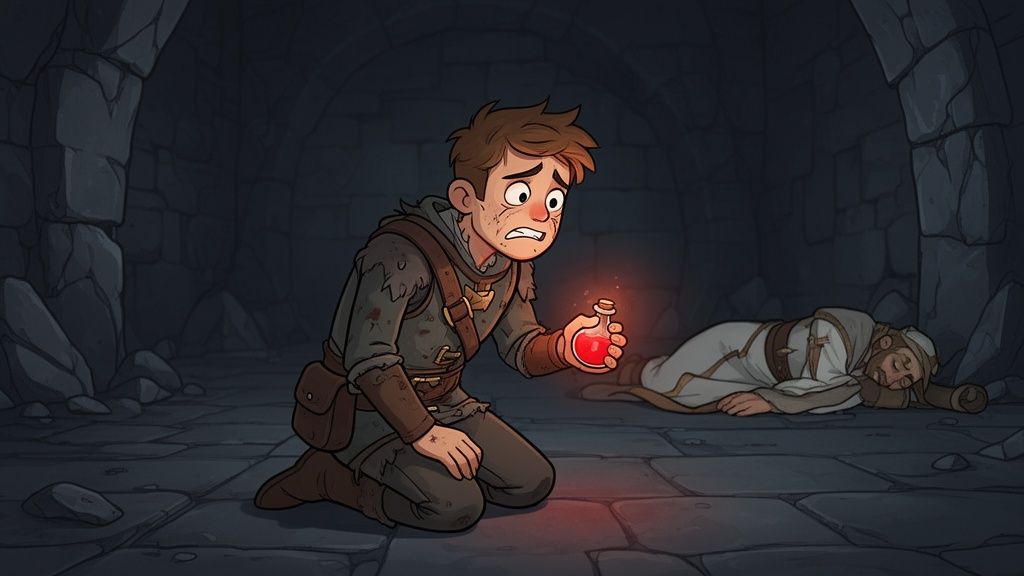
The strength of a healing potion is freedom.
It loosens the party’s dependence on a single character to keep everyone alive. A barbarian can carry one. A wizard can carry one. A rogue who never prepared for support can still pull a friend back from the edge. For newer groups, that flexibility makes the whole game easier to read. If you are still learning how the roles fit together, this beginner-friendly guide to D&D classes and party play helps put that into context.
This freedom is most valuable in campaigns where the table wants to preserve momentum. A potion lets the group patch a problem without stopping the whole adventure to rest, retreat, or reorganise around one healer’s spell slots.
A small 2021 EN World poll of 38 respondents found that 52.6% of parties used a Potion of Healing exactly once per long rest. That is too small a sample to treat as a broad rule, but it does reflect a pattern many Dungeon Masters recognise. Groups often carry healing potions as a reserve tool. Useful enough to matter, limited enough that players hesitate before spending one.
This is why healing potions matter beyond the raw numbers on the dice.
In play, a potion works like a held resource in a modern tabletop game such as TerraClash Grimoire. You can spend it early to protect tempo, or hold it back for a more dangerous swing later. Neither choice is automatically correct. What matters is whether the potion changes the next few turns in your favour.
That makes the item more interesting than it first appears. The bottle may only restore hit points, but the decision around it touches action economy, risk, party confidence, and retreat options. Good players do not ask only, “How much healing do I get?” They ask, “What does this let us survive?”
Tip: A potion can buy one more turn, one more room of progress, or one clean escape route.
This is the essential nature of potions of healing 5e. On the character sheet, they restore HP. At the table, they shape pacing, rescue bad positioning, and turn a near-collapse into a story the group will remember.
The official game gives you four main healing potion tiers, and each one fills a different role.
The easiest mistake is assuming every red bottle does roughly the same job. It does not. The gap between the weakest and strongest official options is wide enough to change how boldly a party plays.

According to the official table summarised at dnd5e wikidot’s Potion of Healing entry, the four tiers are:
| Potion Type | Rarity | Healing Roll | Average HP | Suggested Value |
|---|---|---|---|---|
| Potion of Healing | Common | 2d4 + 2 | 7 | 50gp |
| Potion of Greater Healing | Uncommon | 4d4 + 4 | 18 | Not listed in verified data |
| Potion of Superior Healing | Rare | 8d4 + 8 | 34 | Not listed in verified data |
| Potion of Supreme Healing | Very Rare | 10d4 + 20 | 45 | Not listed in verified data |
That table gives you the practical answer most players need in the middle of a session. Roll, recover, move on.
The Potion of Healing is the everyday emergency vial. It restores 2d4 + 2 hit points, with an average of 7 HP. This is the one most adventurers recognise and carry as a baseline safety net.
A Potion of Greater Healing jumps to 4d4 + 4, averaging 18 HP. Potions at this level start to feel less like patchwork and more like a meaningful reset after a nasty hit.
The Potion of Superior Healing restores 8d4 + 8, averaging 34 HP. At this point, the item can pull a front-line character back from serious danger, not just cushion the next blow.
Then there is the Potion of Supreme Healing, which restores 10d4 + 20, averaging 45 HP. This is the kind of potion players remember because it changes the tone of a fight immediately.
New players often think rarity is flavour text. It is not.
Rarity signals how often you are likely to see the potion, but it also hints at how much confidence you should place in it. A common potion helps you endure. A very rare one can reshape a crisis.
Key takeaway: Do not judge healing potions only by colour or name. Judge them by how many hit points they realistically return compared with the damage your party is taking.
Even with stronger options available, the common healing potion stays relevant because it is accessible and familiar. It is the tabletop equivalent of a small but reliable utility card. You may not build your whole strategy around it, but you are glad to draw it when things go sideways.
That is the heart of potions of healing 5e. The tiers are simple on paper, yet they create very different tactical choices at the table.
Your fighter is on single-digit hit points. An ogre is still standing. The cleric is out of position. In that moment, the question is not how many hit points a potion restores. It is what your turn is worth.
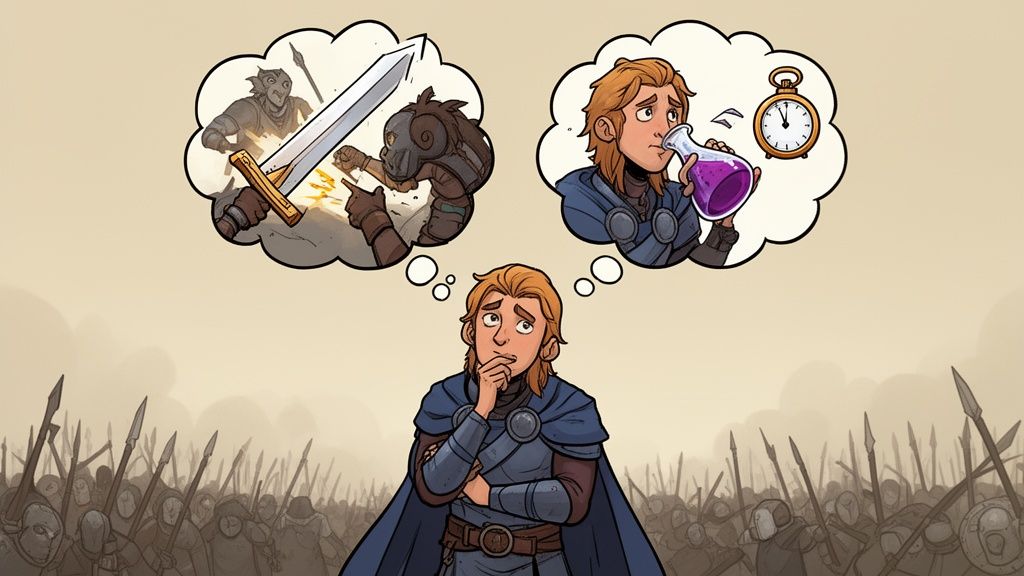
In standard 5e, drinking a healing potion usually costs your Action. That is a steep price in combat, because your action is often your attack, your spell, your escape, or your way to protect someone else. A potion may restore hit points, but it also uses the part of your turn that usually changes the board.
That is the heart of action economy. In plain terms, action economy is the contest over who uses their turns more effectively. A side that spends actions removing threats often gains control. A side that spends actions merely surviving may stay alive, but can still lose ground.
A healing potion works a bit like a defensive card in a fast tactical game. It does not always push you towards victory on its own. It buys time. In modern game design, that matters because tempo matters. TerraClash™ Grimoire uses a similar pressure point. Every turn spent recovering is a turn not spent advancing your plan. D&D combat creates the same tension, only with swords and spell slots instead of cards.
A basic healing potion restores a modest amount of health, as noted in Before You Roll’s discussion of healing potion rules. Early on, that can be enough to keep you in the fight. Later, enemies often hit hard enough that the potion feels more like a pause button than a reset.
That does not make the potion weak. It makes the timing of its use more important.
Players often get confused here because they treat healing as automatically safe. It is not. If you spend your action healing while the enemy keeps all of its pressure, you may absorb one more hit before ending up in the same problem again.
The 2024 rules revision changes this discussion at some tables. It introduces a rule that allows potion use as a bonus action, which makes healing far easier to fit into an effective turn. If your group uses that revision or a similar house rule, potions become much stronger in combat because you can often heal and still attack, cast, or move into cover.
Suppose your fighter is facing one dangerous enemy.
If the fighter attacks and drops that enemy, the incoming damage may stop completely. If the fighter drinks a potion instead, they recover some hit points, but the threat remains active for another round. The better choice depends on what is more likely to keep the party stable. Remove the source of damage, or survive long enough for help to arrive.
This is why many groups save common potions for moments outside direct pressure, or for rounds where falling unconscious would wreck the party’s position. The decision is less about raw healing and more about preserving tempo. Card game players would call that protecting your line of play. A seasoned DM would call it staying alive without surrendering the fight.
A short visual explanation can also help clarify the flow of potion use in play.
Use the potion when:
DM advice for players: Ask, “Does spending my turn on this potion keep our plan intact?” That question usually leads to better choices than staring at the healing dice alone.
A fighter drops in a narrow corridor. The rogue is still holding the flank, the cleric is pinned behind cover, and someone asks, “Can I pour a healing potion into his mouth and clear the poison too?”
That question gets to the heart of potion rules. A healing potion restores hit points. It does not function as a catch-all cure unless a separate rule says it does. If the problem is poison, paralysis, fear, a curse, or a monster trait that keeps causing trouble, the potion may help the target survive, but it does not remove the underlying effect.
That split between hit points and conditions trips up plenty of players because both feel like “being hurt”. In 5e, they are different tracks. Hit points measure how close you are to dropping. Conditions and ongoing effects change what your character can do.
A character can drink a potion, regain a few hit points, and still be poisoned. They can be conscious and still frightened. They can be back on their feet and still unable to act properly if a condition says so.
The easiest way to read this at the table is to ask two separate questions.
A healing potion answers the first question. Other spells, class features, or item descriptions answer the second.
Administering a potion to an unconscious ally is one of the most common table questions. At many tables, and under common readings of the rules, a creature can use its action to feed the potion to another creature. The pressure point is usually position and timing. Can you reach them safely, and is spending your action worth it this round?
That makes healing potions feel less like raw recovery and more like a tempo tool. Modern card games handle resources in a similar way. In TerraClash™ Grimoire, spending a card to keep your board state intact is often stronger than saving it for perfect value later. A potion works much the same way. You are buying one more turn of presence on the board, except the board is a dungeon floor and the piece is your ally.
Healing potions make more sense when you stop comparing them as if every support option is competing for the same job.
Each tool covers a different gap in the party’s safety net. A seasoned group usually carries more than one kind of answer for that reason.
Some confusion comes from rules text, and some comes from table habit. Clear these points early.
That last point matters most. Players sometimes reject potions because the item does not solve the whole problem. In play, partial solutions win encounters all the time.
Rule of thumb: If the issue is lost hit points, a healing potion helps. If the issue is a condition, curse, poison, or special creature effect, check the specific rule that caused it.
The party has made it back to town with torn packs, low coin, and one clear lesson from the last dungeon. Next time, they want healing in their own hands before the doors close behind them.
Buying potions solves that problem with gold. Crafting solves it with time, planning, and a bit of character identity. For many groups, that shift matters. It turns downtime into preparation, much like setting aside key cards before the next round in a fast resource game such as TerraClash™ Grimoire. You are spending a calm phase to improve your options in a dangerous one.
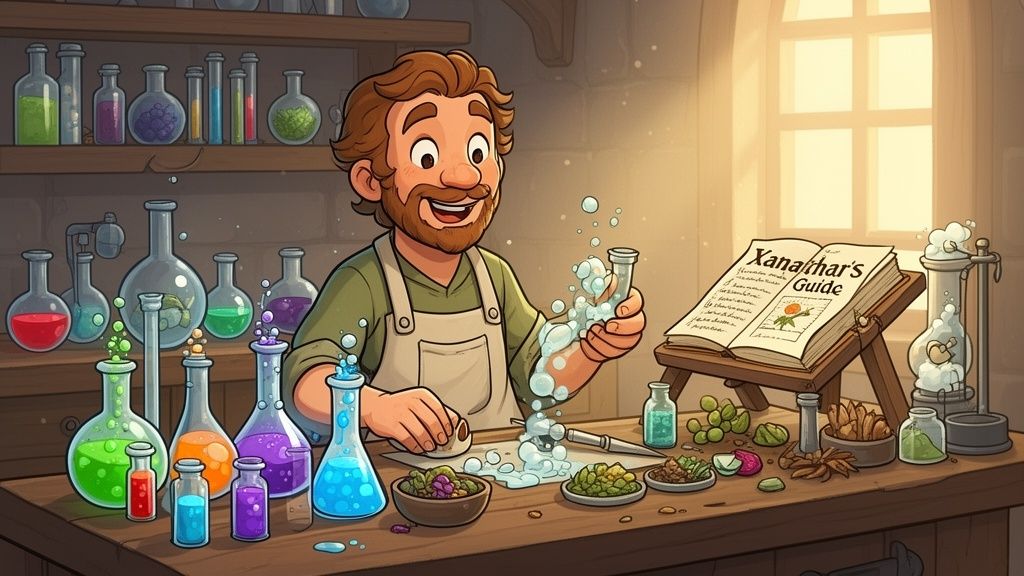
For a common Potion of Healing, Xanathar’s Guide to Everything gives players a clear starting point. Crafting costs 25 gp, which is half the usual 50 gp market price from the Player’s Handbook.
That difference is the whole appeal. If your campaign includes real downtime, a potion is no longer only something found in loot or bought in a shop. It becomes a reserve you can build in advance, one bottle at a time.
Potion crafting works like stocking your bench in a modern strategy game. The benefit does not appear in the quiet scene at the worktable. It appears later, when a fight runs long and the party still has one more answer ready.
That is why careful players often value crafted potions more than their gold-piece maths suggests. They are not only saving money. They are converting spare days into future stability.
If you want the wider rules context, this guide to D&D healing potion rules and uses in 5e pairs well with the crafting rules.
Healing potions invite worldbuilding in a way many consumables do not. One DM may describe a monastery’s honey-thick restorative tonic. Another may prefer sharp-smelling hedge-witch draughts bottled in wax-sealed vials. Both still serve the same mechanical role, but the fiction around them gives the setting texture.
That impulse shows up often in community discussions. Many DMs share homebrew crafting rules that draw on local folklore, rare ingredients, or unstable experimental brews, especially in conversations that followed recent playtests. The pattern is easy to understand. Potion making feels more satisfying when it reflects the place it came from.
A fighter who keeps a satchel of practical battlefield tonics tells a different story from a druid who brews mossy infusions under moonlight. The rules may produce the same healing, but the table learns something about the character from the method.
That matters more than players sometimes expect.
Downtime systems work best when they do two jobs at once. They give a useful reward, and they show who the character is when swords are sheathed. Potion crafting does both.
Before a character commits to potion making, check the ground rules.
A short conversation here prevents confusion later. It also helps crafting feel like part of the campaign rather than a line on a shopping list.
A party limps out of a brutal fight. The rogue is on 4 hit points, the cleric is out of spell slots, and someone uncorks a healing potion only to gain so little that the table barely reacts. That moment tells a DM something useful. The item still works by the rules, but it may no longer work for the pace and pressure of your campaign.
At low levels, a healing potion can swing a scene. Later on, the same bottle can feel more like a pause button than a rescue. That gap matters because treasure is not only a reward. It is also a signal. If players stop caring about potions, one part of your loot economy has gone flat.
Online discussion around 5e makes one pattern clear. Many DMs use house rules for healing potions once campaigns move beyond the early game, often preferring table-specific fixes over official variants.
The reason is simple. Players judge an item by what it lets them do right now. Modern card games handle this well. In a fast tactical game such as TerraClash™ Grimoire, a resource has to justify the moment you spend it. A card that costs time or tempo but barely changes the board tends to stay in hand. Healing potions in 5e can run into the same problem. If drinking one feels weaker than attacking, dashing, or preserving an action for something better, players hoard the bottle and wait for a perfect moment that never comes.
That is a warning sign for DMs. A potion no longer feels like treasure if the table treats it like clutter.
For broader advice on running rewards, pacing, and rulings, this guide to the Dungeon Master’s Guide for Dungeons and Dragons is a helpful reference.
You do not need a complicated fix. You need a rule the table remembers under pressure.
Some groups let characters drink a potion as a bonus action. Some keep the normal action cost but give maximum healing when a character uses their full action to drink it. Others place better potions more deliberately so that stronger healing enters play at the same rate the campaign’s danger rises.
Each option changes player behaviour in a different way. Bonus-action drinking makes potions feel like tempo tools. Maximum healing rewards caution and planning. Better loot scaling keeps the official rules intact while adjusting the economy around them.
Use the version that matches the tone of your campaign.
DM takeaway: If players keep saving potions because using one feels like a poor trade, the rule is creating hesitation instead of tension.
Where a potion appears often matters more than its price.
Too many potions soften attrition and blur the difference between a hard day and an easy one. Too few make every hit point feel irreplaceable, which can slow decision-making to a crawl. Good placement creates relief without removing uncertainty.
A simple way to place them is to tie each potion to a job in the adventure:
That last category is easy to overlook. Players value consumables more when access feels earned.
A healing potion is more memorable when it has a place in the world.
Do not write “2 potions” and move on. Put them in a shrine’s medicine chest, a mercenary surgeon’s satchel, a coach guard’s emergency case, or the private stores of a paranoid noble. The mechanics stay the same, but the context does useful work. It tells players who prepared for danger, who expected violence, and what kind of setting they are travelling through.
That is also good game design. In tabletop RPGs, as in modern card games, resources feel better when they carry both function and meaning. A potion should restore hit points, but it should also tell a story about why it was there and why this was the moment the party found it.

