Learning how to play Shed is simple: your goal is to get rid of all your cards before anyone else. You’ll have three sets to work through—the cards in your hand, your face-up cards, and finally, your hidden face-down cards. It's a game of quick thinking, a bit of strategy, and just enough luck to keep things interesting at your next games night.
Have you ever been at the pub or a friend’s house and watched a card game suddenly explode into cheers and groans? There’s a good chance they were playing Shed. Consider this your official invitation to learn the rules and jump right into the fun.
At its heart, Shed is a beautifully simple "shedding" game where the only objective is to be the first person with no cards left. It’s the perfect mix of luck and tactics, especially when you get that little spark of joy watching a mate have to pick up a massive pile of cards.
What makes Shed so brilliant is how easy it is to pick up and play. Forget about complicated rulebooks or long setup times. All you need is a standard 52-card deck and a few friends who are up for a laugh. The game moves fast, and your fortunes can change in the blink of an eye.
This kind of fast, tactical fun is something we really enjoy in modern games too. For example, the thrill of a quick, smart match is a huge part of TerraClash™ Grimoire, which manages to pack a whole strategic duel into just 10-15 minutes. Much like Shed, it’s all about making clever plays when it counts. If you find yourself enjoying the tactical depth hiding beneath Shed's simple exterior, you might want to give the TerraClash™ Grimoire card game a look.
The game has gone by many names over the years—Karma, Palace, and the slightly less polite Shithead. It first gained traction among backpackers travelling the world in the late 20th century, its popularity growing right alongside backpacking culture itself from the 1970s to the 1990s. By the early 2000s, Shed was a staple in UK pubs and living rooms, with countless house rules popping up. If you're curious, you can read more about the game's origins on Wikipedia).
This guide will walk you through everything you need to know, from dealing the first hand to mastering the tricky endgame. By the end, you’ll be playing like you’ve been at it for years. For more general advice on getting into tabletop gaming, feel free to check out our guide on how to play card games.
If Shed gets you hooked on fast-paced, strategic card games, why not see what else is out there? That feeling of outsmarting your opponent in a quick match is what makes so many modern games great. We’d recommend checking out the TerraClash™ Grimoire Kickstarter campaign and joining a new gaming community from the ground up.
Every game of Shed, like any good card game, begins with the deal. But this isn't just about dishing out cards; the setup is your first chance to play strategically. Getting this part right can be the difference between a quick win and being stuck with a handful of cards while everyone else is finished.
All you need is a standard 52-card deck. We usually let the loser of the last round deal, but you can pick however you like. After a good shuffle, the dealer hands out nine cards to each player, but they're split into three distinct piles that will define your game.
It’s a surprisingly tactical start. It reminds us a bit of the initial character and gear choices you make in a game like TerraClash™ Grimoire, where those early decisions can completely shape how the rest of the game unfolds.
The deal is done in three stages. First, everyone gets three cards dealt face-down in a row. These are your last-resort cards, the ones you can only play when everything else is gone. Don't look at them! The mystery is part of the fun—and the challenge.
Next, you'll get three cards dealt face-up, one on top of each of your face-down cards. These are your 'on the table' cards. Everyone can see them, so take a good look at what you’ve got and what your opponents are showing. These will be your second-to-last cards to play.
Finally, the dealer gives everyone their last three cards to form their starting hand. These are the cards you'll kick things off with. The remaining deck goes in the middle as the draw pile, and you're almost ready to go.
Before the first card hits the table, you get one crucial opportunity to rig the game in your favour. This is the swap phase. You can exchange any of the cards in your hand with any of the face-up cards on the table.
Our golden rule? Always put your best cards on the table. If you're holding a 2 (reset), a 10 (burn the pile), or a high card like an Ace, swap it with one of the face-up cards immediately. It might weaken your opening hand, but it guarantees you have some serious firepower waiting for you in the endgame.
Think about it: your hand changes with every draw, but those face-up cards are set in stone until you play them. Loading them with good stuff is like setting a trap for later.
Here’s what we usually prioritise when swapping:
This pre-game manoeuvring is what makes Shed so addictive. A single round can be over in just 10-15 minutes, but it’s packed with tactical choices right from the very start. That fast pace and depth is something players who enjoy modern card games like TerraClash™ Grimoire will definitely connect with. If you're a fan of quick, strategic games, it's well worth checking out the TerraClash™ Grimoire Kickstarter campaign to see what all the fuss is about.
With the cards dealt and your starting hand finalised, you're now staring at the battlefield. This is where the real fun of Shed begins. The turn-by-turn flow seems simple at first glance, but you’ll quickly find it's a game packed with tactical decisions and sudden, dramatic shifts in power.
The core principle is easy to grasp: you must play a card from your hand that is equal to or higher than the card on top of the discard pile. Play then moves clockwise. If you can't make a legal move, you have to pick up the entire discard pile. It's as simple—and as brutal—as that.
The game kicks off with whoever is holding the lowest starting card (usually a 3, though house rules might change this). They play that card to start the central discard pile. From there, players take turns adding to it, always trying to play a card of the same or higher rank.
After you play a card, you must draw a new one from the deck to get your hand back up to three cards. This goes on until the draw deck is completely empty. Only then does the game transition into its tense, nail-biting final stages.
The basic card hierarchy is straightforward, ascending from 3 up to the powerful Ace.
But the real soul of Shed, the thing that makes it so chaotic and fun, lies in its 'magic' cards. These cards break the standard rules and can completely flip the game on its head in a single turn.
Learning how to play the Shed card game well means mastering these special cards. Think of them as your secret weapons, your escape hatches, and your best tools for sabotaging your opponents. Wasting them is a classic rookie mistake; using them wisely is the mark of a seasoned player.
First, here's a quick look at the setup that gets you ready for this phase of the game.
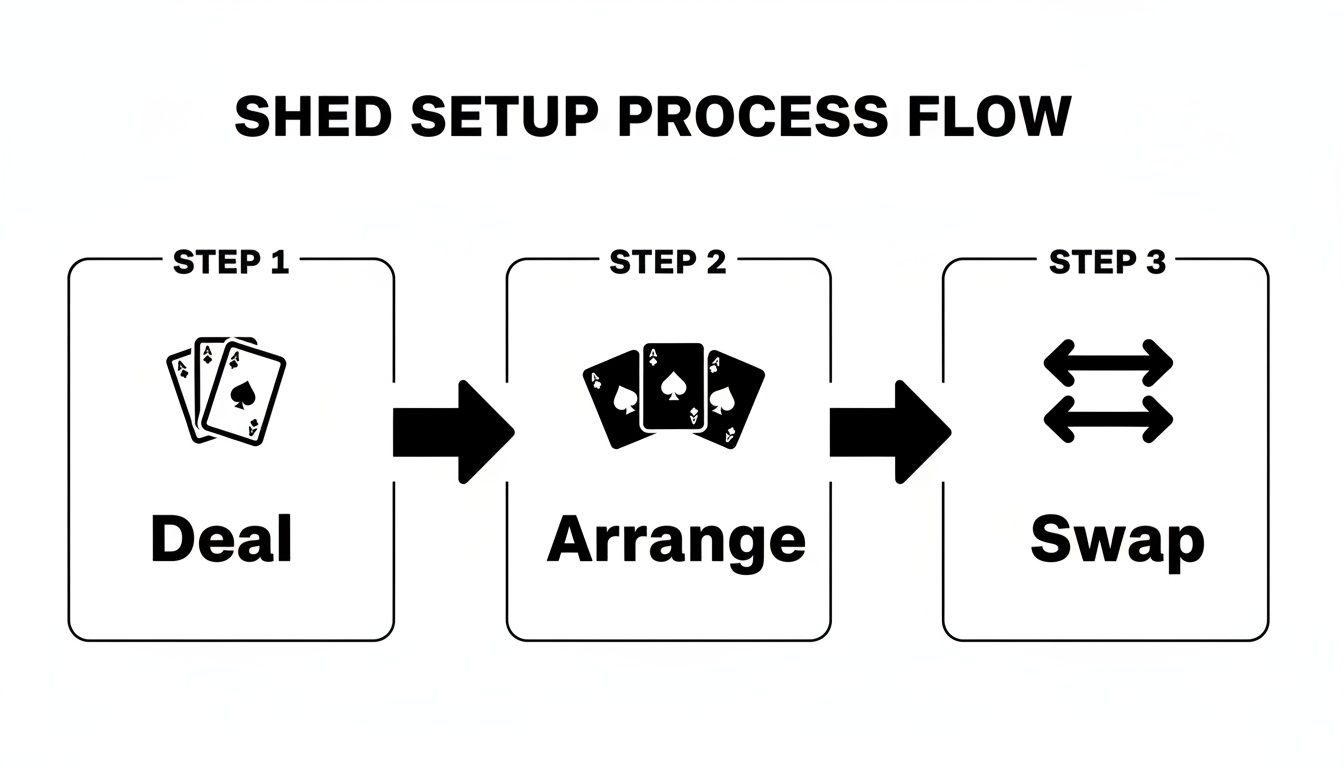
This flowchart neatly shows the dealing, arranging, and swapping that sets you up for the main event. Now, let's get into the cards that make the game tick.
A good game of Shed is all about knowing when to deploy your special cards. Here’s a quick-reference table to keep their powers straight.
| Card | Value/Power | Strategic Use |
|---|---|---|
| 2 | Reset: Can be played on any card. Resets the pile's value to 2. | Your ultimate get-out-of-jail-free card. Use it to escape a high card (like an Ace) and put the next player in a bind. |
| 3-6, 9, J, Q, K, A | Standard: Must be equal to or higher than the previous card. | These are your workhorse cards. Play them to build the pile, but try not to get stuck holding low ones late in the game. |
| 7 | Play Lower: The next player must play a 7 or a card of lower value. | A brilliant trap card. Drop a 7 when you suspect the next player is holding nothing but high cards, forcing them to pick up the pile. |
| 8 | Invisible: "See-through." The pile's value is the card under the 8. | Great for when you don't have a high card. If there's a 4 on the pile, you can play an 8 and the next player still only has to beat a 4. |
| 10 | Burn: Removes the entire discard pile from the game. Gives you another turn. | The most powerful card. Use it to clear a massive, dangerous pile or to chain plays together and get rid of your cards quickly. Don't waste it! |
Mastering these powers is what separates the winners from those who end up with a mountain of cards. The dynamic creates a fast-paced, engaging experience that feels a bit like games such as TerraClash™ Grimoire, where knowing the unique abilities of your cards is the key to outmanoeuvring your opponent in a quick 10-15 minute match.
Pro Tip from a Veteran Player: One of the best feelings in Shed is playing multiples. If you're holding, say, three 5s, you can slap them all down in a single turn. This clears your hand much faster and really puts the pressure on everyone else.
Sooner or later, it will happen. You’ll be staring down a King, and the best card in your hand is a measly 4. When you can't play a legal card, you have no choice but to scoop up the entire discard pile and add it to your hand. Your turn ends immediately.
It’s a painful moment, for sure, but it’s also what makes Shed so thrilling. No one is ever truly out of the game. A player who was just one card away from winning can suddenly be saddled with twenty cards, completely changing the table's dynamic. It’s a humbling, hilarious part of the game that keeps everyone on their toes.
If Shed’s rapid-fire tactics and game-changing moments appeal to you, and you're ready for a new challenge, consider checking out the TerraClash™ Grimoire Kickstarter campaign to discover a game that shares that same spirit of fast-paced fun.
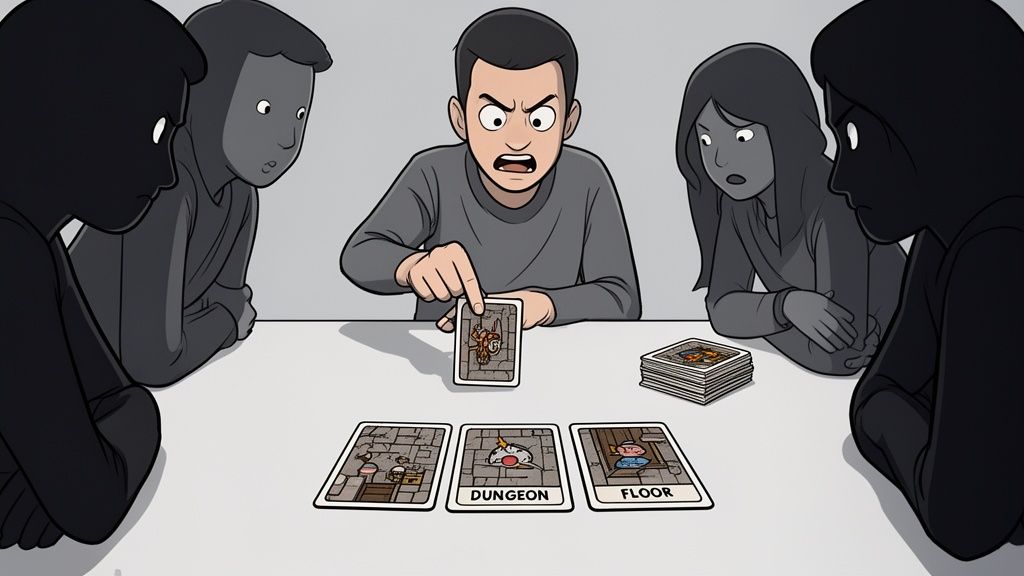
This is it. The draw pile is empty, your hand is gone, and a new kind of tension descends on the table. Welcome to the endgame, the part of Shed that really separates the lucky from the strategic. All you have left are the three cards laid out on the table in front of you.
You’ve been staring at those face-up cards since the deal, and now that foresight is about to pay off. How you play these last few known cards can make or break your entire game.
First up are your three face-up ‘floor’ cards. Unlike the chaos of a full hand, you know exactly what you’re working with here, and the trick is to use them in the most effective order.
If you took our advice during setup, you hopefully have some decent cards waiting for you. A 10 to burn a towering pile, an Ace to seize control, or a 2 to reset everything are your best friends now.
We’ve seen players agonise over this: do you play your best card first just to get it out, or do you save it for the perfect moment? Honestly, it all depends on the table. If you're close to winning and the discard pile is small, getting rid of a high card like a King is probably a safe bet. But if that pile is looking monstrous, holding onto that precious 10 to clear it might be your only shot at victory.
Once your face-up cards are played, you're left with nothing but your three face-down ‘dungeon’ cards. This is the heart-pounding finale of learning how to play the Shed card game—a moment of pure, blind faith. On your turn, you have to pick one, flip it for everyone to see, and hope it’s a legal play.
If the card you flip is valid—equal to or higher than the top card, or a magic card—you can breathe a huge sigh of relief. You’re one step closer. But if it isn’t, disaster strikes. You must pick up the entire discard pile, including your just-flipped card.
The most devastating feeling in Shed is flipping a 3 onto a pile topped by a King. In an instant, you're back to square one with a massive hand of cards, and your hopes of a quick win are completely dashed. It's a brutal but brilliant mechanic that ensures no lead is ever truly safe.
This is where the game gets personal. Other players will often gang up on whoever is in the lead, trying to force them into a position where picking up the pile is inevitable. It adds a delicious psychological layer that anyone who enjoys modern tactical card games will absolutely love.
This kind of rapid-fire, high-stakes gameplay, where a match can be decided in a few crucial turns, is what makes a game night truly memorable. It’s this same spirit we channelled into TerraClash™ Grimoire, a fast-paced game that packs a complete strategic experience into just 10-15 minutes. Every card matters, much like flipping that last unknown card in Shed. If this blend of luck and tactics gets your pulse racing, you can learn more about the TerraClash™ Grimoire card game on our site.
Managing to shed that final face-down card makes you the winner. You get to sit back, relax, and enjoy watching your friends battle it out. The last person left holding cards earns the game's dubious honour, and usually, the job of dealing the next round. If you’re already hungry for your next fast-paced adventure, we highly recommend checking out the TerraClash™ Grimoire Kickstarter campaign.
So, you've got the basics down. You know how to get rid of your cards and avoid picking up that dreaded pile. Now, we get to the good stuff—the clever plays and sneaky tactics that separate the casual players from the true Shed masters. This is where you move beyond just surviving and start dictating the flow of the game.
This deeper strategy is what makes Shed so addictive. It’s got that “just one more game” quality, much like the tactical duels in TerraClash™ Grimoire. Both games scratch that same itch for fast-paced fun, where a quick 10-15 minute match is packed with smart moves and sudden reversals of fortune.
Knowing what your cards do is one thing; knowing when to play them is the real game-changer. It’s tempting to use your powerful ‘magic’ cards—the 2s and 10s—as soon as you can, but patience is a virtue. A classic rookie mistake is burning a 10 on a tiny pile just to get another turn. You'll kick yourself later when a massive pile comes your way and you have no escape. Save it for a real emergency.
Forcing an opponent to pick up is an art. If you’ve noticed the player after you has been struggling, that's your cue. Drop a high card like a King or an Ace and watch them squirm. Even better is the well-timed 7, forcing them to play low. If you suspect their hand is full of picture cards, this move can be absolutely devastating.
A little light card counting can also give you a serious edge. Say two 10s are already in the discard pile and you’re holding the third. You now know there's only one left, either in someone's hand or still in the deck. This insight is gold, especially as you get down to the wire. It helps you calculate your risks. You can dive deeper into these kinds of strategies in our article on First Strike magic and tactics.
One of the best things about Shed is how it morphs and changes from one group to the next. Almost every family or circle of friends has its own unique twists on the rules, which keeps the game feeling fresh and personal. These ‘house rules’ are part of the game’s charm, passed down through years of play.
The beauty of Shed is its flexibility. Don't be afraid to experiment with your own rules. The goal is to have fun, and sometimes a new rule is all it takes to make an old game feel brand new.
The sheer number of variations is a testament to how ingrained this game is in British gaming culture. By the mid-2010s, several popular rule sets had become widespread. You might have heard of the famous Tenerife Rules, where a player can choose to pick up the discard pile even if they have a playable card. Why would you do that? To snatch a powerful card you know is buried in there! It’s a bold, high-risk, high-reward move. You can learn more about the cultural impact and proliferation of card game rules in this fascinating research paper.
Here are a few popular house rules you could try in your next game:
The way Shed can be tweaked to fit your group’s personality is reminiscent of the customisable adventures in the TerraClash™ Grimoire card game. If you're a fan of this blend of fast fun and deep strategy, it's the perfect game to check out. Sound like your cup of tea? Head over to the TerraClash™ Grimoire Kickstarter campaign and join a growing community of fellow strategy lovers.
So, you've mastered the art of Shed. You know the thrill of emptying your hand and leaving your friends with a pile of cards. If that fast-paced, strategic fun is what you love, you're in luck – there are plenty of other games that capture that same magic. That feeling of a quick, clever battle in just 10-15 minutes is a hallmark of some of the best modern card games out there.
One game that really nails this feeling is TerraClash™ Grimoire. It packs a serious strategic punch into a really quick playtime, making it perfect for a weeknight session or a warm-up on games night. It’s for those of us who crave deep tactics but don’t always have a whole evening to spare. If you've been searching for more easy-to-learn card games that offer surprising depth, this one should definitely be on your radar.
If you’re ready to take the skills you’ve honed playing Shed and apply them to a fresh challenge, we’d personally recommend checking out the TerraClash™ Grimoire Kickstarter campaign. It’s a great chance to get in on the ground floor of a new gaming community.
Once you’ve got a few games of Shed under your belt, you’ll start running into those tricky situations that spark a bit of debate. Getting the basics down is one thing, but knowing how to handle these moments is what keeps the game night fun and friendly. Here’s how to settle the most common arguments before they even start.
Shed’s quick, back-and-forth rhythm is what makes it so addictive. It reminds us a bit of modern tactical games like TerraClash™ Grimoire, where a whole strategic battle plays out in a punchy 10-15 minute match. In both games, knowing the rules inside and out is your best weapon.
Ah, the moment every Shed player dreads. If your turn comes around and you can’t play a card that’s equal to or higher than the top card of the pile, you have to scoop up the entire discard pile.
That’s it, your turn is over. All those cards are now yours. It’s a brutal twist of fate that can instantly send you from the verge of victory right back to square one with a fistful of cards.
Yes, and you absolutely should! If you’re holding multiple cards of the same rank – say, a pair of 6s or three Jacks – you can slap them all down at once.
It’s one of the best ways to empty your hand fast and leave the next player in a tough spot. And if you’re playing with the popular "four-of-a-kind burns" house rule, this move becomes even more satisfying, working just like a 10.
The 2 and the 10 are the game-changers. These are your ‘magic’ cards, each with a powerful and distinct ability to get you out of a jam.
A little tip from experience: we always try to hang on to at least one 2 or 10 for the endgame. Having one of these when you’re down to your last few cards can be the difference between winning and picking up a monster pile. They are your aces in the hole, so use them wisely!
This is it, the final, nail-biting stage of Shed. You only get to touch your three face-down 'dungeon' cards after your hand and your three face-up cards are completely gone.
When it’s your turn, you have to choose one, flip it over, and play it blind. If the card happens to be a legal play (equal, higher, or a magic card), you breathe a sigh of relief. Your turn is over. But if it’s an illegal play, you have to pick up the entire discard pile, plus the card you just failed to play. You’ll then have to get rid of this new hand before you can try your luck with the remaining face-down cards. It’s a pure gamble right at the finish line!
It’s this mix of careful strategy and blind luck that makes for such a thrilling end to the game. If you love this kind of quick, clever gameplay, you’ll feel right at home with a game like TerraClash™ Grimoire. It’s built for players who get a kick out of making smart plays in a fast-paced setting.
If learning how to play Shed has you fired up for more tactical fun, why not discover your next favourite game? Find out more about TerraClash™ Grimoire on the Grimoire page and check out our Kickstarter campaign to join our growing community.

