Hark, adventurer, and draw near. Let us speak of the dead that do not rest. Gather 'round the ethereal campfire, for I shall unveil the secrets of one of the most timeless foes in the realm: the Dungeons and Dragons zombie. They are the cornerstones of fantasy horror, often a party’s first, chilling encounter with the foul work of necromancy.
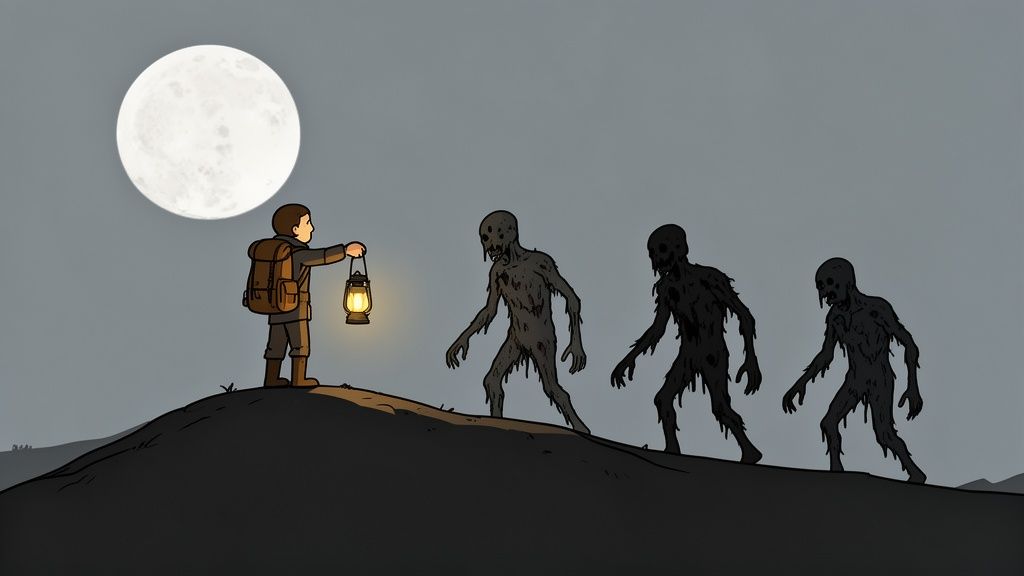
Forget your fleeting ghosts and ethereal spirits for a moment. We delve now into the lore of the shambling corpse, a creature that has menaced heroes since the earliest chronicles of D&D. Their true power lies not in clever tactics or devastating strikes, but in their awful, relentless persistence and the sheer, crushing weight of their numbers.
A single zombie? Scarcely a threat. A well-placed blade or a mighty blow from a mace will usually return one to dust. But a horde... a horde is a different beast entirely. It is a tide of grasping hands and gnashing teeth that can easily swamp even the most grizzled veterans.
This makes them the perfect crucible for new Dungeon Masters. They teach a party crucial lessons about working in unison, controlling the battlefield, and preserving precious spells. If you are just finding your path as a DM or player, our scroll on D&D for beginners may hold further wisdom for you.
Part of their lasting appeal is the visceral imagery they evoke—that iconic, grotesque look you see in everything from campaign art to a Heart Zombie Hands sticker. There is no denying the zombie's place in weaving tales of pure dread.
The true horror of the zombie is its simplicity. It is a mirror of our own mortality, stripped of soul and purpose, driven only by a relentless, mindless hunger. It is a chilling reminder of what awaits when dark magic holds sway over life and death.
This archetype of the overwhelming, numerous foe has inspired countless other games. It forces players to think tactically, whether they're holding a chokepoint against a legion of undead or carefully planning their next move in a roguelite deck-builder.
You can see that classic design DNA influencing new indie games like TerraClash, which challenges you with similar strategic puzzles. The grave is about to give up its secrets, so prepare your wits. You can follow our progress and get ready for the launch over on the TerraClash Kickstarter page.
If you truly wish to understand the nature of Dungeons and Dragons zombies, you must peer into the grim, profane shadows where they are forged. These abominations are not of the natural world. They are twisted mockeries of life, brought back by powerful and deeply malevolent magic. Every single shambling corpse was once a person with a story, a family, a life—all of it wiped clean and replaced by a hollow shell serving a much darker purpose.
The most frequent culprit is necromancy. It is a foul school of magic that yanks a spirit from its final rest, shoves a shard of negative energy into its old body, and forces it back onto its feet. The corpse rises, but the soul is long departed. What you face is a puppet, a rotting automaton that follows the simple, brutal commands of its master. It is nothing more than a ghastly echo, completely devoid of memory or feeling.
It is vital, storyteller, to draw a line between a zombie and its undead cousins. They are all animated dead, to be sure, but they sit on very different rungs of the ladder of dread.
This is not just lore; it is a core design choice in countless fantasy worlds. The zombie's role is to be the overwhelming tide, the slow-moving terror that crushes you through sheer numbers and its unnerving, dogged persistence.
A skeleton might be an enemy you fight, but a zombie is a tragedy you must end. Its vacant stare is a constant reminder of the life it once held, making every encounter a grim and sorrowful affair.
Vile patrons of undeath, like the demon lord Orcus, delight in this kind of corruption. He is a master of twisting life into a horrifying parody of itself, and his mere influence can raise entire legions of the dead. Understanding these dark origins is what gives your encounters true narrative weight, turning a simple skirmish into a chilling, memorable experience. It is this deep well of lore that gives tabletop adventures their flavour, a richness that inspires new systems like the deck-building challenges you might find in a game like TerraClash.
To defeat your enemy, you must know your enemy. So, let us crack open the Monster Manual and gaze upon the standard-issue Dungeons and Dragons zombie. On paper, it seems a pushover. Its rotting flesh grants it a low Armour Class, making it an easy target for any who can swing a sword. But do not be fooled by this simple truth.
The real nasty surprise is their sheer, unnatural toughness. A zombie is not held together by biology; it is animated by dark magic. This grants it the infamous Undead Fortitude trait. A blow that would fell a living creature might merely cause a zombie to stumble. Unless you strike it with a critical hit or radiant power, it has a chance to simply ignore the damage and keep coming. That single ability transforms it from a minor pest into a slow-moving, unstoppable wall of death.
One zombie is a trifle. A horde of them? That is a grave tactical problem that can bury even a well-prepared party. As a Dungeon Master, your greatest weapon is not the zombie’s slam attack—it is the crushing weight of their numbers. They are not clever; they are a force of nature. A shambling tide of decay. Use this to your advantage and command the flow of battle.
Their low Challenge Rating of CR 1/4 is a classic deception. Indeed, a handful of zombies might be a breeze for a level 1 party, but unleash twenty of them upon a group of level 5 heroes, and you have a potentially deadly encounter on your hands. Knowing how to deal with such crowds is where simple weapons can shine, a skill every adventurer should master. If you wish to delve deeper into the tools of the trade, our guide to D&D martial weapons is a worthy read.
To help you peer into the rotting mind of a zombie, here is a quick tactical breakdown. Consider it your secret map for running (or fighting) the undead.
| Attribute | Mechanical Effect | Tactical Implication |
|---|---|---|
| Low Armour Class | Very easy to hit with most attacks. | Players will feel confident, but this can lead to overextending into the horde. |
| Undead Fortitude | Can survive a lethal blow (unless from a critical hit or radiant damage). | Drains party resources (spell slots, health potions). Makes focusing fire less reliable. |
| Slow Speed | Moves at only 20 feet per round. | Easy to outrun in open spaces, but they excel at cornering players in tight quarters. |
| Simple Slam Attack | Low damage, single melee attack. | Individually weak, but devastating in large numbers due to multiple attack rolls. |
| Mindless Nature | Immune to charm, has low intelligence. | Cannot be reasoned with or tricked easily. Follows simple, direct commands or instincts. |
This table should grant you a solid foundation for your zombie-related machinations. Remember, the key is to think of them not as individual creatures, but as a single, sprawling environmental hazard.
Remember this, Game Master: The zombie is not the monster. The horde is the monster. Treat it as a single, sprawling entity with many grasping hands and gnashing teeth. Its goal is to surround, overwhelm, and consume.
Mastering these fundamentals is crucial, not just for running a great D&D game, but for understanding how enemies function in many tabletop systems. The idea of a tough, numerous foe that tests resource management is a design philosophy you will see again and again, even in the strategic deck-building of modern card games like our adventure, TerraClash.
The standard zombie is but a blank canvas, a starting point for something truly monstrous. If you wish to elevate your undead encounters from a simple hack-and-slash to a truly memorable event, you must think beyond the basic stat block. A great Dungeon Master looks at a shambling corpse and sees potential.
Consider this. Your players could stumble into a cavern where the dungeons and dragons zombies are animated not by necromancy, but by a strange, bioluminescent fungus. Every sword swing risks bursting a spore sac, filling the air with toxic, mind-altering fumes. Or what of cryo-zombies in a frozen crypt? Their chilling touch does not just deal damage; it drains the very warmth from your players' bodies, inflicting levels of exhaustion with every strike.
This small map breaks down the essential tactics of a standard zombie fight. It shows how their poor defences connect to their surprising resilience, and the one great weakness that short-circuits it all.
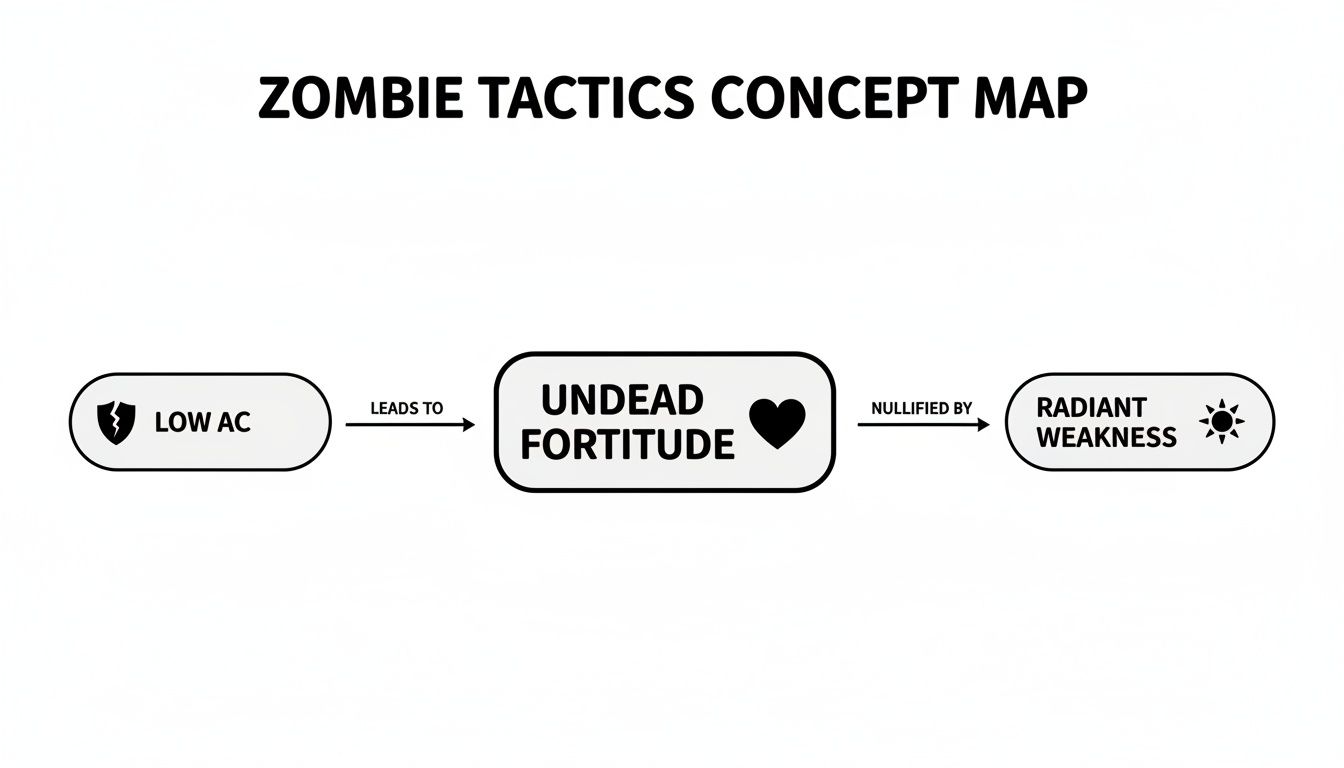
As you can see, a zombie's low AC is balanced by its Undead Fortitude, but that entire defensive trick is completely bypassed by a potent blast of radiant damage.
The environment must be as much a threat as the zombies themselves. A zombie is merely an obstacle, but its lair is what creates the terror. Forget the classic graveyard for a moment and consider these locales:
The choices players make in these situations can reveal much about their characters. It is curious, but player morality often reflects real-world attitudes, even when facing a zombie apocalypse. A YouGov survey found that nearly a third (31%) of Brits see themselves as Neutral Good—the perfect alignment for pragmatic survivors trying to do the right thing in a world gone mad.
The most frightening encounters aren't about the monster's strength. They're about the story they tell and the choices they force upon the heroes. A zombie that was once the beloved village elder is a far greater threat than any generic corpse.
If you wish to make your D&D zombie encounters truly unforgettable, look to some horror story prompts for inspiration. They can provide that narrative spark to turn a simple fight into a chilling tale. Weaving these encounters together takes thought, but tools can aid your dark craft. A good encounter builder for 5e can be a massive help for any DM's toolkit.
These design ideas are universal, truly. You see them in other fantasy games where creators are constantly reimagining old tropes to build exciting new worlds. The strategic depth needed to design a great undead encounter translates surprisingly well to things like deck-building games, such as TerraClash, where every single choice you make shapes the world and the challenges you will face.
The shadow of the undead stretches far beyond the pages of any Dungeon Master's guide. That raw, primal fear of the horde—the feeling of being slowly, inevitably overwhelmed—is an incredibly potent storytelling tool. It is no surprise, then, that its influence has seeped into the very foundations of modern tabletop games. After all, the challenge posed by Dungeons and Dragons zombies is not just about swinging a sword; it is a desperate test of wits, resource management, and teamwork against a foe that simply never stops coming.
This design philosophy is breathing new life into other kinds of tabletop adventures, especially in the world of board games and deck-builders. Indie creators have done a masterful job of capturing that feeling of a desperate last stand, forcing players to think several moves ahead just to see the next sunrise. Many board games, for instance, use mechanics like escalating threat trackers or horde rules that add more enemies each round, brilliantly simulating a full-blown apocalypse. It is this kind of creative thinking that keeps our hobby so fresh and thrilling.
The kind of strategic thinking you need to survive a zombie encounter in D&D has a direct parallel in modern card games. Instead of managing spell slots and hit points, you might be carefully curating a hand of cards, agonising over when to play a powerful ability and when to hold back. This jump from roleplaying to strategic card play feels completely natural because the core challenge is identical: use your limited resources to overcome a relentless, and often numerous, enemy.
It is a challenge players are embracing more than ever. Since the pandemic, tabletop gaming in the UK has absolutely skyrocketed. Surveys have shown a 37% increase in tabletop RPG play and a staggering 85% surge in interest for Dungeons & Dragons alone, fuelling countless zombie-centric campaigns. You can dig deeper into these numbers with these insights into the UK's growing RPG scene.
The essence of fighting the undead is a puzzle of attrition. Whether you face them with dice and character sheets or with a hand of beautifully illustrated cards, the goal is to outlast the darkness. It’s a timeless challenge that speaks to the survivor in all of us.
This design is at the heart of so many new adventures, where every card drawn can mean the difference between glorious victory and a grim demise. games like TerraClash lean right into this philosophy, tasking players with building a powerful deck to face down fierce foes in a world that changes with every quest.
This image from their Kickstarter page gives you a real feel for the game's vibrant art and the kinds of monstrous foes you'll need to outwit.
The artwork just pops, suggesting a world packed with unique creatures where you’ll have to constantly adapt your strategy to overcome whatever the game throws at you. If that kind of strategic, story-driven gameplay calls to your adventuring spirit, you might want to consider lending your support to the TerraClash Kickstarter campaign and become part of a new legend.
And so, our time among the crypts draws to a close, but that tell-tale sound of dragging feet will likely linger. We have delved deep into the lore of Dungeons and Dragons zombies, dissected their stat blocks, and conjured some truly terrifying encounters for your next dark campaign. It is a testament to their simple, horrifying concept that they have inspired countless tales, not just at the D&D table, but across the entire, wonderful landscape of tabletop gaming.
The true magic of the zombie, I have always found, lies in its versatility. A zombie can be a single, tragic figure your players feel a pang of guilt for putting down. It can be a relentless, overwhelming horde that pushes a party's resources and resolve to the absolute limit. It can even be a narrative tool for exploring deeper themes of survival, loss, and what it means to find hope when the odds are stacked against you. They are a monster that challenges you physically and emotionally.
The zombie is more than just a monster; it's a question aimed directly at the living. In its vacant stare, we're forced to confront the fragility of our own existence and decide what's truly worth fighting for when everything seems lost.
I hope these dark inspirations fuel your own campaigns and maybe even tempt you to look beyond the well-trodden paths of D&D. The world of tabletop gaming is vast and brilliant, stretching from epic roleplaying sagas to thrilling deck-building games that let you forge entirely new kinds of legends. A fantastic example of this spirit is the indie game TerraClash, where a different kind of strategic thinking and creativity is key for any hero aged 12 and up.
As you journey forth on your own adventures, hold on to the lessons the shambling dead have taught us. Keep exploring, keep rolling the dice, and never, ever let that adventuring flame die out.
Even the most seasoned dungeon delver has a question or two when the dead start walking. Let us unearth some of the common queries that arise when DMs and players prepare to face the shambling hordes.
On the surface, it is a matter of aesthetics. Zombies are the gruesome, fleshy ones, animated by dark magic that keeps their rotting meat clinging to their bones. They are a grotesque mockery of the life they once had. Skeletons, on the other hand, are the 'cleaner' of the two, all rattling bones and empty eye sockets.
But in battle, the differences truly matter. A Dungeons and Dragons zombie is a stubborn brute. Its Undead Fortitude trait means it has a nasty habit of rising again right after you think you have put it down for good. This makes them fantastic meat shields. Skeletons are more fragile but often more cunning; they are nimble enough to use bows and swords, making them the perfect undead archers and infantry.
Once your players have seen a dozen zombies, the fear factor can wane. That is your cue to get creative and introduce some nasty variants. Homebrewing your own undead is a brilliant way to inject fresh terror and story hooks.
The boom in D&D's popularity, especially across the UK, means players are always hungry for new challenges. A lot of this excitement is tied to shows that feature zombie-like monsters straight out of D&D lore. You can discover more about this trend and its cultural impact if you are curious.
Indeed. If you love the desperate, back-against-the-wall feeling of a zombie encounter, the co-operative survival genre is packed with gems. Many great indie board games and Kickstarter projects explore similar themes.
The core puzzle of fighting a zombie horde—managing limited resources against a relentless, overwhelming enemy—is just brilliant game design. It translates perfectly from a roleplaying campaign to a board or card game.
Games like Zombicide or even Gloomhaven: Jaws of the Lion perfectly capture that feeling of teamwork against waves of automated enemies, just like battling a tide of the undead. This kind of strategic thinking against the odds is also at the heart of many fantastic indie games.
That spirit of tactical survival and overcoming immense odds is what we at TerraClash live for. If building clever strategies to defeat powerful foes gets your blood pumping, we think you’ll love our roguelite deck-building adventure. You can find out more and join our quest over on the TerraClash Kickstarter.

