Hark, adventurer, and gather 'round. Let us speak of the tome that has launched a thousand quests. If you hold the Dungeons and Dragons 5e Player's Handbook, you possess more than mere paper and ink – you hold a key. This is a portal to realms untold, a grimoire of countless adventures, and the first step toward forging the hero of your grandest imaginings.
In this guide, I shall be your wizened sage, leading you through its hallowed pages. Think of me as a seasoned traveller who knows the lay of the land. We shall explore how this one volume grants you everything needed to build a character from the ether of imagination, wield incredible magic, and understand the fundamental laws that bind these fantasy worlds together.
Essentially, the Player's Handbook is a map for your spirit. It provides just enough structure to let your creativity run wild, offering the tools to craft a unique champion with their own story and destiny. Every choice you make, from your hero's race to their class, becomes a building block for an epic tale yet to be written.
The true genius of this handbook is that it weaves a shared reality for all who gather at the table. It brings you, your comrades—and the Dungeon Master—into alignment on how the world works. How far can a dwarf see in a pitch-black cavern? What truly happens when a wizard casts Fireball in a tiny, crowded tavern? The answers are whispered from these pages.
For any soul just cracking open the Dungeons and Dragons 5e Player's Handbook for the first time, it is the perfect starting stone. It’s an essential guide for beginners and the first step on any great quest.
We shall also peer into how the ancient art of roleplaying connects to the strategic thrill of modern tabletop games. Consider that heart-pounding moment in a deck-building game when your next card draw could alter the course of destiny. That same feeling—of making difficult tactical choices and yielding to the roll of fate—is a spirit we've poured into our own saga, a deckbuilding and dice RPG for ages 12+ called TerraClash.
The greatest tales are not just about reaching the end. They are about the choices made along the path. Whether you're rolling a d20 or drawing a card, you are the storyteller. This handbook is but your first chapter.
The skills you'll glean from D&D—thinking on your feet, managing your resources, and finding creative solutions to dire problems—will make you a more formidable player at any gaming table. And if you are entirely new to this world of shared storytelling, our separate scroll on D&D for beginners is a fine place to begin your journey. Now, prepare to turn the page and let your own legend commence.
So, the first great quest the Player's Handbook sets before you is not in a dragon's lair or a forgotten tomb. It happens within the crucible of your imagination. Who shall you be? A stoic Dwarven Cleric, their faith a literal shield against the encroaching darkness? A nimble Halfling Rogue, whose footsteps are mere whispers in the shadows? Or perhaps a haunted Tiefling Warlock, drawing on otherworldly power from a pact they might one day regret?
This is the forge where legends are hammered into shape. The first crucial decision you shall make is choosing your character's Race and Class – the very heart and soul of your adventurer. Think of it as building a deck for a card game; your first few selections will define your core strategy and the kinds of plays you can make as the game unfolds.
Your character's Race, or lineage, grants you a starting package of innate abilities, a fragment of cultural history, and a unique way of seeing the world. An Elf’s natural grace and keen senses are a world away from a Dragonborn’s elemental breath and proud, draconic heritage. This choice is not just about the numbers on your sheet; it is about grounding your hero in the world and giving them a place to belong (or not belong).
Next comes your Class. This is your hero's vocation, their training, and their role in an adventuring party. Are you a frontline Fighter, a master of every weapon and shield? A wise Wizard, literally reshaping reality with ancient, arcane formulae? Or perhaps a wild Druid, a fierce guardian of the natural world? Each class offers a distinct path forward, with unique abilities that grow and evolve as you gain experience.
The true magic happens when you begin to weave these elements with your own visions. A Half-Orc Barbarian is a classic, to be sure. But a Half-Orc Warlock who made a desperate pact with a shadowy patron to save their tribe from starvation? Now that is a story yearning to be told.
This entire process is a wondrous blend of strategy and pure creativity. If you desire a more detailed walkthrough of all the steps, our guide on how to make a Dungeons and Dragons character can light the path for you from start to finish.
Beyond race and class, your hero needs a Background. Where did they hail from before their life of adventure began? Were you a scrappy street urchin who learned to survive on wit and speed alone? A noble cast out from your family, desperately seeking to reclaim your honour? Or a soldier, still haunted by the horrors of a war you barely survived? Your background grants you skills, potential allies, and a narrative hook to ignite your roleplaying.
These elements—race, class, and background—are designed to work in concert, creating a powerful synergy. The handbook is built around this modular approach, allowing for nearly endless customization. It is no surprise that since its debut, the D&D 5e Player's Handbook has sold millions of copies. The sheer freedom it offers, with its 12 classes and 10 backgrounds, feels akin to the deck-building freedom in modern board and card games, which resonates with so many players.
To help you feel how these choices come together, think of them in terms of common adventuring archetypes. Each one fills a different, vital role in a party.
Here’s a quick glance at the primary roles and typical playstyles of the core character classes. This should help you divine which path calls to you.
| Class Archetype | Primary Role | Key Abilities | Example Playstyle |
|---|---|---|---|
| The Warrior (Fighter, Barbarian) | Frontline Combat & Damage | High durability, weapon mastery, powerful strikes. | A strategic protector who controls the battlefield and shields weaker allies from harm. |
| The Priest (Cleric, Paladin) | Support & Healing | Divine magic, healing spells, turning undead, protective auras. | A dedicated healer and holy warrior who buffs allies and smites evil with righteous fury. |
| The Rogue (Rogue, Ranger) | Stealth & Skill Specialist | Sneak attack, lockpicking, trap disarming, survival skills. | A cunning scout and striker who operates from the shadows, dealing precise damage and overcoming obstacles. |
| The Mage (Wizard, Sorcerer) | Arcane Spellcasting & Control | Powerful elemental spells, utility magic, reality-warping effects. | An intellectual powerhouse who controls the flow of battle with devastating spells and clever illusions. |
Ultimately, the hero you forge is yours and yours alone. The Player's Handbook gives you the tools, but you provide the spark. Choose wisely, for the path you set out on today will shape the sagas you and your friends will be telling for years to come.
Every world, whether it springs from a Dungeon Master’s mind or the flip of a card, runs on a set of basic laws. The Dungeons and Dragons 5e Player's Handbook is your guide to the very physics of these fantasy realms. At first glance, all those tables and terms can look a bit intimidating, but trust me, they're much more straightforward than they seem.
These rules are not here to restrain you; they are the engine that drives the story forward. They create those nail-biting moments of tension and those fist-pumping scenes of victory. Think of it like this: a great board game has rules that open up deep strategic possibilities, and D&D's rules do the same for your character's incredible adventures.
At the heart of Dungeons & Dragons lies one simple, elegant mechanic. You roll a 20-sided die (the iconic d20), add a number based on your character’s skills and training, and try to best a target number set by the DM. That is all. This single action resolves everything from trying to sweet-talk a grumpy guard to landing a final, desperate blow on a snarling owlbear. These are your ability checks, skill checks, and saving throws – the rolls that stand between success and failure.
Everything your character attempts is rooted in their six core ability scores: Strength, Dexterity, Constitution, Intelligence, Wisdom, and Charisma. These numbers are the bedrock of your hero, influencing almost every roll you make and representing their raw, inherent potential.
Learning these core mechanics is akin to learning the grammar of a new language. Once you grasp the basic structure, you can begin to build beautiful, complex sentences and tell your own unique story through the rolls of your dice.
The whole process of bringing a character to life and figuring out what they can do is an adventure in itself, and it all starts with a few key choices. This is the simple, foundational path the Player’s Handbook lays out for you.
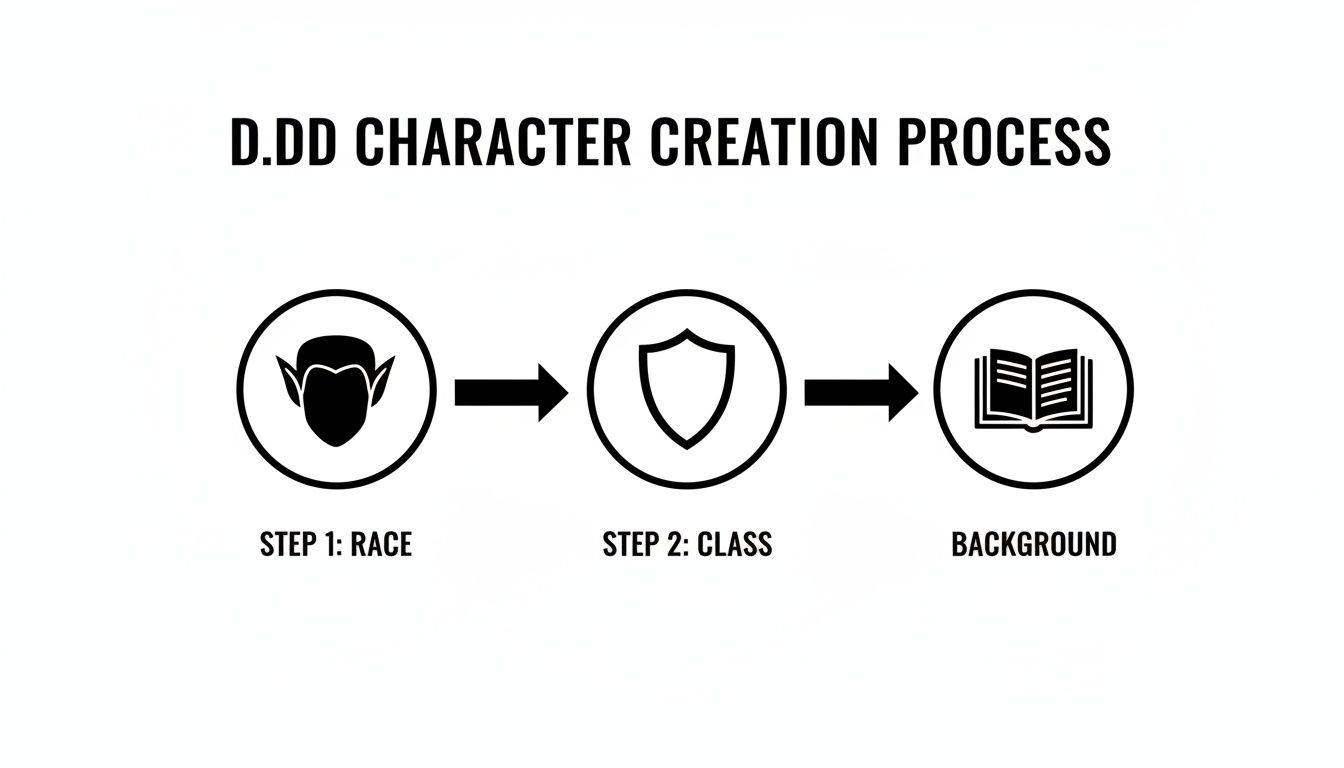
Just by picking a Race, a Class, and a Background, you create a fantastic foundation for your hero's abilities and story hooks.
When swords are drawn and incantations are shouted, the game’s pace changes. It shifts into a structured, turn-by-turn flow where tactical thinking truly comes alive, feeling almost like a great strategy game. On your turn in a fight, you generally get to perform three things:
You also get one reaction to use each round, which lets you act even when it’s not your turn—like taking a swing at an enemy foolish enough to run past you. Getting the hang of this "action economy" is the secret to becoming a true powerhouse on the battlefield. For anyone trying to get their head around the deeper rules, especially the dense chapters in the Player's Handbook, tools like AI PDF Summarizers can be surprisingly helpful for breaking it all down.
This simple system turns every fight into a dynamic puzzle. It’s all about teamwork, smart positioning, and knowing when to unleash your best tricks—skills that you’ll find useful in all sorts of other tabletop games, from sprawling board games to tactical deck-builders like our own adventure, TerraClash. Once you grasp these rules, a whole world of storytelling opens up, where a single good dice roll can change everything.
Ah, now we speak of the good stuff. The true heart of fantasy. If you've ever dreamt of calling down lightning, mending a fatal wound with but a touch, or tricking a guard with illusions woven from pure shadow, then the magic chapter of the Dungeons and Dragons 5e Player's Handbook is where you belong. This is your personal spellbook, your key to bending reality to your will.
Magic in D&D is not just about yelling funny words and waving your hands. It is an art, a science, and a raw force of nature all rolled into one. The handbook is your mentor, ready to guide you through its incredible mysteries.
Your first step on this path is grasping the two main flavours of magic. On one hand, you have cantrips. Think of these as your basic, reliable tricks—little magical feats you can perform whenever you wish. Creating a spark of light, slamming a door shut with a gust of wind, or unnerving an enemy with a chilling touch. They are simple, but you shall use them constantly.
Then you have the true powers: levelled spells. These are the showstoppers, the incantations that can incinerate a host of monsters or solve a seemingly impossible problem. To cast one of these, you must spend a spell slot, which is a measure of your magical stamina. Once it's gone, you must rest to regain it. This system creates brilliant, nail-biting decisions in the heat of the moment.
The choice to expend a powerful spell slot is a moment of pure D&D. Do you unleash that Fireball on this pack of goblins, or do you save it for the massive beast you hear roaring in the next chamber? Managing these resources is what separates a novice from a seasoned hero.
To actually make the magic happen, the handbook breaks down the "components" of a spell. You can think of these as the gestures, words, and special items you need to shape raw magic into a specific effect.
Knowing how to cast your spells is one thing, but understanding just how potent they are is another. If you wish to dig deeper into the numbers behind your magical power, our guide on understanding Spell Save DC in 5e is the perfect next step.
Honestly, the whole process of choosing, preparing, and casting spells feels much like building a deck for a card game. You must carefully select an arsenal that covers all your bases—combat, exploration, and tricky social situations. Each spell is a card in your hand, a unique tool for a specific job. It is this same feeling of strategic planning and resource management that we have woven into the core of our own adventure, TerraClash, where your cards and dice rolls will shape your legacy.
The skills you glean poring over the Dungeons and Dragons 5e Player's Handbook do not just stay within its pages. They have a peculiar way of bleeding into every other game you bring to the table. The lessons it teaches are surprisingly universal, echoing in the rattle of different dice and the shuffle of unique card decks across the whole hobby.
Consider this. The core principles you master are the bedrock of great gaming. You learn about managing your resources, weighing whether to unleash a powerful spell slot now or hold it back for a greater threat down the line. That is the exact same strategic tension you feel when deciding whether to play your trump card in a deck-builder like Dominion or wait for the perfect moment.
Learning D&D gives you a powerful framework for understanding almost any other strategic game. You begin to speak the language of the tabletop, recognizing familiar ideas dressed in new clothes.
These games, much like a classic D&D session, are all about making meaningful choices and rolling with the fates. The creative spark you get from the handbook can fuel a passion for a hundred different worlds, each with its own rulebook and its own challenges.
The sheer success of D&D has shown the gaming industry what players truly seek. In fact, the Player's Handbook has become one of the fastest-selling D&D products ever, with recent sales figures tripling those of earlier editions at launch. For indie creators, this sends a clear message: accessible fantasy rules and deep, strategic gameplay are a winning combination. You can read more about the phenomenal success of the Player's Handbook on MyNewsDesk.
This boom has inspired a whole new generation of designers. Just look at the deck-building genre, where modern classics and bold indie projects on platforms like Kickstarter challenge you to build a powerful engine from just a few starting cards. Every draw is a new possibility, and every choice shapes your strategy for the rest of the game, not unlike the fantasy card game Magic: The Gathering.
Every time you choose a spell, manage an inventory, or decide when to use a powerful ability in D&D, you are honing a skill. This skill is a key that unlocks the strategic heart of countless other tabletop adventures, from grand board games to tactical card duels.
It’s this very spirit of choice, strategy, and adventure that we have woven into our own quest, TerraClash. The lessons of the handbook are timeless, and they offer the perfect foundation for exploring new realms. The adventure is far from over; in fact, the journey into the wider world of tabletop gaming is just beginning, and you can see a hint of what is to come by following the TerraClash Kickstarter campaign.
We have reached the end of our journey through the Dungeons and Dragons 5e Player's Handbook, but for you, the true adventure is only just beginning. This book is so much more than a set of rules; it is a key that unlocks countless shared stories, epic victories, and unforgettable moments with your comrades around the table. It is the toolbox you shall use to build your legend.
Whether you use what you've learned to tackle ancient evils in a grand campaign or just to get a better handle on the mechanics of other tabletop games, that power is now in your hands. So, dive in, embrace the spirit of collaboration, and feel the thrill of that one dice roll when everything hangs in the balance.
The skills you glean from D&D—teamwork, managing your gear, and thinking on your feet—are a solid foundation for any quest you can imagine. The Player's Handbook has been a massive influence on D&D's recent explosion in popularity, with the number of players growing by over 275% in the last decade. A big reason for that is how well it teaches you the fundamentals of things like spells, weapons, and inventory. If you wish to see more on this, there’s a great video about how the handbook brought new players into the fold.
This passion for deep, satisfying gameplay is what makes the entire tabletop world tick.
The greatest adventures are not found in the pages of a book; they're created in the shared imagination of the people reading it. The Player’s Handbook is just the spark that gets the fire of epic storytelling going.
If you find yourself looking for new horizons, remember there are always other worlds to discover. Keep an eye on realms like Kickstarter, where new games are constantly being forged by creators who live and breathe this craft. Fresh takes on deck-building and dice-rolling adventures, like the cooperative Gloomhaven: Jaws of the Lion or the strategic Everdell, pop up all the time, offering brand new challenges for heroes like you.
May your dice always roll in your favour. And when you're ready for your next campaign, you can follow our own adventure over on the TerraClash Kickstarter page.
If you are just starting out, you probably have a few questions rattling around in your head. It is completely normal. Let's tackle some of the most common ones that crop up when people first crack open the Player's Handbook.
Heavens, no! Trying to read the Dungeons and Dragons 5e Player's Handbook cover-to-cover before your first game is a recipe for madness. It is not a novel; think of it more as an encyclopaedia for adventuring.
Your first port of call should be creating your character. Focus on Chapters 1-3 to pick your race and class—that is the fun part! After that, have a quick look at Chapters 7 and 9 to get the gist of how skill checks and combat work. Honestly, you will learn most of the rules as you go. Your Dungeon Master and the other players will help you out, and you can always look things up when you need to.
Despite the name, the Player's Handbook is absolutely essential for Dungeon Masters. In fact, it's one of the three core rulebooks they need. This book contains all the foundational rules of the game—how characters are built, what the spells do, the flow of combat, and how equipment works. A DM cannot build a world or run a story without knowing this stuff inside and out.
The Dungeon Master's Guide gives you tools for running the game and the Monster Manual fills your world with creatures, but the Player's Handbook is the engine that makes the whole thing run. It's non-negotiable for everyone at the table.
Think of the three core rulebooks as a toolkit. The Player's Handbook has the specs for the car you're driving. The Monster Manual is a catalogue of all the road hazards you might face. And the Dungeon Master's Guide is the manual on how to be a great mechanic, tour guide, and storyteller all at once.
Funnily enough, yes. Getting to grips with the Player's Handbook is like learning the secret language of game design. Once you understand its core ideas, you'll start seeing them pop up in all sorts of other games.
Concepts like action economy (the idea that you can only do so much on your turn) and resource management (like using your best spell at just the right moment) are the building blocks of countless strategy games. You'll spot these patterns in deck-building games, complex board games, and even other RPGs. Understanding them doesn't just make you a better D&D player; it makes you a smarter, more tactical player in almost any game you pick up, whether you're battling a dragon or a friend in a game like TerraClash.
The skills you sharpen with the Dungeons and Dragons 5e Player's Handbook truly are transferable to countless other adventures. If you're looking for a new quest that marries the tactical depth of deck-building with classic RPG dice-rolling, the world of TerraClash might be your next stop.
Keep an eye on our progress and be ready for the call to adventure by following the TerraClash Kickstarter.

