Gather 'round, fellow adventurers, for every truly great quest begins not with the swing of a sword, but with the unfurling of a map. Heed my words, for this is more than mere ink on parchment; it is a silent promise of forgotten ruins, sprawling cities, and wild, untamed lands awaiting your tread. These charts are the very bedrock of our campaigns, the spark that ignites a thousand tales of heroism and high adventure.
This guide is your compass, your divining rod for navigating the grand tapestry of the Forgotten Realms through the eyes of its most dedicated cartographers. We shall delve deep into the arcane arts of both making and reading these maps, seeking to understand why the charts of Faerûn and the legendary Sword Coast hold such a powerful grip on our imaginations. A worthy map does not just show a place; it breathes life into it, forging the very lands your party will bleed and triumph upon.
It lays a foundation for storytelling, acting as a silent Dungeon Master whispering of danger in the jagged peaks of a mountain range or hinting at sanctuary in a secluded grove. A map’s power is much like the shifting battlefield in a game of TerraClash—each new layout, each discovered territory, creates a new world ripe for conflict and alliance. The saga emerges from the world spread out before you.
Long before the first die clatters upon the table, the map sets the stage. It is often the first artefact your players interact with, a tangible piece of the fantasy they are about to inhabit. It grants them context, a sense of scale, and most importantly, a world of possibilities.
So, what power do these scrolls truly grant a fellowship of heroes?
A map is a covenant between the storyteller and the adventurer. It promises a world of consequence and wonder, where every choice of path has the potential to lead to glory or ruin.
Whether you are a seasoned DM preparing your next grand chronicle or a new player seeking to learn the lay of the land, consider this guide your trusty companion. For those of you truly at the dawn of your adventuring careers, our tome on Dungeons & Dragons for beginners can help you take those crucial first steps. This journey into the maps of Forgotten Realms will explore both the official masterpieces from the world's creators and the incredible maps crafted by the fan community.
So, let us unroll these scrolls and begin. Your next great adventure is waiting, etched upon these faded parchments.
Listen closely, for if you wish to know the heart of the Forgotten Realms, you do not begin with a history book. You begin with a map. The true lorekeepers, those who truly understand the world, are the cartographers. And the master map-makers at Wizards of the Coast? They have gifted us a dragon's hoard of official maps, the canonical bedrock for countless adventures.
These are not just pretty drawings; they are the agreed-upon truth of the land, a shared geographical lexicon for DMs and players everywhere. When your party speaks of trekking the High Road from Waterdeep to Neverwinter, it is these official maps that define that journey—its length, its dangers, and its promise. They are essential for any Dungeon Master wishing to ground their tale in the deep, rich history of Faerûn.
For most of us who weave tales in the 5th Edition era, one map stands above all others: the magnificent poster map from the Sword Coast Adventurer's Guide. It is the perfect starting point, granting a sweeping view of the most famous, adventure-rich corner of the Realms. The style is classic D&D, a beautiful marriage of artistic flair and genuine usability.
You can practically trace the coastline with your finger and feel the whispers of history. You can almost smell the sea spray off Luskan’s coast or taste the bustling commerce of Baldur's Gate. Every forest is named, every mountain range sketched with care, and every city a beacon calling for a new story. For a DM, this map is not merely a prop; it is a campaign generator waiting to be unleashed.
Once you have the lay of the land, it is time to gaze closer at the jewels of the Sword Coast: the great city-states. The official maps of Waterdeep are a triumph of urban cartography. They do not just show the City of Splendours as a dot on the map; they present it as a living, breathing labyrinth of wards, streets, and districts. Every alley and landmark, from the grandest temples to the grimiest taverns in the Dock Ward, feels as if it conceals a secret.
The same tale is told by the maps of Baldur's Gate, which perfectly capture a city choking on its own intrigue and ambition. You can see the stark division between the glittering Upper City and the teeming Lower City—a visual reminder of the conflict that defines the place. These city maps turn an urban adventure from an abstract idea into a tactical, explorable sandbox. They grant a sense of scale and place that you simply cannot fake.
Regard these official charts as your most trusted ally. They provide the skeleton of the world—a sturdy, reliable framework you can then flesh out with your own unique narrative.
To possess these authentic maps is to work from the creators' original vision. You will typically find them tucked inside the core rulebooks and adventure modules themselves, such as Waterdeep: Dragon Heist or Baldur's Gate: Descent into Avernus.
Digital versions are also readily summoned on official platforms like D&D Beyond. Virtual tabletops such as Roll20 often have them pre-loaded and ready for online play, a massive time-saver for the busy storyteller. While our world is one of fantasy, the principles of good, official cartography—capturing the essence of a place—are universal, even applying to detailed real-world locations like those in this Ultimate Mt Panorama Circuit Map and Racing Guide.
Having the official map provides everyone at the table a common ground, a shared reality. It makes players feel part of a larger, persistent world. It is much like how a shared set of cards creates a consistent battlefield in a TerraClash game; these official maps of forgotten realms ensure every adventurer is exploring the same Faerûn, even as they forge their own legendary path through it.
While official scrolls chart the known world, there is another kind of magic at play. If you listen closely, you can hear it: the scratching of digital quills in countless workshops, the whispers of lore shared across forums. This is the sound of the community—the unsung heroes of cartography who take the world we know and breathe new life into it.
Beyond the sanctioned archives, a vibrant world of creation thrives. In these digital artisan guilds, the maps of Forgotten Realms are reimagined, expanded, and filled with a passion you can feel. These creators are not bound by the official narrative; they are free to chart the uncharted, to fill in the blank spaces, and to offer their own unique vision of Faerûn.
What these fans create is often astonishing. You shall find sprawling, breathtakingly detailed atlases that painstakingly stitch together disparate regional maps into one seamless whole. These are colossal undertakings, often representing years of collaborative effort to forge a single, unified vision of the entire continent.
They offer a level of detail that official maps sometimes cannot, charting minor trade routes, forgotten ruins, and tiny hamlets that make the perfect starting point for a new adventure. Their work is a testament to a deep love for the source material, and it is an invaluable resource for Dungeon Masters seeking to add incredible depth to their campaigns.
But the creativity does not stop at merely filling the gaps. Many fan-made maps are genuine works of art, offering stylistic versions of familiar cities like Waterdeep or Baldur's Gate in unique visual styles—from stark, minimalist layouts to lavishly illustrated isometric views.
Even more exciting are the maps that dare to dream beyond the Sword Coast. Inspired by fragments of lore, some creators chart entirely new continents or delve into mysterious planes, offering visual guides to places only hinted at in the core books. These maps provide endless inspiration for unpredictable, player-driven stories where the world itself feels as dynamic as the shifting landscapes in a game of TerraClash. For those inspired to create their own unique locales, a wealth of TTRPG generators can provide the spark for your next masterpiece.
To give you a sense of the scale these cartographers are working with, here are some key statistics for a few of the most famous locations found on official maps.
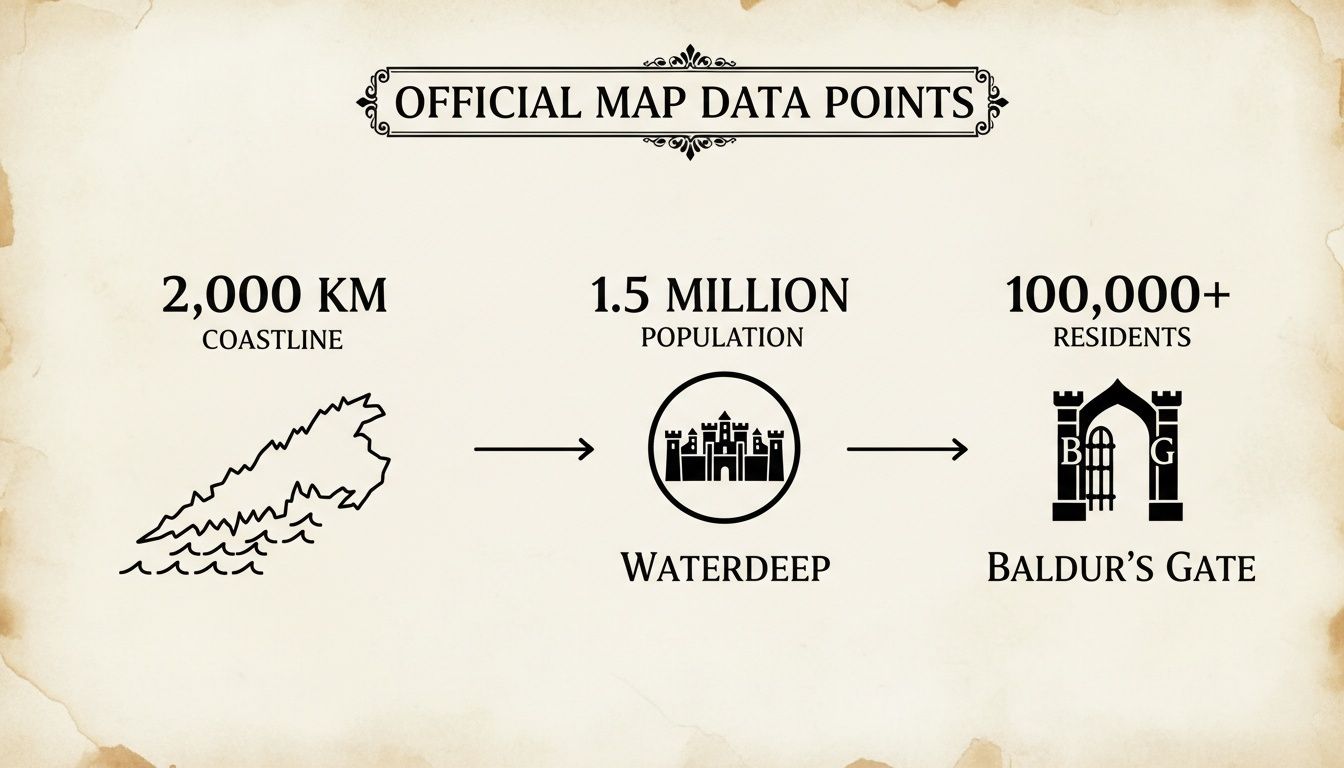
These figures show the immense scale that both official and fan cartographers work with when detailing these iconic settings.
The value of these maps, whether official supplements or home-made charts, isn't just a feeling; it has a measurable effect on how we play. Here in the UK, high-quality maps are a significant driver of engagement and spending within the tabletop RPG hobby. In fact, research shows that UK hobby retailers reported map supplements and poster-maps accounted for roughly 11–13% of their RPG accessory revenue through 2023–2024.
What's more, customers who bought map packs spent, on average, £9.80 more per transaction—a 23% uplift—than those who just bought rulebooks. This tells us that maps are powerful tools for both gameplay and immersion, a trend that independent creators should absolutely take note of.
These fan-made creations are a dialogue between the game's creators and its most devoted players. Each map is a new chapter in a story that we all write together, a shared world that grows richer with every new contribution.
This vibrant ecosystem of fan cartography ensures that the Forgotten Realms will never truly be "fully explored." There will always be a new valley to chart, a lost city to rediscover, or an ancient forest to map, all thanks to the tireless passion of the community.
A map is a sleeping dragon, its true power dormant until summoned. That gorgeous chart of Faerûn you downloaded is but a whisper of an adventure while it is locked away in a digital folder. To truly work its magic, a map must cross from the ethereal plane into our world, laid out on the table where dice clatter and legends are born.
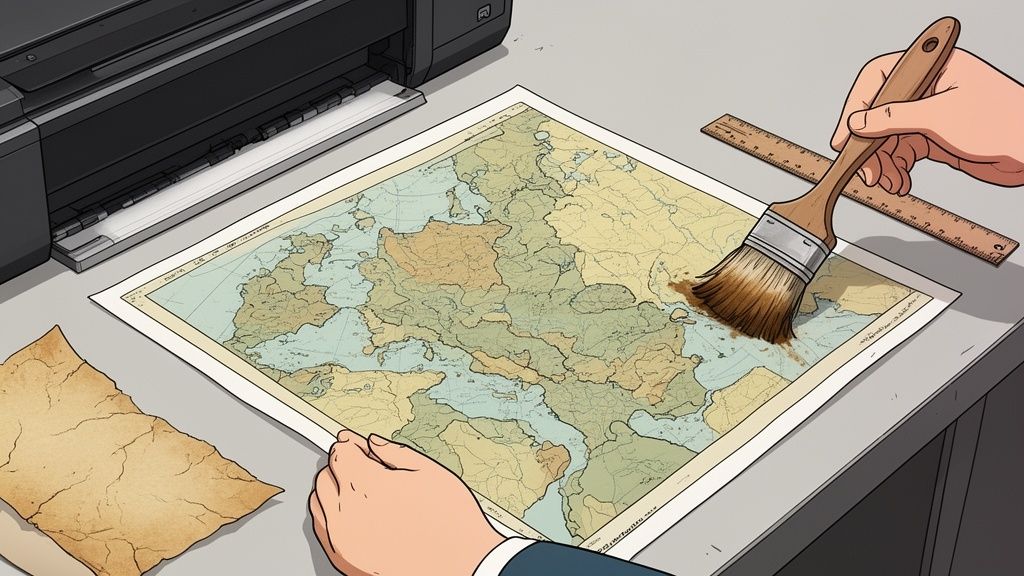
Think of this section as your grimoire for the modern storyteller. I shall walk you through the arcane arts of printing and presentation, turning that high-resolution file into a magnificent, table-spanning poster that will stop your players in their tracks. Mastering this can elevate a simple prop into a treasured artefact of your campaign—a tangible piece of the world you have built together.
Bringing a digital map to life is more than just hitting 'print'; it is a form of modern-day alchemy. You are attempting to create an object that feels as though it has a history, with stories etched into its very fibres. This is where your creativity as a Dungeon Master truly shines.
Here are a few tricks I have learned over many years:
A well-crafted map is an invitation. It tells your players that this world is real, its history is deep, and their actions within it have weight. It is an anchor for their imagination.
Of course, not all adventuring parties gather around a physical table. For campaigns that span continents in the real world, the digital frontier offers its own kind of magic. Virtual Tabletop (VTT) platforms are the modern scryer's crystal, allowing you to share your maps of Forgotten Realms with players no matter where they are.
Platforms like Roll20 or Foundry VTT are built to handle high-resolution maps, making integration a simple enchantment. You can upload your chosen map, snap it to a grid, and even add dynamic elements like a fog of war to hide unexplored areas. This keeps the thrill of discovery alive, even in a digital space. For any storyteller seeking to master this digital domain, our Dungeon Master guide holds fantastic insights for running a smooth and engaging game online.
The true power of digital maps lies in their potential for interactivity. They can be so much more than a static backdrop; they can become a living, breathing part of your story. Imagine your party's tokens moving across a map of Icewind Dale as a digital blizzard swirls around them, or revealing a secret passage in a Baldur's Gate sewer with a single click.
For those with a creator's spirit, perhaps looking to turn your own hand-drawn maps into interactive experiences, getting to grips with powerful tools is key. If you’re curious about taking that next step, you can learn more about game development with Unreal Engine, a popular engine for crafting immersive virtual worlds.
Whether your adventures unfold in person or online, these methods ensure your maps are not just seen, but truly experienced, becoming as vital to the adventure as the characters themselves.
So, you possess a beautiful map. It is not just a pretty picture or a simple guide from A to B. Consider it an invitation, a catalyst for stories that have not yet been dreamed. We are about to cease being mere tourists in the Forgotten Realms and start becoming the architects of our own legends, using these iconic charts as the very anvils on which we shall forge new adventures.
The true magic happens when you learn to read between the lines. A simple patch of green on the map is not just a forest; it is the potential hunting ground of a territorial owlbear, its borders marked with grim, bone-carved totems. That unnamed mountain peak? That is not just a rocky crag. It could be the long-lost citadel of a forgotten dwarven clan, its gates sealed by a riddle no one has solved for a thousand years.
Every river bend, every lonely ruin, every speck of an island is a seed of adventure awaiting your care. This is where the official lore and your imagination collide, turning a known world into the backdrop for a saga that is uniquely yours.
The cartographer's ink can only show you so much. It will point out a city, but it will not tell you of the thieves' guild pulling the strings from the shadows. It can chart a swamp, but it cannot warn you of the ancient hag who calls it her domain. That, my friend, is where you come in.
Take a map of the Sword Coast and lay it before you. Let your eyes drift across it, and begin to ask questions:
A map provides the skeleton of your world. It is your job, as the storyteller, to give it flesh, sinew, and a beating heart. You provide the soul that transforms simple geography into an unforgettable adventure.
A single location on a map can blossom into a sprawling campaign. It is much like how a single card can define your entire strategy in a deckbuilder such as TerraClash. The greatest stories are often built upon the foundations of a rich, detailed world, and these maps give you that foundation in spades. Let us try turning a few landmarks into proper adventure hooks.
Gaze upon Neverwinter. It is famous for its skilled artisans. So, what if a master clockmaker has vanished, and his latest creation—a device rumoured to bend time itself—has gone with him? The party must follow clues etched onto a cryptic map fragment, a chase that will drag them through the city's glittering high-society manors and its grimy, dockside underbelly.
Or what of the Underdark, that chaotic maze of caverns far below? Perhaps a rare, phosphorescent fungus, the only cure for a magical plague sweeping a surface village, grows only in a cavern controlled by a paranoid Myconid Sovereign. The players will have to navigate treacherous, unmapped tunnels to either broker a peace treaty or pull off a desperate heist.
Your custom adventures need not overwrite the established lore—in fact, they are better when they enrich it. By weaving your own stories into the familiar geography of Faerûn, you make the world feel more alive and deeply personal to your players. Their actions can leave a real mark on a world they already recognise. That generic spot on the map becomes "the place we fought that hill giant and barely survived," or "the wizard's tower where we rescued the alchemist."
The table below is but a jumping-off point, a few ideas to get your own creative gears turning. See how easily a well-known location can become the epicentre of your next great tale.
| Map Location | Thematic Hook | Potential Adversary | Suggested Reward |
|---|---|---|---|
| The High Forest | An ancient Elven ruin, visible only during a full moon, is said to hold a powerful nature spirit. | A corrupted Treant, guardian of the ruin, twisted by a dark influence. | A sentient seed that can grow into a magical staff or bow for a worthy hero. |
| Luskan, City of Sails | A notorious pirate captain has hidden their treasure map, tattooed in pieces on the backs of three former crew members. | Rival pirate crews, city guards, and the treacherous former crewmates themselves. | The captain's legendary ship, the Sea Serpent, and a chest filled with rare magical items. |
| The Spine of the World | A clan of dwarves has unearthed a sealed passage leading to a city frozen in ice, but a great beast has been awakened. | A Remorhaz or a slumbering White Dragon, disturbed by the excavation. | Access to ancient dwarven forging techniques and a vein of priceless mithril. |
With these maps as your guide, you are no longer just a player in the Forgotten Realms—you are a co-creator of its ongoing story. So grab your quill, gaze upon these charts, and start dreaming. Your legend awaits to be written.
And so, our grand tour of the Forgotten Realms' cartographic treasures comes to a close—for now. We have journeyed from the official, well-trodden highways of the Sword Coast to the hidden, fan-drawn alleyways of Waterdeep. Along the way, we have not just learned where to find these incredible maps of Forgotten Realms, but how to make them truly sing at the gaming table.
Think of the map as your silent storyteller. It is the ever-present guide, the sacred canvas where your party will paint its legend, one quest at a time.
I urge you to seek out some of these wondrous works. When you do, support the creators—whether they are part of the official team or passionate fans burning the midnight oil. These folk pour their hearts into every single line, landmark, and cryptic symbol, giving us the foundations to build our own adventures. Their dedication keeps this whole community thriving.
So, as you prepare your next campaign, whether it is a continent-spanning epic across Faerûn or a gritty street-level skirmish, never forget the power of a good map. It is so much more than a simple tool for getting from A to B; it is a spark for the imagination. Let it inspire you to build worlds, dream up terrifying challenges, and forge the kind of memories that endure long after the dice have been put away.
A map is a promise. It’s an invitation to step off the path and into a world humming with danger, discovery, and glory. It's the first step in making a story that is uniquely yours.
The best adventures are not just found; they are made. They are built from a Dungeon Master's vision, a player's audacious choices, and the shared world that a map lays out for all to see.
May your dice roll true, and may your maps always point the way to grand adventures. The world is laid out before you—go forth and explore.
Even the most seasoned adventurers and loremasters have questions that flicker in the firelight. Let us tackle some of the common queries that arise when you are wading through the vast, ink-stained world of Forgotten Realms maps. Think of this as a page torn from a well-worn traveller's guide.
These questions often emerge right before a new campaign kicks off, just as a fresh map is unrolled on the table, full of promise. Settling these can set the stage for a smoother, more epic journey for all.
If you are just stepping into the storyteller’s boots for the first time, you cannot go wrong with the map from the Dungeons & Dragons Starter Set. It is a brilliant starting point. It wisely focuses on a small, manageable region around the town of Phandalin, right on the iconic Sword Coast.
This map is packed with enough detail to spark an adventure, but it will not drown a new DM in an entire continent's worth of lore. It has been specifically designed to run the Lost Mine of Phandelver campaign, which makes it an excellent, guided introduction to using maps of forgotten realms to tell a story.
For your private home game? Absolutely. Using fan-made maps for a non-commercial game night with friends is generally fine and a cherished part of the hobby. It is the lifeblood of the community. Things become more complicated, however, if you plan to stream your game, publish content featuring the map, or use it commercially in any way.
Always look for a licence from the creator. Many fan cartographers are incredibly generous, often using Creative Commons licences that spell out exactly how their art can be shared and adapted. When in doubt, the most honourable path is to simply respect the artist’s work and ask for permission.
Ah, this is where a DM truly earns their stripes. Let us take a well-trodden city like Neverwinter. To make it your own, begin adding your unique flair. Perhaps a new thieves' guild, the "Ashen Hands," has risen to challenge the old guard, their sigil now appearing in shadowed alleyways.
You could introduce brand new NPCs with their own secrets, add hidden locations that are not on the official map—like a smuggler's den beneath the city docks—or completely shake up the political climate. A map gives you the skeleton of a world; as the storyteller, it is your duty to give it a soul.
As you chart these new territories and bring them to life, remember that every great world is built on a foundation of adventure and conflict. For a fresh challenge that captures the spirit of exploration and strategic battle, consider the dynamic world of TerraClash. Unfold a new map with every game and forge your own legend. A new tabletop adventure for ages 12 and up is coming soon. Discover more at https://terraclash.co.uk.

