Hark, adventurer, for you are drawn to the arcane arts. A fine choice indeed. But now you face a timeless dilemma, a question whispered in shadowed libraries and sealed pacts: will you walk the path of the Warlock or the Wizard? At a glance, both command the very fabric of magic, but the source of their power lies worlds apart.
The fundamental schism is this: a Warlock draws their magic from a pact, a perilous bargain struck with an entity of immense power. A Wizard, however, earns their might through decades of sweat and study. It is the difference between a high-stakes cosmic bargain and a lifetime chained to a grimoire.
Welcome, spellcaster. You stand at a fork in the road, and the path you choose will define your very essence. Will you borrow power beyond mortal comprehension, striking a deal with something from beyond the veil? Or will you master magic through sheer force of will and intellect? Warlock or Wizard—a question that echoes through the ages.
Let this humble guide illuminate the way. We shall delve into the shadowy bargains of the Warlock and the dust-choked tomes of the Wizard, exploring what truly makes them tick. This decision transcends mere spell selection; it fundamentally shapes who your character is. For the uninitiated, it is a core part of learning how to make a Dungeons and Dragons character.
Together, we shall examine this choice from several angles:
By the journey's end, you shall have a much clearer vision of which magical path calls to you.
To grasp the nature of these two great powers, it helps to see them side-by-side. Their entire approach to magic, from its origin to its execution, is built upon a different foundation.
| Attribute | The Warlock | The Wizard |
|---|---|---|
| Source of Power | A pact or bargain with a powerful entity (e.g., Fiend, Celestial, Great Old One). | Decades of intense study, research, and intellectual discipline. |
| Primary Ability | Charisma, reflecting their talent for negotiation and influence. | Intelligence, representing their mastery of arcane theory and memory. |
| Magical Style | Fewer, but more potent and quickly refreshed, spells. High-impact bursts of power. | A vast and versatile spellbook, requiring careful daily preparation and resource management. |
| Core Theme | Transactional power, innate talent, and mysterious obligations. | Knowledge is power, meticulous preparation, and arcane science. |
As you can see, one is raw, channelled power with unseen strings attached, while the other is earned, encyclopaedic knowledge. Neither is greater—they are simply different flavours of awesome.
Listen closely, for a Warlock’s journey does not begin in a library. It begins with a whisper in the dark, a deal struck with something far beyond the mortal coil. This is not about learning; it is about borrowing immense power, channelled directly from an otherworldly patron.
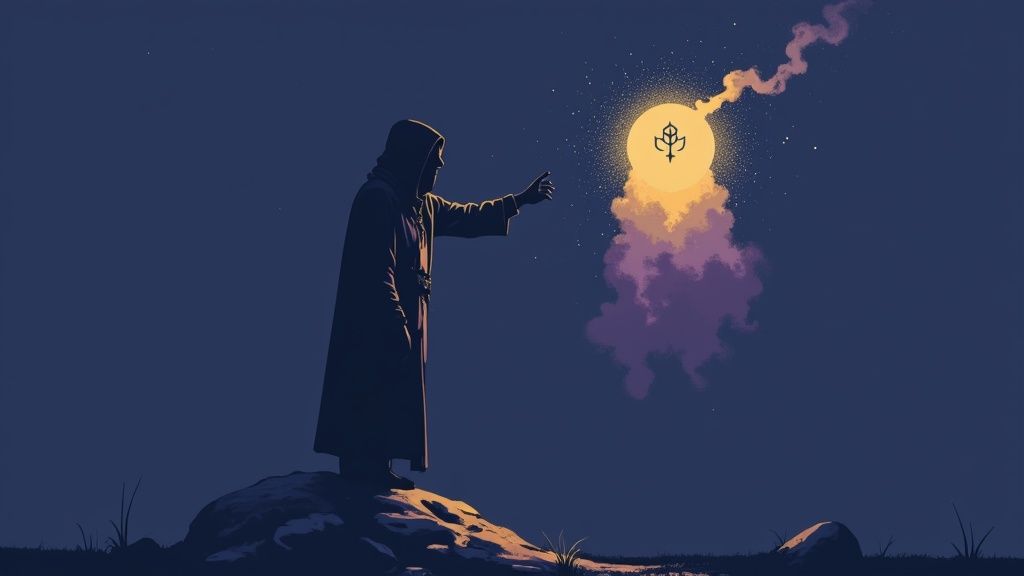
While the Wizard treats magic as a science to be mastered, the Warlock sees it as a relationship—a constant, perilous negotiation. Power is given, not earned, and it often comes with a price. This makes the class a perfect fit for games where your charisma and decisive, show-stopping moves can turn the tide of battle.
The specific bargain you strike completely defines your abilities and weaves instant story into your very being. A pact with a Fiend might grant you command of hellfire, while a deal with a sanity-shattering Great Old One could unlock mind-bending psychic powers. Your character is not merely a spellcaster; they are defined by their cosmic connection.
This idea is not mere fantasy fluff; it has deep roots. The word 'warlock' itself emerged in 16th-century Scotland to describe male magic-users, often accused of being oath-breakers or in league with dark forces. It comes from the Old English 'wǣrloga', meaning 'liar' or 'deceiver', revealing the deep suspicion held for those who made pacts with unseen powers. You can delve deeper into the historical context of Warlocks at michellepillow.com.
This rich backstory makes the Warlock a brilliant choice for any player who loves a strong narrative drive from the outset. Your power source is not just a mechanic; it is a character in your story.
So, how does this manifest upon the tabletop? It leads to a very focused and potent style. Warlocks generally have fewer spells than Wizards, but the ones they command are incredibly powerful and, crucially, can often be regained after a mere short rest.
This makes them perfect for players who would rather make a few grand, game-changing plays than juggle a vast list of situational spells. Every cantrip you cast feels significant, like a direct gift from your patron.
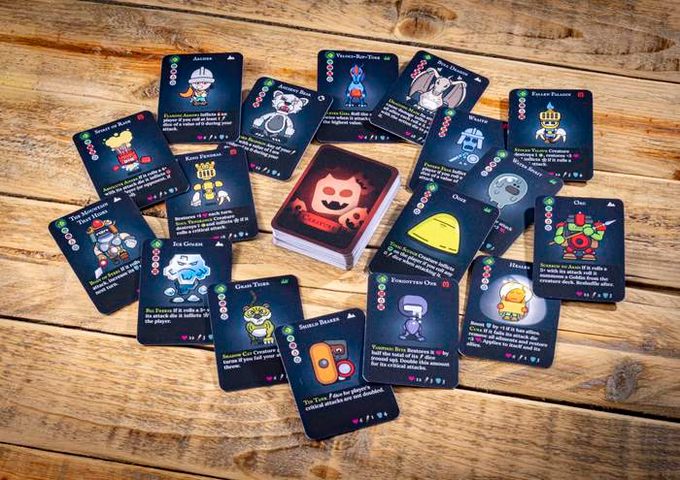
Consider how this would translate to a deckbuilding game like TerraClash. A Warlock-themed deck would not possess an answer for every threat. Instead, it would be built around a handful of devastatingly powerful cards, each representing your patron's blessing. The entire strategy revolves around knowing the perfect moment to unleash that borrowed power.
Mastering the Warlock, then, is a matter of timing and tactical precision. It’s not about what you can do, but knowing exactly when to call in a favour from your otherworldly benefactor to completely change the game. To glimpse the possibilities, consult our guide which includes a complete list of Warlock spells.
Picture a quiet study, the air thick with the scent of old parchment and the low thrum of raw magic. This is the Wizard's domain. For them, magic is no back-alley deal or a gift from a higher power; it is a science. It is a fundamental force of the universe to be studied, understood, and ultimately, bent to a disciplined will. Where the Warlock bargains, the Wizard knows.
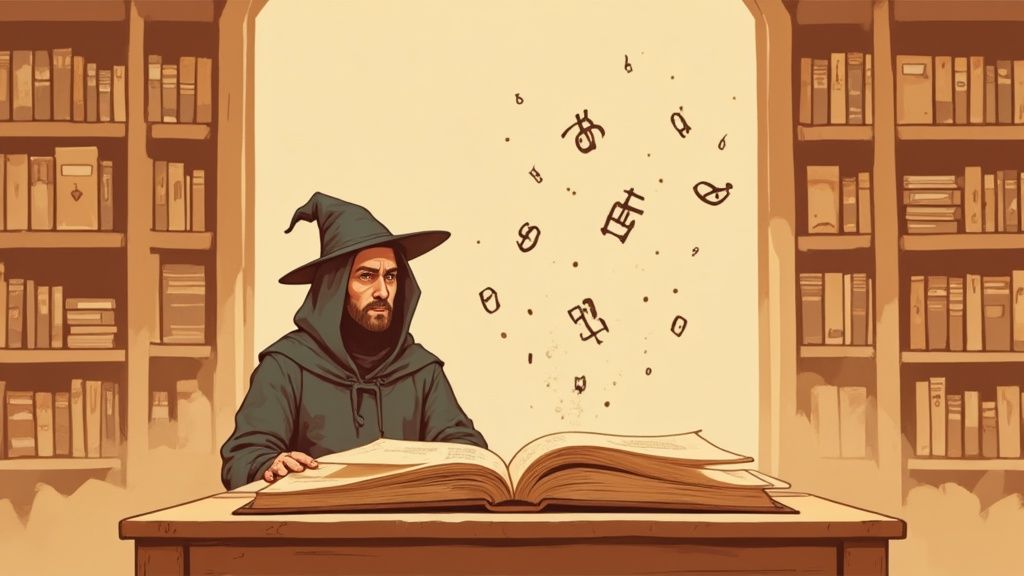
This is a path of pure intellectual grit. Power comes from years of painstaking research, countless experiments (some of which undoubtedly went awry), and the careful curation of a personal spellbook. Every incantation is a precise formula, every somatic gesture part of a complex arcane equation. This is the class for the ultimate planner and tactician.
The life of a wizard is often a lonely one, filled with long hours and hard-won knowledge. It means poring over forgotten languages, memorising intricate movements, and understanding exactly which material components are needed to nudge reality. This approach forges a true connection between you and your character's power—you did not simply receive your spells, you earned them.
This archetype of the scholarly magician is a cornerstone of modern fantasy, often painting a picture of a hidden world operating just beneath our own. Consider J.K. Rowling's Harry Potter series; the wizarding population in Britain is estimated to be a mere 3,000 souls. It is a tiny, secretive society built upon earned magical knowledge, a concept you can explore further with these magical demographics from redhen-publications.com.
This trope of a hidden, knowledge-driven world is everywhere, from the vast lore of Dungeons & Dragons' Forgotten Realms to the grand halls of magical academies in countless fantasy sagas.
When it comes to the game itself, the Wizard's greatest strength is their incredible adaptability. A Warlock may have a few devastating moves, but a prepared Wizard has a spell for nearly any problem tucked away in their grimoire.
The Wizard’s spellbook is the ultimate toolbox. If you were to build a Wizard-style deck for a game like TerraClash, it would be a large, diverse collection packed with situational cards. The true skill lies not in drawing a powerful card, but in knowing which of your many options is the perfect tool for that exact moment.
🎲 Want to try a solo card and dice RPG tonight? Get TerraClash Lite free: a print-and-play game you can play with ordinary dice.
To play a Wizard is to embrace the role of the party’s strategist. It is the right choice for players who derive satisfaction not just from winning, but from winning with a clever plan, a bit of foresight, and the perfect, intellectually chosen tool for the job. Your mind is your greatest weapon.
Let us get down to brass tacks. When the dice are rolling and the cards are on the table, how do these two spellcasters actually feel to play? It is one thing to speak of ancient pacts and dusty tomes, but another to see their magic unfold in the heat of battle.
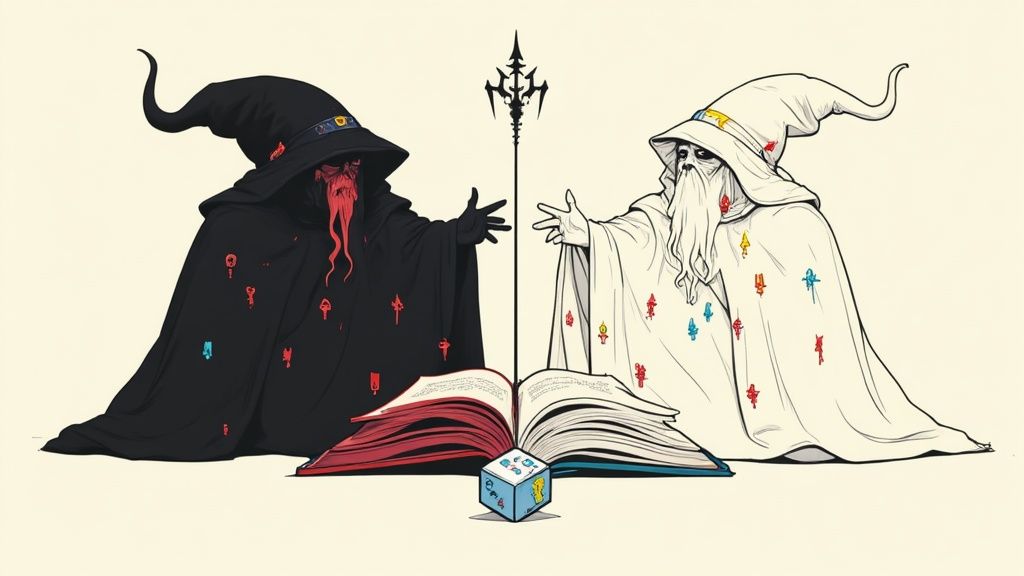
Playing a Warlock feels like being a magical sprinter. You have a handful of incredibly potent spells, and your entire game plan is built around unleashing them for maximum impact. You hit hard, hit fast, and then take a short respite to regain your power for the next engagement. It is a rhythm of explosive bursts of energy.
The Wizard, on the other hand, is the quintessential arcane marathon runner. They step onto the battlefield with a massive toolkit of spells, prepared for almost any eventuality. Think of them as a magical Swiss Army knife. This incredible versatility comes with a cost, however; they must carefully manage their resources over the long haul, as their best spells do not return easily.
Let us frame this within the context of a card game. A Warlock’s deck would be lean, mean, and built around a few show-stopping cards that can flip the board in a single turn. The strategy is direct: find those game-winners and unleash them, putting immense pressure on your opponent with focused, repeated blows.
A Wizard’s deck is more akin to a library. It is packed with answers, control effects, and clever utility cards for every situation. The true skill for a Wizard player is not just in casting spells, but in knowing which spell to cast and when. It is about reading the board, anticipating threats, and having the perfect, subtle counter at the ready. This kind of strategic thinking is a huge part of games like TerraClash, which is designed for adventurers aged 12 and up.
The true difference comes down to tempo. The Warlock seeks to break the game open with massive, sudden plays. The Wizard prefers to control the flow, patiently dismantling their opponent's strategy piece by piece.
Understanding this fundamental split is key to choosing your path. Are you drawn to reliable, explosive power or the challenge of endless tactical flexibility?
To truly nail down the distinction, let's place their approaches side-by-side. Whether in a roleplaying session or a one-on-one card duel, their paths to victory could not be more different. This table breaks down how they typically operate.
| Gameplay Element | Typical Warlock Approach | Typical Wizard Approach |
|---|---|---|
| Resource Management | Works with a small pool of high-impact spell slots that recharge quickly, often after a short rest. | Manages a large reserve of spell slots that recover slowly, requiring careful planning for long fights. |
| Core Strategy | Overwhelm with a few devastating, well-timed spells like Eldritch Blast. | Control the battlefield with a wide array of spells, adapting on the fly to exploit enemy weaknesses. |
| In-Game Flexibility | Very consistent and reliable, but can be caught off-guard by something they don't have a direct answer for. | Extremely adaptable with a prepared spell for nearly any problem, but vulnerable if they've prepared incorrectly. |
| Key Challenge | Knowing the perfect moment to unleash their limited, powerful abilities for maximum effect. | Anticipating what's coming and preparing the right selection of spells from their vast spellbook. |
As you can see, the mechanics directly shape the experience. Picking between a Warlock and a Wizard is as much about matching your playstyle as it is about the lore. Of course, a big part of landing those spells is overcoming your opponent's defences, which you can learn all about in our guide on how to calculate your Spell Save DC.
It is remarkable how the classic Warlock and Wizard archetypes have seeped into the very soul of modern board games. You see their shadows cast across countless mechanics, long after they have left the pages of old roleplaying books. This ancient rivalry plays out in card games and sprawling campaigns, and observing how they are handled gives us a great feel for what makes each one tick.
Think of a game like Mage Knight. Every turn feels like a final exam. You constantly pore over your hand of spell cards, trying to squeeze every last drop of efficiency out of them to solve the puzzle before you. That is the Wizard, right there – victory is all about careful planning, meticulous resource management, and having the perfect spell ready for the moment it is needed.
On the other side of the coin, you have the Warlock's philosophy of high-stakes, all-or-nothing power. Take Gloomhaven, for instance. You are often faced with a gut-wrenching decision: play a card for its safe, repeatable action, or burn it from your deck forever to unleash a single, spectacular effect that could turn the tide of the entire scenario.
That is the Warlock's pact, made real in cardboard. Burning that card is a pure, high-risk, high-reward gamble. You sacrifice a future option for a sudden, overwhelming surge of power, just like calling on your patron to intervene and rewrite your fate.
You see this theme pop up in other indie darlings, too. In sprawling narrative adventures like Sleeping Gods from Red Raven Games, your choices have real, lasting consequences that echo throughout the whole campaign. This focus on binding decisions that define your story feels just like a Warlock's pact, tying your destiny to forces far greater than yourself.
The indie board game scene is a brilliant crucible for fresh takes on these old roles. In a cooperative masterpiece like Spirit Island, each player embodies a unique, powerful spirit. Mastering a spirit means truly learning its complex, interconnected powers – a process that feels remarkably like a Wizard slowly mastering a new and intricate school of magic.
Seeing how designers reinterpret these roles for new games truly highlights how timeless they are. They provide such a solid foundation to build new and exciting challenges upon. It is this same well of inspiration that you will see in games like TerraClash, where your choice of arcane path fundamentally shapes how you play. Whether you are drawn to the Scholar’s dusty library or the Patron’s tempting whisper, their legacy is alive and well on our tables.
Ultimately, the choice lands squarely upon your shoulders, adventurer. It all comes down to the kind of saga you wish to tell and the way you want to wield your power.
Are you pulled towards a tale of pacts and patrons, where every ounce of strength comes with a fascinating, and perhaps dangerous, string attached? If that constant, thrilling negotiation for power sounds like your kind of narrative, the Warlock offers a path rich with story and focused, devastating magic.
Or perhaps you are a purist. Perhaps the patient pursuit of knowledge, of meticulously building your arcane arsenal from scratch through sheer intellect, is what calls to you. In that case, the Wizard’s path promises near-limitless versatility, rewarding the clever planner with a perfect tool for every problem.
Think on how you enjoy playing games. This is your truest compass. If you live for those explosive, game-changing turns and prefer a reliable, concentrated set of abilities, the Warlock's shadowed cloak will fit you perfectly.
But if you are the type who gets a kick out of having the right answer for every possible scenario, outsmarting opponents through cunning preparation, then the Wizard's well-worn robes are waiting for you.
This decision tree for choosing a board game mirrors the core difference between the two classes. It truly boils down to whether you prioritise grand strategy or emergent narrative.
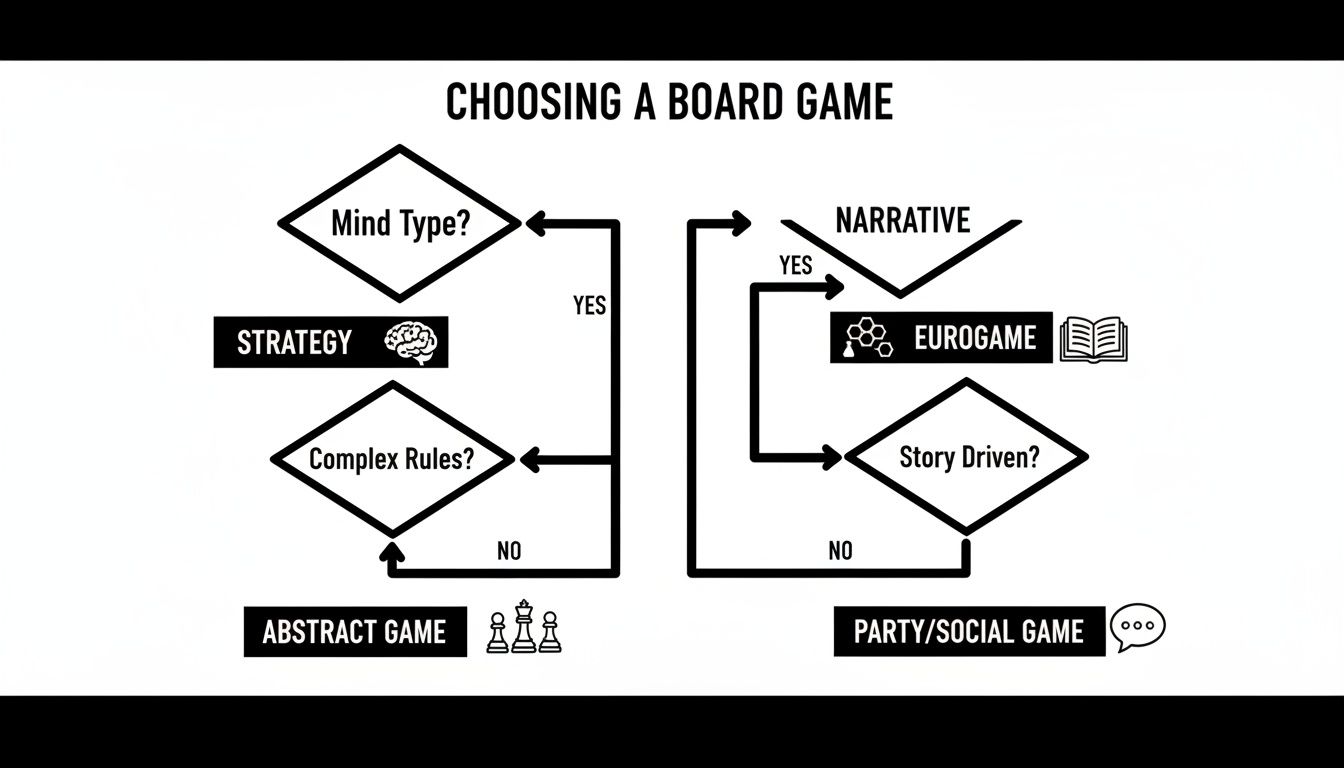
As the flowchart shows, a love for deep strategy points towards one style of game, while a passion for story and character leads to another. This is the very heart of the Wizard versus Warlock debate.
Think of this as the very first spell you cast in your next great adventure. Whether you are diving into a classic roleplaying epic or a strategic deckbuilder like TerraClash, your arcane mantle will define the journey ahead. Choose wisely, and may your power echo through the ages.
Right then, let us clear the fog from some common questions that arise when one tries to choose between these two arcane powerhouses. Even seasoned players can be tripped up by the nuances.
In all honesty, it is almost unheard of in the lore. The two paths are like oil and water. A warlock’s power is a gift, a transaction with a powerful being, while a wizard earns every scrap of their knowledge through sheer graft and study.
For a warlock to become a wizard, they would essentially have to sever their pact—which is often easier said than done—and then begin their arcane education from the very beginning. It is less a change of careers and more a complete rebirth of the soul.
If you are just starting your journey, the warlock is generally the smoother path. You are granted a few core abilities, like the ever-reliable Eldritch Blast, that are powerful and straightforward to use. You need not be bogged down managing a massive list of spells.
Wizards, on the other hand, throw you into the deep end with spell preparation and resource management. It is a lot to juggle when you are still learning the ropes.
It all boils down to the source of conflict. A wizard's tale is usually one of external struggles—hunting for a lost tome, outsmarting a rival mage, or unravelling an ancient mystery. It is a very classic adventure setup.
A warlock's story, however, is often intensely personal and internal. Their main conflict comes from the pact itself. What does their patron demand? What is the true price of their power? The drama is built right into their character from day one.
So, ask yourself this: do you want your character's greatest challenge to be mastering the world around them, or mastering the dangerous deal they have struck?
That single question is a fine compass for determining which class will grant you the kind of story you wish to play. It defines your motivations, your loyalties, and the personal stakes you bring to the campaign.
Your own grand adventure awaits. TerraClash combines deep strategy with epic fantasy, letting you forge your own path to victory. Discover more and prepare for the upcoming campaign.