Hark, adventurer! Do you feel it? The call of the divine, the inexorable pull of an unbreakable oath. Welcome. You are poised to walk the path of the Paladin, one of the most iconic and rewarding archetypes in the grand tapestry of Dungeons & Dragons.
A Paladin is far more than a mere warrior clad in heavy armour, capable of a few parlour tricks with magic. Nay, they are a living, breathing embodiment of conviction, channelling the raw power of their solemn promise into every sword swing and whispered prayer. Picture them as the ultimate champions of a cause, blending martial might with a direct conduit to the divine.
Many are drawn to the Paladin's flame, and it is easy to understand why. You are not just playing a character; you are playing an ideal. Whether you are a radiant beacon of hope in a darkening world or a grim instrument of vengeance, your oath is your very soul.
Consider this guide your training ground, a sacred scroll to be studied. We shall break down everything from the soothing touch of Lay on Hands to the soul-shattering impact of a Divine Smite. This is your squire's orientation before you take your final, world-shaking vows.
Choosing to play a Paladin is like selecting a key strategic piece in a grand campaign. You are versatile, powerful, and often the moral compass of your fellowship. It is no wonder that the Paladin was the most popular class when the epic tale of Baldur's Gate 3 first unfolded; players everywhere were captivated by their blend of tankiness, healing, and raw damage potential. The archetype is a classic for good reason.
To grasp what truly makes a Paladin tick, we must gaze upon the core mechanics that set them apart. These are not just features on a character sheet; they are the very pillars that uphold their sacred duty.
Below is a glimpse at these foundational elements.
| Core Mechanic | Role in Your Saga |
|---|---|
| Martial Prowess | You are a fortress on the front lines, comfortable in the heaviest armour and with any weapon. |
| Divine Magic | Your oath is your power source, allowing you to heal, protect, and punish with divine energy. |
| Sacred Oath | The heart and soul of your character. At 3rd level, your chosen oath defines your code and powers. |
These three pillars work in harmony to forge a truly formidable hero. You do not just swing a sword; you deliver a divine verdict with every blow.
If you are just beginning your grand adventure into the realms of tabletop RPGs, our D&D for beginners guide can help you find your bearings. Now, let us prepare to forge your legend.
When you reach the 3rd level of your journey, everything changes. This is the moment your Paladin truly comes into their own, cementing their beliefs into a Sacred Oath. This is not merely picking a subclass; it is the moment your character declares their purpose to the cosmos, and the cosmos answers back with divine power.
Think of it like choosing your champion in a sprawling board game like Gloomhaven, or selecting a hero whose deck you will master in a card game. This single decision sets the tone for everything that follows—your powers, your role in the party, and the very flavour of your heroism. In our own game, TerraClash, this choice will be just as crucial, defining your strategy for ages 12 and up. Are you the shining beacon on the hill, or the grim hunter who stalks evil in the shadows?
This choice will fundamentally shape how you approach combat, often nudging you towards being a frontline champion, a stalwart defender, or a crucial support healer.

As you can see, different Oaths naturally push a Paladin towards certain specialisations. Let us delve into what makes these paths so distinct.
This is the Paladin you see in storybooks and hear of in bards' tales. The knight in gleaming armour, whose word is their bond and whose heart is pure. If you have sworn the Oath of Devotion, you are a walking symbol of justice, courage, and honour.
The tenets are precisely what you would expect from this classic archetype:
Playing a Devotion Paladin makes you the moral compass and the unwavering shield of your party. Your abilities are geared towards protecting your friends and smiting fiends and undead, making you an absolute terror to the forces of darkness.
Some Paladins have no time for the high-minded ideals of mercy. They have seen evil up close, and they know it must be stamped out, not redeemed. That is the Vengeance Paladin—a relentless hunter sworn to bring ruin to the truly wicked, no matter the cost.
The core philosophy here is simple and stark: "By any means necessary." You are not held back by the same strictures as a Devotion Paladin. The mission—destroying a greater evil—is all that matters.
This is a much darker path. You prioritise hunting down your sworn enemy above all else. Your powers are built for single-target annihilation, letting you chase down a foe and unleash absolute ruin upon them. You become the party's divine spear, aimed straight at the BBEG's heart.
Your oath is not sworn to a god or a king, but to the very light and life of the world itself. You are a Guardian of the Old Faith, a champion for growth, beauty, and joy. You stand firm against anything that would see the world wither and turn to ash.
The tenets of the Ancients are all about celebrating life:
Ancients Paladins make for incredible defenders and supports. Their auras are legendary for providing resistance against spells, making them a nightmare for enemy mages. They are the unyielding, ancient trees in a dark forest, offering strength and shelter to those who stand with them.
Choosing your Sacred Oath is the first true step in defining your legend; pick the one that truly speaks to your character's soul.
Swearing an oath is one thing; living it is another. When you make that sacred promise, the cosmos listens, and it answers by infusing you with a power that sets you apart from any mere warrior. Think of these abilities as your signature moves—the game-changing plays you will use to turn the tide when all seems lost.
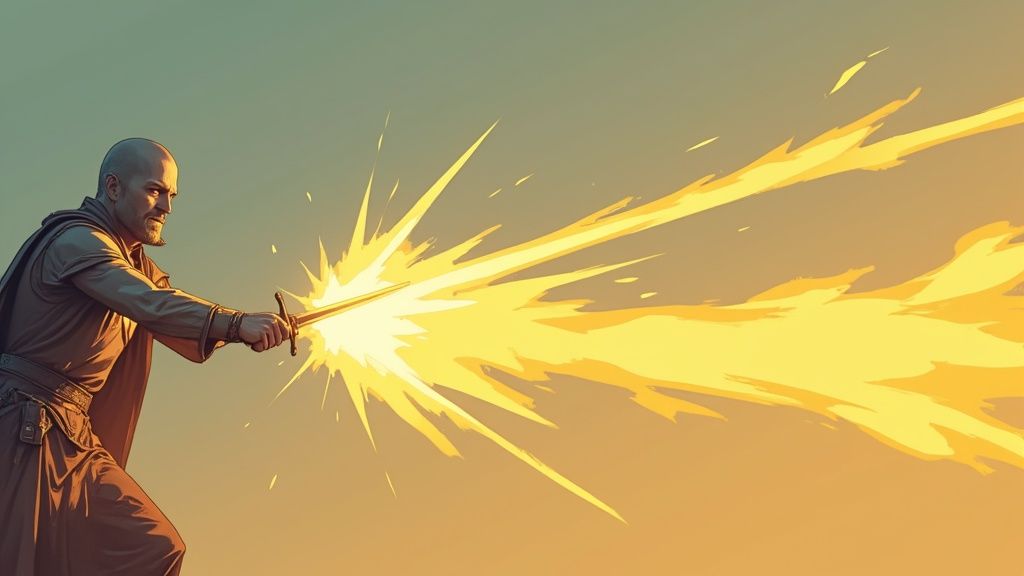
These core features are the very engine of the dnd 5e paladin. They are not just flashy tricks; they are a direct manifestation of your divine connection, a tangible reward for your conviction. Getting a feel for how to manage these resources is the true secret to mastering the class.
Every Paladin carries within them a wellspring of healing energy, a gift to mend broken bodies and purge foul corruption. This is your Lay on Hands, and it is one of the most reliable tools in your entire arsenal. You have a pool of healing points equal to five times your Paladin level.
With a simple touch (and an action), you can channel this power into a creature, restoring a precise number of hit points you choose, right up to the maximum left in your pool. It is not flashy, but when an ally is on death's door, there is nothing better than a guaranteed, powerful heal to bring them back into the fight.
But it is not just for patching up wounds. You can also spend 5 hit points from your pool to instantly cure a disease or neutralise a poison. This makes you an absolute godsend when facing down nasty plagues or venomous beasts, cleansing corruption just as effectively as you mend flesh.
Here it is. The heart of the Paladin's righteous fury and the ability that makes monsters tremble in their lairs. When you strike a foe with a melee weapon, you can choose to pour your divine power into the blow, unleashing a Divine Smite for a burst of extra radiant damage. This is not a spell you prepare and cast; it is a raw, instantaneous judgement you deliver at the moment of impact.
The greater the spell slot, the greater the boom:
The genius of Divine Smite is that you decide to use it after you know you have hit. This means you never waste a precious spell slot on a miss. And when you land a critical hit? You double all those beautiful Smite dice. It is no wonder this ability is legendary for its sheer damage output, a topic you will find widely discussed as a cornerstone of the Paladin’s power, like in this video explaining why it's considered a top-tier class on YouTube.
Of course, your weapon is the conduit for all this holy wrath. If you wish to delve deeper into the tools of the trade, consult our guide on the best DnD martial weapons.
At 3rd level, you learn to Channel Divinity, opening a direct line to the unique power of your oath. This gives you a couple of powerful options you can use, one of which is always Turn the Unholy, while the other is unique to your chosen sacred path.
Channel Divinity is your way of making your presence truly felt. It is a momentary, potent effect that can control the battlefield, empower allies, or cripple your foes, all depending on the tenets you swore to uphold.
For example, an Oath of Devotion Paladin might use it to make their weapon glow with holy light, while a Vengeance Paladin can use theirs to strike fear into the heart of a sworn enemy. This feature is what makes your oath feel less like flavour text and more like a core part of your tactical identity.
As you grow in power, you do not just wield the divine—you begin to radiate it. This starts at 6th level with the incredible Aura of Protection. You and any friendly creatures within 10 feet of you gain a bonus to all saving throws equal to your Charisma modifier.
Let that sink in. This single feature makes your entire party dramatically tougher to take down with spells and nasty effects. You become a walking, talking sanctuary for your friends. As you level up, this aura gets bigger, and your oath will grant you even more auras, cementing your role as the unyielding anchor of the team.
A Paladin's true power is not just about faith; it is forged through careful choices. Think of it less like filling out a form and more like an artisan crafting a legendary weapon. You are taking the raw materials of the class and shaping them into something truly formidable.
This whole process starts with your ability scores. They are the very foundation of your champion, influencing everything from how hard you hit to the divine power you command. If you are just starting on this path, our guide on how to make a Dungeons and Dragons character will walk you through the basics of bringing a hero to life.
Here is the truth about Paladins: you must be adept at several things at once. You are a warrior, a leader, and a conduit of holy energy all rolled into one. This balancing act is what makes the class so rewarding to build and play. It is no wonder the dnd 5e paladin is consistently one of the most popular classes; mastering that blend of martial and magical might is a fantastic challenge. If you are curious about the class's history, you can read more about the Paladin class on Wikipedia).
First, you must decide if you are a Strength or a Dexterity Paladin. Strength is the classic path – think plate armour, a massive greatsword, and being the unmovable rock in the centre of the battlefield. Choosing Dexterity makes you a more nimble, rapier-wielding duelist, relying on agility instead of raw power.
Next, you absolutely cannot neglect Charisma. This is not merely about being charming; it is the engine for your divine magic. A higher Charisma makes your spells more potent, your life-saving auras more powerful, and supercharges many of your most iconic Oath abilities.
Finally, there is Constitution. This is your grit, your staying power. More Constitution means more hit points, which is what keeps you on your feet when you are standing between your softer friends and a very angry dragon.
Think of these three stats—Strength/Dexterity, Charisma, and Constitution—as the three pillars holding up your temple. If one is weak, the entire structure becomes unstable. A great Paladin is built on a solid, well-balanced foundation.
Deciding which to prioritise truly depends on the kind of champion you wish to be. Here is a quick look at how you might arrange your stats depending on your focus in the party.
| Playstyle | Primary Stat | Secondary Stat | Tertiary Stat |
|---|---|---|---|
| Frontline Striker | Strength | Charisma | Constitution |
| Agile Duelist | Dexterity | Charisma | Constitution |
| Defensive Guardian | Strength | Constitution | Charisma |
| Aura Support | Charisma | Strength/Dexterity | Constitution |
Ultimately, there is no single "correct" answer. The right balance is the one that feels best for the hero you are trying to build.
While everyone speaks of Divine Smite, do not sleep on your spell list. As a "half-caster," you do not get as many spells as a Wizard or Cleric, so every single choice matters. Your spells should be tools that help you do your job better, whether that is protecting your allies or bringing the pain.
Here are a few absolute must-haves you should consider:
Feats are where you can truly customise your Paladin and break the mould. Choosing a feat instead of an Ability Score Improvement is a momentous choice, but the right one can define your entire combat style. It is like adding a rare, powerful card to your hand that opens up entirely new strategies.
Here are some of the best feats for a Paladin:
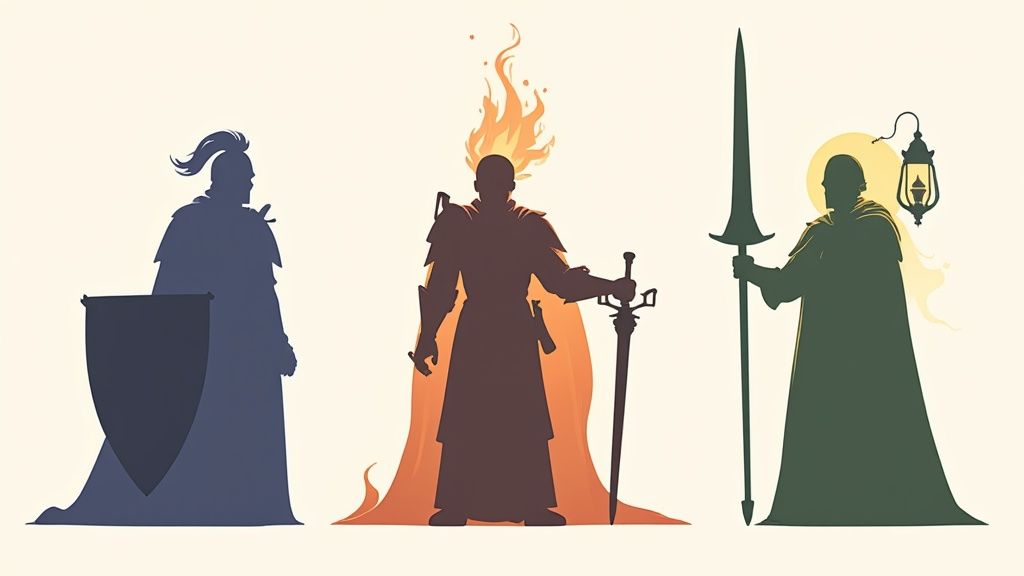
The path of a holy warrior is not a single, straight road. It is more like a sprawling map with countless paths leading to different kinds of heroism. Your oath, your spells, and your feats all weave together to create a champion with a unique purpose on the battlefield.
To help you find your calling, let us break down three classic archetypes that have proven their mettle in countless campaigns. Think of these as proven templates—solid foundations you can build upon, tweak, and personalise to forge your own legend.
First, we have the guardian. The protector. The shield against the dark. This dnd 5e paladin build is all about defence and control, turning you into an immovable object that enemies simply cannot get past. Your job is not to deal the most damage; it is to ensure your allies never have to.
To walk this path is to become a fortress of steel and conviction.
Your spell list should be all about control. A spell like Compelled Duel forces that big, scary monster to face you and you alone, while Shield of Faith makes your already high Armour Class even more ridiculous. You are the wall upon which the waves of evil break.
While the Bastion defends, the Crusader attacks. This build is a divine engine of destruction, designed to hunt down the most dangerous threat on the field and deliver a final, explosive verdict. You are the party's holy spear, aimed right at the heart of darkness.
Your purpose is simple: channel divine wrath into overwhelming force. This archetype is all about using the Paladin's signature Divine Smite to its absolute fullest, often erasing major threats in a single, brilliant flash of radiant energy.
The Righteous Crusader’s philosophy is brutally effective: find the biggest threat and delete it. Every spell slot is a potential nova of damage, and every critical hit can single-handedly turn the tide of a fight.
To become this instrument of divine judgement, you will want to build like this:
Your spell list becomes a toolbox for making your attacks even deadlier. Spells like Divine Favour add a little extra radiant kick to every hit, while smite spells like Branding Smite or Blinding Smite tack on both damage and nasty side effects to your assault.
Not every battle is won with a sword. The Beacon of Hope is a support-focused Paladin who leads from the front, bolstering allies, mending wounds, and turning the chaos of battle into a well-oiled machine. You are the commander, the medic, and the inspirational heart of your party.
This build leans heavily into the Paladin's high Charisma, using powerful auras and spells to make the entire group better at what they do. You are less concerned with your own personal damage and more focused on elevating your companions.
Your spells are your greatest asset. Bless is arguably the best low-level support spell in the entire game, and you should have it prepared at all times. Later on, spells like Aura of Vitality provide fantastic out-of-combat healing, ensuring your team is always topped up and ready for whatever is next.
https://www.youtube.com/embed/CxuEsBVr4-E
So, you have sworn your oath and are well on your way. But for some paladins, the path forward is not a straight line. Sometimes, true power lies in weaving different threads together, combining your divine mandate with another discipline entirely. This is where multiclassing comes in, and it is how a great paladin becomes a legendary one.
This is not a decision to be taken lightly. It is about more than just grabbing a few new tricks; it requires a plan. Think of it like a master tactician combining different units in a wargame, or carefully building a deck in a TCG to find the perfect synergy. In our game, TerraClash, these combinations will be key. You are looking for a way to create a hero far greater than the sum of their parts.
What if your oath led you to make a pact with something... else? Dipping your toes into the Warlock class opens up a whole new world of power, and one particular feature changes everything for a paladin. Warlock spell slots are weird, powerful, and, most importantly, they come back after just a short rest.
For a paladin, this is a game-changer. Every one of those pact slots can be used to fuel a Divine Smite. Suddenly, you're not just a holy warrior; you're a relentless engine of destruction, refuelling your smites while the rest of the party is just catching their breath. This "Pactadin" build has incredible stamina for dishing out big hits all day long.
Another classic and incredibly potent combination is with the Sorcerer. Where your power comes from devotion, theirs is a birthright, magic flowing through their veins. This fusion, the "Sorcadin," is a true master of divine and arcane devastation. The Sorcerer’s secret weapon? Metamagic, especially Quicken Spell.
Picture this: on your turn, you use a bonus action to cast a game-changing spell like Haste. Then, with your main action, you still get to swing your weapon twice, dropping a thunderous Divine Smite on each hit. That is the kind of explosive turn a Sorcadin can pull off.
This route gives you a massive pool of spell slots from two different classes, effectively turning you into a smite battery. You become a whirlwind of spell and steel, controlling the battlefield one moment and delivering devastating blows the next. It is a more complex build to pilot, but its potential for a single round of overwhelming force is the stuff of legends.
Do not underestimate the power of a shared stage presence. The Bard and Paladin both rely on the force of their personality (Charisma), making them a natural fit. A few levels in Bard grant you a staggering amount of utility, from extra skills and spells to the one-and-only Bardic Inspiration.
This combination creates the ultimate battlefield commander. You are no longer just the party’s tank and damage dealer; you are its heart. You can inspire allies, lock down enemies with clever spells, patch up wounds, and still bring the divine hammer down with a smite when needed. You become the complete package—a true champion who leads from the front.
Every adventurer, no matter how righteous, has a few nagging questions before they take up their sword and shield. Let us tackle some of the most common ones I hear from players stepping into the paladin's armoured boots for the first time.
There is no single "best" race, but some certainly give you a running start. You will want to look for races that boost your key stats: Strength, Constitution, and Charisma.
If you want pure optimisation, the Variant Human is a classic for a reason. Gaining a feat at level one is too good to pass up, letting you grab something like Polearm Master or Sentinel right out of the gate. Half-Elves are also top-tier, giving you that crucial +2 to Charisma and two other +1s you can place wherever you need them.
But do not forget the flavour! Dragonborn make for incredible-looking paladins, and the celestial-touched Aasimar are practically tailor-made for the role, both in story and stats. Honestly, the best race is the one that gets you excited to play your character.
You absolutely can, and it can be a fantastic roleplaying experience. A paladin's power does not come from being a "good person"; it comes from the sheer, unshakeable force of their conviction to their Oath.
Think about it: an Oath of Conquest paladin could easily be a ruthless tyrant, hell-bent on crushing all opposition to forge a "perfect" order. An Oath of Vengeance paladin might become a dark, brooding anti-hero who believes the ends always justify the means, leaving a trail of broken bodies—and morals—in their wake.
The real lynchpin here is the Oath itself. A paladin who violates their sacred vows risks falling and becoming an Oathbreaker. Your alignment is a footnote; your commitment is the headline.
This is a big one. The key is to throw the "lawful stupid" cliché right out the window. That stereotype, the paladin who follows every rule to the letter with no critical thought, is a trap. Instead, dig into the why of your Oath.
The most interesting characters are born from conflict. What happens when your Oath of Devotion paladin has to choose between telling the truth and protecting an innocent? How does an Oath of Vengeance paladin deal with the immense personal toll of their quest? Give them flaws. Give them doubts. Give them relationships that challenge their beliefs. Focusing on their humanity, not just their divine code, is what makes a paladin truly compelling.
Hopefully, this has armed you with the confidence to walk the paladin's path. Just as your Oath defines your hero, the right game can make for an unforgettable adventure. If you are looking for a new world that rewards tactical thinking and heroic deeds, keep an eye on TerraClash. You can find news of our quest at https://terraclash.co.uk. For more tales of indie tabletop creations, consider exploring games like Frosthaven by Cephalofair Games or Oathsworn: Into The Deepwood by Shadowborne Games.