Gather 'round, adventurers, and lend thine ears. Every game of Magic is a saga, a tale of mighty planeswalkers clashing across the multiverse, and you are the storyteller. The core card types are your vocabulary—the arcane runes and sacred words you use to weave your epic. Master these, and you’re no longer just playing cards; you're speaking the very language of creation.
At its heart, Magic revolves around seven distinct types of cards. Each one serves a purpose, a unique role in your grand strategy.
Each type offers a different strategic angle. It’s this variety that has forged Magic: The Gathering into a titan of the tabletop realm, a legend whispered among collectors and duelists alike. You can find out more about MTG's history on Wikipedia.
“The diversity of card types is what makes each match in MTG an endlessly replayable saga.”
To help you on your quest, here’s a quick scrying of what each card type generally does and when you can play it.
| Card Type | Primary Role | Typical Casting Speed |
|---|---|---|
| Lands | Mana production | N/A (You play one per turn) |
| Creatures | Attack and defend | Sorcery speed |
| Instants | Reactive plays | Instant speed |
| Sorceries | One-time game-altering effects | Sorcery speed |
| Enchantments | Ongoing enhancements or restrictions | Sorcery speed |
| Artifacts | Versatile, colourless tools | Sorcery speed (usually) |
| Planeswalkers | Legendary allies with loyalty abilities | Sorcery speed |
Seeing how they work on paper is one thing, but making them sing together in concert is where the true magic happens.
A worthy spellbook isn't just a pile of powerful cards; it's a well-oiled machine. For instance, pairing your basic lands with creatures that have demanding colour requirements is fundamental—it ensures you can actually summon your army when the clarion call sounds. On the other hand, a deck packed with game-changing sorceries might benefit from a few artifacts that help you generate extra mana, letting you cast those huge spells ahead of schedule.
Here are a few morsels of wisdom to get you started on building a smoother deck:
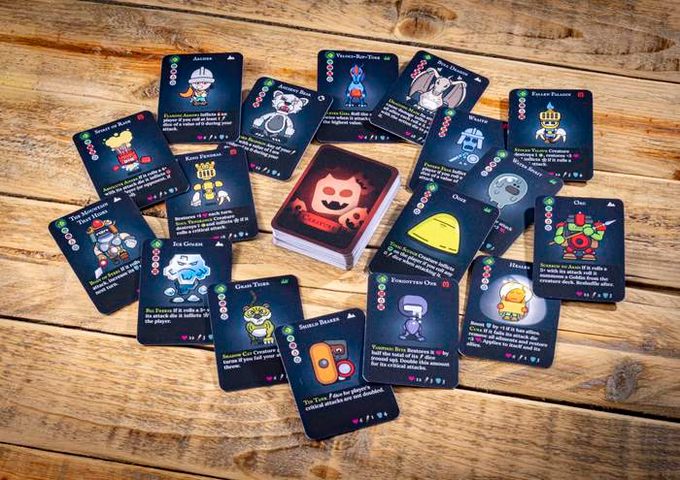
With these core concepts in your arsenal, you’re ready to build decks that feel both powerful and consistent. This kind of foundational knowledge is gold, not just in MTG but across all deckbuilding games, from Magic's classic duels to the elemental clashes awaiting you in realms like TerraClash.
Once you're comfortable with the basics, you can start exploring the beautiful, complex ways these card types interact. This is where you truly begin to master the art of the duel.
You could, for example, layer an enchantment that gives a creature lifelink (you gain life when it deals damage) and then use an instant to temporarily double its power for a massive, life-swinging attack.
Here are a few more powerful combinations to contemplate:
Learning to spot and build around these interactions is what separates a good mage from a great one, preparing you for whatever the ever-shifting battlefield throws at you.
May your journey through the multiverse be as epic as MTG’s legacy and the new realms awaiting you in TerraClash.
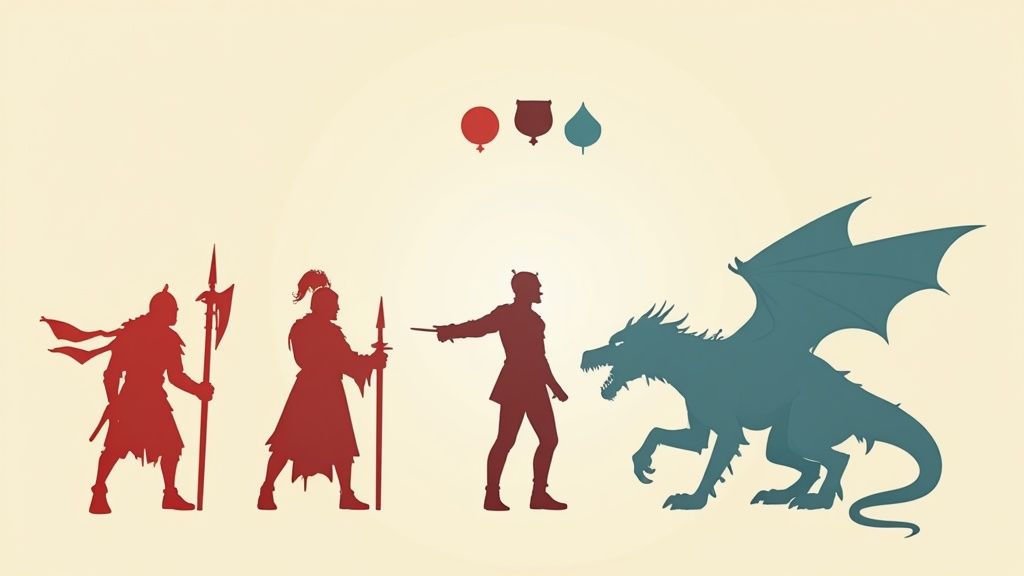
Every mage worth their salt understands that victory often hinges on the shades, scales and steel you summon. In Magic, your Creatures act as the frontline—your living army marching to the beat of your will.
Each creature card carries a pair of stats in the bottom-right corner: Power and Toughness. Power determines how much damage your fighter deals, while toughness shows how much punishment it can absorb before heading to the graveyard. A lone 1/1 Human Soldier might look fragile, but a swarm of them can topple a sturdy 5/5 Demon.
This give-and-take is the very soul of combat. Whether you’re leading your forces in Magic or fielding champions in a game like TerraClash, mastering these basics sets the stage for every epic clash.
Creatures aren’t just numbers on a card. Many boast keyword abilities that can reshape the battlefield in your favour. Here are a few essentials:
These keywords form a secret combat dialect, separating everyday monsters from battlefield legends. For a closer look at creatures that truly define the game, dive into our guide on Magic: The Gathering legendary creatures.
Alongside your foot soldiers stand the Planeswalkers—powerful heroes and sorcerers who aid you with their unique talents. Instead of power and toughness, they arrive with Loyalty counters representing both health and magical resource.
Opponents can attack your Planeswalkers directly, chipping away at those counters. If a Planeswalker’s loyalty drops to zero, they’re removed from play.
A Planeswalker on the board changes everything. They demand your attention, offering ongoing value that can tip the scales if left unchecked.
Each turn, you may use one of your Planeswalker’s loyalty abilities:
Balancing an aggressive creature army with Planeswalker defence is a core challenge. Do you press the attack now or hold back to protect your legendary allies? This push-and-pull lies at the heart of every memorable duel.
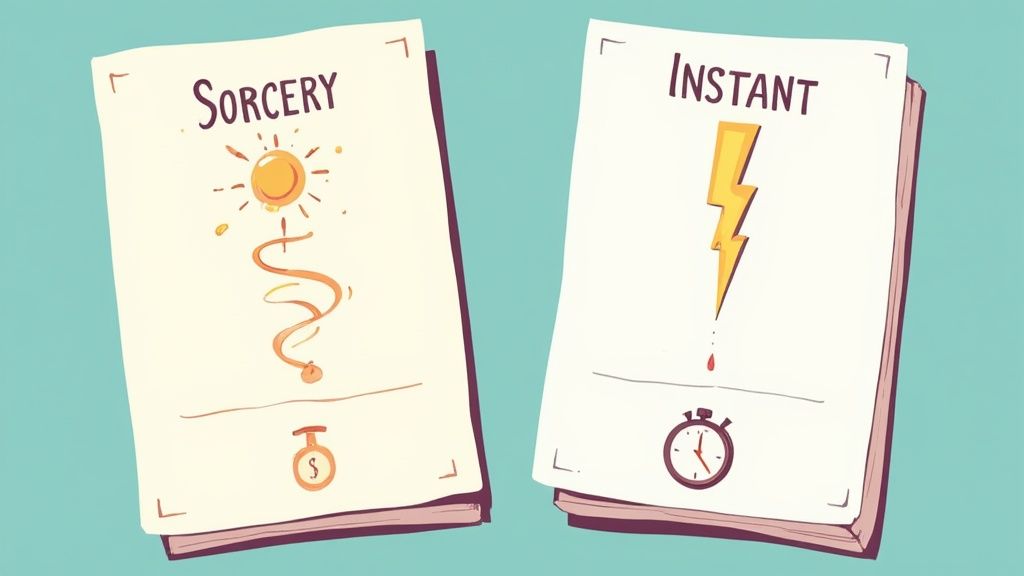
Beyond the brute force of creatures lies the true art of a mage's power: spellcraft. This is where we delve into the two core ways a Planeswalker bends reality to their will: Instants and Sorceries.
Think of these as powerful one-shot effects. Unlike a creature that lingers on the battlefield, these spells happen, their magic resolves, and then they're gone, leaving their mark on the game. They are pure magical energy, unleashed for a fleeting but often game-changing moment.
A Sorcery is like a grand, deliberate ritual. It's a spell that demands focus and preparation, meaning you can only cast it during the main phase of your own turn when the battlefield is relatively calm. This might seem restrictive, but the trade-off is often raw power. A sorcery can wipe the entire board clean, summon a legion of creatures, or force an opponent to discard their hand.
Instants, on the other hand, are the quick, reflexive spells. They're the sharp retort, the lightning-fast parry that catches an opponent completely off-guard. The crucial difference is timing. You can cast an Instant almost any time you have priority, even during your opponent’s turn or right in the middle of combat.
The distinction between "Sorcery speed" and "Instant speed" is one of the absolute pillars of Magic strategy. A mage who only ever taps their mana on their own turn is an open book. But the player who ends their turn with mana still available? They are a coiled serpent, a palpable threat. What tricks do they hold? A counterspell? A removal spell? A combat trick?
This tactical dance is what makes games like this so compelling. Whether you're holding back mana for a crucial counter in Magic or setting up a sneaky gambit in the arenas of a game like TerraClash, mastering the element of surprise is everything.
The most powerful weapon in a duel is not the card in your hand, but the moment you choose to play it. An Instant played at the perfect time is worth more than the mightiest Sorcery cast too soon.
Sorceries are the sledgehammers in your magical toolkit. They are proactive, built to push your grand design forward or smash your opponent's to pieces.
These are the spells you build your deck's core strategy around, giving you the heavy-hitting power to break a stalemate or clinch victory.
If Sorceries are the grand statement, Instants are the clever comeback. Their real power comes from flexibility and surprise. Take a card like Silence – a favoured tool in many a Commander's arsenal. Cast at the right moment, it can completely shut down an opponent's big turn before they even get started.
Here’s what Instants do best:
Learning to balance the raw, proactive power of your Sorceries with the reactive, tactical finesse of your Instants is a huge step in your journey as a planeswalker. This very blend of deliberate strategy and cunning replies is what separates a good spellcaster from a great one.
Lands, artifacts, and enchantments are the backbone of any Magic deck. They’re the permanents that stick around, shaping the battlefield and paving the way for your bigger, flashier plays. Get these right, and you've built a solid foundation for victory.
Every spell you cast, every creature you summon, begins with mana. And from whence does mana flow? The Lands. Think of them as the very bedrock of your magical domain, channelling the raw energy needed to bring your strategy to life.
Basic lands are your reliable workhorses. A Forest just taps for a green mana. Simple. Dependable. No fuss.
But then you have the nonbasic lands, and this is where things get interesting. These are the cards that can tap for multiple colours of mana, draw you a card, or even turn into a creature and attack. Choosing the right mix of basic and nonbasic lands is a crucial deckbuilding skill—it's the difference between a finely-honed weapon and a clumsy club.
The way lands can fundamentally alter the game is a deep well of strategy. If you've ever seen how terrain effects can warp a battlefield in other games, you'll know what I mean.
For a classic example of this in Magic, check out our guide on the Blood Moon Magic Card to see just how potent a single land-affecting card can be.
A solid mana foundation lets you weave epic strategies with confidence.
Artifacts are the tools, gadgets, and magical constructs of the multiverse. Because most are colourless, they can slot into almost any deck, acting as a bridge between your raw mana and your battlefield presence.
Some of the most powerful artifacts are ‘mana rocks’. A card like Sol Ring is a classic—it’s like a magical battery, giving you a huge jump in resources early in the game and letting you cast your big spells way ahead of schedule.
Then you have Equipment. These artifacts attach to your creatures, turning a humble soldier into a legendary hero. A simple creature can suddenly wield a gleaming sword, granting it more power, new abilities, and making it a massive threat.
Imagine equipping a creature with a Sword of Fire and Ice. Suddenly, every time it hits your opponent, you get to draw a card and deal damage. That's the power of a good artifact.
Artifacts are the keystone that bridges raw mana and battlefield might.
While instants and sorceries are fleeting moments of magic, enchantments are spells that you bind to the battlefield for the long haul. They create persistent effects that can completely change the rules of the game.
Some enchantments are global, affecting every creature on the board with a buff or a penalty. Others, called Auras, attach to a single creature or permanent, either cursing an opponent's best threat or blessing your own.
What makes enchantments so potent is their subtlety. They often don't win the game on the spot, but they quietly tip the scales in your favour, turn by turn, until your advantage becomes overwhelming.
The way enchantments layer with artifacts and creatures is where deep, complex strategies are born. An aura boosting a creature that's already wielding a powerful piece of equipment? That’s how you build an unstoppable force.
A deck built on strong permanents weaves a tapestry of enduring power.
The rarity and power of these card types have fuelled a massive collector's market. Cards from the earliest sets are now legendary artifacts in their own right. For instance, the original Limited Edition Alpha rares had a print run of only around 1,100 copies each. This scarcity has led to some mind-boggling prices, culminating in a pristine Black Lotus (graded CGC Pristine 10) selling for an incredible £2.4 million in April 2024. For more on the wild world of high-end Magic cards, you can find great insights over at CGC Cards.
Mastering the interplay between lands, artifacts, and enchantments is what separates good players from great ones. This trio of permanents sets your game plan in motion long before the first creature attacks.
Finding the right balance is key, of course. Too many lands, and you'll have nothing to cast. Too few, and your powerful spells will be stuck in your hand. An artifact like Sol Ring can smooth out your early turns, while an enchantment like Ghostly Prison can buy you the time you need to build your board by taxing your opponent's attackers.
With deliberate land choices, powerful artifacts, and cunning enchantments, you craft a resilient and powerful foundation. This is the sturdy frame upon which you'll build your victory.
In the next section, we’ll start summoning the creatures and planeswalkers who will breathe life into your strategy and march you to victory.
Right, you’ve grasped the seven core card types. That’s the alphabet of Magic. Now we delve into the grammar – the clever bits that let you build truly powerful incantations. Beyond a card's main type, you'll find two other critical classifications on the type line: Supertypes and Subtypes.
Do not mistake these for mere flavour text. They're game-changers, pure and simple, and they open up a whole new world of strategy.
Think of Supertypes as powerful, game-wide rules that get attached to a card. They change its fundamental nature and dictate how it behaves on the battlefield.
A Supertype appears before the main card type, like a title given to a knight or a king. These titles carry real weight. The most common ones you'll run into are Basic, Legendary, and Snow, and each one has a massive impact on your game plan.
This chart breaks down the most common Supertypes you'll come across.
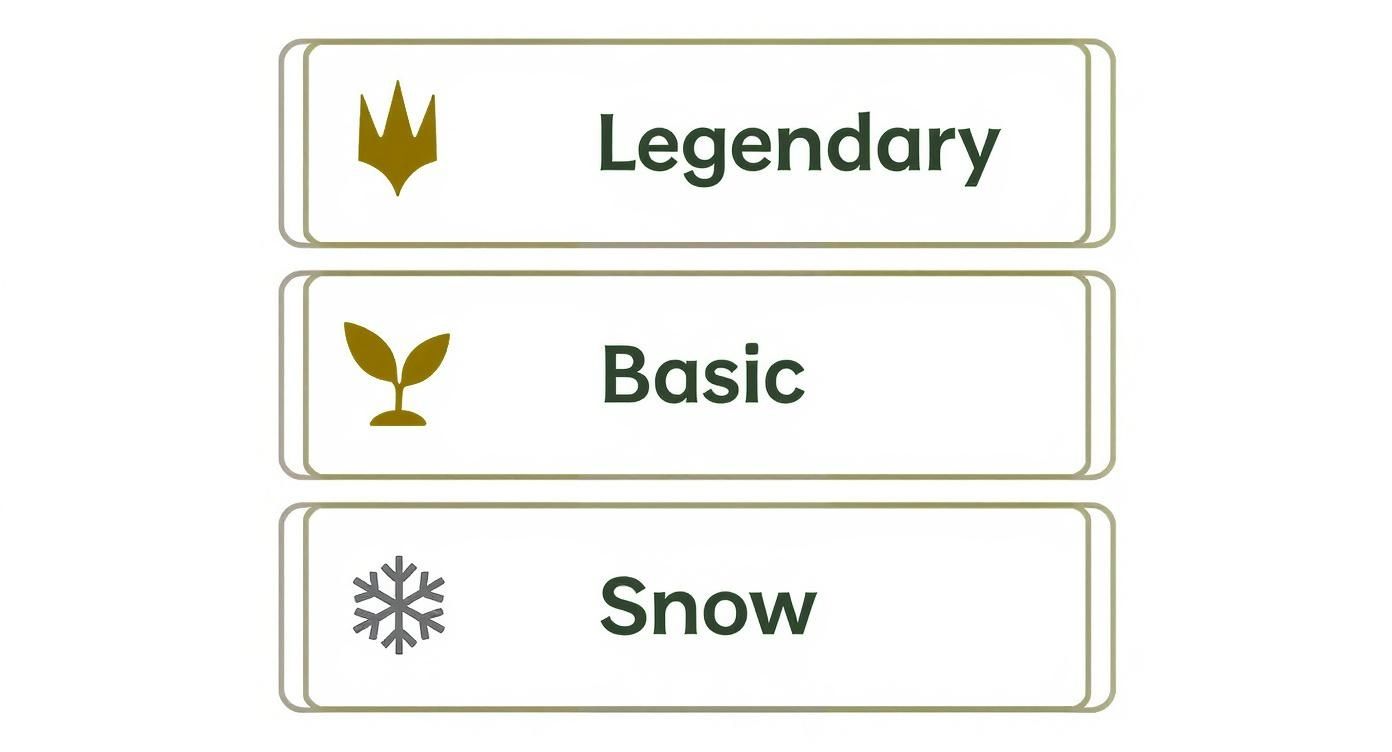
As you can see, they add a distinct strategic layer. 'Basic' gives you deckbuilding freedom, while 'Legendary' introduces some very interesting restrictions.
Let's look at Legendary, probably the most common one you'll see. A Legendary creature is a one-of-a-kind hero; a Legendary land is a unique, named place. The big rule here is that you can only control one Legendary permanent with the same name at any time. If you play a second, the game forces you to pick one and put the other into your graveyard. This "legend rule" makes you think carefully about your deck, as you can't just spam the board with copies of your most powerful champion.
Supertypes are like the fundamental laws of the multiverse. Ignore them at your peril, but master them, and you can bend the game to your will.
If Supertypes are the grand laws, then Subtypes are the dialects – the language of tribes, tools, and schools of magic. Found after the main card type, Subtypes are the heart and soul of synergy, letting cards link up to make each other stronger.
For creatures, the Subtype is their tribe or species: Elf, Goblin, Dragon, Wizard. When you see a card that reads, "All Goblins get +1/+1," your horde of small, pesky creatures suddenly becomes a serious threat. This kind of tribal synergy is the foundation of countless powerful decks. Every member of the clan makes the whole stronger. It's a classic feature in tabletop games, similar to the elemental factions you might find in a game like TerraClash.
For other card types, Subtypes tell you what they do:
The incredible depth these systems provide is a huge reason why the collectible card game community is so passionate. This isn't just a niche hobby, either. The UK card games market is a formidable force, and the global scene is a testament to the enduring power of tabletop gaming. You can dig deeper into these numbers by reviewing the latest market projections.
Getting to grips with how Subtypes interact is the real secret to building a deck that isn't just a pile of good cards, but a well-oiled machine. It’s in these subtle connections that the true art of deckbuilding lies.
So, there you have it, planeswalker. You've journeyed through the seven core card types that form the very foundation of Magic: The Gathering. From the humble land to the mighty planeswalker, this knowledge is now yours to wield.
Think of it like learning the notes of an arcane chant. At first, they're just individual sounds, but soon you begin to hear the melody. You see how a simple Goblin becomes a real threat with a Tribal enchantment backing it up, or how a legendary Artifact sword can turn a lowly soldier into a battlefield hero.
This is the real magic of the game. It’s about more than just playing cards; it's about seeing those connections and building something that is uniquely yours.
Once you grasp these fundamentals, you start to see the hidden language that connects all great card games. The push-and-pull of threats and answers, the importance of building up your resources, the thrill of seeing your grand plan come together – these ideas are universal.
As you start piecing together your first decks, keep this core principle in mind.
The greatest decks are not merely collections of powerful cards, but harmonious ecosystems where every piece supports the whole. True mastery lies in seeing the connections others miss.
This knowledge is your passport to countless new worlds. Whether you're battling across the planes of Magic or diving into a brand-new game from an indie creator on Kickstarter, these skills will serve you well. Games like TerraClash are built on this same rich DNA of creature combat and clever spellcasting, offering a new arena for players aged 12 and up to test their mettle.
Ready to put all this theory into practice? Our guide on how to build an MTG deck in our detailed guide is the perfect next step to start forging your own powerful creations.
The path to becoming a seasoned planeswalker is filled with questions. It is the way of the wise to seek answers. Let's clear up a few of the most common points of confusion that trip up new players, so you can get back to battling with confidence.
This is a classic riddle. The easiest way to think about it is that an Artifact is a physical thing—a sword, a shield, a mechanical creature, a strange contraption. They're often colourless because, in theory, anyone can pick up and use a tool, no matter what colour of mana they wield.
An Enchantment, on the other hand, is pure magic. It's not an object, but a lingering spell or effect. Think of it as a blessing on your troops, a curse on your opponent, or a magical field that fundamentally changes the rules of the game. It's an intangible force, woven from mana, which is why it always has a colour.
Think of it like this: a magical sword is an Artifact (the sword itself) that might have an Aura (a type of Enchantment) on it. One is the physical object, the other is the magic infused into it.
Mastering this is key to levelling up your game. Sorceries are like big, planned-out rituals; you can only perform them on your own turn when nothing else is happening. They're powerful, but predictable.
An Instant is the complete opposite. It's a quick, reflexive spell you can fire off almost whenever you want. You can cast an Instant on your opponent's turn, in the middle of combat, or even in response to another spell to counter it or change the outcome. They are the secret to ambushes, last-minute saves, and outsmarting your rival when they least expect it.
A powerful wizard without any mana is just a person in a fancy robe with a bunch of useless cardboard. Lands are the absolute bedrock of your entire strategy; they are the channels you use to draw mana from the world around you.
Every single creature, every spell, every powerful ability costs mana. Without playing lands consistently every turn, your hand full of awesome-looking cards is just a wish list. Building a solid mana base isn't the most glamorous part of the game, but it's the engine that makes everything else work. Get it right, and you're already halfway to winning.
This kind of strategic depth is what makes tabletop games so compelling. If you're looking for a new world to explore where every card tells a story, you should definitely keep an eye out for TerraClash. You can discover the realms waiting for you at https://terraclash.co.uk. Other fantastic indie projects like Frosthaven and Wyrmspan also show the incredible creativity brewing in the tabletop world, often brought to life through platforms like Kickstarter.