Come, sit by the fire, traveler. The scent of pine and damp earth welcomes you. If the whispers of the wild have guided your steps here, it is because you feel the hum of the world in your very bones and seek to give it a voice. What you hold is more than a mere druid spell list; it is a sacred text, a grimoire of primal power drawn from the living heart of the world.
This guide is for all who heed the call, from the newly awakened acolyte just starting to hear the secrets on the wind, to the ancient Archdruid whose wisdom runs as deep as the roots of the mountains.
Think of me as your guide, a fellow wanderer who has walked these ancient paths before. I have spent countless nights under starlit skies at the gaming table, and I am here to help you navigate the raw, untamed energies a druid commands. We shall begin with the subtle hum of cantrips and journey together toward the earth-shattering power of 9th-level spells.
This is no clinical list of mechanics. It is a journey into a unique form of magic—one not learned from dusty tomes but felt in the rustle of leaves and the crash of waves. The druid's power is a direct reflection of their sacred bond with the natural world, a core fantasy that makes grand adventures like Dungeons and Dragons so compelling.
That deep connection, the very notion that a character's strength is tied to the environment around them, is a feeling many of us chase in our games. It is what gives a fantasy setting its soul. You can even see this ancient philosophy inspiring the next generation of tabletop sagas. The deckbuilding game, TerraClash, for instance, is built entirely on the concept of the land itself being a wellspring of power and strategy. Much like a druid preparing their spells at dawn, every card you play in that game helps shape the world.
I have organised this tome to be a practical tool at your table, something you can quickly reference when you need to find the perfect incantation for the moment. If you are just setting out on your adventure, think of this as but one stop on a longer journey. Our guide on D&D for beginners is an excellent place to get your bearings.
Whether you aim to shield your allies, call upon wild beasts for aid, or unleash a storm's fury upon your foes, knowing your spells is everything. So, let us step into the sacred grove together and learn the secrets the world is waiting to share. The wild magic calls to you.
To truly grasp the complete druid spell list, you must first understand its secret language. Druidic magic is no rigid science learned in a laboratory; it is a living, breathing force. It is organised into different philosophies, or ‘schools’, which are but reflections of nature's many faces. Do not think of them as strict rulebooks—they are more like currents in a great river of power.
Understanding these currents is the first true step toward mastery. Such insight is crucial, not just for weaving tales of your character, but for any game where knowing your faction’s strengths is the key to victory, whether you're deep in a grand strategy campaign or a tense deckbuilding duel.
Each school grants you a unique way to channel the world's primal energy. Some are woven for protection, others for creation, and some are simply for unleashing nature’s raw, destructive side.
These three schools form the very backbone of most druidic traditions, but there are other, more subtle paths you can walk.
"A druid does not simply cast a spell; they ask a favour of the world. Abjuration is asking the stone for its resilience. Evocation is asking the storm for its wrath. The wisest among us know not only how to ask, but when."
Beyond these core disciplines, a druid's bond with the natural world opens doors to other forms of magic, each with its own purpose. Divination, for instance, lets a druid read the future in the flight of a flock of birds or see prophecies in the pattern of falling leaves. Then you have Conjuration, which allows you to summon creatures of the wild to fight at your side, effectively turning the forest itself into your personal army.
To give you a clearer vision, I have prepared a quick-reference table. It breaks down what each school truly represents and the kind of spells you can expect to find within its domain.
| School of Magic | Core Concept | Example Spell Types |
|---|---|---|
| Abjuration | Protection, Warding, Banishment | Creating magical barriers, dispelling harmful effects, protecting allies from harm. |
| Transmutation | Alteration, Transformation, Reshaping | Changing shape into animals, altering the properties of objects, controlling plant growth. |
| Evocation | Elemental Force, Raw Energy, Destruction | Calling lightning, creating fire, summoning gusts of wind, causing earthquakes. |
| Divination | Foresight, Scrying, Information | Gaining knowledge, seeing into the future, communicating with nature spirits. |
Getting to know these schools is fundamental. It helps you choose your spells not just for what they do in the moment, but for how they fit your character's philosophy and your party's overall strategy. This is a skill honed at the gaming table, whether you're preparing spells for the day's adventure or building a powerful deck in a game like TerraClash, where knowing your cards and their synergies is how you shape the world.
Every mighty druid’s journey begins with a single step. Before you can summon nature's wrath or take the form of a great bear, you must start with the basics: cantrips and 1st-level spells. Think of these as the first words you learn in the secret language of the natural world. They are not mere tricks; they are the absolute bedrock of your connection to the wild.
Gaining a feel for these foundational spells is your first true step into the druidic circle. It is here you learn the rhythm of your magic, discovering the versatile and often surprising power you can wield from the very beginning. Let us delve into the seeds from which your great power will grow.
Cantrips are the spells you can cast on a whim, little sparks of natural magic that flow through you without draining your reserves. They become second nature—your trusted tools for everything from interacting with the world to holding your own in a skirmish. They are less like memorised incantations and more like magical instincts.
These cantrips, along with a few others, are your core toolkit. They set the flavour for your character and grant you endless utility without ever costing you a spell slot.
Every time you cast a spell like Entangle, you are not just creating an effect; you are asking the land itself to aid you. The strength of that plea is what determines its power.
Once you have mastered the cantrips, you can begin to pull on deeper wells of power. Your 1st-level spells are the true workhorses of any adventuring druid. They heal, they control the battlefield, and they provide crucial utility that can easily be the difference between a successful quest and a total party calamity.
Many of these spells force a target to make a saving throw to resist their effects. If you are a bit fuzzy on the arcane numbers behind that, our guide on how to divine your spell save DC in 5e is a fine place to brush up on the mechanics.
Here are a few of the cornerstones you shall find on the 1st-level druid spell list:
These first spells are where you get a true taste of what it means to be a druid. Learning when to lock down the battlefield with Entangle versus when to use that slot to heal an ally is the kind of decision that makes this path so rewarding to walk.
Once you move past the basics, your connection to the wild truly begins to flourish. The magic that flows through you from levels 2 to 4 is where a druid truly comes into their own, shaping the battlefield and the world itself. You no longer just nudge nature along; you are beginning to command its power, bending it to your will to turn the tide of any conflict.
This is a massive leap in capability. You will summon powerful allies, call down storms, and make your friends as tough as ancient oaks. It is at this point that clever thinking truly pays off. Think of it like a deckbuilding game—one perfectly timed spell can create a combination that completely dominates the encounter. Gaining a feel for these synergies is what separates a good druid from a great one.
At this stage, your influence over a conflict expands dramatically. You are able to bring creatures to your side and twist the environment to directly hinder your enemies. This level is all about taking control and supporting your allies in tangible ways.
Now we speak of raw, untamed power. At third level, you can call down the fury of the sky or summon a pack of wild animals to overwhelm whatever stands in your way. Spells from this tier are often powerful enough to decide a major battle all on their own.
"A druid does not just cast a storm; they become its heart. Third-level magic is where the world stops just listening and starts to obey with thunderous applause."
One of the standout spells is Conjure Animals. Summoning a pack of eight wolves can completely shatter an enemy's battle line, bogging them down with teeth and claws while your allies pick them off. Then there is Call Lightning, which lets you repeatedly blast foes from above, establishing you as a source of persistent, terrifying damage from a safe distance.
By the time you can cast 4th-level spells, you are a genuine force of nature. Your magic can alter the very fabric of living things, transport you across huge distances, and create defences that feel unbreakable. This tier is defined by its staggering versatility and its potential to reshape reality.
Just look at the defensive power of Stoneskin. Granting resistance to physical damage can turn your most fragile ally into a walking fortress. On the other side of the coin, you have the incredible utility of Polymorph. It can neutralise a terrifying enemy by turning it into a harmless snail or, even better, transform your party's fighter into a Giant Ape to smash down a castle gate.
Spells like Grasping Vine and Guardian of Nature cement your role as a battlefield controller. The vine can drag enemies back into dangerous areas turn after turn, while Guardian of Nature turns you into a primal champion, ready to defend the wild places of the world with tooth and claw.
As you grow in power, you cease to be just a guardian of nature and start becoming its living embodiment. The spells you now wield are not simple tools; they are expressions of a deep, primal connection to the very lifeblood of the world. At this point in your journey, you command the fabric of life and land, performing feats that will be told as legends around campfires for years to come.
You are well and truly an avatar of the wild. This is where the druid spell list shifts from providing a tactical edge to granting world-shaping power. You can cross continents in a single step or tear down a fortress with a wall of living thorns. This tier of magic feels ancient, echoing the kind of power that one can almost feel radiating from real-world sacred sites.
Once you reach 5th-level spells, your abilities become genuinely awe-inspiring. You can now pull knowledge directly from the land itself, erect immense barriers, and even pull souls back from the afterlife. These are not just for combat; they define entire arcs of a story.
The following infographic gives a great sense of a druid's growth, showing how those early, foundational abilities build towards these mightier spells.
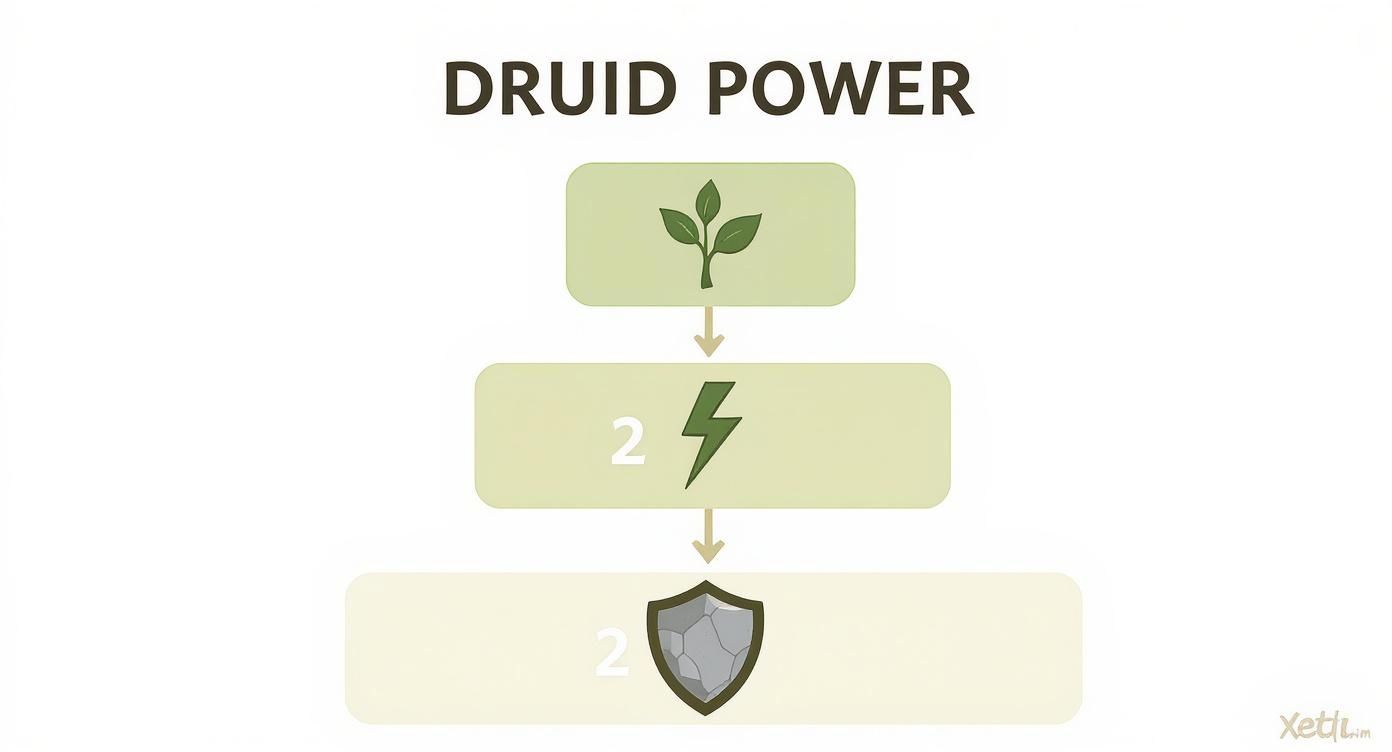
You can see the thematic progression in the diagram, moving from the nurturing magic of the early levels to the raw elemental and defensive power that truly defines a mid-level druid.
Reaching the 6th level on the druid spell list is another huge milestone. Your spells now grant incredible mobility, potent healing, and battlefield control that can completely shut down an encounter. You are a true champion of the natural world.
Prominent ancient sites across the UK, like Stonehenge, Avebury, and the sacred groves of Anglesey, have always been central to both historical and modern Druid practices. These places are considered centres of power, where rituals connected practitioners to the earth in a way that mirrors the incredible magic you now wield. You can discover more insights about these sacred locations and their history at Mindful Ecotourism.
"To cast a 6th-level spell is to speak with the authority of the mountain and the patience of the ancient forest. Your words do not ask nature for aid; they remind it of its own immense power."
Some key spells at this tier include:
You have made it, Archdruid. This is the final ascent, the very peak of your journey through the druidic arts. The spells you will find here do not just influence the world—they fundamentally reshape it. Casting these is not just an action; it is an event, one that demands respect and carries a heavy weight of responsibility. Wielding this kind of power is how legends are born.
This last chapter of our grimoire delves into the most potent and frankly awe-inspiring magic a mortal druid can command. Spells from the 7th, 8th, and 9th levels are forces of nature in their own right. They can turn the tide of a war, bring an entire ecosystem back from the brink, or obliterate an army. At this point, your bond with the wild is absolute, an unshakeable connection to the very pulse of the world.
Once you reach this tier, your magic begins to feel less like a tool and more like divine intervention. You perform feats that would leave common folk speechless, cementing your place as a true guardian of the natural order.
This deep yearning for a connection to nature is not just confined to fantasy worlds. Here in the United Kingdom, for instance, census data has shown a surprising growth in people identifying as Druids. This cultural revival, which led to The Druid Network gaining official recognition as a charity in 2010, speaks to a powerful, widespread desire to reconnect with the earth. If you are curious, you can get a sense of the history and followers of modern Druidry in this detailed overview on Wikipedia).
Now we have reached the absolute summit. At this level, you command spells that can permanently alter landscapes and rewrite the very rules of life. These are the kinds of incantations that bards will sing about for centuries; this is the stuff of myth.
"To cast a 9th-level spell is to speak in the world's first language. The mountains tremble, the skies weep, and the very cycle of life and death pauses to listen to your command."
Spells like Control Weather let you dictate the climate over miles for hours on end, summoning a life-saving rain to end a drought or a punishing blizzard to stop an army in its tracks. With Shapechange, you can become almost any creature you can imagine, from a hulking ancient dragon to a cunning pit fiend, borrowing their might while keeping your own mind intact.
And then, there is Storm of Vengeance. This is not just a spell; it is nature's unbridled fury unleashed. It is a terrifying maelstrom of acid, lightning, and crushing hail that devastates anyone foolish enough to stand against you. Learning to master such raw power is the final test for any Archdruid.
The Druid's path is a potent one, steeped in the raw, primal magic of the natural world. It is a journey of whispered secrets carried on the wind and a deep connection to the earth itself. But as any seasoned adventurer knows, this is just one trail among many winding through the vast, mystical forest of tabletop gaming. Think of this druid spell list as a starting point, not a final destination.
If you've enjoyed mastering the Druid's toolkit, you might find that same spark in the vibrant world of indie board and card games. Passionate creators are constantly building new worlds from scratch, and platforms like Kickstarter are often where these fresh experiences first take root. It is a fantastic way to get in on the ground floor and help bring a new saga to life.
Many games out there capture a similar spirit of strategy and a connection to the land. You might feel right at home with the charming woodland city-building of Everdell, where every card you play helps your little community flourish. On the other hand, Root offers a brilliant game of asymmetrical woodland warfare; each faction interacts with the forest in its own unique, deeply thematic way.
These games, and ones like our own TerraClash, push you to think on your feet, master new rules, and discover powerful combinations. Supporting projects like these is what helps new and mystical worlds continue to blossom for all of us to enjoy. If building characters with a strong bond to their world is what truly inspires you, our guide on how to make a Dungeons and Dragons character can be a great resource for channelling that creativity.
To truly get lost in the world of druidic power, why not explore visual styles that conjure images of ancient forests and forgotten realms? Resources like the detailed Medieval Fantasy Style guide are brilliant for sparking your imagination, helping you picture the very worlds your characters walk through and adding another layer of depth to your adventures.
The real magic of tabletop gaming is that every session, every campaign, and every choice is a new path waiting to be walked. The druid teaches us to listen to the world; other games ask us to help build it.
At the end of the day, whether you're mastering a complex druid spell list or building a deck of powerful cards, the thrill is the same. It's about becoming part of a story, making clever choices, and watching a good strategy pay off while sharing a unique adventure with friends. Keep exploring, keep playing, and may your path always be filled with wonder.
Here at TerraClash, we’re all about the power of the land and the thrill of strategy. If the idea of shaping a new world with every card you play sounds like your kind of adventure, keep an eye on our deck-builder. You can learn more about our vision for a new kind of fantasy game at https://terraclash.co.uk.