Greetings, traveller. Before you lies a humble scroll, a canvas of ink and parchment. Do not be deceived by its simplicity. Within its lines and boxes, a hero slumbers, awaiting the spark of creation. Your Dungeons & Dragons character sheet is far more than a mere record; it is the very soul of your adventurer, the arcane blueprint for the legend you are about to forge.
Here, in this sacred space, an idea—be it a stoic dwarf, a fleet-footed elf, or a sagely wizard—transcends imagination and takes its first breath.
Consider your character sheet the mystical DNA of your hero. It is the tome that chronicles their strengths, their frailties, and the epic potential simmering just beneath the surface. Every number you inscribe, every box you mark, is a choice that shapes the saga about to unfold. From the raw might in their sword arm to the whispered secrets of their past, this sheet captures the essence of who they are.
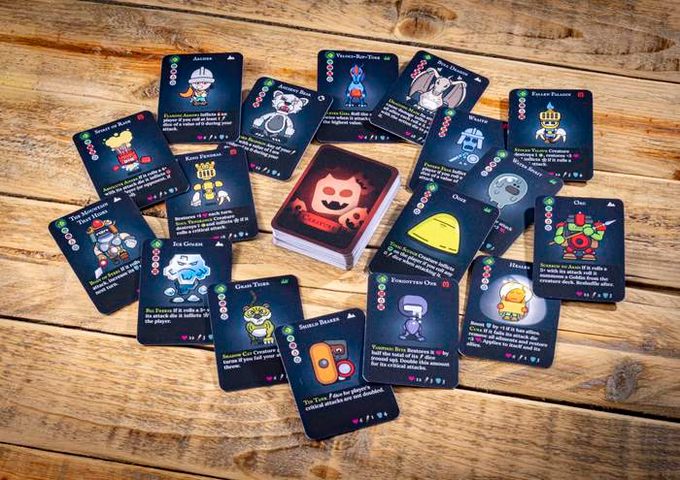
Mastering this page is your first true step on the path to an unforgettable quest. Just as every champion in a grand tale has a defining moment that sets them upon their path, your journey begins here, with this piece of paper. This idea of deep, meaningful character creation is what fuels the rich worlds we love in tabletop games, and it's a profound inspiration for our own deck-building game, TerraClash, which is designed for adventurers aged 12 and up.
Your character sheet is the central pillar of your D&D experience. It is your guide, your memory, and your direct conduit to the laws of the realm. It gives structure to your imagination, helping you consistently embody your character and understand their capabilities.
Ever since Dungeons & Dragons 5th Edition was unleashed in 2014, these sheets have been a vital artefact of the game, allowing players to track everything from abilities and inventory to their character's life story. Even with the rise of digital scriveners, the love for physical sheets remains strong, especially here in the UK. There is a certain magic to the tangible craft of building a hero by hand.
Whether you are a newcomer to these realms or a seasoned veteran, mastering your character sheet is key. If you are just embarking upon your quest, our guide to D&D for beginners is a fine place to find your bearings.
Now, let us delve deeper into the arcane architecture of the sheet itself.
To truly grasp its power, you must understand how the character sheet is divided. Each section serves a specific purpose, and together, they paint a complete portrait of your hero.
| Section | Purpose in Building Your Hero |
|---|---|
| Character Info | The essentials: your name, race, class, and background. This is your hero's chronicle in brief. |
| Ability Scores | The six core pillars (Strength, Dexterity, Constitution, Intelligence, Wisdom, Charisma) that define your raw physical and mental prowess. |
| Skills & Proficiencies | What your character excels at, from moving like a shadow (Stealth) to swaying a king (Persuasion). |
| Combat Stats | The vital numbers for battle: Armour Class (AC), Hit Points (HP), Initiative, and Speed. |
| Equipment & Inventory | Your worldly possessions, from a trusty blade and worn leather armour to that curious, glowing gem you unearthed. |
| Personality & Backstory | The heart and soul of your character—their traits, ideals, bonds, and flaws. This is what makes them truly unique. |
| Spells (if applicable) | For the magically gifted, this is their grimoire, listing the arcane power they can command. |
Each of these sections weaves together to create a character who feels real and stands ready for whatever the Dungeon Master conjures before them.
We shall now explore these core components one by one, revealing how each part—from ability scores to personality traits—threads into the grand tapestry of your story. Learning to navigate this document is much like learning the map of a new kingdom. At first, it appears a complex labyrinth, but soon you will know its every path and secret way.
Your character sheet is not merely a collection of numbers and notes. It is the first chapter of an epic waiting to be written—a promise of the hero you are about to become.
In a way, filling these boxes is an act of creation, akin to the thrill of starting a new role-playing game or cracking open the first tome in a great fantasy saga. It connects you deeply to your character and the world they are about to explore. Before long, these simple markings on a page will give rise to a hero worthy of bard's song and legend.
Every hero, from a hulking barbarian to a silver-tongued sorcerer, is forged from the same six essential elements. These are not just numbers you jot down on your character sheets dnd; they are the very soul of your adventurer, the raw clay from which their legends will be sculpted.
These core attributes are Strength, Dexterity, Constitution, Intelligence, Wisdom, and Charisma. They represent your character's innate physical and mental gifts, the foundation for every skill they will learn and every challenge they will face. Is your hero a powerhouse, able to shove a boulder aside? That is a testament to Strength. Or are they a phantom in the night, slipping past sentinels unseen? That is pure Dexterity.
Think of these scores as the bedrock of your character. They influence everything from how hard they strike to how well they can perceive a hidden truth.
Each ability score holds dominion over a specific slice of your character's capabilities. To understand them is to take the first step in breathing life into the hero of your imagination.
The infographic below reveals how these six pillars support every other aspect of your character, creating a blueprint of their strengths, weaknesses, and potential.
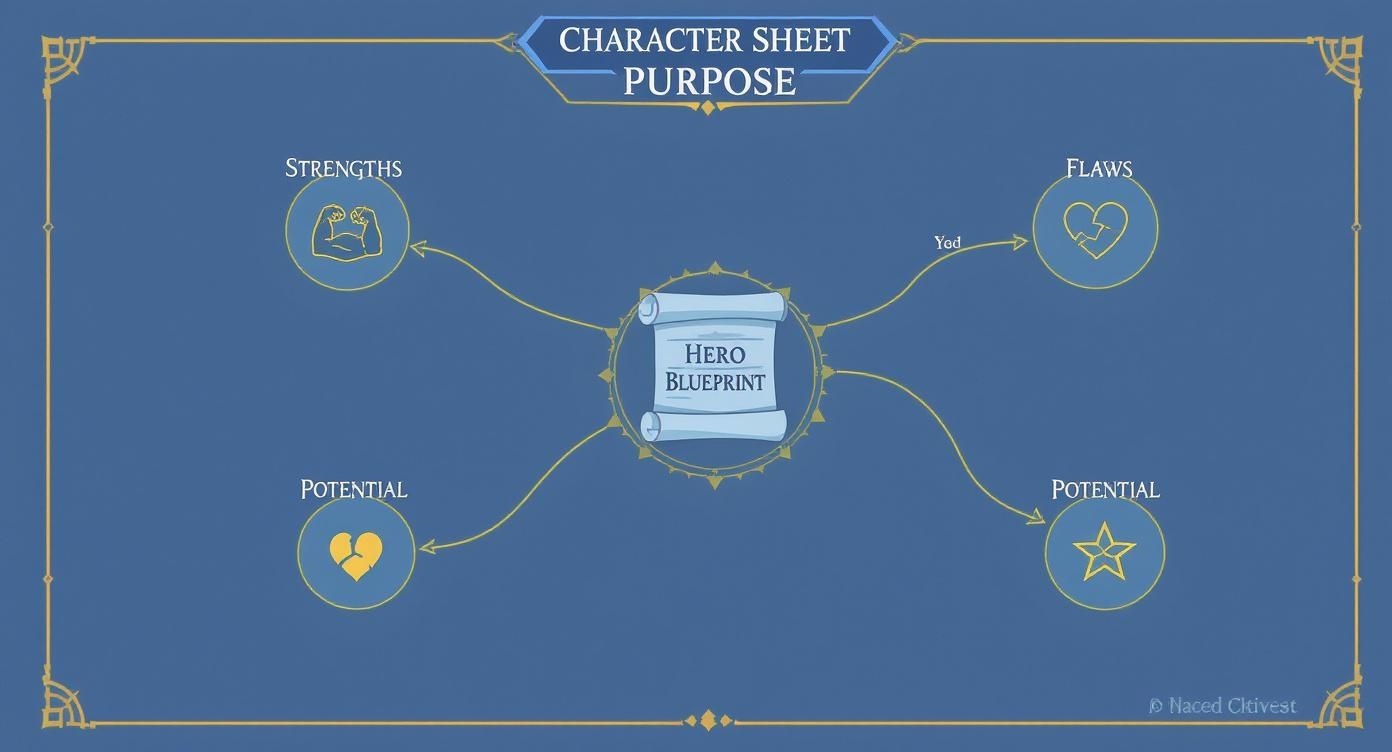
As you can see, a character sheet is no mere list of statistics. It is a complete map of your hero's being, from their raw talents to the epic potential waiting to be unlocked.
While a Strength score of 18 looks magnificent on parchment, the number you will truly call upon most often is the Ability Score Modifier. This is a smaller, simpler bonus (or penalty) that you will add to almost every D20 roll you make in the game.
Think of the ability score as your character's raw potential. The modifier is how well they can actually apply that potential when the pressure is on.
The calculation is quite straightforward. You begin with a baseline score of 10, which represents an average person and grants a +0 modifier. For every two points your score is above 10, your modifier increases by +1. Likewise, for every two points below 10, it drops by -1. So, a score of 12 grants you a +1 modifier, a 14 a +2, and a paltry 8 a -1.
From persuading a city guard to dodging a wyrm's fiery breath, it all comes back to these six core numbers and their modifiers. They are the absolute foundation of your character's journey, a design principle you'll find in almost every great tabletop game—including our own adventure, TerraClash. To truly understand them is your first great step towards creating a hero for the ages.
So, you have determined your hero's six core ability scores. Think of those as the raw, untamed potential bubbling under the surface. But true effectiveness, the kind that forges legends, comes not from raw power alone. It comes from practice, training, and the honing of that potential. It is here that skills and proficiencies enter the chronicle.
Allow me to put it another way. Your rogue might possess a fantastic Dexterity score, which is a great boon for nimbleness. But it is their proficiency in the Stealth skill that allows them to truly melt into the shadows. That proficiency represents countless hours of dedicated training, turning raw agility into a reliable tool for slipping past a dragon or liberating the keys from a sleeping jailer.
On your character sheet, you will find a list of eighteen skills. Each is tied directly to one of your main ability scores—Athletics to Strength, Acrobatics to Dexterity, Arcana to Intelligence, and so on. When you are proficient in one of these skills, you gain a special advantage: you may add your Proficiency Bonus to any check you make with it. This bonus is not static; it grows as you gain levels, reflecting your expanding experience.
It may not seem a huge number, but that small bonus is often the difference between a fumbled attempt and a heroic feat. It is how your ranger, proficient in Perception, catches the glint of a hidden tripwire that all others miss. It is how your bard, a master of Persuasion, can sweet-talk a grumpy city constable into letting the party through the gates, no questions asked.
You do not simply choose these proficiencies from thin air. They are granted by your character’s class and background, a brilliant method of weaving their personal history directly into the game's mechanics. A character with a soldier's background, for example, might be proficient in Athletics and Intimidation, while a wizard will naturally have proficiency in Arcana. This kind of strategic selection is what makes so many great tabletop games tick, from the tactical planning in Frosthaven to building the perfect engine in a game of Dominion.
As you gaze upon the skills section of your character sheets dnd, you must consider two things: mechanics and story. First, which skills synergise well with your class? A fighter will gain much from Athletics, and a wizard without Arcana will face a difficult path.
But do not stop at what is merely optimal. Consider who your character was before they embraced this life of adventure.
These choices are what make your character feel like a real person with a past. It is fascinating to see how others approach this, too. An analysis of over a million D&D Beyond character sheets revealed that Fighter and Rogue are consistently among the most popular classes, which has actually influenced how character sheets are designed to track their combat skills. If you are curious, you can delve deeper into these trends over at EN World.
Your proficiencies are the narrative threads connecting your character's past to their present. They are the tangible results of a life lived, represented by a simple bonus on a dice roll.
Choosing your skills is a foundational step in creating a hero who can solve problems with more than just a blade. It is much like building a deck in our own game, TerraClash—the synergy between your choices is what truly leads to victory and, more importantly, to unforgettable stories. A well-chosen proficiency can be the key that unlocks a secret door, deciphers an ancient riddle, or turns a deadly foe into an unlikely ally. Choose them well, for they are the tools you will use to carve out your legend.
An adventurer's life is one of constant peril. Whether creeping through a forest haunted by ancient spirits or delving into a dragon's hoard, danger is ever-present. The combat section of your character sheet is where your survival is inscribed in numbers. But this is not mere mathematics—it is the story of your resilience, your speed, and your will to stand firm when darkness falls.
These figures are the tangible proof of your hero’s fighting prowess. They decide whether a goblin’s scimitar bites deep or scrapes harmlessly off your shield. They are a measure of your very life force, the grit that keeps you on your feet when any other would have fallen.
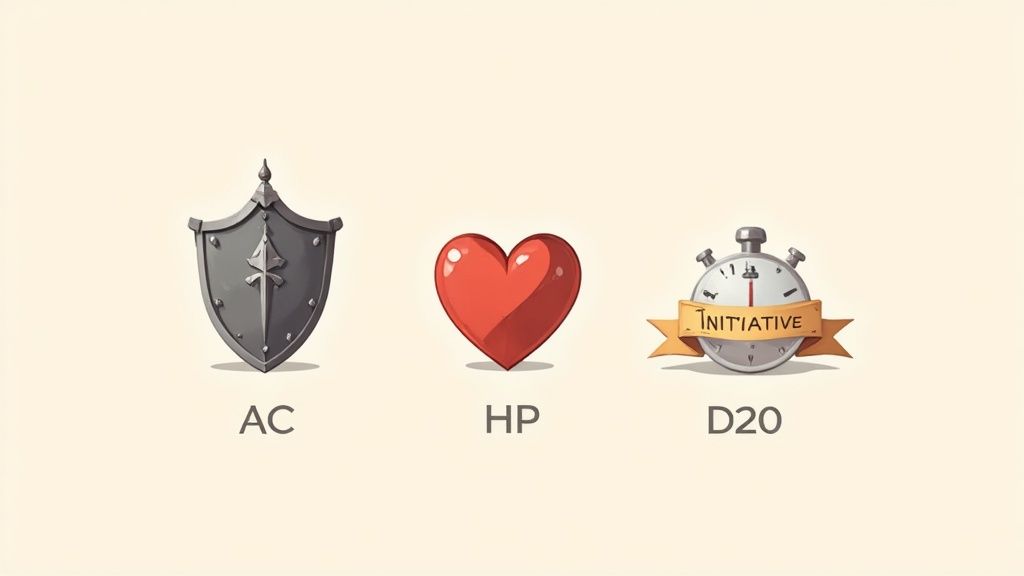
Let us now examine these vital statistics and see how they translate from ink on a page to the heart-pounding moments of a life-or-death struggle.
Your Armour Class (AC) is your first line of defence in a hostile world. It is not just a number; it tells a story. For a stoic paladin, a high AC might come from their divinely blessed plate armour, gleaming in the torchlight. For a nimble rogue, it is that whisper-quick dodge, the subtle twist of the body that makes them so difficult to strike.
Simply put, AC represents how difficult you are to hit. Any attack roll made against you must meet or exceed this number to inflict harm. The calculation begins with a base (usually 10 for an unarmoured character), to which you add your Dexterity modifier and any bonuses from armour, shields, or magical wards you might possess.
Your Armour Class is your character’s silent guardian. It is the difference between a clean miss and a mortal wound, turning a chaotic battlefield into a dance where you get to lead.
Understanding AC helps you visualise the ebb and flow of a fight. It transforms a simple dice roll into a narrative beat: the clang of a sword on steel, the whoosh of an arrow narrowly missing its mark, or the shimmer of a mage's protective ward flaring to life.
If AC is about avoiding harm, Hit Points (HP) are about weathering it. Think of HP as more than mere physical health; it is a mixture of your stamina, your grit, and your sheer determination to keep fighting. It is the measure of how many blows—be they physical or magical—your character can endure before they are overwhelmed.
Your maximum HP is determined by your class and your Constitution modifier. A tough barbarian will have a massive pool of hit points, ready to absorb punishment, whereas a frail wizard must rely on their wits and spells to stay out of harm's way. When an attack lands, you subtract the damage from your current HP. If that number reaches zero, you fall. It is that simple, and that terrifying.
Combat is rarely a neat and tidy affair. It is a chaotic symphony of clashing steel, crackling spells, and desperate gambles. Initiative is what brings a semblance of order to that chaos. When a fight erupts, everyone rolls a 20-sided die and adds their Dexterity modifier. The results create the turn order for the entire battle, from highest to lowest.
A high Initiative roll means you act before your foes, granting you a massive advantage. You might cast a debilitating spell before the other side can even react, or fell a goblin before it has a chance to sound the alarm. Initiative truly dictates the rhythm of the fight, and being quick on your feet can completely change the outcome of an encounter. These are the kinds of tactical choices that are at the core of great tabletop games, including our own deck-building adventure, TerraClash, where timing is everything. For those who prefer a more direct approach, understanding your arsenal is just as vital; you can learn more in our guide to D&D martial weapons.
https://www.youtube.com/embed/nyhCeWcpq9w
Hark, we have forged your hero's raw potential, sharpened their skills, and armed them for battle. But what truly transforms a collection of numbers into a legend worthy of song? It is the story, the very soul of the character. A truly memorable hero is so much more than their stats; they are a saga waiting to unfold.
This is where the Personality Traits, Ideals, Bonds, and Flaws section on your character sheets dnd becomes paramount. For a moment, forget numbers and bonuses. This is the heart of your creation, the sacred space where you breathe life into ink and paper.
Think of these four elements as the pillars upholding your character's entire identity. They are your guiding stars when a difficult choice arises and the wellspring of your most memorable roleplaying moments. Let us examine what each truly means.
These narrative fragments are powerful tools, not just for you but for your Dungeon Master as well. They give the DM hooks to weave your personal story directly into the main adventure, making the entire campaign uniquely yours.
A hero's true strength lies not in their sword arm, but in the conviction of their heart. Their Ideals, Bonds, and Flaws are the anvils upon which their legend is truly forged.
When you know your character inside and out, your decisions feel natural, creating those unforgettable moments that transcend mere dice rolls. This kind of deep character investment is what makes the best tabletop games so compelling, from the personal quests in an epic like Gloomhaven to the narrative choices in card-based adventures.
It is this very depth that inspires the lore we are crafting for our own world, TerraClash. In it, every choice helps to tell a story that is completely unique. Your character sheet ceases to be just a tool; it becomes a living document that grows right alongside your hero.
The enduring love for physical character sheets dnd in the UK speaks to this connection. Here, the way we use character sheets mirrors the massive growth Dungeons & Dragons has seen everywhere. The steady demand shows that the sheet is more than a gameplay aid; it is a cherished part of our tabletop culture, where keeping detailed records is all part of the magic. You can get a better sense of these trends and the UK's love for the game with these insights on D&D character sheets.
Ultimately, your character's backstory is the "why" behind all their traits. It explains what motivates them, what they fear, and what they dream of. Are they seeking redemption, trying to restore their family's honour, or searching for lost knowledge to prevent a catastrophe? Answering these questions is the key to making your hero truly unforgettable.
A hero is more than their innate abilities. What good is a rogue without their lockpicks, or a cleric who has forgotten the words to a healing prayer? This part of your character sheets dnd is where you track the practicalities of adventuring: your equipment and, if you are a wielder of magic, your spells. This is not dull bookkeeping; it is ensuring you have the right tool for the job when chaos descends.
Think of this section as your inventory, a detailed list of all you carry. From the weight of that gleaming longsword to your last few rations, every item matters. Keeping a watchful eye on your gear is a skill that separates a seasoned adventurer from a greenhorn caught in a dungeon without a torch.
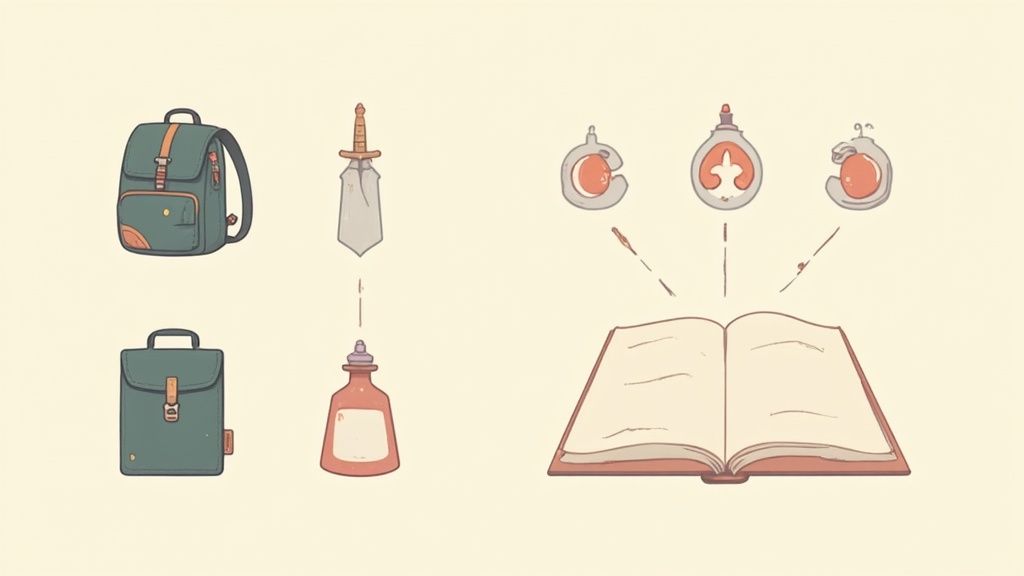
This kind of careful resource management is at the heart of so many great tabletop games. Whether you're managing a hand of cards in a deck-builder or plotting a route in a grand campaign, your choices have real weight. It is always thrilling to see indie games on platforms like Kickstarter bring these ideas to life in fresh, exciting ways.
For those who wield magic, there is another layer to manage. The spellcasting sheet is your lifeline to the arcane energies of the world. It is where you will track the spells you have learned and the raw power you have to unleash them.
Let us briefly touch upon a few key concepts you will find here:
The true art of spellcasting is not just in throwing the biggest fireball. It is in foresight. A well-prepared spell list is the hallmark of a truly wise and dangerous magic-user.
Keeping your inventory and spell list organised is simply good sense. A messy sheet can grind the game to a halt at the most exciting moments. A few minutes of tidying means you can focus on the adventure, not rummaging through your notes to find a number. If you wish to better understand your magical might, our article on how to calculate your spell save DC in 5e is a fantastic resource for any budding mage.
Ultimately, mastering your gear and spells is a delightful game within the game. It is a strategic puzzle that adds a brilliant layer of depth to your character—much like how building the perfect deck in our game, TerraClash, shapes your every move on the path to victory.
Now, let us address a few common questions before you set out on your adventure. As we conclude this deep dive into the art of character creation, a few queries always seem to arise. Think of this as the final chat around the campfire before the true journey begins.
Even veterans of countless campaigns sometimes ponder these questions, so do not be shy. Settling these details now means more time for adventuring later.
So, you have etched everything onto your character sheet in what feels like permanent ink. Is it set in stone? By no means. Your character sheet is a living, breathing document that should grow and change right alongside your hero.
Most Dungeon Masters are perfectly content with you tweaking things, especially in the early levels. Perhaps that personality trait you chose simply does not feel right after a few sessions, or you realise a different skill would make more sense for your backstory. The story is king. If your once-cynical rogue has a change of heart and finds a new purpose, their bonds and ideals should change to reflect that.
Think of your character sheet less like a stone tablet and more like a well-worn travel journal. It is meant to be updated with new experiences, triumphs, and the occasional scar.
When the dragon is breathing down your neck, the last thing you want is to be fumbling for your character sheet. Keeping it organised is crucial for staying in the moment. For many, the classic pencil and a trusty eraser are all you need to track things that change often, like your hit points or spell slots.
If you are more digitally inclined, there are some fantastic apps and online tools that handle all the mathematics for you. For the pen-and-paper purists, a simple folder or a clipboard can be a lifesaver, protecting your precious sheet from spilled drinks or a misplaced map. Ultimately, the best system is whatever lets you find what you need without missing a beat.
This kind of deep, tactical thinking is what we love about tabletop gaming, and it’s the very spirit we're capturing in our own game, TerraClash. If you enjoy forging a hero from the ground up, prepare to forge a legend with us. Our Kickstarter is launching soon, so keep an eye on our progress and be one of the first to step into a brand new world at https://terraclash.co.uk. For more on great indie games, consider checking out campaigns like Gloomhaven or Frosthaven on Kickstarter and BackerKit.