Hark, adventurer, and gather 'round the hearth, for we are about to delve into a realm of cardboard and cunning, one of the most satisfying genres in all of tabletop gaming. Deck-building card games are a unique form of spellcraft. Forget arriving at a duel with a pre-made grimoire you spent hours agonising over. In these arcane contests, forging your deck is the game itself.
So, you are ready to test your strategic mettle? Good. Welcome to a world that has kept players like us enthralled for ages. This is not merely about the luck of the draw; it is about crafting your own fate, one card at a time.
Every quest begins not with a bang, but with a whisper. You shall have a small, almost pitiful hand of basic cards. Think of it as your starting gear—a rusty sword and some flimsy leather armour. From these humble beginnings, you will build an empire.
Each turn is a new crossroad on your journey. You will have the chance to add a powerful new spell, a fearsome creature, or a game-changing artefact to your deck. It becomes a living, breathing testament to your choices throughout the game, a chronicle of your rise from peasant to king.
The true magic of a deck-builder is witnessing your deck evolve. It’s a dynamic, ever-changing engine that you build from the ground up. This arc, from a clunky starter hand to a finely tuned powerhouse, is what makes every game a compelling story. It is, in essence, a classic hero’s journey, but with cards:
It’s this unique blend of long-term strategy and in-the-moment tactical decisions that has built such a dedicated fellowship. The UK market for playing cards and board games, which is home to these brilliant games, summoned around US$1,049 million in revenue and is expected to reach US$1,499.5 million by 2030. What is truly telling is that the playing cards segment—where deck-builders reside—is the fastest-growing part of that market. It’s clear that UK gamers are falling in love with the art of card-based strategy. You can discover more insights into the UK tabletop games market to see just how much this realm is booming.
This is the very spirit that fuels new chronicles like TerraClash. That incredible moment when you draw the one card you desperately need feels like a warrior pulling a legendary sword from a stone. It is a genre that speaks directly to the tactician and the storyteller within us all.
Every great saga must have a beginning. In the world of deck-building card games, that starting point is your first hand of cards. The ritual is always the same: you begin with a small, often identical, set of cards known as your starting deck. Think of it as the basic toolkit you're given before setting off on a grand quest.
This starter deck is deliberately weak, usually filled with cards that grant you basic resources or allow you to perform simple actions. It is your blank spellbook, your unsharpened sword. Your entire mission is to transform this humble beginning into a powerhouse by adding new, stronger cards to the mix.
These new cards almost always come from a central, shared pool that everyone can access. We often call this the market or the 'river'. Picture a bustling bazaar where powerful spells, mighty allies, and ancient artefacts are all up for grabs. You use the resources from the cards in your hand to 'buy' these new additions, and this is where the real strategy begins. What you choose to add to your deck defines your path to victory.
The true enchantment of a deck-builder lies in its cyclical nature. You play cards from your hand, use them to acquire new ones from the market, and then discard everything at the end of your turn. Once your draw pile is empty, you perform a special ritual: you shuffle your entire discard pile—which now contains all those gleaming new cards you bought—to create a brand new deck.
This loop of playing, discarding, and reshuffling is the engine that drives your deck's evolution. Each time you shuffle, the odds of drawing one of your powerful new cards improve. It’s a slow burn, a gradual process of forging your deck from a blunt instrument into a finely-honed weapon.
"Deckbuilding is just as much about buying new cards, as it is about removing them from the deck. The further you get into the game, the more it’s about trimming the fat. You’ve bought those shiny new cards; now it’s time to make your deck hum."
This brings us to one of the most crucial skills in any deck-builder: culling. You might also hear it called thinning or trashing. This is the act of permanently removing cards from your deck, usually those weak starting ones. Any veteran adventurer will tell you that a slim, efficient deck is far more dangerous than a bloated one full of junk. By getting rid of the chaff, you make every card you draw more impactful.
This infographic breaks down how all these mechanics work in concert, showing you how a deck's power level ramps up as the game unfolds.
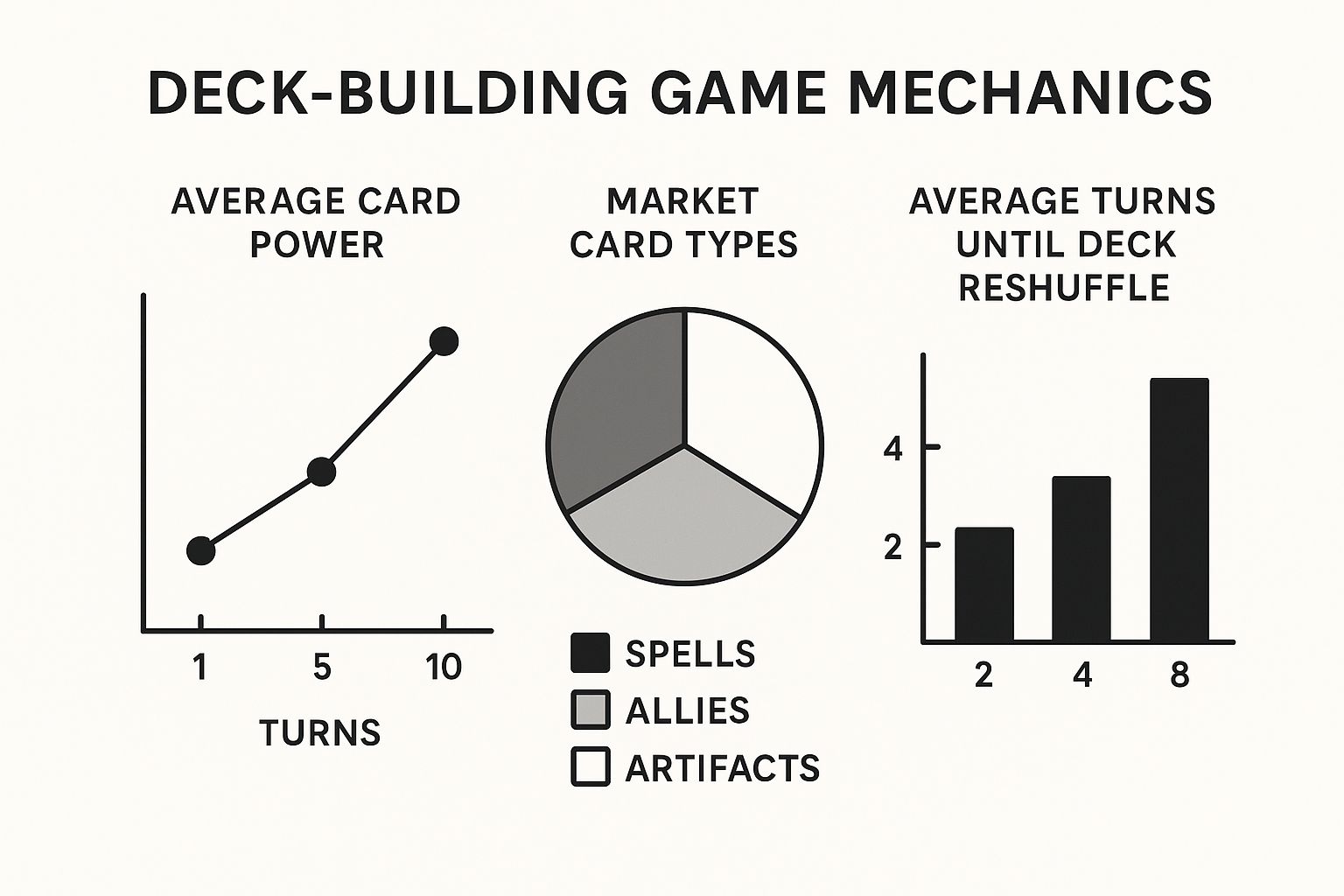
As you can see, the goal is to summon those powerful cards into your hand as often as possible. A smaller, more focused deck means a faster reshuffle cycle, which is exactly what a wise strategist desires.
When you put all these pieces together, you get an incredibly satisfying and strategic game. Every match feels like a unique puzzle you're solving in real-time.
It’s this elegant system that makes the genre so compelling and replayable. In a game like TerraClash, these mechanics are woven deeply into the experience, making every decision a critical part of your journey. Grasping this core loop is the first, and most important, step to mastering any deck-building card game.
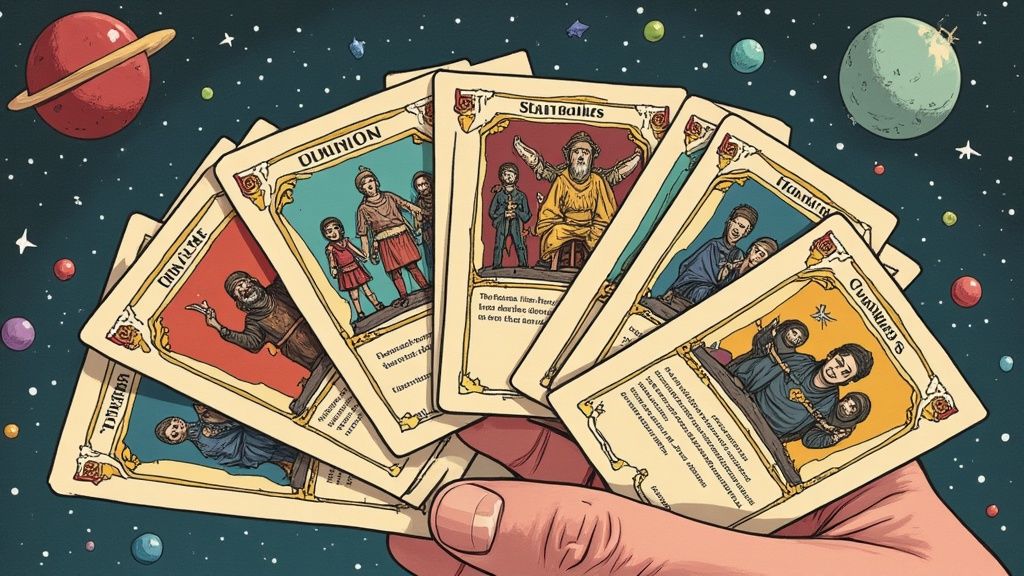
To truly understand what makes modern deck-building card games tick, you must look back at the giants on whose shoulders they stand. These are not just games; they are the foundational pillars of the entire genre. Each one brought a new enchantment to the table, carving out a fresh path to build an empire, fight a war, or simply survive another day.
It all truly began with Dominion. For so many of us, this was the game that opened our eyes. It took the idea of building your deck and made it the entire point of the game. Suddenly, the contest wasn't just about playing your hand; it was about crafting the perfect engine from scratch, turn by turn. Elegant, simple, and fiendishly replayable, Dominion is the grand master of them all.
From that single, brilliant spark, the genre exploded in a thousand different directions. We saw games like Star Realms take the core idea and streamline it into pure, fast-paced combat. It proved you could have a deep, strategic duel between starfleets that could fit right in your pocket. A grand experience did not require a massive box.
But herein lies the magic of deck-building: it’s not just about combat. Consider Clank!, a game that masterfully mashes up deck-building with a nail-biting, push-your-luck dungeon crawl. Your deck isn't just your weapon; it's your stealth, your speed, your very survival. Each card you play could let you sneak past a dragon, or it could make a loud ‘Clank!’ that brings a fiery doom ever closer.
That shows you the true flexibility of the mechanic. It can tell the story of a frantic heist just as beautifully as a galactic war.
And then there are the games that forged paths of fellowship. In cooperative titans like The Lord of the Rings: The Card Game, you do not battle each other. Instead, you stand together against a malevolent game system. Your decks must work in harmony, complementing each other's strengths to overcome Sauron's forces. It’s a perfect reflection of the Fellowship’s spirit.
The innovation did not stop with the classics. A whole new generation of designers, often funded through platforms like Kickstarter, have been pushing the boundaries of what's possible.
This is where you see the modern epics being forged. Sprawling campaign games like Gloomhaven and its siblings, Jaws of the Lion and Frosthaven, have woven deck-building DNA into deep, legacy-style role-playing. These aren't just games you play in an evening; they're sagas that unfold over dozens of sessions, where your character and the world itself change permanently.
This vibrant scene is a testament to the genre's enduring appeal. While UK market reports often group deck-builders with broader card game categories, the thriving community tells the true story. The global trading card game market, which shares many players with our beloved deck-builders, is seeing explosive growth across all ages, from school clubs to competitive adult leagues. This passion is visible in every packed game café and bustling online forum in the UK. Learn more about the trends shaping the collectible card games market and its incredible growth.
Before we proceed, it is worth seeing how these titans stack up against one another. The differences in their design philosophy truly highlight how diverse the deck-building world has become.
| Game Title | Core Theme | Key Innovation | Player Interaction Level |
|---|---|---|---|
| Dominion | Medieval Kingdom Building | Pioneered deck-building as the central mechanic | Low |
| Star Realms | Sci-Fi Fleet Combat | Streamlined, direct conflict in a small package | High (Direct Attack) |
| Clank! | Fantasy Dungeon Crawl | Fused deck-building with a push-your-luck board game | Indirect (Race) |
| The Lord of the Rings TCG | Cooperative Fantasy Adventure | Fully cooperative gameplay against an automated "AI" | High (Cooperative) |
| Gloomhaven | Tactical Fantasy Campaign | Integrated deck-building with legacy/RPG mechanics | High (Cooperative) |
As you can see, the core idea—building a better deck—can serve completely different experiences, from low-interaction engine building to fully cooperative campaigning.
This constant flow of fresh ideas is what keeps the genre so thrilling. If you are keen to explore more, we have put together a guide to some of the best deck-building games to launch your next adventure.
Each of these games, from the old guard to the new challengers, adds a unique thread to the grand tapestry of tabletop gaming. They are the inspiration for worlds like TerraClash, and by understanding their stories, we can better appreciate the adventures still to come.

Any apprentice can learn the rules of a deck-building card game, but winning consistently? That, my friend, is another story entirely. It is about seeing the flow of the battle before the first card is even played.
True mastery is not just about knowing what a card does; it is about understanding why you are playing it. Let us peel back the layers and look at the core philosophies that separate the novices from the veterans.
Right from the get-go, you face a fundamental choice. Do you pursue quick, raw power, or do you play the long game?
One of the most direct strategies is what many players call 'Big Money'. The game plan here is simple: focus everything on buying the cards that generate the most in-game currency. Your goal is to build up a powerful economy that lets you snatch up the most valuable victory point cards before your opponent has a chance to get their own strategy off the ground. Think of it as a brute-force approach—it's not subtle, but it can be incredibly effective.
On the other hand, you have the more intricate path of the 'Engine Builder'. This is all about synergy. You are not just buying cards; you are meticulously assembling a well-oiled machine where every card works in concert with the others. A good engine lets you draw more cards, take extra actions, and create incredible chain reactions that feel unstoppable.
An engine takes time to construct, and it can feel slow at first. But once it gets going, its power can completely eclipse what a Big Money player can achieve. The real skill is knowing which path to take and when.
Now, listen closely, for this is perhaps the single most important piece of advice you shall ever receive. A strong deck is not just about what you put into it. It is about what you take out.
This is called ‘deck thinning’ or ‘culling’. Those basic, weak cards you start the game with? They quickly become dead weight, clogging up your hand and stopping you from drawing the powerful cards you’ve worked so hard to acquire.
To become a master, you must be ruthless. Every weak card that remains in your deck is a potential point of failure, a crack in your armour. Culling the weak ensures that only your champions, your most potent spells, answer the call of the draw.
Think of your deck as an elite fighting force. You would not send a peasant with a pitchfork to fight a dragon, would you? The same logic applies here. Get rid of the weak links so that when it truly matters, you’re drawing your best cards.
Every decision you make is a balancing act. Do you buy a card that gives you a small, immediate advantage? Or do you invest in something that will pay off big in the long run? This constant push-and-pull is known as tempo.
Grabbing an early lead can put your opponents on the back foot, forcing them to react to you. But a strategy based only on short-term gains can run out of steam later on. The best players learn to read the table and adapt on the fly.
These principles are the foundation of countless victories. For a deeper dive into crafting powerful card combinations, our guide on how to build a powerful deck is the perfect next step. In a game like TerraClash, applying these ideas is what turns a simple pile of cards into a legendary, game-winning force.
Every great fantasy story, from the sprawling sagas of Tolkien to the epic campaigns of Dungeons & Dragons, pulls from the same ancient well of myth and legend. Deck-building card games are no different. They are the perfect modern vessel for this kind of storytelling, letting players build their own legends, one card at a time.
This connection to lore is baked right into the mechanics. Consider this: drawing the perfect spell just when you need it feels like a wizard unearthing a forgotten incantation from a dusty tome. When you add a powerful new ally to your deck, it's like forging a fellowship destined for great things. You are not just playing cards; you are writing your own story.
A truly great deck-builder does not just hand you a pile of cards; it gives you fragments of a world. TerraClash truly leans into this heritage, weaving its rich, unfolding narrative directly into the gameplay itself.
Each card is more than a simple action or resource. It is a piece of a bigger picture—a character with a history, a spell with a legend, or an artefact with a purpose. You might even find some cards are steeped in the chaotic traditions of goblin magic.
This is how new legends are made. They stand on the shoulders of giants while carving out a fresh identity. The aim is to capture that same sense of wonder you get from classic fantasy, translating epic tales into strategic, card-based adventures suitable for ages 12 and up.
The thrill of exploration in fantasy is perfectly mirrored in deck-building. Each shuffle is a journey into the unknown, and every draw is a discovery. A well-designed game makes you feel like an adventurer, not just a player.
This deep love for thematic storytelling is fuelling the genre's incredible growth, especially here in the UK. The whole ecosystem for both digital and physical card games has absolutely blossomed. This is partly thanks to a huge expansion in e-commerce, a sector in the UK valued at US$297 billion and still projected to climb.
This boom has made it easier than ever for indie creators to bring their worlds to players, building vibrant communities around exciting new projects. You can learn more about the UK board games market and see just how much it has grown. It is in this exciting climate that new worlds like TerraClash can take root, inviting players not just to play a game, but to become part of a new legend.
The map of deck-building card games is not yet complete. Far from it. There are still vast, undiscovered territories waiting for someone brave enough to explore them. We now look to that horizon, where indie studios are pushing the boundaries of what these games can be, writing new legends for the rest of us to follow.
We stand on the precipice of a new era. We see the rise of legacy mechanics, where the game world itself remembers your choices and changes permanently over multiple playthroughs. We are also witnessing a fascinating fusion of genres, where deck building is being woven into deep role-playing games with branching stories.
The old formulas are being reforged in the fires of creativity. Digital versions continue to bring classic tabletop experiences to a whole new audience around the globe. At the same time, platforms like Kickstarter have become the proving grounds for the next generation of classics, a place where a community's faith can literally bring a new world to life.
This is where the real adventure is happening. It is a space of endless experimentation:
The greatest quests are those not yet written. The future of deck building is a living, breathing art form, and its most epic adventures are still taking shape in the minds of creators and the hands of players.
games like TerraClash are a perfect example of this exciting new wave, adding a unique voice to the genre’s growing chorus. It is a testament to the idea that a simple mechanic—building a better deck—can be the foundation for countless incredible stories.
This journey is far from over. Deck building is not a static set of rules; it is a craft that is constantly evolving. I encourage you to seek out these new experiences, whether it is an ambitious indie project on Kickstarter or the next big release at your local game shop.
Support the creators who dare to explore uncharted lands. Become part of the story, and help write the next chapter in the grand saga of deck building. The best adventures await those who are willing to shuffle up and deal.
Stepping into a new genre of game always comes with a few questions. Let us tackle some of the most common ones that arise when one first discovers the world of deck-building card games.
Ah, the great question! It all comes down to when the deck is built.
With a Trading Card Game (TCG) like Magic: The Gathering or Pokémon, you do all the work beforehand. You painstakingly assemble your perfect deck from your personal collection, and then you bring that finished deck to the table to play.
In a deck builder, the game is the act of building the deck. Everyone starts on a level playing field, usually with the same handful of weak, basic cards. The entire point of the game is to use those starter cards to buy better, more powerful ones from a shared marketplace, gradually crafting a powerhouse deck right there on the fly.
Not at all! While there are plenty of brilliant competitive games where you are trying to vanquish your opponents, like Star Realms, the genre is incredibly diverse.
In fact, some of the most popular deck builders are cooperative. Games like the Legendary series or Aeon's End have players team up, building their decks together to take down a massive, game-controlled foe. It is all about working together to survive.
The best stories are often written together. Co-op deck builders are less about individual glory and more about shared strategy and celebrating a hard-won victory as a team. It’s a completely different, but just as rewarding, kind of thrill.
These games are a fantastic way to enjoy a challenging campaign with friends, where your combined brainpower is the only thing standing between you and defeat.
Do not be intimidated, young adventurer. One of the best things about modern deck builders is how welcoming they are to newcomers. The core concept is usually very straightforward.
The basic loop is simple: you draw a hand, play your cards to generate some kind of resource (like gold or combat power), and then use those resources to buy new cards for your deck. That’s it! While the strategies can get incredibly deep, the fundamental rules are easy to pick up. Games designed for ages 12 and up, like TerraClash, are designed to hit that sweet spot between being easy to learn and hard to master.
Your first couple of games are all about exploration. You'll quickly get the hang of it, and the real fun begins when you see your deck evolve from a few simple cards into a well-oiled machine. The learning process is part of the adventure.
Ready to start your own adventure? The world of TerraClash is just over the horizon. Be the first to know when the gates open by visiting https://terraclash.co.uk.

