At its heart, Magic: The Gathering is a sprawling fantasy world squeezed into a deck of cards. It’s a game that brilliantly merges deep, chess-like strategy with the thrill of collecting beautiful art. You and your opponent play the part of mighty wizards, known as Planeswalkers, battling for supremacy.
Your deck isn’t just a pile of cardboard; it’s your spellbook, your arsenal. You’ll use it to summon fearsome creatures, cast devastating spells, and wield powerful artefacts to crush your rival.
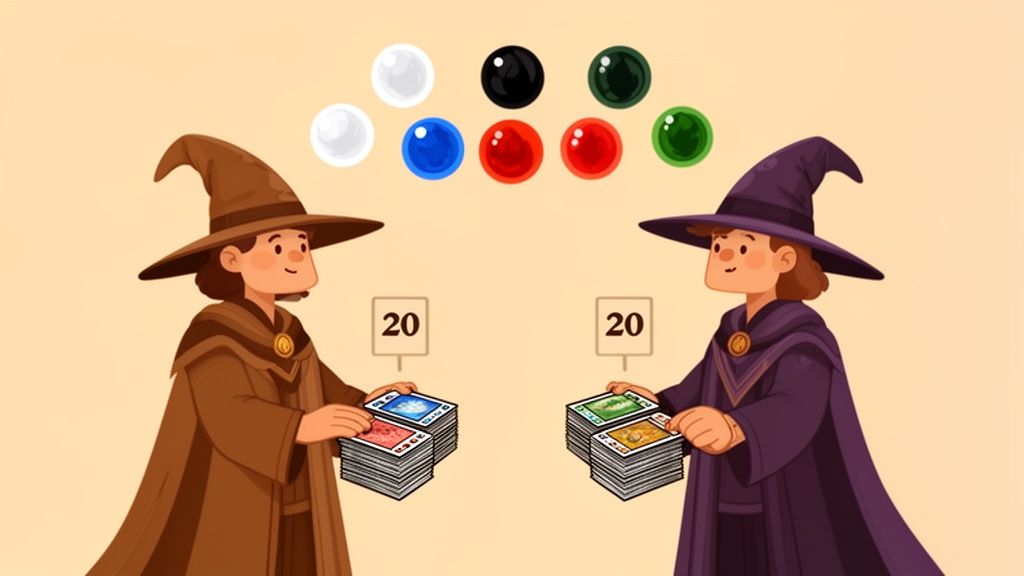
Picture this: you're locked in a tense duel of wits. The cards in your hand are your grimoire, brimming with possibilities. The very lands you control are conduits, funnelling magical energy that lets you command dragons, raise armies of the undead, or reshape the battlefield itself.
The goal is simple enough on the surface: knock your opponent's life from 20 down to zero. But getting there is an art form. This blend of strategic thinking and creative deck-building is what has kept millions of us hooked for decades, forging one of the most passionate communities in all of gaming.
For new players, it can be helpful to see the core concepts laid out simply. Here’s a quick overview of what makes Magic tick.
| Concept | Brief Explanation |
|---|---|
| Planeswalker | The role you, the player, assume. A powerful wizard who can travel between different worlds (planes). |
| Deck | Your customised library of at least 60 cards, containing all your spells, creatures, and lands. |
| Mana | The magical energy, produced by Land cards, used to cast spells. Comes in five colours. |
| Creatures | Your army. You summon them to attack your opponent and defend you from their attacks. |
| Spells | One-off effects like direct damage, drawing more cards, or countering your opponent's moves. |
| Life Total | Your health. Each player starts with 20 life, and the first to reach zero loses the game. |
This table just scratches the surface, but it gives you a solid foundation for understanding the flow of a typical match.
The real joy of the game, the thing that keeps you coming back, is the story each match tells. Every draw of the card, every agonising decision—do I attack now, or hold back to defend?—weaves a unique narrative. This is why so many players get completely absorbed in crafting the perfect deck that truly reflects their personal playstyle. It’s your story to tell.
If that kind of tactical card combat sounds appealing but you’re looking for a quicker, more streamlined experience, there are some fantastic alternatives out there. Games like TerraClash™ Grimoire capture a similar spirit of wizard-on-wizard duelling but are built for speed. It delivers that same satisfaction of outsmarting an opponent with a clever play, but in a tight, fast-paced format that wraps up in just 10-15 minutes.
For anyone curious about this rapid-fire take on strategy, you can explore the TerraClash™ Grimoire page to see how it puts a modern spin on the classic duel. You can even check out its successful Kickstarter campaign to get a feel for the community behind it. And if you want to give it a go before committing, there’s a Print and Play version available.
At the heart of Magic's design, what truly makes it tick, is the 'Colour Pie'. This is the game's brilliant system of five distinct colours of mana, and each one comes with its own unique philosophy, strengths, and tactical weaknesses. Choosing your colours is a lot like picking a class in an RPG—are you a noble knight, a cunning wizard, or a raging barbarian? That choice will define your entire strategy and the kind of story your deck tells on the battlefield.
Getting to grips with the colours is your first real step towards finding your personal playstyle. It’s how you decide if you want to swarm the board with an army, meticulously dismantle your opponent’s plans, or just burn everything in sight with a flurry of lightning bolts. This is where you start to express yourself through the cards.
So, let's look at what each colour is all about. These aren't just arbitrary rules; they're rich, philosophical identities that give every card its flavour and purpose.
White (Plains): This is the colour of order, community, and protection. White decks are all about building a society on the battlefield. You’ll use lots of small creatures that work together, create enchantments that enforce fairness and rules, and protect your forces. If you like the idea of playing as a steadfast commander leading your troops, you'll feel right at home with White.
Blue (Islands): The colour of knowledge, intellect, and deception. Playing Blue is a game of wits. You’ll spend your time drawing extra cards to stay ahead, countering your opponent's biggest threats before they even hit the table, and using clever tricks to control the flow of the game. It’s the perfect choice for anyone who loves a good mind game.
Black (Swamps): This is the colour of ambition, death, and sacrifice. Black mages are utterly ruthless and believe power is worth any price—even if it means paying with their own life points. They excel at destroying creatures, reanimating the dead from any graveyard, and making their opponents discard their best cards. It's a dark path, but a powerful one.
Red (Mountains): The colour of chaos, freedom, and pure aggression. Red is all about impulse and fury. You’ll use fast, reckless creatures and a barrage of direct damage spells—think lightning bolts and fireballs—to overwhelm your opponent before they even get a chance to set up. If your motto is "act now, think later," you're a Red mage at heart.
Green (Forests): This is the colour of nature, growth, and brute force. Green magic is straightforward: grow your mana resources as quickly as possible, then summon enormous creatures to stomp all over your opposition. If you want to command titanic beasts and see the raw power of nature unleashed, Green is your calling.
The real magic, though, happens when you start mixing them. A Black and Green deck can turn death into new life, while a Blue and White one can lock down the board with laws and illusions. The strategic depth that comes from these combinations is a hallmark of the genre.
This idea of finding your identity through different factions is something many modern card games have embraced. You can see a similar spirit in newer indie games like TerraClash™ Grimoire, though it offers a much quicker, more streamlined experience. Where a game of Magic can be a long, drawn-out duel, TerraClash™ is built for complete, satisfying matches in just 10-15 minutes.
It manages to capture that same feeling of strategic choice, letting you find a playstyle that clicks without needing a huge time commitment. If that sounds like a good way to dip your toes in the water, you can check out the game's unique mechanics on the TerraClash™ Grimoire page or see what the community is saying over on its Kickstarter campaign. For those who want to dive straight in, there's even a Print and Play version available.
So, you’re ready to see how a game of Magic actually plays out? The best way to get a feel for it is to walk through a turn. Picture this: you’ve sat down across from your opponent, shuffled your 60-card deck, and drawn your opening hand of seven cards. The duel is on.
Your turn kicks off with a quick sequence of housekeeping steps. First, you Untap all your cards on the battlefield, getting them ready for action. This is followed by your Upkeep, a small window where certain abilities might trigger. Then comes the part everyone looks forward to—the Draw Step, where you draw a new card, hoping it’s the exact spell or resource you need.
Now we get to the heart of your turn: the Main Phase. This is where you make your big strategic moves. Each turn, you can play one Land card from your hand. Think of Lands as your power generators; they produce the magical energy, or mana, you need to do anything of consequence.
With your Land played for the turn, you can start casting spells. You do this by ‘tapping’ your lands—turning them sideways—to generate mana. You then spend that mana to summon creatures, weave powerful enchantments, or unleash surprise instants to throw a spanner in your opponent’s works. Every choice here is a step towards victory.
The infographic below hints at some of the core playstyles you might build your deck around, which are heavily influenced by the five colours of mana.
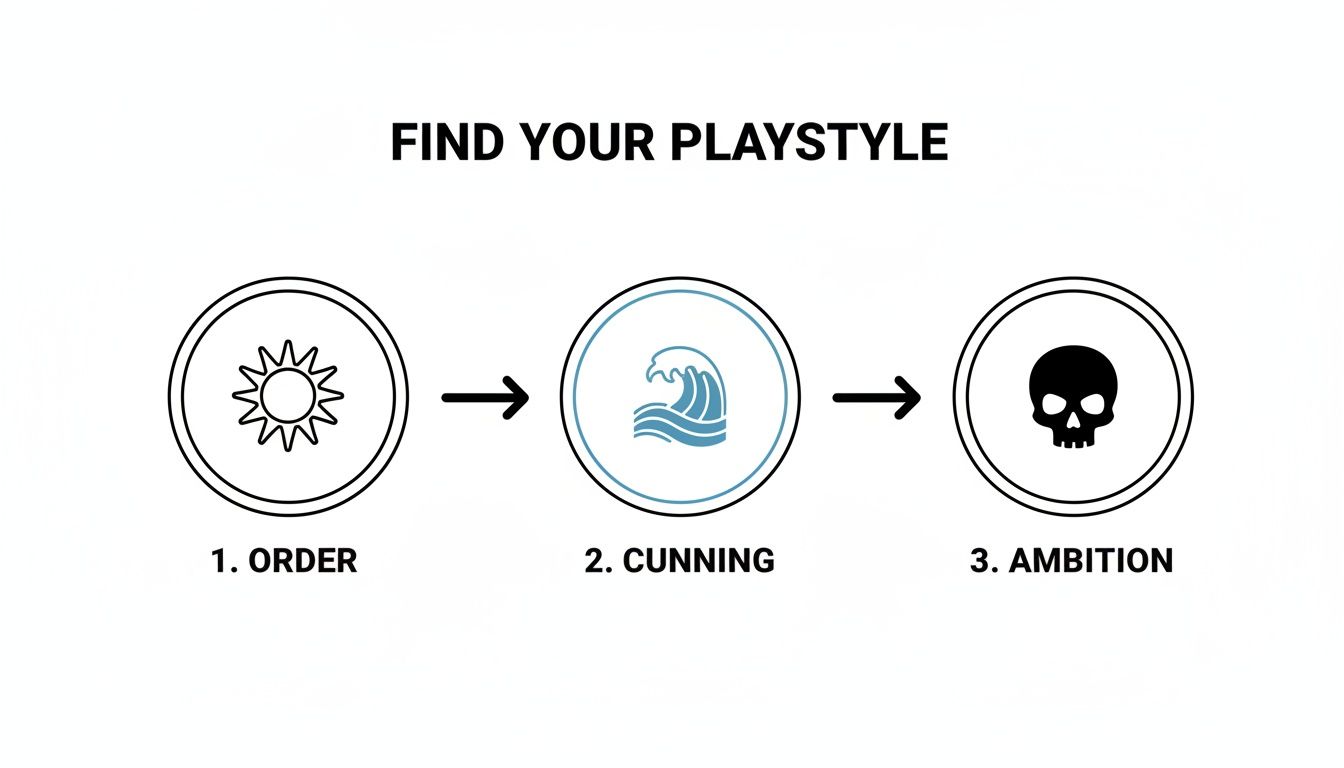
This visual gives you a glimpse into how different magical philosophies—like order, cunning, or ambition—shape your strategy on the battlefield.
Once you’ve arranged your forces, it's time for a fight. The Combat Phase is where the action happens. You declare which of your creatures will attack, and your opponent must then decide which of their creatures will stand in the way to block. Any unblocked attackers deal damage straight to your opponent's life total, bringing you closer to winning the game. It’s always a tense exchange of risk and reward.
The rhythm of a turn—building resources, deploying threats, and clashing in combat—is a satisfying loop that underpins many great strategy card games. It’s a classic formula that rewards careful planning and smart plays.
You'll find this fundamental structure echoed in other games. The indie title TerraClash™ Grimoire, for example, shares that same spirit of summoning forces and casting spells to defeat a rival. It’s built for a much quicker pace, though, with a full, strategic game wrapping up in just 10-15 minutes. It’s a fantastic option if you’re looking for that duelling experience but are short on time.
If you're curious about a different spin on this classic formula, you can find out more on the TerraClash™ Grimoire page or check out what the community built during its successful Kickstarter campaign. For anyone eager to dive in, a complete Print and Play version is available to get you into the action right away.

Once you've got the hang of casting spells and summoning creatures, you’ll discover one of the best things about Magic: it’s not just one game. It's an entire system with dozens of different ways to play, known as 'formats'.
Think of it like this: the core rules are the grammar, but each format is a different dialect. They all use the same language, but with their own unique rules about which cards you can use and how many people can play. Finding your favourite format is a huge part of your journey as a player.
If you thrive on competition and love staying on the absolute cutting edge, Standard is for you. This format uses only the most recently released card sets, so the entire landscape of the game shifts every few months. Old strategies become obsolete, and new, powerful decks rise to the top. It’s a fast-paced and ever-changing puzzle.
But Magic isn't just about intense one-on-one duels. For many, its real magic happens when you get a group of friends around a table. This is where the game transforms into a social event.
The undisputed king of multiplayer Magic is Commander (you'll also hear old-timers call it EDH). Here, you build a 100-card deck, with no duplicates, all themed around a single legendary creature—your 'Commander'. You then sit down with three or more other players for a sprawling, unpredictable free-for-all. It's less about winning at all costs and more about spectacular plays, temporary alliances, and telling a great story together.
The sheer scale of Commander is mind-boggling. The room for personal expression in this format is immense, which explains why it has become so popular for social gaming.
Then you have Draft, which is perhaps the purest test of a player's skill. You don't bring a deck at all. Instead, you and your friends open fresh booster packs, pick one card, and pass the rest to the person next to you. You build your deck right there on the spot. It puts everyone on a level playing field, where success comes from reading the table and making smart choices under pressure.
Of course, not everyone has hours for a sprawling game night. If you love the idea of a strategic card duel but need something that fits into a tighter schedule, there are some brilliant alternatives. Games like TerraClash™ Grimoire are designed from the ground up for quick, punchy matches that are over in just 10-15 minutes. It’s perfect if you're looking for that card game fix without the long time commitment.
You can check out the TerraClash™ Grimoire page to see how it works, or see what the community built during its successful Kickstarter campaign. If you fancy giving it a go yourself, there's even a Print and Play version available.
The world of trading card games is huge, and there’s an incredible amount to explore. If you love the idea of magical duels and deep strategy but find the thought of a long game of Magic a bit intimidating, don't worry. There are some fantastic alternatives out there built for people with busy lives, so you don't have to miss out on the fun.
It’s well worth looking at the independent card game scene. This is where you’ll often find new ideas and clever, quick-playing mechanics that deliver that same strategic kick in a much more compact package. They all share that brilliant core idea: you draw cards, manage your resources, and try to out-think your opponent.
A perfect example of this is TerraClash™ Grimoire. It captures that same feeling of magical combat—building up a force, casting powerful spells, and battling for control—but wraps it all up in a format where a full, satisfying game takes just 10-15 minutes.
It gives you the same joy of crafting a unique deck and outmanoeuvring a rival, just with a much quicker, more intuitive system that feels both new and familiar. For anyone who loves that strategic puzzle but can’t set aside a whole evening, this could be the perfect new battlefield to master. You can see what makes its mechanics special over on the TerraClash™ Grimoire page.
Stepping into a new game is often your ticket into a whole new community. You can feel the buzz when a new game arrives, like with the successful Kickstarter campaign for TerraClash™ Grimoire, which rallied fans who were all looking for that quick-fire strategic experience.
One of the best things about modern tabletop gaming is how easy it is to dip your toes in. Lots of creators now give you a chance to try their game before you buy, which is a great way to see if it’s the right fit for you. While Magic has MTG Arena for a digital test drive, many indie games let you get your hands on a physical version right away.
For example, you can get a feel for the fast-paced action of TerraClash™ right now. The creators offer a free TerraClash™ Print and Play core game that you can download and put together yourself. It’s a brilliant, no-risk way to get some friends together, learn the ropes, and discover if its rapid-fire duelling is your next game night favourite. It lets the gameplay do all the talking.
Jumping into a game with decades of history can feel like a lot to take in. You've probably got a few burning questions, and that's completely normal. Let's walk through some of the most common ones that new players ask—we’ll get you feeling confident and ready to see if this is the game for you.
That’s the big one, isn’t it? The honest answer is: it can be, but it absolutely doesn’t have to be. While you might see headlines about rare cards selling for eye-watering prices, those are collector's items, not a requirement to play.
Think of it like any other hobby. You can get started for a very reasonable price with a pre-built starter deck. Plus, the free-to-play digital version, MTG Arena, is a fantastic way to dive in without spending a penny. There are even formats like Draft where owning cards isn't necessary at all. Plenty of people have a blast on a tiny budget, focusing purely on the thrill of the game.
The core of the game is actually pretty straightforward: you play lands for power, use that power to cast spells, and attack your opponent until their life total hits zero. Simple enough, right?
The real depth comes from the thousands of unique cards and the clever ways they interact. But don't let that intimidate you.
The absolute best way to learn is by doing. Just grab a simple deck—or better yet, fire up the tutorial on MTG Arena—and play a few games. You’ll grasp the fundamentals much faster by actually playing than you ever would by just reading a rulebook.
Once you see the flow of a turn in action, everything starts to click into place.
A classic, one-on-one match usually wraps up in about 20 to 45 minutes. The exact time really depends on the decks being played. Some hyper-aggressive decks can snatch a win in minutes, while slower, more strategic "control" decks can lead to long, thoughtful battles of wits.
If you love deep strategy but are often tight on time, you might find that games like TerraClash™ Grimoire hit the sweet spot. They’re designed from the ground up to give you that full, satisfying tactical experience in just 10-15 minutes, making them a brilliant choice for a quick gaming fix.
Absolutely! This is where digital versions and print-at-home options really shine. For Magic, the best place to start is MTG Arena. It’s completely free to play and gives you a perfect feel for the game without any commitment.
Many independent creators also offer great ways to sample their games. For instance, you can try out the fast-paced gameplay of TerraClash™ Grimoire right now with their official TerraClash Print and Play core game. It's a fantastic way to experience the game for yourself before you decide to pick up a physical copy.
If you're on the lookout for a new strategic card game that's quick, fun, and packed with fantasy flavour, it’s well worth seeing what TerraClash™ has to offer. You can learn more about the TerraClash™ Grimoire and check out the amazing community that built up around its successful Kickstarter campaign.

