If you’ve ever found yourself in a student flat, a pub garden, or stuck indoors on a rainy holiday, chances are you’ve come across a game of Shed. The goal sounds simple enough: be the first player to get rid of every single one of your cards. But beneath that simple premise lies a surprisingly deep game of bluffing, strategy, and knowing exactly when to drop that game-changing magic card on an unsuspecting opponent.
For a quick overview before we dive into the nitty-gritty, here’s a summary of what you’re getting into.
| Component | Details |
|---|---|
| Players | 2 - 5 players (best with 3-4) |
| Deck | Standard 52-card deck (Jokers optional) |
| Objective | Be the first to play all your cards. |
| Key Skills | Hand management, tactical play, and a little bit of luck! |
This table just scratches the surface, but it gives you the basic idea. Now, let’s get into what makes this game so brilliantly addictive.

Whether you know it as Shed, Palace, or by one of its cheekier names, this game is practically a cultural institution. It's the ultimate icebreaker during freshers' week and the unsung hero of countless family gatherings. The beauty of mastering the shed rules card game is that it’s all about cunning tactics and perfect timing, not just blind luck. Don't be fooled by how easy it is to learn.
The game's roots in British social life run deep, especially on university campuses. It's no accident that it saw a massive resurgence during lockdown game nights. Back in 2015, some UK student union surveys found that over 65% of freshers had played Shed within their first month at uni, which tells you everything you need to know about its legendary status. If you're curious about its journey, you can read more about its social history in this fascinating guide from folenglish.com.
The magic of Shed is how accessible it is. All you need is a standard deck of cards and a few mates to spark a competitive, dynamic game that honestly never plays out the same way twice.
The quick thinking and careful hand management it demands are hallmarks of any great card game. I've always found that the fast-paced, turn-by-turn tension is a lot like what you find in modern tabletop games. Take TerraClash™ Grimoire for example; it packs a full, strategic experience into just 10 - 15 minutes. If that kind of quick-witted fun appeals to you, Shed is the perfect place to start.
And for those of us who love tinkering with rules and making a game our own, you might get a kick out of the customisable options in our TerraClash™ Print and Play core game. But if you're ready for a new fast-paced adventure right now, you can discover the world of TerraClash™ Grimoire or check out our journey on the TerraClash™ Grimoire Kickstarter campaign.
Right, grab a standard 52-card deck and pull up a chair. One of the best things about Shed is how quickly you can get a game going. All you need are the cards and a couple of mates. The setup itself is a core part of the game's strategy, so pay close attention.
We often call the deal the 'three-three-three' here in the UK, and for good reason. It’s a simple, rhythmic process that lays the foundation for the entire match.
Everyone gets nine cards, but they’re dealt in three distinct layers.
First, each player gets three cards face-down in a neat row in front of them. These are your mystery cards, your last-ditch effort at the end of the game. Whatever you do, do not peek at these cards! The tension of not knowing what you're left with is half the fun.
Next, another three cards are dealt face-up, one on top of each face-down card. These are public knowledge. Everyone can see them, and they'll be your main tactical tools once your hand is empty.
Finally, you're dealt a three-card hand. These are the cards you'll be playing with from the get-go.
Before anyone plays a card, you get one chance to rig the game in your favour. This is the swap phase, and it’s your first big strategic decision.
You're allowed to exchange any of the cards in your hand with any of your face-up cards on the table. The goal here is to craft a powerful set of face-up cards that will see you through the mid-to-late game. My advice? Move your high-value cards (Aces, Kings) or, more importantly, your game-changing special cards (like the mighty 2s and 10s) up to the table. Keep your lower, more playable cards in your hand to help you get started without any fuss.
This moment always reminds me of managing your opening hand in TerraClash™ Grimoire. Both are fast-paced games where a round can fly by in 10 - 15 minutes, so your initial setup can genuinely make or break your entire game. Every choice matters, right from the first deal.
Once all the swapping is done and everyone is happy (or as happy as they can be) with their face-up cards, it's time to kick things off.
Have a look at your hand. The player holding the lowest-value card starts the game by playing it to the centre of the table. Since 2s are special cards, this usually means the first card played is a 3. If a couple of you have a 3, it’s down to house rules to decide who goes first – a friendly argument or a quick coin toss usually sorts it out. And just like that, you're playing Shed.
If you get a taste for these kinds of quick, deceptively strategic card games, you might be ready for a new challenge. You should definitely check out the innovative gameplay of TerraClash™ Grimoire or consider supporting our Kickstarter campaign.
Right, the cards are dealt, and you've made your swaps. This is where the real game begins. The central rule in Shed is beautifully simple, but the strategy runs deep. On your turn, you just need to play a card from your hand that's the same value as, or higher than, the one on top of the pile.
So, if the person before you played a 6, you’re looking for any 6 or higher (a 7, 8, 9, and so on). Got a matching card? Perfect. In fact, if you happen to have a few cards of the same rank, you can play them all at once. Dropping three 9s in a single go is a brilliant move for shedding your hand quickly.
This handy visual shows you the flow from the initial setup right into the first turn.
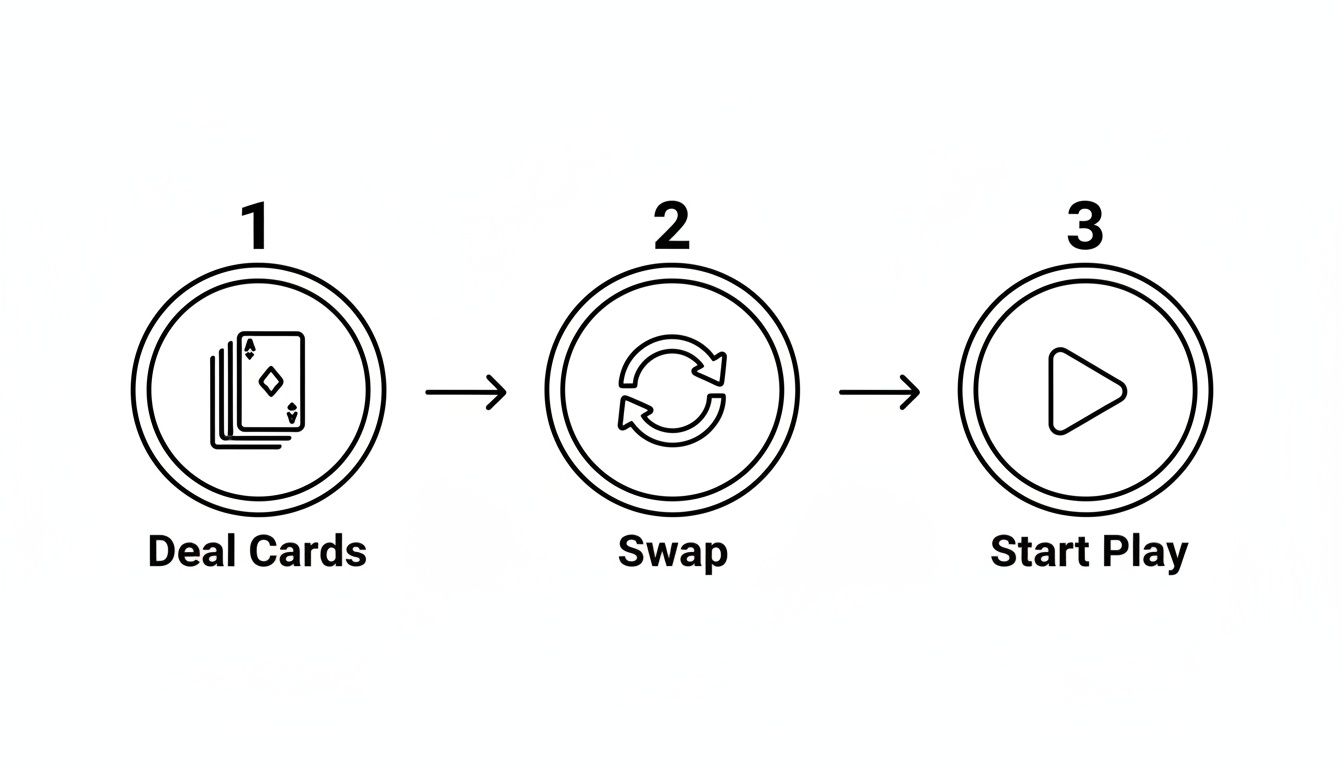
As you can see, the game moves neatly from the deal, through that crucial swap phase, and straight into the action.
Every game of Shed plays out in three distinct stages, each determined by the cards in front of you. You can feel the tension ramp up as you move from one to the next.
Playing From Your Hand: This is where it all starts. You’ll be playing from your hand and, as long as there are cards left in the draw pile, you’ll pick one up after every turn to keep your hand at three. This continues until the main deck is completely empty.
Playing Your Face-Up Cards: Once the draw pile is gone and your hand is empty, it’s time to play the three face-up cards you set aside earlier. This is your chance to show off your foresight from the swap phase. Choose carefully, because everyone can see what you’re about to do.
The Final Blind Gamble: After your face-up cards are played, you're on the home stretch with just your three face-down cards. This is the endgame, and it's pure luck. You have to pick one card and play it completely blind. If it's a valid play, you breathe a sigh of relief. If it isn't, you face the dreaded penalty.
There's no moment in Shed quite like watching a player's confident smile vanish when they realise they can't make a legal play. The punishment is swift and brutal: you have to pick up the entire discard pile. Just like that, you're back to a full hand, and victory feels miles away.
This thrilling, almost cruel, mechanic is a huge part of Shed's charm. It’s no wonder a 2022 survey of 5,000 UK households put simple card games like Shed in the top 15% for family game nights. What’s more, 28% of players aged 25-44 remembered it fondly from their childhoods. Many of the house rules we all know and love—like using a 10 to ‘burn’ the pile—are used in over 70% of recorded UK games, which just shows how much we’ve made it our own. You can dive deeper into these stats in Which?'s breakdown of popular board games.
The exhilarating pace and sudden shifts in fortune are things we see in a lot of modern tabletop games, too. The experience reminds me a lot of TerraClash™ Grimoire, where you can get a full, satisfying game done in just 10-15 minutes. If that kind of fast-paced tactical fun is your cup of tea, you should definitely discover TerraClash™ Grimoire or check out its live Kickstarter campaign.
Anyone can learn the basic up-and-down rhythm of Shed, but the game truly comes alive when you get to grips with the special cards. These are your trump cards, your get-out-of-jail-free moments that can completely flip a game on its head.
Think of them less like standard playing cards and more like spells you’d cast in a fantasy skirmish. They don’t just beat the last card; they change the very rules of the game, even if just for a moment. They can nuke a threatening pile, reverse the flow of play, or even turn a card invisible.

These four cards are the heart of strategy in the shed rules card game. Knowing not just what they do, but when to deploy them, is what separates the novices from the seasoned players.
While house rules always add a bit of local flavour, these four cards are almost universally recognised for their game-breaking powers. Learning to read the table and deploy them at the perfect moment is a skill you'll build with every game you play.
The 2 (The Reset Button): This is your panic button. The humble 2 can be played on top of absolutely anything, and it instantly resets the pile. The next player is then free to start a new sequence with any card they like. It’s the perfect escape when you’re facing a high card with no answer in your hand.
The 7 (The Reversal): Is someone building the pile up to Aces and leaving you stranded with low cards? The 7 is your best friend. When you play it, the next person must play a card of 7 or lower. It’s a brilliant way to turn the tables and force an opponent to pick up the pile when they thought they had you cornered.
The 8 (The Invisibility Cloak): This one is subtle but deadly. When an 8 is played, it effectively becomes invisible. The next player has to ignore it and play on whatever card was underneath it. It’s a fantastic way to pass a tricky card, like a Queen, onto the next person without having to beat it yourself.
The 10 (The Nuke): This is the ultimate power play. Playing a 10 burns the entire discard pile, removing all those cards from the game permanently. And the best part? You get to take another turn straight away. A well-timed 10 can rescue you from picking up a mountain of cards and give you a massive tempo advantage.
There's a reason Shed is a fixture at campsites and festivals across the UK. It’s a game that thrives on social interaction and clutch plays. In fact, a 2018 survey found that 41% of attendees played it at major events like Glastonbury. Its simple setup and quick, dramatic games make it the perfect travel companion, a history you can explore in more detail on the game's Wikipedia page).
That feeling of pulling off a perfect special-card play is something special. It reminds me of the high-impact turns in TerraClash™ Grimoire, where one card can swing the entire momentum of a battle in a game that’s over in just 10-15 minutes.
If you love how these cards add layers of strategy and enjoy tinkering with house rules, you'll probably get a kick out of building your own games from the ground up. The TerraClash™ Print and Play core game is a brilliant sandbox for just that. And if you're ready for a new fast-paced adventure, check out the full TerraClash™ Grimoire or help us make more games by supporting our Kickstarter campaign.
So, you’ve dealt the cards and played a few rounds. How do you actually win at Shed? The goal is beautifully simple: be the first player to have absolutely no cards left. You need to burn through your hand, clear your three face-up cards, and then face the sheer luck of the three face-down cards at the end.
The last person left holding cards gets the dubious honour of being the 'Shed' for that round. Trust me, it’s a title you'll be fighting tooth and nail to avoid.
But the core rules are just the beginning. The real magic of the shed rules card game happens when a group starts making it their own. This is where the unwritten constitution of 'house rules' comes into play, turning a simple game into something uniquely yours.
This is what we love about tabletop gaming—that freedom to tinker. If you're looking to add a new layer of chaos or strategy to your games, here are a few popular house rules we've come across over the years.
This very spirit of customisation and replayability is a design philosophy we poured into our own game, TerraClash™ Grimoire. It’s built from the ground up for players who love to discover new strategies and make a game their own.
Here's a little peek at the world of TerraClash™ Grimoire, where every card is a new tactical possibility.
The rich artwork and unique card effects are all about creating those dynamic, memorable moments at the table. If you get a kick out of adding your own house rules to Shed, you'll feel right at home with the flexible, combo-driven gameplay in our fast-paced card game.
Just like a perfectly timed house rule can turn a game of Shed on its head, the synergies in TerraClash™ Grimoire are all about creating clever, game-changing plays. Best of all, a full, satisfying match wraps up in just 10-15 minutes. It’s perfect for anyone who loves quick, strategic duels.
You can dive into the full experience on the TerraClash™ Grimoire page or help bring our vision to more tables by checking out our Kickstarter campaign.
Alright, so you’ve got the shed rules card game down. But there's a world of difference between just playing the game and actually winning consistently. To do that, you need to start thinking a few steps ahead. Any experienced player will tell you that a game of Shed is often won or lost before the first card even hits the pile.
The very first thing you do—the swap—is your first and best chance to shape your destiny. I see so many new players make the same mistake: they just put their three highest number cards face-up. It seems logical, but it's a short-sighted move.
A much better approach is to prioritise your special cards. Think about the endgame. Having a 10 that can clear the pile or a reset 2 waiting for you on the table can be an absolute game-changer when you're down to your last few cards.
It's also a good idea to keep a few flexible, mid-range cards like 4s, 5s, and 6s in your hand. These give you easy plays at the start of the game, so you aren’t immediately forced to pick up the discard pile. Don't be afraid to take a small pile early on if it means grabbing cards that will set you up for a stronger finish. Sometimes a tactical sacrifice is the smartest play you can make.
Mastering the flow of Shed—knowing when to attack and when to defend—hones skills that are valuable in any strategic card game. The ability to read your opponents and manage your resources under pressure is a universal skill.
The kind of quick, tactical thinking you need in Shed is exactly what makes so many modern card games tick. I've found that players who love that strategic thrill are always looking for the next challenge. Games like TerraClash™ Grimoire, for example, are built for people who love that same rush, but they pack it into an intense 10-15 minute experience. If you’ve sharpened your teeth on Shed, it’s a natural next step.
You can see the excitement building for this kind of fast-paced strategy right here.
This screenshot from the TerraClash™ Grimoire Kickstarter campaign shows just how many people are hungry for a fresh, strategic card game. For anyone who gets a buzz from the quick thinking in Shed, this is a project you’ll want to check out.
No matter how many times you've played Shed, certain questions always spark a debate mid-game. It’s part of the fun, but it can also grind the action to a halt. Let's settle some of the most common ones so you can keep the cards flying.
This is where the endgame truly begins, and it's a completely normal part of the game! Don't panic. Once the last card is drawn from the central pile, the game just carries on.
Players simply stop drawing cards after their turn. The objective doesn't change – you still need to get rid of all the cards in your hand, then play through your face-up cards, and finally, take on the challenge of your face-down cards to be crowned the winner.
Ah, the classic "revenge burn." I've seen players try this a million times, but the answer is almost always a firm no. Your turn ends the second you're forced to pick up the discard pile.
You'll have to stare at that glorious, pile-clearing set of four matching cards in your hand until your turn comes around again. It’s painful, but it’s the rule!
Absolutely not. Your hand is your own secret to guard. The only cards everyone can see are your three face-up cards on the table and whatever's sitting on top of the discard pile. Keeping your hand hidden is a huge part of Shed's strategy.
That constant game of cat-and-mouse, where you're trying to figure out what others are holding while protecting your own plans, really reminds me of modern duelers. It has that same strategic feel as the quick, turn-based battles in TerraClash™ Grimoire, where you can get a full, satisfying game in just 10-15 minutes.
This happens all the time, especially with more players. If a couple of people are both holding a 3 as their lowest card, you've got two common ways to sort it out.
If you get a buzz from the quick thinking and sneaky tactics of Shed, you're probably ready for your next tabletop obsession. TerraClash™ Grimoire captures that same rush of outsmarting your opponent but in a fresh fantasy world.
You can check out the full game at TerraClash™ Grimoire or help us bring it to life by visiting our Kickstarter campaign.

