Picture this: an adventure where the world around you doesn't just change with every new attempt, but actively learns and adapts to the way you play. This isn't just a randomly shuffled map; it's a living, breathing challenge that's constantly evolving. That’s the core idea behind an AI roguelite game.
To really get our heads around this, let's break it down into its two key ingredients: the ‘roguelite’ foundation and the clever ‘AI’ layer built on top.
First, you have the roguelite genre, which is famous for its high stakes and procedurally generated worlds. Think of it like this: unlike a game with a fixed story, every single ‘run’ is a completely new roll of the dice. You get a fresh map, different enemy placements, and unique loot every time you start over. It’s a design style that's been brilliantly captured in tabletop card games for years, where shuffling decks of locations, events, and monsters creates a brand-new story every time you sit down to play.
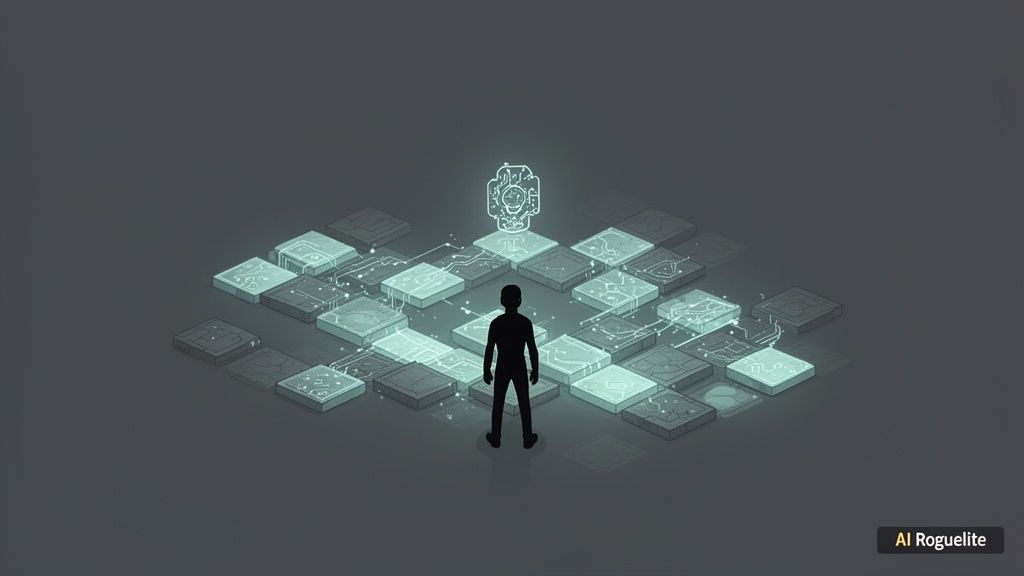
Procedural generation is the secret sauce that makes these games so replayable. It’s the reason a game like Slay the Spire feels almost infinite, as every climb presents a completely different set of challenges and opportunities. This isn’t just a digital trick, either. The best tabletop card games have been doing this forever, using special card decks to build the world and ensure no two adventures are ever the same.
This is exactly the kind of experience we've poured into a fast-paced card game like TerraClash™ Grimoire. The world is randomised for every game, which means even a quick 10-15 minute session can feel like a whole new, epic campaign.
Now, let's add that second ingredient: the AI. This is where things get really interesting. Artificial intelligence takes a game from being simply random to being genuinely responsive.
Think of it as having a digital Dungeon Master running the show. This DM doesn't just build a new dungeon for you each time; it watches how you play. It learns your favourite moves, your go-to strategies, and then uses that knowledge to design smarter traps and tougher enemies for your next adventure. The game becomes a dynamic conversation, a back-and-forth between you and the system itself.
It’s the difference between fighting a random monster and fighting a monster that remembers you love using fire spells, so it shows up with water-based defences. This kind of intelligent opposition pushes you to evolve your own tactics and become a better player.
When you start to understand these principles, you can see how they're inspiring a new generation of tabletop card games. By cleverly simulating these ideas with cards and mechanics, physical games can offer incredible depth and replayability without ever needing a screen.
If you’re excited by the thought of a card game that bottles this spirit of endless adventure into quick, strategic bursts, we think you'll love what we're doing. You can learn more about TerraClash™ Grimoire on our site, or even better, come join the adventure by checking out our Kickstarter campaign.
When we talk about an AI roguelite game, we're not just talking about smarter baddies. The shift is far more fundamental. AI is getting its hands dirty with the very building blocks of the game world, changing how these experiences feel from the ground up. This isn't just about tweaking difficulty; it's about adding a whole new layer of life and strategic depth.
We're seeing this play out in three really exciting ways.
The first is how worlds are built. Classic roguelites have always used procedural generation to shuffle pre-designed rooms and corridors into a "new" map. It was random, but you could often see the seams. Now, with Dynamic Procedural Generation, AI can build worlds that aren't just random but make sense. They feel coherent, thematic, and almost handcrafted, making each new journey feel like you're stepping into a genuinely undiscovered place.
Next up, and this is a big one, is Adaptive Enemy Intelligence. Forget enemies that just pace back and forth on a set path. AI-driven opponents can now watch how you play, learn your go-to moves, and actively work out how to counter them.
Say you always lean on a powerful ranged attack. After a few encounters, you might find enemies start using cover more effectively, or aggressively closing the distance to stop you. You can no longer rely on a single winning formula. This turns every fight from a simple test of strength into a strategic puzzle, where the game itself is pushing you to evolve. It's the kind of dynamic you see in great card games, where a sharp opponent quickly figures out the weaknesses in your deck.
The appetite for this kind of thoughtful gameplay is huge. The turn-based strategy games market—a genre that shares a lot of DNA with roguelites—is valued at $5.2 billion in 2025 and is tipped to hit $12.9 billion by 2035. People are clearly hungry for games that challenge their minds. You can dig deeper into the growing investment in gaming on Lancaric.
Finally, there’s Emergent Storytelling. Instead of dragging you along a pre-written plot, sophisticated AI can spin a unique narrative from your actions. The choices you make—the allies you save, the shortcuts you take, the gear you choose to wield—all become narrative threads woven into a story that is entirely your own.
This is where a simple playthrough becomes a personal saga. The game stops just telling you a story and starts creating one with you. It makes your victories feel earned and your failures sting in a much more meaningful way.
These advancements are genuinely pushing the boundaries of what video games can do. But what’s fascinating is that the core ideas—dynamic challenges, adapting to your opponent, and endless replayability—are perfectly suited to the tabletop.
A fast-paced card game like TerraClash™ Grimoire captures this spirit perfectly. It simulates these concepts through clever card mechanics, randomised world-building, and encounters that adapt to how well you’re doing. The result? A brand new, bite-sized adventure in every 10-15 minute session.
If this blend of deep strategy and endless possibility gets your mind racing, come and see what we're building. Check out the Grimoire page and join the adventure by visiting our Kickstarter campaign.
So, how do you bottle that lightning? How do you take the seemingly infinite, adaptive world of an AI roguelite and pour it onto a tabletop? The real challenge lies in translating complex digital algorithms into elegant, physical mechanics. It's about simulating that feeling of a living, breathing, unpredictable world with nothing more than a deck of cards.
This is exactly the design philosophy we’ve poured into our fast-paced deck-building card game, TerraClash™ Grimoire. The principles are surprisingly similar. Where a video game uses an AI for procedural generation, we use a deck of 'Terra Cards'. Shuffling this deck randomises the world every single time you play, ensuring no two adventures ever feel the same.
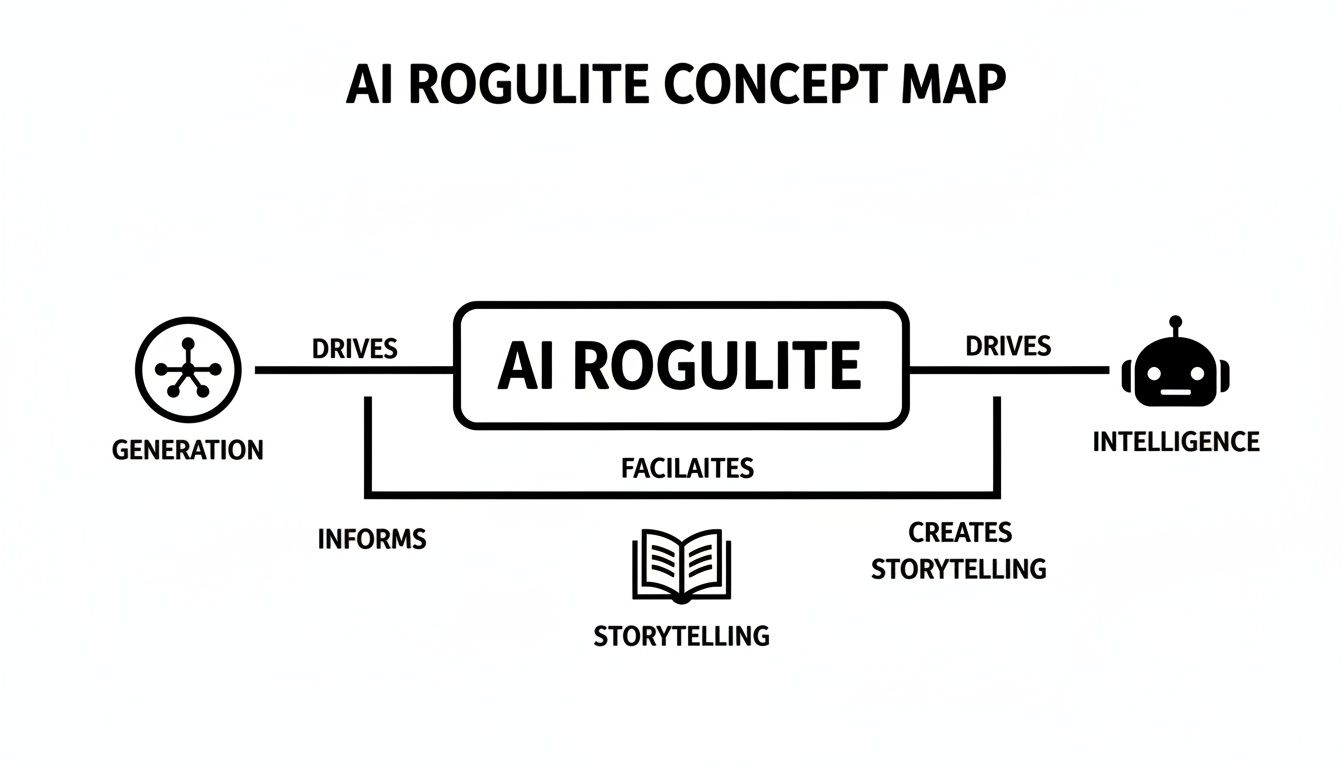
The map above really gets to the heart of it, showing how Generation, Intelligence, and Storytelling all feed into one another. It highlights how even a tabletop experience can mirror these digital ideas through clever, card-based systems. A well-designed card game doesn't need a computer to feel intelligent and reactive.
Okay, capturing the essence of an AI that truly learns and adapts is a much tougher nut to crack without a computer. But clever tabletop design can achieve a similar effect through modular, evolving systems.
Think of it like this:
This approach creates the feeling of an adaptive challenge. The game world isn’t just random; it feels like it’s responding to your actions. A brilliant example is how some card games scale their difficulty based on how many objectives you've completed. Have an easy run, and you’ll find the final boss is significantly tougher as a result.
It’s no wonder that players who love deep digital deck-builders like Slay the Spire find a similar strategic satisfaction in tabletop card games. They offer that same compelling loop of building a powerful deck against ever-changing odds.
| Core Roguelite Feature | Digital AI Implementation | Tabletop Simulation (TerraClash™ Example) |
|---|---|---|
| Procedural Generation | Algorithms generate unique maps, items, and encounters for every run. | Shuffling a core deck of 'Terra Cards' and other modifier decks creates a random world layout and challenges each game. |
| Adaptive Difficulty | The AI Director analyses player performance and adjusts enemy strength, spawn rates, or resource availability in real-time. | 'Challenge' cards are added to the deck as players succeed, or boss enemies gain new abilities based on game progress, simulating a responsive world. |
| Emergent Storytelling | Random events and AI-driven NPC interactions combine to create unique, unscripted narrative moments. | Event cards trigger unexpected scenarios, forcing new decisions. The random combination of locations and foes tells a new story with every playthrough. |
| Permanent Progression | After a run ends (win or lose), players unlock new characters, items, or abilities for future attempts. | Players might 'unlock' new, more complex cards to add to the base game for future sessions, creating a sense of long-term achievement. |
| High Replayability | The combination of all the above ensures no two runs are ever identical, encouraging endless replays. | The core loop—shuffling the world, facing randomised threats, and making new strategic choices—provides immense replay value in a compact format. |
Ultimately, both paths lead to the same destination: a game that feels fresh, challenging, and personal every time you play.
The real magic is creating a rich, strategic, and highly replayable experience that can be enjoyed in short, satisfying bursts. It proves you don't need a screen to have a deep and ever-changing adventure.
This idea is absolutely central to our design for TerraClash™ Grimoire. We wanted to build a full roguelite adventure that could be completed in just 10-15 minutes. It’s perfect for those moments when you crave a deep strategic challenge but just don't have hours to spare. The fast pace and constant variety keep every single session exciting.
By using these physical mechanics, tabletop card games deliver the core thrill of an AI roguelite. They prove that the spirit of endless discovery and smart opposition is a universal principle of great game design, whether it's powered by code or by cardboard.
If this idea of a fast, strategic, and endlessly different adventure captures your imagination, we invite you to see it in action. You can discover more about TerraClash™ Grimoire and its unique world-building system on our site. To be part of the story, please consider supporting our Kickstarter campaign.
That relentless drive for replayable, strategic depth? It's not just a digital thing. It’s a philosophy that beats at the very heart of the indie tabletop scene, and it’s easy to see why when you look at what's happening in video games. Titles like Slay the Spire and Darkest Dungeon weren't just hits; they sent a clear signal that players were hungry for challenges that actually respected their intelligence.
This same energy is now fuelling a new generation of physical card games. You can see it everywhere. Players are actively seeking out unique experiences, turning away from mainstream titles to find games that offer fresh mechanics and endless strategic puzzles. It’s a movement built on a simple, timeless idea: a card game should be easy to learn but take a lifetime to master.
This is precisely where TerraClash™ Grimoire comes in. We’ve designed it to capture that very same indie spirit, giving you a complete, strategic ai roguelite game adventure that you can dive into and finish in just 10-15 minutes. It’s fast, it’s accessible, and it was built from the ground up to be played over and over again.
The indie development scene has become a real powerhouse in the gaming world, especially within the roguelike market. You have trailblazing studios like Red Hook Studios (Darkest Dungeon) and Motion Twin (Dead Cells) showing the world that a small team with a powerful idea can create an experience that rivals blockbuster titles for sheer engagement.
Sure, the steep learning curve of some roguelikes can be a bit daunting for casual players. But this has, almost paradoxically, created a perfect opening for games that offer deep strategy without overwhelming complexity. This is especially true in the UK, where gaming communities have a rich history of supporting indie projects and are always looking for compelling alternatives in the tabletop sector. You can find out more about this expansion in this detailed industry report on roguelike games.
What this trend really highlights is a clear demand: players want games that offer lasting value. They want a gameplay loop that invites them back, not with a punishing schedule, but with the simple promise of a new puzzle to solve every single time. It's a design ethos that so many successful indie titles share, whether they’re on a screen or on your table.
The real magic of these games lies in the discovery. It's that "aha!" moment when you find a new, powerful card combination or a clever strategy that completely changes how you approach the challenge. That's the feeling that keeps you coming back for just one more run.
That feeling is the core of TerraClash™ Grimoire. Every session presents a new world, new enemies, and new opportunities to build your perfect strategy. It’s a game designed for quick bursts of deep, satisfying play, perfectly matching the tastes of players who are looking for something a bit different.
If the idea of a fast-paced, endlessly replayable adventure excites you, we invite you to see it for yourself. Learn more about the mechanics and the world on the official Grimoire page. To help bring this vision to more tables, consider becoming part of our community by supporting the Kickstarter campaign.
Right, let's talk about why games you can play forever are suddenly everywhere.
It's not just a passing trend. What we're seeing is a huge change in what people actually want from their games. This hunger for real, lasting value and experiences that keep you coming back for more has catapulted the ai roguelite game from a quiet corner of the industry into a mainstream powerhouse. It’s a clear signal that players are looking for deep, replayable adventures.
And the numbers back this up. The global market for roguelike games hit a valuation of $3.2 billion in 2024, with forecasts predicting it'll explode to an incredible $10.5 billion by 2033. This isn't just a fluke; it's proof that games built on these core ideas of replayability and challenge are connecting with a massive, and still growing, global audience. You can dig into the specifics of this impressive market expansion if you're curious.
This is fantastic news, whether you're a player or a creator. If you're a player, it’s comforting to know your love for smart, strategic games is shared by millions. If you're a designer, it's a huge validation for the philosophy behind games like TerraClash™ Grimoire, which aims to capture that 'endlessly fresh' feeling in short, sharp bursts of play.
I think this shift really shows players are voting with their time and money. They're choosing experiences that reward their intelligence and always tempt them back for one more run, instead of games that are played once and then just gather dust.
Games like ours are built to answer that call directly. We're offering the kind of strategic depth you'd find in a digital roguelite, but packed into a fast-paced card game you can play in just 10-15 minutes. It’s the perfect fix for when you want a genuinely satisfying adventure but don't have hours to spare.
If the thought of a tabletop game that really respects your time and desire for lasting fun sounds good, I'd love for you to see what we're building. You can find out more over on the TerraClash™ Grimoire page and, if you feel like it, join us on this journey by checking out our Kickstarter campaign.

There’s something truly special about an adventure that feels alive—one that pushes back, surprises you, and never plays out the same way twice. We’ve all seen how clever AI in video games can create these unforgettable, evolving challenges. But what if you could capture that same magic on your tabletop?
It turns out you can. Many of us have lost hours to the "just one more run" loop of digital deck-builders like Slay the Spire. The core appeal is undeniable: simple rules that open up a vast strategic puzzle, making every game a fresh test of skill. That's the exact feeling we've poured into TerraClash™ Grimoire.
Picture this: you and your friends, carving out a complete, satisfying adventure during a quick coffee break. We built TerraClash™ Grimoire from the ground up to make that possible. A single session is a tight, strategic whirlwind clocking in at just 10–15 minutes. But thanks to a randomised world, each of those sessions feels like a brand-new quest. You get all the epic feeling without needing to set aside an entire evening.
Its soul is pure replayability, just like the digital card games that inspired it. You’ll be building your deck on the fly, facing down threats from a world that never takes the same shape twice, and hunting for those game-breaking card combos. It’s the very essence of an AI roguelite game, brought to life in a way you can hold in your hands and share with others.
The real beauty of card games is their ability to simulate complex ideas through simple mechanics. A shuffle of a deck can create a brand-new world, and a clever event card can feel like an AI director throwing an unexpected twist into your story.
So, this is your invitation to a game that respects your time but still delivers a rich, mind-bending challenge. The concepts of dynamic worlds and adaptive enemies aren't just for screens anymore. They’re here, waiting on your table, ready to offer a completely different kind of fun.
If you’re intrigued by a card game that’s always new, always challenging, and always ready for another go, your adventure starts right here.
To see how we’ve brought all these ideas to life, have a look at the TerraClash™ Grimoire page. To become part of our story and help us get this game onto more tables, please consider backing the project over on our Kickstarter campaign.
The idea of an AI roguelite, especially how it translates to the tabletop, can spark some curiosity. It’s a fascinating crossover, so let’s clear up a few common questions that pop up.
At its heart, it all comes down to progression.
A classic ‘roguelike’ is completely unforgiving. When your character dies, that’s it. You lose everything and start from square one, armed only with the knowledge you gained from your last attempt.
‘Roguelites’, on the other hand, are a bit kinder. They let you carry something forward. Even when you fail, you might unlock a new character, discover a powerful item for future runs, or gain some other permanent bonus. It’s a philosophy that makes each failure feel like a small step forward. Many card games like TerraClash™ Grimoire capture this spirit, because your own skill and strategic know-how grow with every quick game you play.
Absolutely. While you don’t have an actual learning algorithm sitting in the box, you can cleverly mimic its effects. Think of it like a stage magician creating an illusion.
Through smart design—like randomised event decks, encounter cards you mix and match, or special rules that completely change the game mid-play—a tabletop card game can feel just as unpredictable and responsive as an AI-driven one. The goal is to create surprises that make sense within the game's world, giving you that feeling of a living, breathing opponent without ever needing to plug anything in.
Not in the slightest! In fact, some of the most famous roguelites are built on incredibly simple foundations. The real magic isn't in a hefty rulebook; it's in the endless, mind-boggling combinations of items, enemies, and situations that can arise.
This approach is perfect for a tabletop game you can get to the table quickly. Take TerraClash™ Grimoire, for example. It’s designed to be learned in minutes and played in just 10–15 minutes, but the sheer variety of cards keeps it fresh and strategic every single time. It nails that fast-paced, high-stakes feel without getting bogged down, something it shares with the best digital and physical card games out there.
Hopefully, that shines a bit more light on this exciting blend of AI thinking and modern game design. If you're looking for a tabletop experience that truly embodies that fast, endlessly replayable spirit, we think you'll love TerraClash™ Grimoire.

