Thinking about jumping into Commander? Brilliant. You're about to discover what is, for my money, the best way to play Magic: The Gathering. Forget what you know about tight, 60-card decks and frantic races to 20 life. Commander is a different beast entirely—a sprawling, social, and incredibly creative format.
At its heart, you’ll be building a 100-card deck around a single legendary creature, your Commander. This card is your general, your hero, the star of the show. Every other card in your deck has to fit within your Commander's colour identity, and you start the game with a comfortable 40 life.
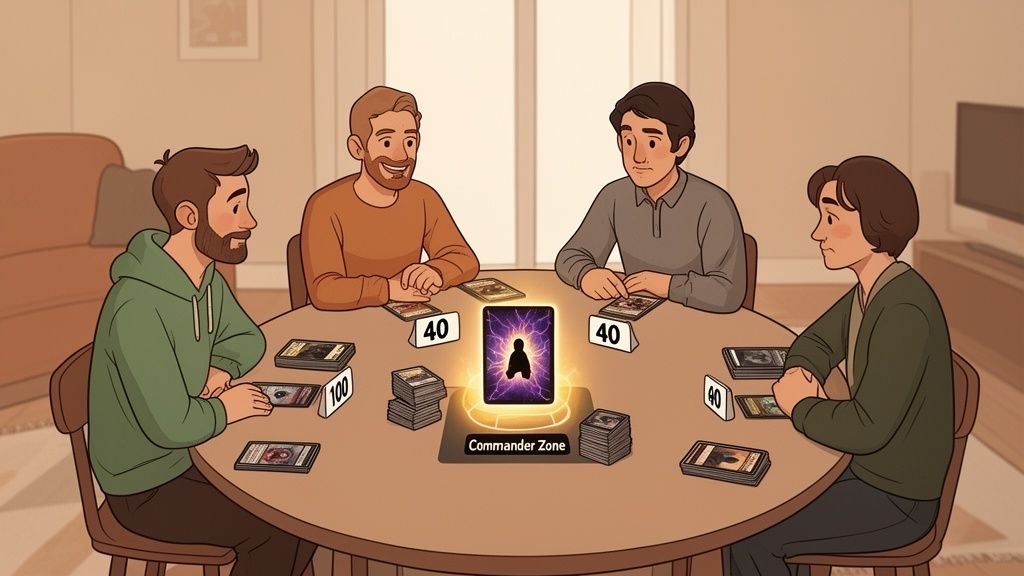
You might have heard people call it EDH, which stands for Elder Dragon Highlander. It's now Magic’s most popular multiplayer format by a long shot. It’s not just a game; it’s an event. You and a few friends get together, each with a unique deck, and settle in for an epic battle of wits and luck. Because you can only run one copy of any card (other than basic lands), no two games ever play out the same way.
The growth has been staggering. Here in the UK, we've seen Commander participation jump by 28% year-over-year. At big events like the UK Games Expo, it now outnumbers Standard play by a 3:1 ratio. That tells you everything you need to know: players are craving that freedom to customise and build something truly their own.
That spirit of personal expression is what makes a game truly great. It reminds me of the way players craft their own stories in TerraClash™ Grimoire, using Terra Cards to build a unique world and strategy. Both games put the power of creativity squarely in your hands.
If you've played other Magic formats, a few of Commander's rules will feel a bit strange at first. Getting your head around these is the key to unlocking the format.
To help you see how different the experience is, here's a quick comparison for anyone coming from a Standard MTG background.
| Feature | Commander (EDH) | Standard MTG |
|---|---|---|
| Deck Size | Exactly 100 cards | 60 cards minimum |
| Life Total | Starts at 40 life | Starts at 20 life |
| Players | Typically 3-5 players (multiplayer) | Typically 2 players (head-to-head) |
| Key Card | A Commander (legendary creature) | No designated key card |
| Card Copies | Singleton (one copy per card) | Up to 4 copies per card |
| Game Zone | The Command Zone for your Commander | No Command Zone |
These rule changes aren't just minor tweaks; they fundamentally alter the flow and feel of the game, encouraging bigger plays and more complex political decisions.
The real beauty of Commander isn’t just about winning. It's about creating memorable moments, epic plays, and a shared story with your friends around the table. The rules create a framework for fun, not a rigid contest.
Honestly, Commander is an exercise in self-expression. Building a deck is like writing a novel. Your Commander is the protagonist, and the other 99 cards are the supporting characters, the plot twists, and the legendary items they discover. It's this narrative approach that hooks so many people.
For those of us who love that strategic depth but do not always have a few hours to spare, other games can scratch a similar itch. The card game TerraClash™ Grimoire, for example, delivers a satisfying tactical experience in just 10 - 15 minutes. If you're curious about its blend of fast-paced action and customisable campaigns, you can check out the Grimoire page or see its journey on the Kickstarter campaign.
This guide will walk you through everything, showing you that behind the huge decks and big life totals is a game all about having a great time with great people. And if you're looking to broaden your horizons even further, you might find our guide on learning how to play other card games helpful.
Alright, let's talk about building your very first deck. This is where the real fun begins, where you get to craft something that’s a true extension of your personality. It’s a very different beast from the lightning-fast, all-out brawls in games like TerraClash™ Grimoire, where a match is over in a thrilling 10-15 minutes. Commander is more of a slow burn, a creative project.
Do not let that 100-card number scare you. It seems like a lot, but there's a tried-and-true method that nearly every seasoned player uses to get started.
The soul of Commander is its singleton rule. Outside of your basic lands, you get exactly one copy of any card you want to include. This one constraint is what makes the format so endlessly replayable and surprising. It forces you to dig deep into your collection and get creative.
Your first big decision, and honestly the most important one, is choosing your Commander. This legendary creature is your general, and it defines your deck's colour identity. A card's colour identity includes every coloured mana symbol on it—front, back, and even in the rules text. So, if your Commander is blue and black, your entire deck is limited to cards that are blue, black, or colourless. It sets the boundaries for your creative playground.
Every deck is a unique creation, but the best ones are all built on a solid foundation. You can think of it like a recipe. The spices and signature ingredients are all you, but you still need the flour, eggs, and sugar for the cake to hold together. For a 100-card deck, there’s a simple ratio that just works.
Most of us start with a breakdown that looks something like this:
Following this structure is the best way to make sure your deck actually does something every game. It’s a lesson many of us have learned the hard way and is a core principle when you learn how to build an MTG deck for any format.
I cannot stress this enough: building a Commander deck is not about chasing the most powerful cards. It's about finding cards you think are cool. The best deck is the one you know inside and out because you genuinely love playing it.
Feeling a bit overwhelmed by it all? That’s perfectly normal. We’ve all been there. Deckbuilding is an art form that takes time to master, but luckily, there’s an amazing shortcut: getting a pre-constructed Commander deck (or "pre-con").
Wizards of the Coast designs these decks to be playable and fun straight out of the box. They’ve already done the hard work of balancing the lands, ramp, and card draw for you, giving you a coherent deck with a clear game plan.
Grabbing a pre-con is, without a doubt, the smartest way to dive in. It lets you skip the initial stress of building from scratch and get right to playing. You’ll learn the rhythm of a multiplayer game, see different strategies in action, and figure out what kind of player you want to be. And the best part? You can start upgrading it piece by piece, swapping cards out as you discover new favourites.
Alright, let's get into the nitty-gritty of how a game of Commander actually plays out. Forget everything you know about a typical two-player duel; this is a completely different beast.
Once you've all shuffled your 100-card behemoths and drawn your opening seven cards, the first big decision arrives: do you keep this hand? Commander uses the London Mulligan, which is a lifesaver in a multiplayer game. If your hand is a dud, you can ship it back and draw a fresh seven.
For every time you mulligan, you'll have to put one card from your new hand on the bottom of your library. So, your first mulligan leaves you with six cards to work with, the next with five, and so on. It’s a great system that helps prevent those frustrating non-games where you’re stuck without enough lands or spells, giving you a fighting chance to get your strategy going.
Every player's turn follows the same sequence of phases. Getting this rhythm down is crucial because every phase is an opportunity, not just for you, but for your opponents to interact as well.
Here’s the basic flow:
Think of the turn structure as the game's pulse. Knowing when you have priority to act is what separates a decent play from a game-winning one. In Commander, timing is absolutely everything.
Your commander does not get shuffled into your deck with the other 99 cards. Instead, they hang out in a special area called the Command Zone, ready for you to call upon them.
You can cast your commander from this zone just like you’d cast them from your hand, paying their mana cost. But there’s a twist. If your commander dies or gets exiled, you have the option to send them right back to the Command Zone. The catch? The next time you want to cast them, you have to pay an extra two generic mana. This is the infamous commander tax. It stacks up each time, going from two, to four, to six, making it more and more costly to bring your general back into the fight.
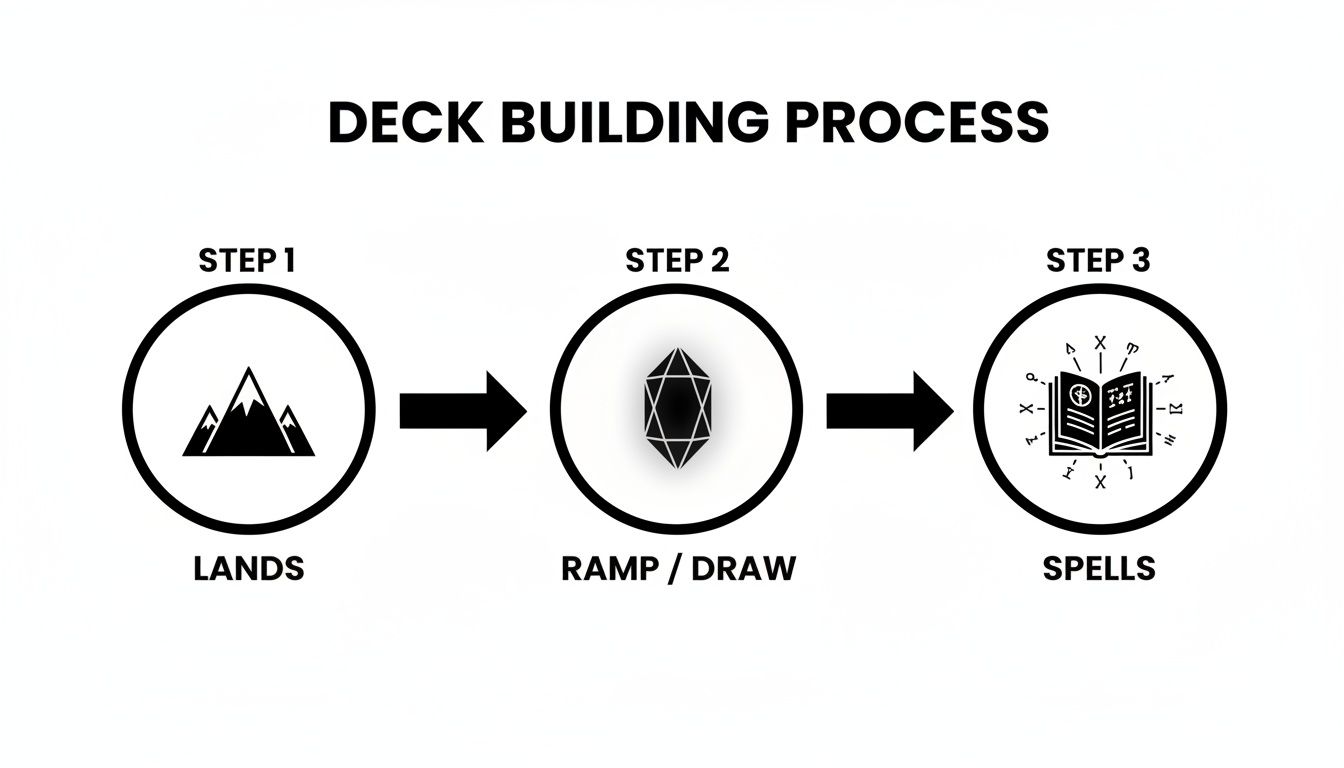
Getting your commander onto the battlefield is just one part of the puzzle. As you can see, a solid deck always comes back to balancing your resources—having enough lands, the ramp and card draw to stay consistent, and the spells that actually execute your game plan.
In a normal game of Magic, you lose when your life hits zero. That's still true here, though you start with a much healthier 40 life. But there's a second, very important way to knock a player out: commander damage.
If any single commander deals 21 points of combat damage to a player throughout the game, that player loses instantly. It does not matter if they're still at 40 life. This rule gives aggressive, commander-focused decks a clear route to victory without having to chew through a massive life total.
The format has certainly seen its share of changes over the years. Back in the day, you could "tuck" an opponent's commander into their library, which was a nightmare to deal with. That rule was thankfully removed in 2014, and the format's popularity has since skyrocketed. Just look at the numbers: Magic's revenue hit $1 billion in 2022 after printing over 20 billion cards between 2008 and 2016. Events like CommandFest London in the UK now draw crowds of 4,500 players, a testament to how much people love the strategic depth. You can read more about Magic's incredible journey on Wikipedia.
The long, winding games full of politics and big plays are what make Commander so special. If you enjoy that tactical, think-ahead gameplay but do not always have hours to spare, TerraClash™ Grimoire offers a similar strategic thrill in a fraction of the time, with games lasting just 10-15 minutes. It’s a brilliant way to scratch that card-battling itch. If that sounds interesting, check out the Grimoire page or see what’s happening on the Kickstarter campaign.
In a typical game of Magic, the goal is simple: crush the person sitting opposite you. Commander, though, is a different beast entirely. You’ve got three other people at the table, and they can be opponents, obstacles, or even temporary allies. This is where the real game is played, far beyond just casting spells.
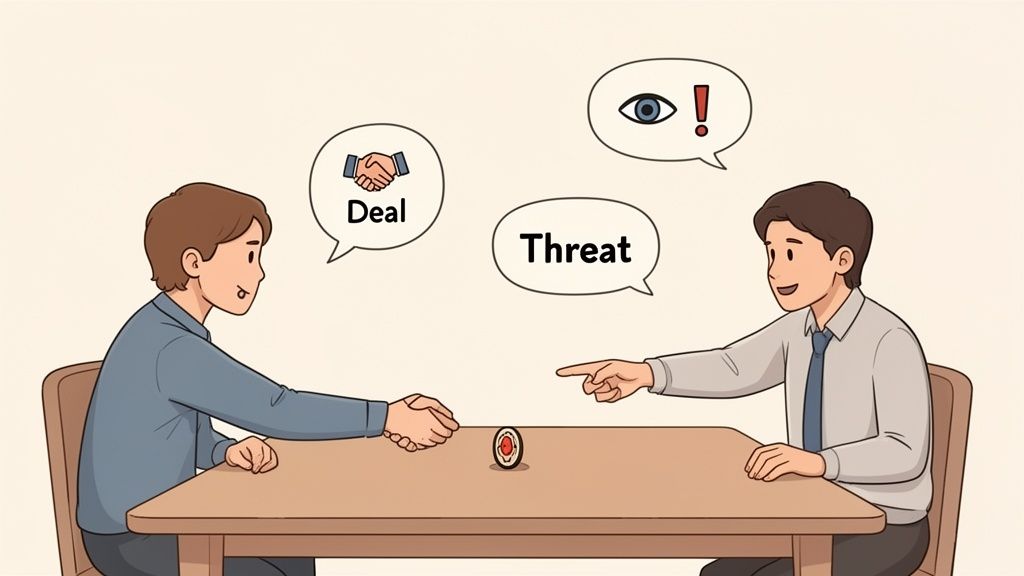
Learning how to play Commander is not just about what’s in your deck; it’s about reading the room. You have to learn how to make deals, forge alliances, and sometimes, convince everyone that someone else is the real villain at the table.
In a four-player free-for-all, trying to fight everyone at once is a surefire way to get yourself knocked out first. You'll become the "archenemy," uniting the table against you. Instead, you need to use your resources—and your words—to get ahead.
You’ll see these kinds of political manoeuvres happen all the time:
This social dance of negotiation and potential betrayal reminds me a lot of the dynamics in TerraClash™ Grimoire. In that game, forming a quick alliance can completely swing a match, but you always have to watch your back—all within a blistering 10-15 minute game. Commander simply plays out that same drama on a much grander scale.
If there’s one skill you need to master in multiplayer Magic, it's threat assessment. It’s the art of figuring out who is actually winning the game. And I can tell you from experience, it’s almost never the player with the most life or the biggest creature on the board.
So, how do you spot the true threat? Keep an eye out for these tell-tale signs:
A classic rookie mistake is attacking someone just because they attacked you. It feels good, but it's rarely the right play. A better move is to take a breath, assess the entire board, and use your resources to stop the player who is actually closest to winning. Do not let revenge cloud your judgement.
Picture this: one player has a single, terrifyingly large creature that can kill someone in one hit. Another player has no creatures at all, but they've drawn ten extra cards and have twice as much mana as anyone else. The big creature is scary, sure. But the player with a fistful of cards and all that mana? That's the real threat. They’re the one you need to convince the table to stop.
Learning to swim in these political waters is a huge part of the Commander journey. It’s what gives the format its endless depth and replayability. If you love this kind of strategic thinking but sometimes wish for a quicker game, you should definitely check out the TerraClash™ Grimoire page and see what's happening with its Kickstarter campaign.
Alright, you’ve got the rules down and you’ve had a taste of table politics. Now for the really fun part. This is where you shift from simply learning how to play Commander to discovering how you love to play.
Think of your deck as your voice at the table. It’s a reflection of your personality and your preferred way of winning—or just causing a bit of chaos. It is less about victory and more about creating a game you'll remember long after the last life point is lost.
While you can build a deck to do just about anything, most winning strategies fall into a few broad categories. Finding one that just clicks with you is a genuine lightbulb moment.
Some of the most common and beginner-friendly strategies include:
Do not be afraid to experiment. You might love the brute force of a Voltron deck or the strategic depth of a control-style build. Just look at a powerhouse like Kaalia of the Vast, with over 23,400 decks registered on EDHREC. She encourages a very specific, explosive playstyle that people absolutely fall in love with.
The only way to truly find what you enjoy is to get your hands dirty. Ask to borrow a friend’s deck for a game, build a cheap tribal list to see how it feels, or proxy a few cards for an archetype that sounds cool. You will not know until you’ve piloted it yourself.
Commander is a social game, first and foremost. The people you play with are every bit as important as the cards you bring. Finding a playgroup with a similar vibe is the key to enjoying the format for years to come. Your local game shop is the best place to start, as most host regular Commander nights.
This brings us to maybe the most important "rule" in Commander: Rule 0. It is not in any official rulebook; it’s the chat you have before a game starts. This is where everyone shares what kind of game they're looking for. Are we playing casual, flavourful decks? Or have we brought our highly-tuned, competitive machines? The point is to make sure everyone is on the same page and has a good time.
As you get more involved, you'll naturally connect with other players. If you're sharing your gaming journey online, a link in bio for gamers can be a great way to pull all your different profiles and content into one easy-to-share spot.
While a sprawling, epic game of Commander is a fantastic experience, sometimes you just do not have hours to spare. For those moments when you want that tactical, card-slinging thrill in a fraction of the time, TerraClash™ Grimoire delivers a surprisingly similar strategic buzz. You can outwit your opponent in a lightning-fast game that’s over in just 10 - 15 minutes. It’s the perfect game to play between those longer Commander matches. If that sounds like something for your game night, you can learn more on the Grimoire page and keep an eye on the upcoming Kickstarter campaign.
Alright, you’ve got the basics down, you’ve seen how a game flows, and maybe you've even started tinkering with a decklist. But I’m willing to bet a few specific questions are still rattling around in your head. It happens to everyone. Let's clear up some of the most common stumbling blocks I see new players run into.
You’ll hear this word, or its nickname 'Highlander', thrown around all the time. It’s the absolute cornerstone of the format. Singleton simply means that with the exception of basic lands (Plains, Islands, etc.), you can only have one copy of any card in your entire 100-card deck.
This one rule is what gives Commander its incredible variety and replay value. You cannot just stuff your deck with four copies of your most powerful spell and hope to draw it every game. It forces creativity and makes every deck a unique expression of its builder.
This is probably the rule that trips up newcomers the most. A card's colour identity is more than just the mana symbols in its casting cost. It includes every coloured mana symbol on the card—that means in the rules text, activation costs, and even on the back of double-faced cards.
So, if your commander is Tasigur, the Golden Fang (black, with a green/blue hybrid ability), your colour identity is Sultai (black, green, and blue). Every other card in your deck must only have mana symbols from that trio. You could not pop in a card with a red mana symbol in its text, even if it costs colourless mana to cast. It’s what keeps decks thematically focused. Getting a feel for how this shapes deckbuilding is crucial, and it helps to explore the vast world of Magic The Gathering legendary creatures to see it in action.
Legally? Yes. There’s no rule against it. Strategically? It is usually a terrible idea.
In a multiplayer free-for-all, ganging up on one person is a fast way to make enemies. That player will obviously focus on you, but you'll also look like a bully to the rest of the table. They’ll start seeing you as the biggest threat and might just team up to take you down. Good Commander politics involves spreading the love (or damage) or, better yet, pointing your creatures at whoever is actually in the lead.
Remember, Commander is a social game of marathon chess, not a series of sprints. Your goal is to be the last one standing, not just to knock out the first player. Targeting the weakest opponent is rarely the path to victory.
This is where things can get a bit tricky, but the rules are straightforward. If an opponent uses a card like Control Magic to steal your commander, it stays on the battlefield under their control. You do not get to put it back in the Command Zone just because you lost control of it. It’s theirs until they lose control or it leaves the battlefield.
What if your commander transforms? If you're running a double-faced card, it is still your commander, even when it flips. But be careful. Commander damage can only be dealt when it's a creature. If your commander flips into an enchantment or a land, it can no longer chip away at that 21-damage win condition. It’s these little interactions that make the game so endlessly fascinating.
Hopefully, this clears things up and gives you the confidence to shuffle up for your next game. The epic, sprawling nature of Commander is a huge part of its magic, but sometimes you just do not have time for a two-hour saga.
If you love the tactical decision-making of Magic but are looking for something you can play in just 10-15 minutes, you might really enjoy TerraClash™ Grimoire. It packs that same spirit of smart combat into a lightning-fast package. You can discover more about TerraClash™ Grimoire here and check out our Kickstarter campaign to get in on the action.