At its heart, how to play the shed card game is wonderfully simple: be the first one to get rid of all your cards. You do this by playing a card that’s the same or higher than the one before it, but the real fun comes from the special "magic" cards that can completely turn the tables. The goal is to strategically empty your hand, then your face-up cards, and finally your hidden face-down cards to claim victory.
There’s a certain magic to a simple deck of playing cards, isn't there? For years, Shed has been a staple at countless British gatherings, turning quiet evenings into roaring sessions filled with laughter and friendly rivalry. Its charm is its simplicity. All you need is a standard deck and a few friends, and you're good to go.
This guide will get you playing in no time, walking you through everything from the first deal to the final, triumphant play. The aim is simple—get rid of your cards first—but don't be fooled. Beneath that straightforward goal is a surprising layer of strategy that makes every round feel different.
The game, which you might also hear called Karma or Palace, really cemented itself in British culture towards the end of the 20th century. While its true origins are a little murky, it exploded in popularity among students and backpackers, spreading by word of mouth in pubs, common rooms, and campsites across the country.
That mix of being easy to learn but tricky to master is something we really admire in modern tabletop games, too. It’s a quality that draws so many of us into the hobby in the first place, as we explored in our look at other easy-to-learn card games. Fast-paced games like Shed have a lot in common with modern gems such as TerraClash™ Grimoire, which are just as easy to pick up but packed with tactical decisions.
The real beauty of both Shed and TerraClash™ Grimoire is the pace. A full game is often over in just 10-15 minutes, which makes them perfect for those quick, energetic bursts of fun without needing to set aside a whole evening.
If that blend of speed and strategy gets you excited, you’ll feel right at home with what modern card games have to offer. For a similar thrill with a unique fantasy flavour, have a look at the TerraClash™ Grimoire page. You can even help bring it to life by visiting the Kickstarter campaign.
Now, let’s get you ready to play your first hand of Shed.
The beauty of Shed is its simplicity. You don't need a sprawling board or a hundred fiddly pieces—just a standard 52-card deck, a few mates, and a flat surface. It’s this minimalist charm that makes it a timeless classic.
It's also why card games have such staying power here in the UK. Card games offer endless nights of entertainment and you can see just how popular these games are with these insights on the UK card game market. This "less is more" philosophy is something you see in great modern indie games too, like the super-fast TerraClash™ Grimoire, which proves you can create a brilliant, tactical experience with just a deck of cards.
Right, let's get dealing. Pick someone to be the dealer for the first round—you can just take turns going clockwise. After a good shuffle, the dealer hands out the cards to each player in a very specific way.
First, you’ll get three cards face-down in a row. Don't you dare peek at these! They’re your last-ditch effort at the very end of the game, and the mystery is part of the fun.
Then, the dealer places three cards face-up right on top of your face-down ones. Everyone can see these, and they form a sort of public 'hand' you'll play from later.
Finally, you're dealt a hand of three cards, which you'll keep to yourself. These are the cards you'll use to start the game. The rest of the deck goes in the middle of the table as the draw pile.
To make this crystal clear, here’s a quick summary of what each player should have in front of them before the game begins.
| Card Type | Quantity Per Player | Arrangement |
|---|---|---|
| Blind Cards | 3 | Placed face-down in a row on the table. |
| Face-Up Cards | 3 | Placed face-up directly on top of the blind cards. |
| Hand | 3 | Held by the player, kept secret from others. |
Once everyone has their cards laid out like this, you’re almost ready. There’s just one crucial step left.
Before anyone plays a card, you get one chance to make a tactical switch. You can swap any of the cards in your starting hand with any of the face-up cards on the table in front of you. This is your first real strategic decision, and it can seriously shape your game.
Top Tip: This is your only opportunity to prepare for the mid-game. I always look to place my best 'power' cards (like 2s and 10s) or any high cards (Jacks, Queens, Kings) face-up. This way, you know you have some powerful options waiting for you later, rather than leaving it to chance.
For instance, imagine you’re holding a 5, a 6, and a King. Your face-up cards are a 2, an 8, and a 4. A savvy move would be to swap your King with the 4 on the table. Now you’ve got a high-value King visible and ready for later, and a low-value 4 in your hand that you can get rid of early.
Once everyone’s happy with their swaps, the game begins! This mix of quick setup and immediate tactical choice is what makes Shed so addictive. If you enjoy that feeling, you'll probably get a kick out of games like the TerraClash™ Grimoire, which packs a similar strategic punch into just 10-15 minutes. You can get a feel for its gameplay on its Kickstarter campaign page.
Right, you've got your cards sorted. Now for the fun part: actually playing the game. The core idea behind Shed is beautifully simple. On your go, you have to play a card that's the same value as, or higher than, the one on top of the discard pile. If you can't play, you have to pick up the whole lot. It’s a rule that’s easy to learn but, trust me, it leads to some delightfully cruel moments.
The game moves from one player to the next, with everyone trying to be the first to get rid of their cards. As you play from your hand, you always need to keep at least three cards if you can. So, if you play a card and drop to two, you'll draw from the main deck to get back up to three. This carries on until the deck is empty, and then it’s a mad dash to empty your hand for good.
This constant push and pull of managing your hand while keeping an eye on your opponents is what makes Shed so addictive. It has that same brilliant, fast-paced strategic feel you get in modern card games like TerraClash™ Grimoire. Both games give you that full, satisfying competitive hit in just 10-15 minutes. If you fancy a change of pace with some fantasy flavour, check out its Kickstarter campaign page.
So, what does a turn actually look like? Let's say the player before you just put down a 6. You glance at your hand and see you’re holding a 6, an 8, and a Jack. You could just match their 6, but the smarter play is probably the 8. It keeps the pressure on and forces the next person to find something even higher.
And here’s a great little trick: if you have more than one card of the same rank, you can play them together. Got two 9s in your hand? You can slap them both down on that 8, shedding cards twice as fast. It's a fantastic way to thin out your hand. If you get really lucky and play all four of a kind—say, all four Queens at once—you get to "burn" the pile (clearing it from the game) and you get to take another turn.
The real skill in Shed is judging when to take a hit. If the pile is only a few cards deep, picking it up is no big deal. But when it's a towering stack of 20 cards, you'll want to do everything in your power to avoid it.
This is the journey every player takes—from the flexibility of your hand, to the known challenge of your face-up cards, and finally to the blind luck of your face-down cards.
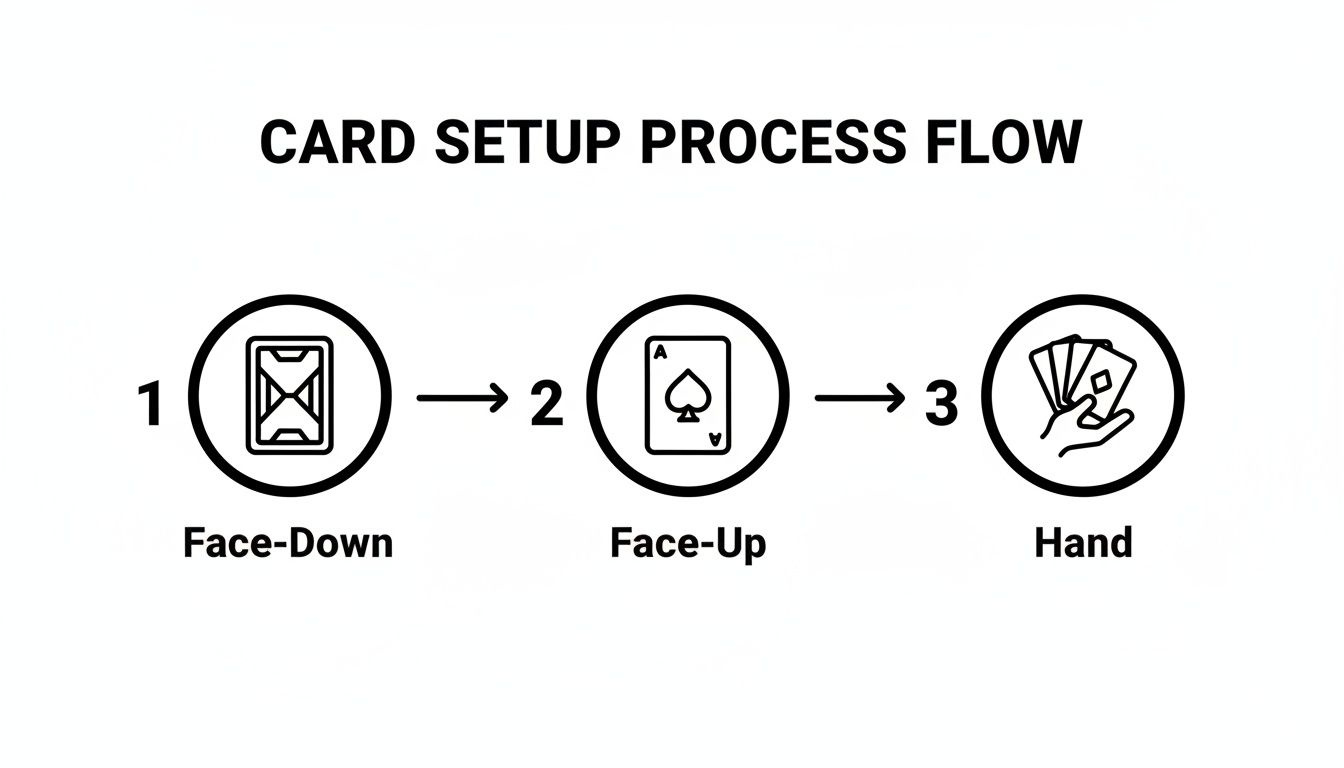
You'll work your way through these three layers of cards. The endgame, playing those face-down cards blind, is where the real chaos begins.
This is where Shed's true personality comes out. The "magic cards" are what elevate the game from a simple race to a strategic battle. Getting to grips with these is absolutely key to winning.
Shed, with its magic cards and regional twists, is a perfect window into the creative spirit of British card gaming. You'll find all sorts of variations, like the "Tenerife Rules" where a player can choose to pick up the pile. These quirks are what make pub and family games so special.
Learning how these special cards work together is half the battle. If you want to brush up on the fundamentals that apply to almost any card game, our guide on how to play card games is a great place to start.
So, you’ve got the rules down. But knowing how to play is a world away from knowing how to win. Once the turn order feels like second nature, it’s time to start thinking like a veteran. This is where Shed transforms from a simple card game into a genuine art form.
Mastering Shed really comes down to one thing: hand management. It's a constant tightrope walk between playing your game-changing magic cards and saving them for that perfect, game-winning moment. It takes a sharp memory and a healthy dose of nerve.
My opening gambit is almost always the same: get rid of the low, awkward cards immediately. If you’re dealt a hand of 3s, 4s, and 5s, dump them while the discard pile is still manageable. This clears out the clutter and frees up your hand for the more flexible, powerful cards you'll need later.
On the flip side, you want to cling to your magic cards—your 2s and 10s—for as long as you possibly can. Treat them like gold.
This kind of tactical depth, where a single clever play can swing the momentum, will feel instantly familiar to anyone who loves games like TerraClash™ Grimoire. It shares that same lightning-fast pace, where a whole game can be decided in just 10-15 minutes. It’s all about quick thinking and making bold moves. If you love that blend of speed and strategy, you can see how it's being made by visiting the Kickstarter campaign.
Shed is never just about the cards in your hand; it's about the people you're playing against. Reading your opponents is a skill you'll pick up with experience. Watch for the tells. Did your friend hesitate before playing? They're probably wrestling with whether to burn their last high card or risk a pickup.
You can also start setting some devious traps. For instance, playing an 8 (the "invisible" card) forces the next person to beat whatever is underneath it. If you know you just covered up a King, you can put your opponent in an impossible position.
Bluffing is a massive part of my game. If I have an 8, I might play it with a confident smirk, making everyone think the card underneath is dangerously high. I’ve seen this bait an opponent into wasting a precious 2 or 10, handing me a huge advantage.
This psychological warfare is what gives the game its incredible replay value. Honing your ability to read the table is a skill that makes you better at almost any game. For more on this, we've actually written a guide on how to improve your strategic thinking. Every round of Shed is a fresh puzzle, a perfect, fast-paced mix of luck, skill, and just a little bit of cunning.
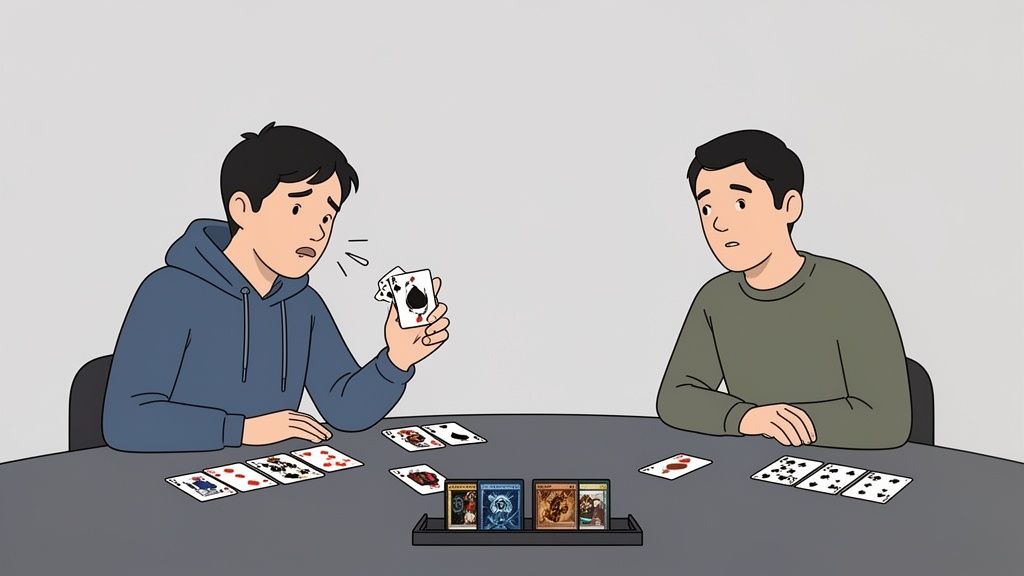
This is where the game gets interesting. Once your hand is empty and the draw pile is gone, the endgame begins. You’re now down to your three face-up cards, which hopefully you’ve been saving for this very moment. It’s a tense, calculated phase that can very quickly give way to pure, heart-in-your-mouth luck.
After your face-up cards are gone, it's time for the big finale: the three face-down cards. You have to flip them one by one, completely blind. This is where the real drama of Shed happens. You might flip a game-saving 2, or you could turn over a dreaded King that forces you to pick up a monster pile, snatching defeat from the jaws of victory. It's this wild, unpredictable finish that makes every round so memorable.
The feeling is a lot like the final turns in a fast-paced game like TerraClash™ Grimoire, where a single perfectly timed spell or a risky attack can decide the winner. Both games pack that same exhilarating, high-stakes experience into short, sharp sessions of just 10-15 minutes.
Getting through the endgame is all about memory and nerve. The best players are the ones who have been paying attention all along. Try to keep a rough mental note of which magic cards have been played, especially the 2s and 10s. If you know a couple of 10s are still out there, you can afford to play more aggressively, hoping an opponent clears the pile for you.
On the other hand, if you're holding the last magic card, its power is incredible. Using your final 2 to dodge a pile, or a 10 to clear the way for your last blind card, is a thing of beauty. Timing that final play is everything and a massive part of learning how to play the Shed card game well.
The most nerve-wracking moment is flipping that first blind card. I've seen players go from certain victory to holding half the deck in a single turn. My advice? Embrace the chaos. It’s the luck of the draw, and that shared moment of shock or triumph is what makes Shed brilliant.
This mix of clever strategy and blind luck makes for a finale that keeps everyone on the edge of their seat until the very last card is flipped. It’s a perfect recipe for a game you’ll want to play again and again.
For anyone who loves this kind of quick, high-stakes gameplay, you might be interested in a brand-new tabletop game that captures that same spirit. You can support the development of TerraClash™ Grimoire by checking out its Kickstarter campaign. It's a great way to discover your next game night favourite.
Even with the rules laid out, a few questions always pop up when you're learning the ropes of Shed. Let's clear up some of the common sticking points so you can play with confidence.
This is where the game gets really interesting. Once you’ve played the last card from your hand and the draw pile is gone, you’re not out of the game – you’ve just entered the next phase.
Now, you must start playing your three face-up cards. You can see them, so you can still strategise a bit, but you have to play them one at a time, following all the usual rules.
After your face-up cards are gone, you’ve reached the final, nail-biting stage. You’ll play your three face-down cards, one by one. The catch? You have to play them blind, without looking first. It’s a moment of pure luck that can make or break your game.
A standard 52-card deck is all you need for a great game with 2 to 4 players.
If you've got a bigger crew of 5 or more, just shuffle two standard decks together. This keeps the game balanced, ensuring there are enough cards to go around and the draw pile doesn't vanish too quickly. It also introduces duplicate cards, which adds a fun layer of chaos and makes burning the pile with four-of-a-kind a bit trickier.
If you've played Shed, you'll immediately recognise the design philosophy behind TerraClash™ Grimoire. Both games are incredibly easy to pick up, but that simplicity hides a surprising amount of strategic depth. The "magic cards" in Shed that flip the game on its head have a spiritual cousin in the powerful spells and character abilities you'll find in TerraClash™ Grimoire, which lead to thrilling and unpredictable battles.
At their heart, both games are built for speed. You get a full, satisfying experience in just 10-15 minutes. They're the perfect fit for any game night when you want to jump straight into fast-paced fun without a lengthy setup.
It's this shared spirit of quick-thinking tactics and replayability that makes both games so hard to put down.
If you get a kick out of fast, strategic card games, you owe it to yourself to check out TerraClash. You can find out everything you need to know on the TerraClash™ Grimoire page and help bring it to life by backing the Kickstarter campaign.

