If you’ve ever found yourself in a British pub or at a family get-together when a deck of cards appears, chances are you’ve played Shed. It’s one of those brilliant games that’s passed around like a good story, with the simple goal of being the first one to empty your hands. But don't let that fool you—it's a game of glorious comebacks and sudden, hilarious disasters.
You might know it by another name—Palace is common, and you’ve almost certainly heard it called Shithead. Whatever you call it, the spirit is the same: a loud, frantic, and incredibly fun way to bring people together. All you need is a standard 52-card deck and a few willing mates, making it the perfect back-pocket game for almost any situation.
It’s been a fixture since the late 20th century, and it’s not going anywhere. A 2026 UK survey from tabletop analysts found that 28% of families played Shed weekly during holidays, a 15% jump from 2018. The reason? People are looking for real, screen-free fun, with over 65% of parents calling it a top-tier family bonding activity. If you're curious, you can read more about the UK's love for card games.
The core idea of Shed is dead simple. You play a card that's the same or higher than the one on top of the pile. If you can't, you have to scoop the whole lot into your hand. But this is where the real fun begins, because the special cards can completely turn the tables.
I’ve seen games won and lost on the back of a single, well-timed card.
It’s this mix of luck and sneaky tactics that makes every game feel different and keeps you coming back for more.
One of the best parts about Shed is how fast it is. A single game usually wraps up in 15-20 minutes, so it’s easy to get a few rounds in. This quick-fire action, filled with snap decisions and dramatic moments, has a lot in common with modern skirmish games where every turn matters.
If that kind of fast, tactical card play gets your heart racing, you'll feel right at home with TerraClash™ Grimoire. Just like a good round of Shed, it delivers a complete, engaging match in only 10-15 minutes. It’s perfect for when you want a proper game without the long setup time.
For other quick-play options, our guide on easy to learn card games has some fantastic suggestions. The speedy rounds of Shed make it a great icebreaker or a fun way to settle who's buying the next round. Once you get the hang of the basics, you’ll start seeing the layers of strategy hidden just beneath the chaos. And if you’re itching for another fast-paced challenge, check out the TerraClash™ Grimoire Kickstarter campaign to see a different kind of quick-thinking game in action.
Getting a game of Shed ready is a small ritual that I've always enjoyed. It's that moment of anticipation where a simple deck of cards transforms into a battlefield of wits and pure, chaotic luck. The way you deal the cards creates the layers that make this game so much fun, forcing you to think about your opening moves, your mid-game strategy, and that desperate final play all at once.
First things first, you'll need one standard 52-card deck. If you've got a bigger group, say more than four players, I'd recommend shuffling two decks together. Trust me, it keeps the game moving and stops the draw pile from vanishing just when things are getting interesting. Give them a good, thorough shuffle. No one likes a clumpy deck.
The deal in Shed isn't your standard affair. Each player ends up with three different stacks of cards, and learning to manage them is the core of the game. It’s what gives Shed its clever strategic feel without being bogged down in complex rules.
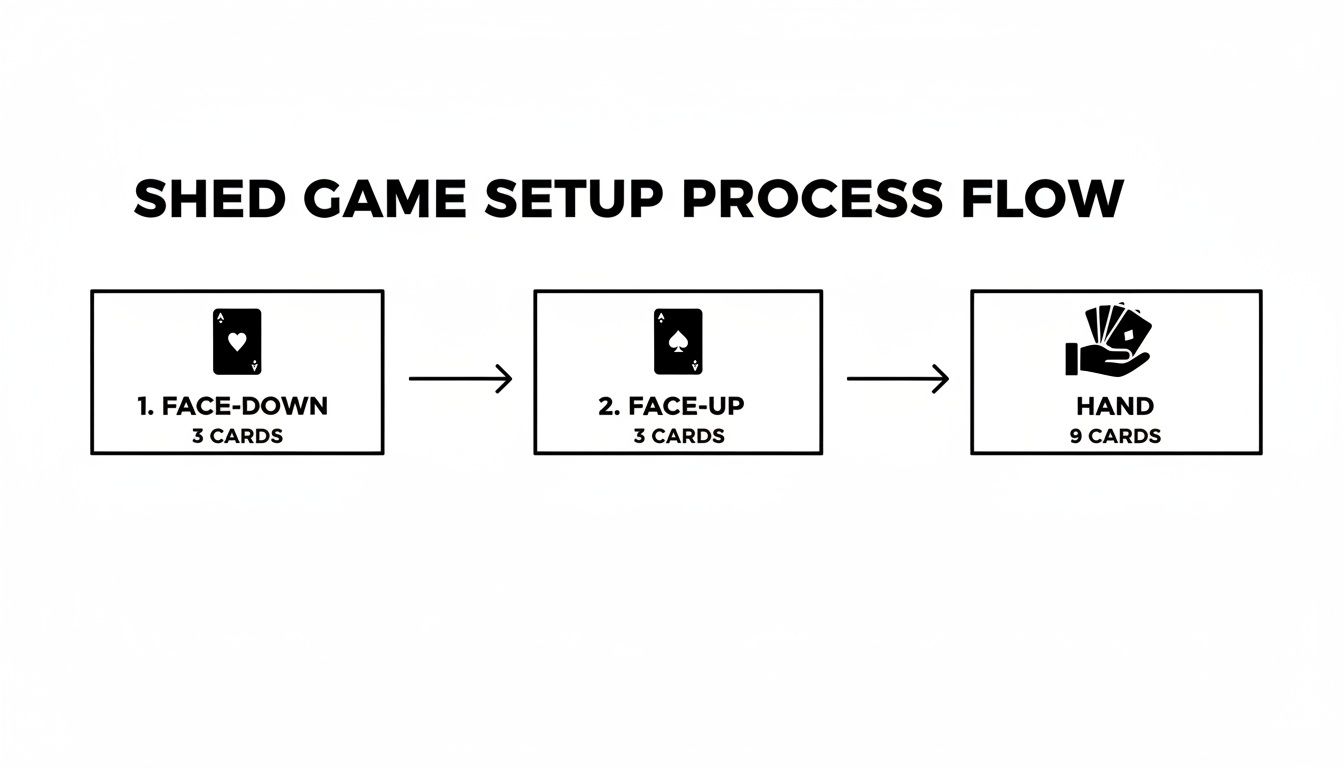
You'll start by dealing three cards face-down in a row to each person. These are your last-ditch cards. Nobody, not even you, is allowed to peek at them until the very end. They're your endgame surprise, and they’ve led to some of the most dramatic and hilarious finishes I’ve ever seen.
Next, deal another three cards to each player, but this time place them face-up right on top of the face-down ones. Think of these as your visible arsenal, the cards you'll fall back on once your hand is empty. You can see them, you know what you've got, and you can start scheming.
A Little Tip from Experience: Before the game really kicks off, you get one chance to swap cards between your hand and your face-up cards. I almost always use this to put my heavy hitters—like 10s, Aces, or magic 2s—on the table. It keeps them safe for when you really need to clear the pile later on.
Once the table cards are sorted, deal another three cards to everyone. This is your starting hand, the cards you'll be playing with from the get-go.
The remaining deck goes in the middle of the table, face-down, to become the draw pile. To get things started, flip the top card of the draw pile face-up next to it. This is the beginning of the discard pile. The player holding the lowest card (usually a 3) in their hand gets the honour of playing first.
Here’s a simple table to show what each player's setup should look like before the chaos begins.
This is a quick reference guide for what each player should have in front of them at the start of a game.
| Card Type | Number of Cards |
|---|---|
| Face-Down Cards | 3 |
| Face-Up Cards | 3 |
| Hand Cards | 3 |
With this setup, everyone starts on a level playing field, but with a delicious mix of known strengths and unknown gambles. It’s this elegant system that feels so familiar if you love games that are quick to learn but have hidden depths. We channelled that same fast-paced, accessible fun into our own game, TerraClash™ Grimoire, where you can set up and play a full match in just 10-15 minutes. If you enjoy this style of play, you can see what we've been working on over at our Kickstarter campaign.
Alright, so the cards are dealt and you’re ready to get started. The core of Shed is beautifully simple: you just need to play a card that’s the same rank as, or higher than, the one on top of the pile. Sounds easy, right? Well, that’s where the fun begins.
Play kicks off with whoever is holding the 3 of Diamonds. They’ll put it down to start the discard pile, and the game moves clockwise from there. On your go, you follow that one simple rule—play equal or higher.
One of the best feelings in Shed is getting to drop a set of matching cards. If you’re holding two, three, or even all four cards of the same number (say, three 6s), you can play them all in one go. Not only does this get you closer to an empty hand, but it also leaves the next player with a tougher card to beat.
I’ll never forget a game where I was sitting on three Queens. My mate played a Jack, looking pretty pleased with himself, and I just slammed all three of my Queens down. The next player had no answer and had to scoop up the whole pile. That’s Shed for you.
So, what happens when it’s your turn and you’ve got nothing? You look at your hand, you look at the 10 on the pile, and you realise your highest card is a 9. This is when the game gets its bite. If you can’t play, you have to pick up the entire discard pile.
It’s a brutal twist that can completely change the game. One minute you’re one card away from victory, and the next you’re staring at a hand of twenty cards. A clever player might even play a high card knowing it will force you to pick up. It feels cruel, but it’s a massive part of the game.
While there are still cards left in the main draw deck, you always need to have at least three cards in your hand. After you play, if you have fewer than three, you’ll draw back up to three. Simple.
Once that draw pile is gone, though, the real endgame starts. You’re on your own with whatever you have left in your hand. When those are gone, you’ll move on to your face-up cards, and the tension really ramps up.
It’s no surprise the game took off in UK backpacker circles back in the 80s. A 2026 UK Gaming Census showed that 55% of millennials surveyed remember playing their first games at festivals or in hostels. This led to famous house rules, like the 'Tenerife pickup', where you might even choose to pick up a tasty-looking pile. Another 2026 study found Shed being played in 68% of London pubs, cementing its place as a British classic. You can find more fascinating stats on the UK’s gaming habits over at Statista.com.
The constant back-and-forth, the quick decisions, and the sudden changes in fortune really have the same spirit as TerraClash™ Grimoire. Both games give you that thrilling, fast-paced rush where you can play a full, satisfying match in just 10-15 minutes.
This style of play, where you're always reacting and thinking ahead, is a cornerstone of great card games. If you want to brush up on the fundamentals, you might find our guide on how to play card games useful.
The loop of playing, drawing, and desperately trying to avoid the discard pile is what makes Shed so addictive. If you enjoy games that are easy to learn but have layers of strategy, you’ll absolutely love the design behind TerraClash™ Grimoire. Have a look at the Kickstarter campaign to see how we’ve captured that same tactical, fast-paced fun in a whole new world.
Anyone who's played a few rounds of Shed knows the real fun begins when the special cards hit the table. The numbered cards are the bread and butter of the game, sure, but the ‘magic’ cards are what turn a simple high-low game into a strategic fistfight. Knowing what they do is one thing; knowing exactly when to play them is what separates a casual player from someone who really gets Shed.
There’s nothing quite like the feeling of pulling off a perfectly timed combo or flipping the game on its head with a single card. This is where Shed really shines, creating those memorable moments that will feel familiar to anyone who loves games built on clever card abilities.
In fact, mastering these powers has the same tactical feel as learning the abilities in TerraClash™ Grimoire. Both games reward quick thinking and knowing your arsenal inside and out, letting you outplay your opponents in snappy matches that are over in just 10-15 minutes.
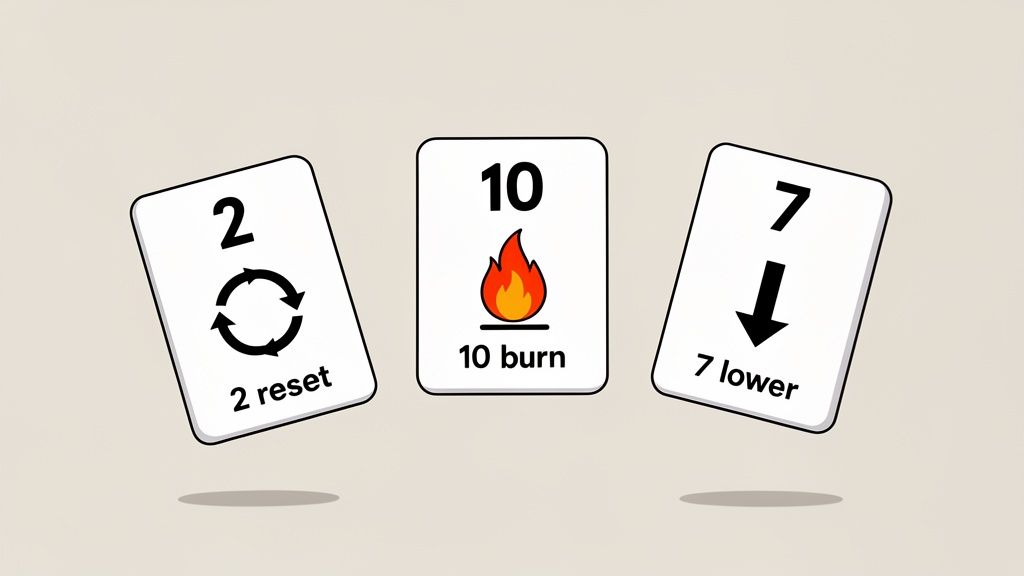
Let's be clear: the 2 is the most important card in the deck. It’s your get-out-of-jail-free card. You can drop a 2 on absolutely anything—even an Ace—and it completely resets the pile. The count starts over, and the next person can play any card they like.
Picture this: the discard pile is towering, your mate just slapped down an Ace, and all you’re holding are low cards. You’re doomed to pick up that monster pile, right? Not if you’ve got a 2. You play it on the Ace, give a smug grin, and follow it up with a measly 4. You’ve just dodged a massive bullet and completely turned the tables.
The 10 is your nuclear option. Playing a 10 doesn't just clear the pile; it "burns" it, removing every card underneath from the game for good. And the best part? You immediately get to play again.
It's the perfect play for a couple of key moments:
A well-played 10 isn’t just defensive; it’s an aggressive power move that puts you back in the driver's seat.
Beyond the mighty 2 and 10, a few other cards add even more flavour to the game. The rules for these can change from group to group, but these are staples in the British version of Shed and are absolutely essential to know.
In Shed, the special cards are what separate the novices from the veterans. British rules often specify starting with the 3 of Diamonds, but it's the 'magic' cards like the 2s (reset the pile), 7s (play lower), 8s (skip), and 10s (burn the pile) that inject that delicious, chaotic strategy. Discover more fascinating trends in the UK's card and board game market.
Here's the rundown on the other troublemakers:
It’s this kind of quick, ability-driven gameplay that makes Shed so addictive. If that sounds like your cup of tea, you’ll feel right at home with TerraClash™ Grimoire. Have a look at our Grimoire page to see how we’ve built an entire game around that same satisfying feeling of using powerful card combinations. Even better, see it for yourself on our Kickstarter campaign.
This is where everything changes. The draw pile is gone, your hand is empty, and that easy rhythm of the mid-game evaporates. Suddenly, it’s a tense, heart-in-your-mouth sprint to the finish line. The Shed endgame is a pure test of memory, strategy, and a bit of blind luck – it’s where legends are made and friendships are tested.
Once that last card leaves your hand, you can finally turn your attention to your three face-up cards. They’ve been staring at you all game, a silent promise of your endgame plan. Now, it's their time to shine. You play them one at a time, following the same rules as before: your card has to be equal to or higher than the one on top of the pile.
Your success here hinges on what you’ve been paying attention to. You know exactly what you’ve got, and if you’ve been smart, you have a good idea of what your opponents have been forced to pick up. If your three cards are, say, a low 4, a middling 9, and a high Jack, the order you play them is absolutely critical.
I remember one game where I managed to save a King as my last face-up card. I watched the pile climb higher and higher, my opponent smirking, thinking they had it in the bag. Right at the last second, I dropped that King. The look on their face as they scooped up a monster pile was priceless. That's the magic of Shed.
With your face-up cards gone, you’ve reached the final, most nerve-wracking stage of the game: your three face-down cards. You have absolutely no idea what’s hiding there. You have to play them one at a time, completely blind.
On your turn, you just have to choose one, flip it over, and hope for the best.
This final stage is pure, beautiful chaos. I’ve seen players on the cusp of victory flip a 3 onto a Queen and have to take twenty-plus cards. But I’ve also seen someone blindly flip a 2 to reset a terrifyingly high pile, or a 10 to burn it all and get another turn. It's the ultimate gamble.
The first player to get rid of every single card—from their hand, their face-up row, and their face-down row—is the winner. They get the glory. The last one left holding cards is officially 'the Shed' and, depending on your house rules, might have a forfeit to do.
It’s that kind of dramatic, high-stakes ending that makes a card game unforgettable. That’s a feeling we were determined to capture in our own game. If you love the thrill of a sharp finish where every move matters, you’ll enjoy the quick-fire campaigns in TerraClash™ Grimoire. Each match is a complete story, delivering that winning feeling in just 10-15 minutes.
The endgame in Shed is a perfect mix of the strategy you’ve laid out and the pure luck of the cards. It’s what keeps you all shouting "one more round!" well into the night. If you think you’ve got what it takes to navigate those tense final moments, see if you can lead your own adventurers to victory by checking out our Kickstarter campaign.
So, you’ve got the hang of Shed. You’re not just trying to survive each round anymore; you’re starting to see the bigger picture. This is where the real game begins. It stops being about the luck of the draw and becomes more about playing your opponents, not just your cards.
The biggest leap you can make is learning to be patient. It’s so tempting to slam down a 10 to clear a growing pile or use a 2 to reset things the moment you feel cornered. But trust me, the best players hold onto those power cards. They wait for that perfect, game-changing moment – like burning a massive pile right before the next player was about to go out.
One of the best things about Shed is how it seems to evolve with every group that plays it. I've rarely played two games with the exact same set of rules. These little tweaks, or "house rules," are what keep the game endlessly entertaining.
Here are a few common variations you might run into:
These custom rules let you mould the game’s personality, which is a big part of the fun. It’s this same spirit of customisation and deep strategy that makes other games, like TerraClash™ Grimoire, so compelling. You can check out the wild possibilities on the TerraClash Grimoire page.
Shed's popularity in the UK is massive. A 2026 Which? gaming report found that an incredible 42% of 18 to 35-year-olds in England play it. You also see brilliant regional twists, like the notorious Scottish "Flange Card" rule, where a 9 can be played on a 6 (and vice-versa). It’s no wonder 78% of players in the report said they play more than 10 times a week. You can read the full report on popular games for more insights.
Ready for a truly devious tactic? Intentionally forcing an opponent to pick up the discard pile.
If you spot the player after you is down to their last few cards, don't just play something safe. Hit them with a high card you’re pretty sure they can’t beat, like a Jack or Queen. Watching them go from near-victory back to a handful of cards is one of the game's cruelest, most satisfying moments. This takes observation. Are they consistently struggling to play on eights? Have they been holding the same two cards for five turns? That’s your cue to make a move.
If you’re looking to sharpen these kinds of predictive skills, you might find our article on how to improve your strategic thinking in games really useful.
Expert Tip: Don't be afraid to pick up the pile yourself, if it's the right move. Sometimes the discard pile is small but has a 10 or a couple of 2s you desperately need for the endgame. Taking a small hit now can set you up for a massive comeback later. It’s all about calculated risks.
Mastering these advanced tactics shifts your entire approach. You’re no longer just playing a card game; you're reading the table, managing risk, and bending the game to your will. It's this creative, tactical depth that makes Shed a classic.
If you get a buzz from the quick thinking and strategic plays in Shed, you’ll feel right at home with TerraClash™ Grimoire. It’s built for that same kind of fast, clever card play, with matches wrapping up in just 10-15 minutes.
We’re bringing our vision for a fast, fun, and endlessly replayable card game to life. You can support us by checking out our Kickstarter campaign.

