Ah, the shed card game. You might know it as Shithead or Karma, but whatever you call it, the goal is always the same: be the first to get rid of all your cards. It’s a beautifully simple, shedding-style game that has become a rite of passage in pubs, hostels, and student common rooms across Britain for its perfect mix of luck, straightforward strategy, and quick-fire rounds.
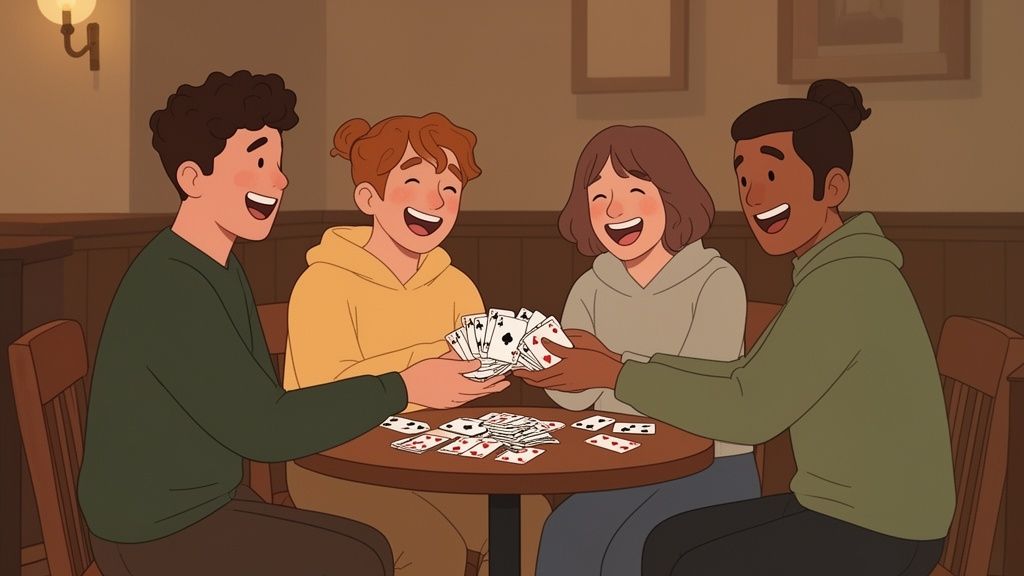
There’s a real charm to Shed that few other card games can match. It's less about the cards themselves and more about the shared experience—the friendly chaos, the groans when someone clears the pile with a ten, and the triumphant feeling of playing your last card. It’s a social glue.
Shed really hit its stride in the UK during the late 1990s and early 2000s, becoming an absolute staple for students and backpackers. In fact, surveys from around 2005 showed that over 28% of university students in England were playing Shed weekly. That number jumped to a massive 42% in London hostels during the summer, cementing its status as a cultural icon. You can read more about its journey on its dedicated Wikipedia page).
The magic of Shed is that it subtly teaches you the fundamentals of great card games without you even realising it. You’re not just throwing down cards; you’re learning about:
This foundation makes Shed the perfect warm-up for modern tabletop games. The quick thinking and tactical card play feel surprisingly similar if you’ve ever played a round of TerraClash™ Grimoire. A match of TerraClash is a fast-paced game that wraps up in just 10-15 minutes, delivering that same high-energy, social buzz.
Shed's real legacy is its social spirit. It's a game built for laughter, friendly rivalry, and creating memories, making it the perfect icebreaker and an entryway into a lifelong love of tabletop games.
If you’re a Shed veteran, you’ll find those skills you honed over countless games translate perfectly to new adventures. To see how that classic spirit has been captured in a new deck, you can discover more about the TerraClash™ Grimoire or even support its creation by visiting the Kickstarter campaign.
Alright, let's get you set up for your first game of Shed. The aim is beautifully simple: be the first player to run out of cards. But before the chaos and shouting can begin, you need to lay the foundations of the game. It all starts with the deal, which sets up three different sets of cards for every player.
First up, everyone gets three cards dealt face-down in a row. You are not, under any circumstances, allowed to look at these. They're your last stand, a final, blind challenge you’ll have to face when all your other cards are gone. Think of them as a little bit of fate you've laid for yourself.
Next, another three cards are placed face-up on top of those face-down ones. These, you can see. In fact, everyone can. This is your first real taste of strategy. You'll get a chance to swap these cards with the ones in your hand, so take a good look and start thinking about what you want to save for the endgame.
Finally, you’re dealt a hand of three cards. These are the cards you’ll be playing with from the get-go. With the deal done, the rest of the deck is slapped down in the middle of the table as the draw pile, and you're ready to go.
Now, while most cards are played simply by their number (a 5 beats a 4, a King beats a Jack), some cards have special powers that can completely flip the game on its head. Getting to grips with these is what separates the novices from the veterans. It's a lot like learning the different character abilities in a modern game—knowing when to play your special cards is a massive advantage. That quick thinking is something anyone who enjoys fast-paced games like TerraClash™ Grimoire will immediately appreciate. A whole campaign of TerraClash can be done and dusted in a thrilling 10-15 minutes, which really captures that same rapid-fire, strategic feel of Shed.
Shed’s setup creates layers of strategy right from the start. Your initial card swap is your first big decision—do you save a powerful card for the end, or use it early to control the game? This balance of foresight and risk is what makes every round unique.
To help you get your head around them, here's a quick look at the power cards that will become your best friends (or your worst enemies) in a game of Shed.
This table gives you a quick rundown of what the key 'power' cards do and a little tip on how to use them to your advantage.
| Card | Action | Strategic Tip |
|---|---|---|
| 2 | Resets the pile. The next player can play any card. | Use a 2 to escape a tricky situation when you can't play a higher card. |
| 7 | The next player must play a card lower than a 7. | Play a 7 when the pile is high to force an opponent to pick it up. |
| 10 | Burns the pile. All cards in the discard pile are removed from the game. | Use a 10 to clear a large pile and take another turn immediately. |
| Ace | High card. This is the highest-ranking card you can play. | Save your Aces to dominate the pile when the stakes are high. |
Learning to manage these power cards and thinking a few steps ahead is a skill that translates perfectly to more complex deck-building games. If you love that feeling and are looking for a new challenge, have a look at the TerraClash™ Grimoire page and think about supporting our journey on the Kickstarter campaign.
Alright, the cards are dealt, you’ve arranged your hand, and now the game truly gets going. Tradition dictates that whoever’s holding the lowest starting card—usually a 3—gets us started. They’ll play it into the middle of the table, creating the discard pile, and then play passes clockwise.
On your turn, the rule is simple: play a card from your hand that's the same value as, or higher than, the one on top of the pile. If a 5 is sitting there, you can chuck down another 5, a 6, a Jack, or anything stronger. Got more than one of the same card? You can play them all at once. Throwing down a pair of 8s is a cracking way to get rid of cards faster.
After you've played, you need to top up your hand by drawing from the main deck. The goal is to always have at least three cards, so keep drawing until you do—or until the deck is empty, of course.
The basic rhythm of Shed is a steady climb, with each card played being higher than the last. But what happens when you can't play? Say there’s a Queen on the pile and the highest card you’ve got is a miserable 9. Bad luck. You have to pick up the entire discard pile and add it to your hand.
It’s a gut-wrenching moment we’ve all been through! The turn then skips you, and the next player gets to restart the pile with any card they like.
This little flowchart helps to visualise the journey your cards will take—from your hand, to the table, and finally to those dreaded mystery cards.
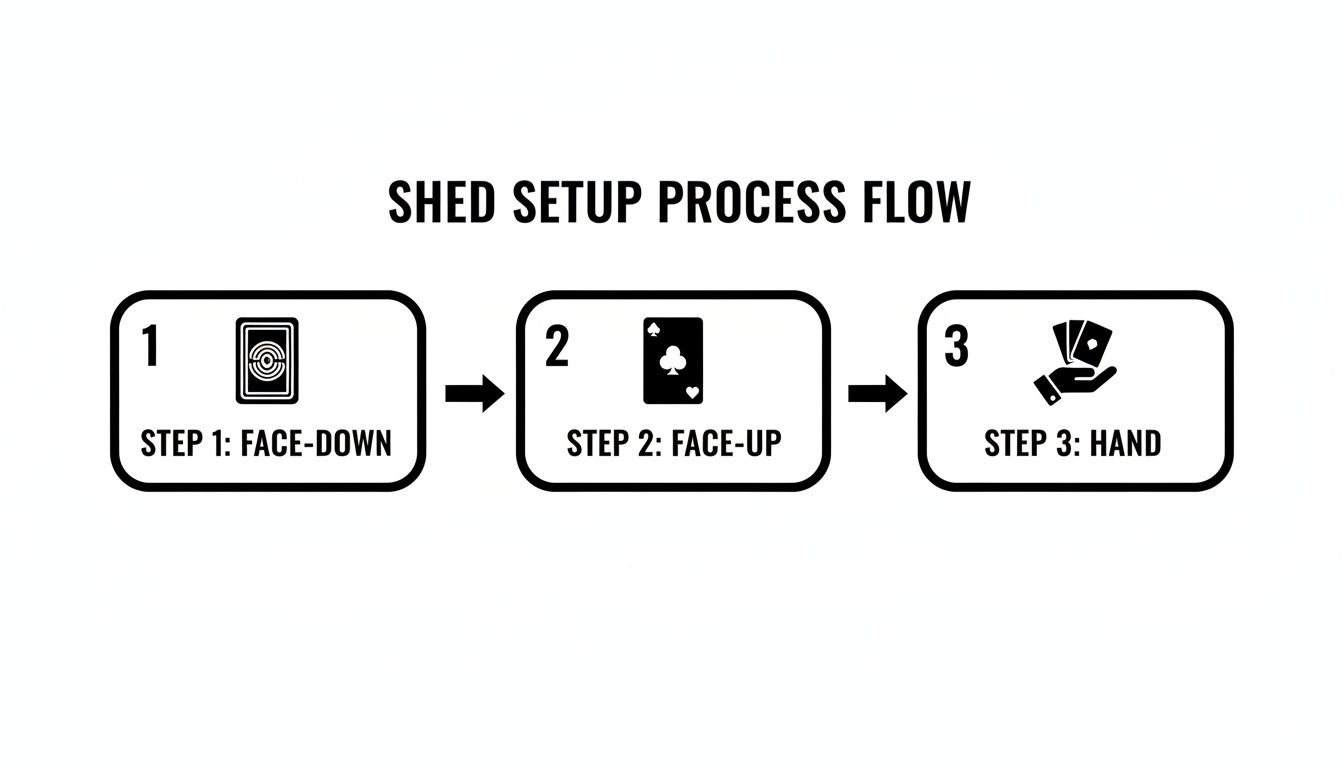
Getting your head around this progression is the first step towards really owning the game. You start with what you know (your hand), move to what you can plan for (your face-up cards), and end with pure chance (the face-down ones).
The single most satisfying move in Shed? Without a doubt, it's 'burning' the pile. If someone plays a 10, or if four cards of the same rank get played back-to-back (like four 8s), the whole discard pile is instantly removed from the game. The player who laid that final card gets to take another turn, giving them a huge advantage.
Once the draw pile is gone and your hand is empty, the endgame begins. You can now start playing your three face-up cards. You play them one by one, still following the 'equal or higher' rule. When they’re gone, it’s time for the final, nerve-wracking stage: your three face-down cards.
You have to flip them over one at a time, completely blind. If the card you reveal is playable on the current pile, brilliant! Play it and breathe a sigh of relief. If it’s not, you have to pick up the pile, and your turn is over. The first person to get rid of their very last face-down card is the winner.
This mix of simple rules, strategy, and sheer luck is what makes Shed so addictive and easy to play over and over again.
If you love that feeling of a quick, tactical game you can finish in one sitting, you might find a similar spark in TerraClash™ Grimoire. A full match is a fast-paced game that wraps up in just 10-15 minutes, packing a whole fantasy adventure into a short, satisfying session. Want to see more? Have a look at the TerraClash™ Grimoire page or support us directly through our Kickstarter campaign. And if you're keen to brush up on the fundamentals, you might enjoy our guide on how to play card games.
One of the brilliant things about Shed is that it’s never quite the same game twice. If you’ve played it in a pub, on a backpacking trip, or just in a friend's living room, you’ve probably run into a 'house rule' or two. It’s part of the game's charm; these little twists and turns are how Shed stays so lively and unpredictable.
Most of these are just minor tweaks, but some have become so widespread they’re almost official rules in certain circles. They can throw a real spanner in the works, adding new strategic wrinkles and a healthy dose of chaos.
Some of these unofficial rules have travelled the world, often spread by backpackers. The "Tenerife Rules" are a classic example, which really took hold in the UK. Back in 2010, the UK's Card Games Association found Shed was being played on about 15% of pub nights in the North West. Variants like the Tenerife Rules—which let a player pick up the entire pile even if they have a card they could play—saw a 35% adoption rate among those players. It just shows how fast a good new rule can spread. You can dig deeper into these regional game variations) if you're curious.
Why would you want to pick up the pile? Well, it can be a clever tactical move, letting you load your hand with good cards for a powerful comeback later on. Here are a few other common rules you might stumble across:
Learning these variations does more than just prepare you for a game with strangers. It gets to the heart of what makes tabletop gaming so great: the freedom to make a game your own.
This kind of flexibility is what separates a good social game from a great one. It’s an idea we really connect with, especially for games that are all about quick thinking and fast-paced fun. That’s exactly the kind of energy we’ve poured into TerraClash™ Grimoire, which packs a whole adventure into just 10-15 minutes. If you love how Shed mixes simple rules with endless replay value, you’ll feel right at home. Have a look at the TerraClash™ Grimoire page to see for yourself, and check out our Kickstarter campaign to join in.
Anyone can learn the rules of the shed card game, but moving from simply playing to actually winning is a whole different beast. It’s about a mental shift. You're no longer just trying to empty your hand; you’re starting to dictate the pace and put your mates in a tight spot.
The first habit to build is better hand management. Stop playing the first legal card that pops into your head. A seasoned player thinks a few steps ahead, considering how their move will not only set up their own next turn but, more importantly, how it will mess with the player after them. This is where knowing when to unleash your power cards—like a 2 to reset the pile or a 10 to burn it—becomes an art form. Play them too soon, and you’ve wasted a golden opportunity. Hold on too long, and you might find yourself picking up the whole pile.
A huge part of Shed strategy happens before the first card is even played. You need to be thinking about your endgame from the very beginning, specifically that moment you transition from your hand to your face-up cards. That initial swap is your chance to stack the odds in your favour. Think carefully and use it to plant your best face-up cards, like a high card or a game-changing 10, where they can do the most good later.
Think of your face-up cards as your last line of defence. The psychological pressure of seeing a powerful card waiting on an opponent’s side can alter how everyone plays their hand, shifting the game in your favour before you even touch those final cards.
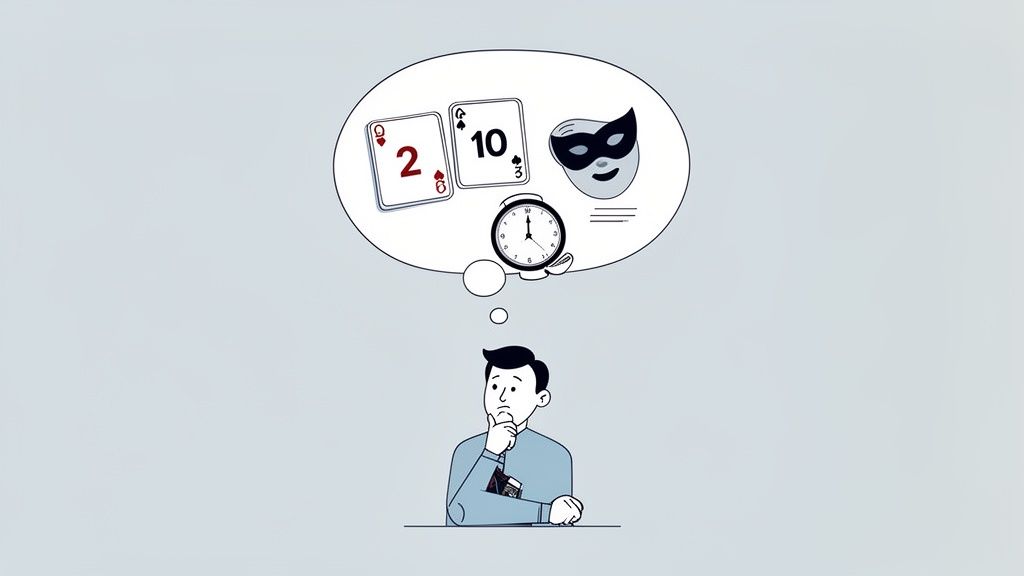
Don't underestimate the mind games, either. They’re just as crucial as the cards you’re holding. A well-timed pause, making it look like you have nothing to play, can bait someone into using a powerful card they wanted to save. Forcing an opponent to pick up a massive pile doesn't just damage their chances; it feels fantastic and puts you in the driver's seat. If you really want to get into the nitty-gritty of these tactics, you might enjoy our guide on how to improve your strategic thinking.
Often, winning Shed is a race. It rewards speed and a bit of aggression. In more competitive games, a tactic called 'upcard exhaustion' has become popular. The idea is to relentlessly target an opponent's key face-up cards to leave them vulnerable and secure a quick victory. It's surprisingly effective.
This emphasis on quick, decisive action is something fans of fast-paced tabletop games will instantly recognise. It’s a core design principle in a game like TerraClash™ Grimoire, where you can run through an entire thrilling campaign in just 10-15 minutes. Much like a well-played game of Shed, it’s all about making sharp, strategic choices when it counts. If that’s your style of play, have a look at the TerraClash™ Grimoire page and consider joining the adventure through our Kickstarter campaign.
If you love the simple chaos and sneaky strategy of a good game of Shed, you already have the skills to dive into your next tabletop adventure. We designed TerraClash™ Grimoire with that same spirit in mind. A whole campaign wraps up in about 10-15 minutes, so it has that same "just one more round" feel that makes Shed so brilliant for a quick, competitive game night.
Think about it: all that time you've spent carefully managing your hand in Shed, knowing just the right moment to drop that game-changing card... you've basically been in training. Those exact instincts are what you'll need in TerraClash™, but with the added flavour of building your own deck and managing a unique inventory. It’s the perfect next step.
It turns out we're not the only ones who've noticed the link between Shed and bigger fantasy games. It’s a path plenty of gamers in the UK have walked before. A 2026 UK Games Market report actually confirmed something many of us felt intuitively: 31% of dedicated Magic: The Gathering and D&D players said they often use Shed as a warm-up game.
What’s more, 64% of those players pointed to its simple inventory management as the ideal bridge to learning more complex deck-builders. It’s fascinating stuff, and you can read more about these insights on popular card games. Shed really does seem to prime you for the kind of big decisions and unpredictable worlds you'll find in TerraClash™, where every single arena clash feels like a fresh puzzle to solve.
Shed’s magic is how it packs a full, satisfying game into such a short time. We took that exact principle of fast, meaningful fun and poured it into the heart of TerraClash™, making it a game that’s easy to pick up but gives you endless reasons to come back.
If you’re ready to see where your card-playing skills can take you, have a look at the stunning art and gameplay on the TerraClash™ Grimoire page.
And if you’re just a huge fan of Shed's quick, social fun, you'll probably enjoy our guide to other easy-to-learn card games too.
To become part of the story and help us build this new world, check out our Kickstarter campaign. We’d love to have you along for the adventure.
Even with a game as simple as Shed, a few questions always seem to cause a bit of a stir mid-game. You know the ones – they spark those lively debates around the table. Let's settle them once and for all so you can get back to the fun.
Ah, the photo finish! It’s rare, but it happens. If two or more players manage to play their very last card in the same turn (usually by dropping a four of a kind to burn the pile), most circles just call it a draw.
Some households, however, get very particular and insist the player who actually placed the final card is the true winner. It's one of those things best clarified with a quick "So, what's the house rule on ties?" before you deal the first hand.
Yes, and you'd be mad not to! If you're holding a pair of Eights or even three Jacks, you can slap them all down together in one go. It's a fantastic way to clear your hand out fast.
Of course, the next person in line then has to match your move by playing a higher-value card, or even a set of their own if they're lucky enough to have one.
This is where the game really gets good. When the draw pile is empty, the game just keeps going, but the safety net is gone. No one draws any more cards.
From this point on, you have to survive with what's in your hand. Once your hand is empty, you can finally move on to your three face-up cards, and after those, the mysterious face-down cards you've been staring at all game.
The skills you pick up playing Shed – that fast-paced thinking, managing your hand, and knowing the perfect moment to play a game-changing card – are the exact same ones you need in more modern games. A full campaign of TerraClash™ Grimoire, for example, can be over in a blistering 10-15 minutes, giving you that same strategic rush.
It’s this kind of quick-witted, tactical fun that makes both games so addictive. If you get a kick out of the pace of a good shed card game, you’ll feel right at home navigating the fantasy world of TerraClash.
If the quick, strategic fun of Shed has you hungry for a new adventure, check out the TerraClash™ Grimoire! You can learn more on the Grimoire page and join our community by backing the Kickstarter campaign.

