Welcome to Palace, the brilliant and chaotic card game where your only goal is to get rid of your cards before anyone else. It's a game of many names—Shithead, Shed, Karma—but the thrill is always the same. If you're looking for a game that's incredibly easy to pick up but offers enough cunning strategy to keep you hooked for years, you've found it.
There’s a special kind of magic in a simple deck of 52 cards, isn't there? It’s the sound of a deck being shuffled, the snap of a card hitting the table. Here in the UK, games like Palace are part of our social fabric, sitting right alongside pub favourites like Whist and Cribbage. What I love about it is its beautiful deception; it presents itself as a simple game of luck, but beneath the surface lies a wonderful, backstabbing game of strategy that makes every round an unpredictable joy.
It’s no surprise that our love for these games is stronger than ever. The thrill of outsmarting an opponent around a table is timeless. This isn't just a fad; it’s a return to the simple pleasure of gathering friends for a bit of quick, social fun.
This timeless tradition of card-based strategy is the bedrock for many of the fantasy games we see today. Think about it: Palace is a "shedding" game, where the goal is to empty your hand. The quick thinking and tactical plays you need to win share the same DNA as modern strategic card games, which have evolved these core ideas into entirely new experiences.
They’ve taken that spirit of hand management and outsmarting your opponent and wrapped it in rich, imaginative worlds.
For example, games like TerraClash™ Grimoire take the fast-paced, social nature of classics and infuse it with deep fantasy strategy. Much like a snappy round of Palace, a full match is over in just 10-15 minutes, but it’s packed with tactical decisions. It’s this perfect blend of speed and substance that creates a bridge between the old guard of card games and the exciting new generation.
If you get a kick out of the clever ploys and sudden reversals of fortune in Palace, you’ll feel right at home with the next wave of tabletop games. For anyone ready to dive into a new strategic adventure, have a look at the TerraClash™ Grimoire Kickstarter campaign and see where the journey leads next.
Right then, let's get you set up for your first game of Palace. It's one of those brilliant card games that's incredibly easy to pick up but has a surprising amount of depth. The goal couldn't be simpler: be the first player to get rid of every single one of your cards. It's a real rollercoaster of luck, cunning, and knowing exactly when to play that game-changing card.
First things first, you'll need a standard 52-card deck. While you can play with just two people, Palace really comes alive with three or four players crowded around a table. The dealer starts by laying out three cards face-down for each person. These are your 'Palace' cards—your last line of defence—and you won't get to see them until the bitter end.
Next, three more cards are dealt face-up on top of the face-down ones. To finish the deal, everyone gets a final three cards dealt directly to their hand. The rest of the deck goes in the middle to form the draw pile. Here's your first taste of strategy: you're allowed to swap any of the cards in your hand with the face-up cards on the table. A good setup here can make all the difference.
So, who starts? It’s usually the player holding the lowest card (typically a 3). If no one has a 3, it's whoever has the next lowest card. They kick things off by playing that card into the centre, starting the discard pile. From there, play moves clockwise.
On your turn, the rule is simple: you must play a card from your hand that has the same value or higher than the card on top of the discard pile. If you play a single card, you draw one from the draw pile to keep three cards in your hand. If you play a pair of 5s, you draw two. This continues until the draw pile is completely gone.
Be warned, though. If you can’t play a legal card, you have to pick up the entire discard pile. It's the moment every player dreads, as your hand suddenly swells and victory feels a long way off.
This constant back-and-forth, managing your hand while trying to force others into picking up the pile, is what makes Palace so addictive. If you get a kick out of this kind of tactical card play, you'll probably enjoy checking out our guide on how to play other classic card games.
This is where the real fun begins. Certain cards have special powers that can completely flip the game on its head. While rules can vary from one group to another, there are a couple of 'power' cards that are almost universally recognised.
These cards are your secret weapons, able to get you out of a tight spot or set a trap for the next player. Knowing when to hold them and when to play them is a key part of mastering the game.
Here's a quick look at how these special cards work.
The Power of Special Cards in Palace
| Card | Function | Strategic Use |
|---|---|---|
| Two | Resets the pile. Can be played on any card. | The ultimate escape card. Play it when you're stuck and let the next player start a new pile from scratch. |
| Ten | Burns the pile. Can be played on any card. | Instantly removes the entire discard pile from the game and gives you another turn. Perfect for clearing a high-value pile or stringing together plays. |
Timing is everything. A well-played Ten doesn't just save you—it gives you control of the game by letting you play again immediately.
Once the draw pile is gone and you've emptied your hand, you start playing the three face-up cards you set aside at the beginning. After those are gone, you're on to the final, nerve-wracking stage: playing your face-down Palace cards. You have to play them one at a time, completely blind. The first person to successfully play their final card is crowned the winner
Knowing the rules of Palace will get you a seat at the table, but it won’t win you the game. Anyone can play a higher card. The real art lies in the subtle strategies that let you read the table, control the tempo, and turn a mediocre hand into a powerhouse. This is where the mind games truly begin.
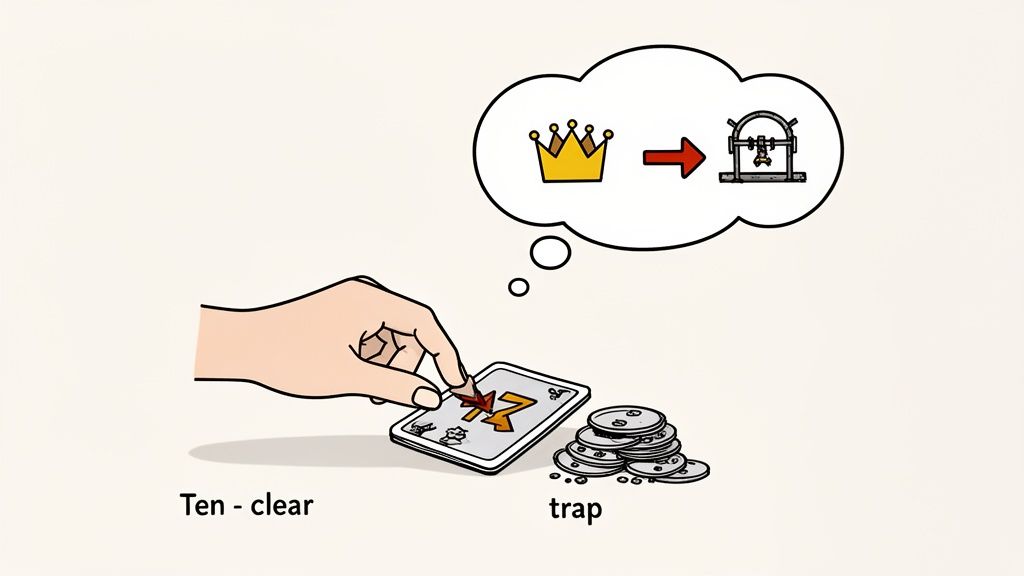
Your first chance to outsmart everyone comes before a single card is played: the setup. Swapping cards between your hand and your three face-up cards isn't just about ditching your lowest numbers. Think of it as building your mid-game arsenal. You might want to place a few high cards like Jacks or Queens face-up to deal with trouble later on, but keep your game-changing Twos and Tens hidden in your hand for maximum impact.
Once the game is underway, you have to stop thinking about just your next play and start anticipating everyone else's. Is someone consistently playing their lowest cards? They're probably sitting on a weak hand and are just trying to survive. Has another player been clinging to the same card for several turns? That could easily be a Ten, waiting for the perfect moment to clear a messy pile and seize control.
This kind of forward-thinking is a skill that sharpens your play in all sorts of games. In a fast-paced strategic duel like TerraClash™ Grimoire, for example, you're constantly mapping out your attack while predicting your opponent's response. A whole match of TerraClash™ might only take 10-15 minutes, but every single turn shapes the outcome—much like a well-played hand in Palace. If you're keen to develop this skill, we have an article on how to improve your strategic thinking.
Advanced Palace is all about manipulation. You might deliberately build the pile up to a 9, knowing the next player probably can't beat it without a special card, forcing them to pick up the entire stack. That’s a classic trap. Sometimes, it's even worth sacrificing a high card early just to see what other high cards get flushed out of your opponents' hands.
A key tactic is to track the special cards. If you’ve seen three Tens hit the pile, you know that fourth and final one is pure gold. Holding onto it can be the difference between a glorious victory and a humbling defeat.
Here are a couple of common dilemmas and how to think through them:
Ultimately, winning at Palace is a fantastic mix of smart setup, a bit of psychological warfare, and knowing exactly when to play your power cards. If you get a kick out of that rapid-fire tactical thinking, you should see how those skills feel in a brand-new setting. Check out the TerraClash™ Grimoire Kickstarter campaign and discover your next favourite card game.
One of the best things about Palace is that it’s not really one game. It’s a game that lives and breathes, passed around pubs, university common rooms, and family get-togethers, with each group adding its own special flavour. You might know it as Shed, Shithead, or Karma, but no matter the name, the goal is always the same: gleefully outplaying your mates.
This tradition of tweaking the rules is what keeps it fresh. It’s a living piece of card game history. Let's look at some of the most common "house rules" you’re likely to bump into—or maybe even adopt for your own games.
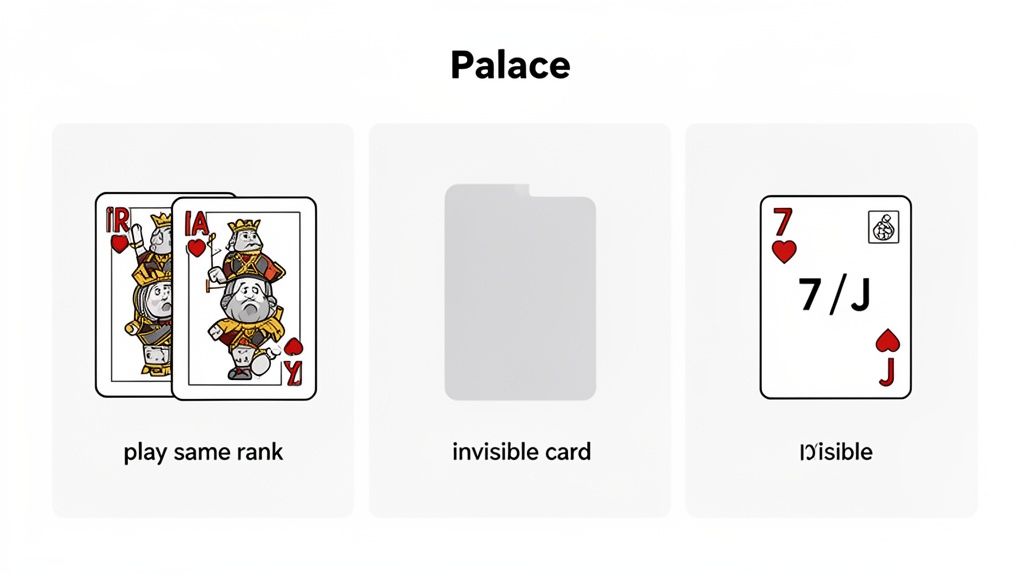
Ever been in a game where someone can drop multiple cards of the same rank? Seeing a player slam down a trio of 8s in one go is a sight to behold. It's a move that can empty a hand in seconds and adds a whole new layer of strategy, making you think twice about breaking up your pairs.
Another really common twist is the 'invisible card'. Usually, this is a 3. When you play it, the card simply takes on the value of whatever is directly underneath it in the pile. It’s a fantastically sneaky way to pass the buck when you don't have a high card yourself and want to put the next player in a tough spot.
Some groups get even more creative, giving other cards special jobs that can turn the game on its head:
This deep-rooted love for casual, strategic card games is a huge part of British culture, creating a community that loves both old classics and new experiences. This passion for strategy has kept games like Palace on the table for generations.
Here’s the thing about Palace: there are no "official" rules etched in stone. The version you and your friends play is the right one. Don't be afraid to mix and match these variants or even make up your own.
The best way to play is to agree on the rules before the first card is dealt. This ensures everyone is on the same page and ready for a fair, fun, and backstabbing game.
Games like Palace are the ancestors of so many modern strategic card games. That feeling of fast, adaptive thinking is the same spark you'll find in games like TerraClash™ Grimoire, which bottles that tactical excitement into quick 10-15 minute battles. If you enjoy customising the rules of your game night, why not try a game that was built from the ground up for endless strategic depth? You should definitely check out the TerraClash™ Grimoire Kickstarter campaign to see the next step in tabletop strategy.
If you love the chaotic thrill of getting rid of your last card in the card game Palace, you're tapping into a classic style of tabletop fun: pure survival. It's all about reacting, thinking on your feet, and doing whatever it takes to empty your hand before anyone else.
But what if you flipped that idea on its head? Instead of desperately trying to shed cards, what if the goal was to thoughtfully collect them? That's where you enter the fascinating world of deck-building games, a completely different, but equally rewarding, kind of challenge.
In a deck-builder, you're not just managing a random hand. You’re building a well-oiled machine, card by card. Every choice is deliberate as you pick from a shared pool, aiming to create powerful combinations that work together. It’s a wonderful shift in mindset from reactive tactics to long-term, proactive strategy.
This style of game isn't just a niche interest; it's a huge part of the tabletop scene. There’s a real appetite for games where players can forge their own path to victory with a physical deck of cards. The core strategies in many of these games are similar to Palace: anticipating your opponent's moves and managing your hand effectively.
A brilliant example of this is TerraClash™ Grimoire. It actually shares the fast pace of Palace, with games often wrapping up in a quick 10-15 minutes, but your objective couldn't be more different. In TerraClash™ Grimoire, you’re not just surviving; you are building a unique grimoire of spells and summons to completely overwhelm your opponent. The real kick comes from seeing your strategic plan click into place.
If this has piqued your interest and you fancy diving deeper, we've put together a great guide on the best deck-building games to get you started.
You could say that where Palace tests your ability to react to chaos, a deck-builder like TerraClash™ Grimoire celebrates your ability to create order and power from it. Both offer a fantastic buzz, just from opposite ends of the strategic spectrum.
So, if the quick-witted, tactical thinking of the card game Palace gets you excited, exploring deck-building is a brilliant next step. It's a great way to see how your skills translate to a new kind of challenge. Why not check out the TerraClash™ Grimoire Kickstarter campaign and see what the community is building?
So there you have it. You’ve got the rules, a handful of winning strategies, and even a few devious house variants to make the card game Palace your own. It's a classic for a reason—that perfect storm of simple rules, sneaky tactics, and the sheer chaos of a well-timed two makes for an unforgettable game night. We hope you're feeling ready to get some friends together, deal the cards, and see who comes out on top.
And when you're looking for your next tabletop obsession, we've got a recommendation for you. If the lightning-fast decisions and strategic thinking of Palace got your pulse racing, you’ll feel right at home in the world of TerraClash™ Grimoire. It’s a game that bottles that same fast pace, giving you a proper, satisfying duel in just 10-15 minutes.
Think of it this way: In Palace, your goal is to cleverly get rid of all your cards to survive. In TerraClash™ Grimoire, you're doing the opposite—you build a powerful deck of spells and summons from scratch, creating a completely unique engine for victory with every match.
It's a whole new kind of quick-witted fun, all wrapped up in a beautifully designed fantasy world. If you want to be part of the next big thing in card gaming and join a growing community of players, have a look at the TerraClash™ Grimoire Kickstarter campaign and see what the adventure is all about.
As you get the hang of Palace, a few questions always seem to pop up around the table. It's one of those games with a lot of "house rules" and little quirks, so let's clear up some of the most common ones to make sure your game night goes off without a hitch.
Ah, the moment of truth. If you look at your hand and realise you have nothing that can legally beat the card on top of the pile, you’ve got to do the walk of shame. You have to pick up the entire discard pile.
All those cards are now yours, and your turn is over. It's a brutal but brilliant part of the game. Forcing an opponent to pick up a huge pile is a key tactic that can completely flip the game on its head, turning a frontrunner into someone struggling to stay afloat.
Palace is great for different group sizes. You can play with as few as two people or as many as six, but the real magic happens with three or four players. That's the sweet spot where the game keeps moving quickly, but there's enough chaos and interaction to make things interesting.
Just a heads-up: if you're playing with more than four, it's a good idea to shuffle two standard decks together. You'll need the extra cards!
A two-player game can feel like a tense, strategic duel, but the game truly comes alive with more people. That's when you see temporary alliances, sudden betrayals, and all the glorious mayhem that makes Palace so much fun.
One of the best things about Palace is that you can get a full game in without it taking over your whole evening. A typical round lasts somewhere between 10 and 20 minutes, depending on how many people are playing and how ruthless they're being.
Its quick-fire nature makes it a perfect game to play in a few rounds or as a warm-up before a bigger tabletop session. It shares that speedy feel with modern games like TerraClash™ Grimoire, which packs a deep strategic punch into a fast 10-15 minute match.
Absolutely, and that's precisely what makes them the best cards in the game. You can drop a Two or a Ten on any card, at any point in your turn, no matter what its value is. It doesn't even matter if you have other cards you could have played instead.
The Two is your reset button, forcing the next player to start the pile from scratch. The Ten is the bomb – it clears the pile from the game completely and gives you another turn. Wield them wisely; they are your get-out-of-jail-free cards and your ultimate power plays.
If the quick thinking and clever tactics of Palace get your competitive spirit going, you might be ready for a new kind of challenge. TerraClash™ Grimoire bottles that same fast-paced excitement in a rich fantasy deck-building game. You can check it out and join a growing community of adventurers over at the TerraClash™ Grimoire Kickstarter campaign.

