Ever played a card that felt amazing in the moment, only to have the consequences come crashing down on you a few turns later? That, my friend, is card game karma. It's the unspoken law of the table where every action you take, good or bad, sends out ripples that eventually find their way back to you.
Think of karma as the game’s memory. It’s not about random luck; it’s a living, breathing social and strategic layer that sits on top of the written rules. When you single out a player with a nasty card, you're not just messing with their board state. You're painting a target on your own back and creating a rival who will remember.
It's this constant cycle of cause and effect that keeps games dynamic and deeply engaging. Your move doesn't just happen in a vacuum—it changes the emotional temperature of the entire game.
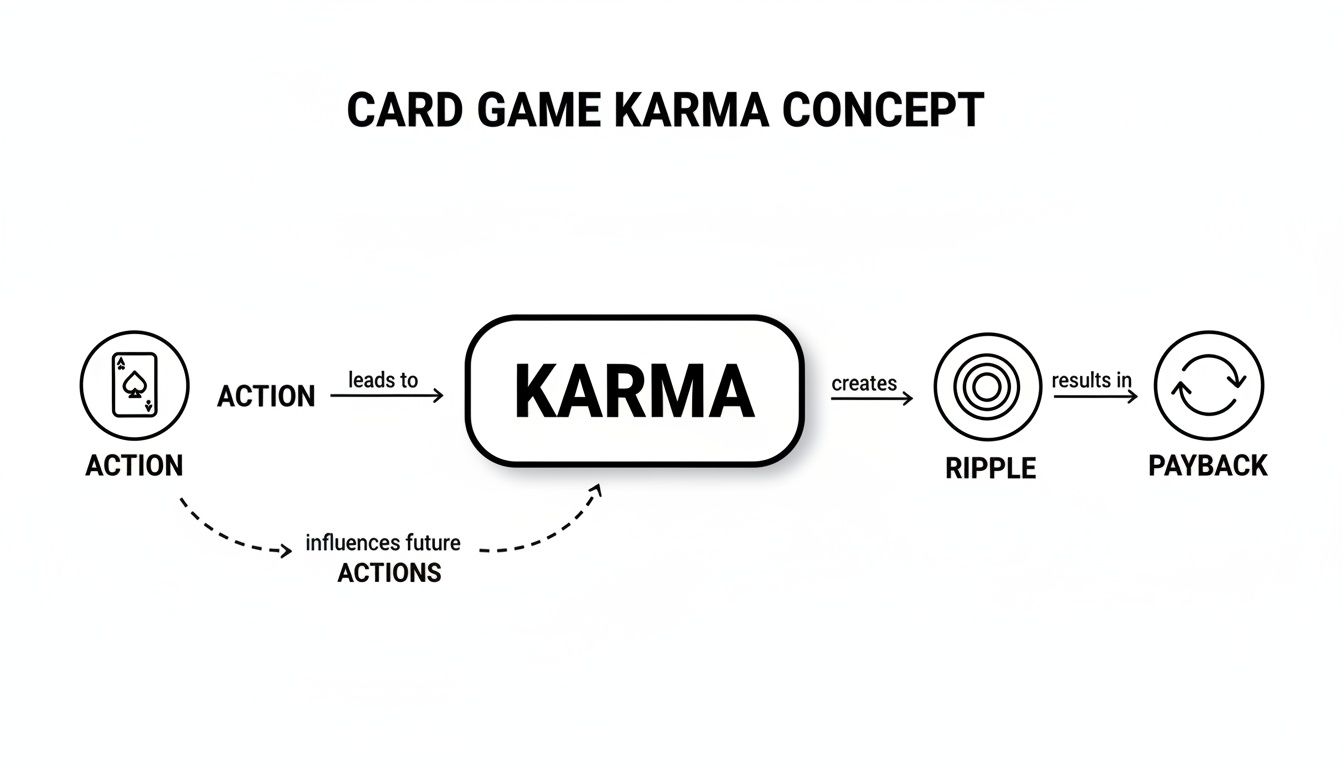
As you can see, every action kicks off a chain reaction. That initial move creates a ripple—a change in the game state and player attitudes—which inevitably leads to payback. This 'payback' then directly influences the next round of actions, and the cycle begins anew. It's what makes karma such a powerful and compelling force.
To truly get a handle on it, let's break down the core components that make up this fascinating mechanic.
| Component | Description | Example in Play |
|---|---|---|
| Action & Consequence | The fundamental principle: a player's move (the action) directly causes a future event (the consequence). | You destroy your opponent’s most powerful creature. On their next turn, they use a card to force you to discard your entire hand. |
| Social Contract | An unwritten agreement among players to maintain a certain level of peace, which can be broken by aggressive plays. | Playing a 'take that' card early on signals you as an antagonist, breaking the initial truce and inviting retaliation. |
| Player Memory | The human element. Players remember who helped them and, more importantly, who hindered them, influencing their future targets. | Sarah remembers you countered her game-winning spell three rounds ago, so she targets you over the current leader. |
| Threat Perception | How players evaluate who is the most dangerous opponent at any given moment, often influenced by recent 'karmic' actions. | Even though Mark has more points, you target Jane because she just wiped your board and feels like a more immediate, personal threat. |
These elements work together to create a rich, player-driven narrative in every match. Karma isn’t just about the cards; it's about the people playing them.
This whole dynamic is magnified in fast-paced games. The consequences aren't a distant threat looming on the horizon; they're immediate and personal.
Take a game like TerraClash™ Grimoire, where a complete match can be over in just 10-15 minutes. In that tight timeframe, the payback for an aggressive move isn't something you worry about later. It’s coming for you on the very next turn.
This rapid-fire karmic cycle makes every single decision feel incredibly weighty. You don't have time to let grudges simmer—retribution is swift. This quick feedback loop is a hallmark of many modern fantasy card games, forcing players to constantly manage their reputation at the table. It becomes a core skill, just as important as knowing your deck.
That feeling of card game karma isn't some brand-new idea cooked up for modern TCGs. It’s a core part of the fun, a feeling woven into the very fabric of the classic card games we've all played at kitchen tables across the UK for generations. This beautiful dance of action and consequence is what creates those truly unforgettable moments.
Think about the raw tension of a game of Uno. The second you slap down a Draw Four on your mate, you've done more than just make them draw cards. You've painted a massive target on your own back. You can almost taste the shift in the air; they're coming for you, and they will wait, ever so patiently, for the perfect moment to serve you a taste of your own medicine.
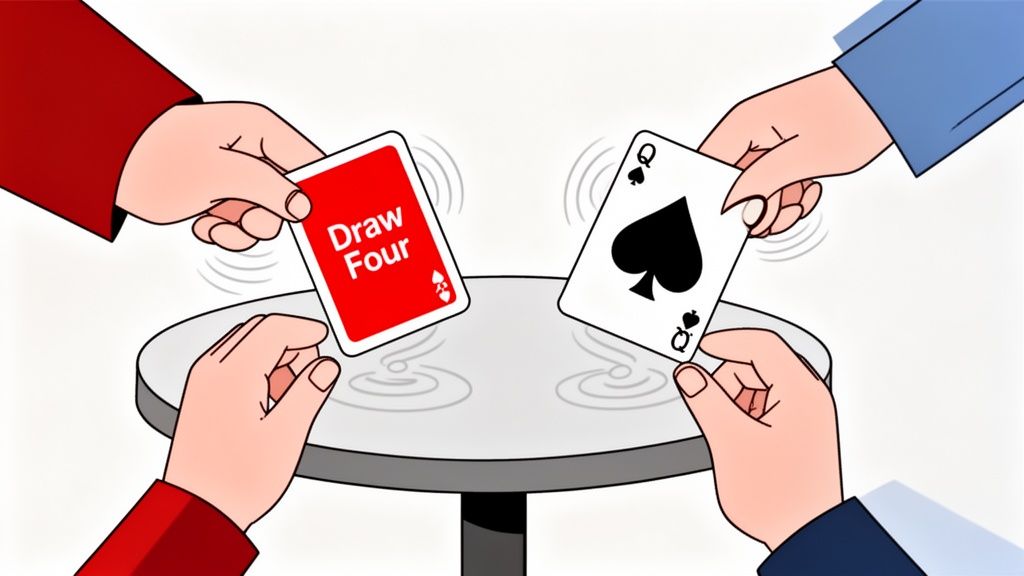
This same spirit is alive and well in trick-taking games like Hearts. Passing the dreaded Queen of Spades feels like you're setting a fiendishly clever trap. But if your opponent is savvy, they might just find a way to dodge the trick, leaving your grand plan to spectacularly backfire right into your own lap. It’s a classic case of “what goes around, comes around.”
These brilliant ‘take that’ moments are where the seeds of card game karma are sown. The real magic, though, is what happens next. It's in the shifting alliances, the targeted revenge plots, and the shared groans and cheers that erupt after a stunning reversal of fortune.
This dynamic is a huge part of the UK’s brilliant tabletop scene. And it’s no surprise, especially when you consider that 68% of UK gamers prefer games that wrap up in under 30 minutes. People want quick, punchy experiences, and that's where these swift, karmic twists really shine. You can dig deeper into how these market trends shape new games.
Modern games have taken these timeless ideas and sharpened them into faster, more focused experiences. They understand that the joy of karma is at its best when the consequence is immediate. Waiting an entire hour for payback just doesn't have the same bite; the excitement fizzles out.
For players who live for that rapid cycle of action and reaction, the quick-fire rounds of a game like TerraClash™ Grimoire will feel instantly familiar. It captures the spirit of those classics and distils it into a magical battle that’s all over in just 10-15 minutes.
In a game moving that fast, karmic payback isn’t some distant threat—it's right around the corner. This cranks up the tension, making every single move feel critical and keeping everyone on the edge of their seat. It's a feeling that fans of other top-tier collectible card games will know all too well. If you’re keen to see this high-speed magical combat for yourself, check out the Kickstarter campaign.
From a game designer’s seat, crafting a satisfying card game karma system is all about walking a tightrope. How do you bake in those epic, table-turning comebacks without making the whole experience feel like a lottery? The secret is to make every decision feel significant, to load each choice with the weight of future consequences.
You’ll often see designers use subtle mechanics to stop one player from ‘snowballing’ into an unstoppable lead. This isn’t about punishment; it’s about keeping everyone in the fight right up to the very end. Nobody wants to sit around for ten minutes knowing they’ve already lost.
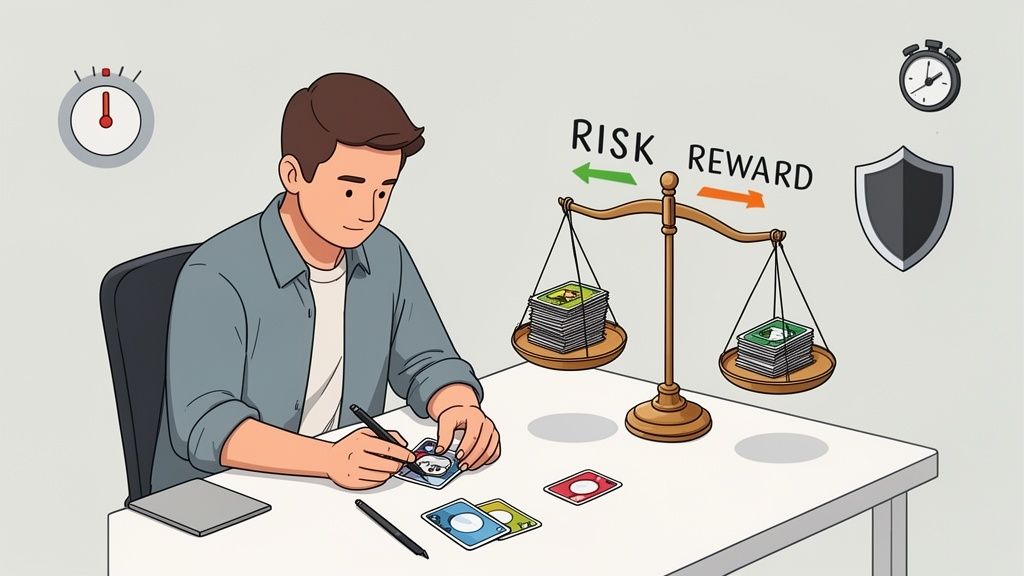
This balance is absolutely vital in a fast-and-furious game like TerraClash™ Grimoire, where games are designed to be snappy 10-15 minute rounds. In such a tight window, the karmic payback has to be just as swift. There’s no time for a slow burn.
At its heart, TerraClash™ Grimoire is built on a simple premise: even your most powerful moves have a potential cost. Maybe launching that ultimate spell empties your Grimoire, leaving you wide open for a retaliatory strike from a rival.
This creates a fantastic rhythm where bold, aggressive plays can feel amazing, but a well-timed defensive move can be just as game-winning. It’s a constant push-and-pull that makes every turn a nail-biter. Every single choice sends ripples across the table.
A well-designed karma system doesn't just punish the leader; it gives every player a reason to pay attention to everyone else. It transforms a simple multiplayer game into a web of temporary alliances, rivalries, and thrilling opportunities for payback.
This philosophy is what turns a good game into a truly memorable one. We’re essentially engineering those moments where a player, through clever observation and perfect timing, can flip the entire game on its head with a single, brilliant play. If you're interested in digging deeper into game design, their blog for design insights offers some great perspectives on this kind of creative development.
The beauty of a quick game is that these moments come thick and fast. If a risky gambit blows up in your face, who cares? You’re only a few minutes away from a fresh start and a new plan of attack. This rapid-fire loop is exactly what makes TerraClash™ Grimoire so addictive.
Some card games are built around a really tight, rewarding karmic loop, and TerraClash™ Grimoire is a fantastic example. Games are lightning-fast, wrapping up in just 10-15 minutes. This means the consequences of your every move feel immediate and intense, creating a rapid-fire cycle of action and reaction that lies at the very heart of its design.
Picture this: you’ve just unleashed a devastating elemental spell, wiping out an opponent's defences to snatch the lead. It feels incredible, a real game-changer. But it always comes at a price. Your own Grimoire is now dangerously low on power, leaving you wide open to a counter-spell from another player who was just waiting for their moment.
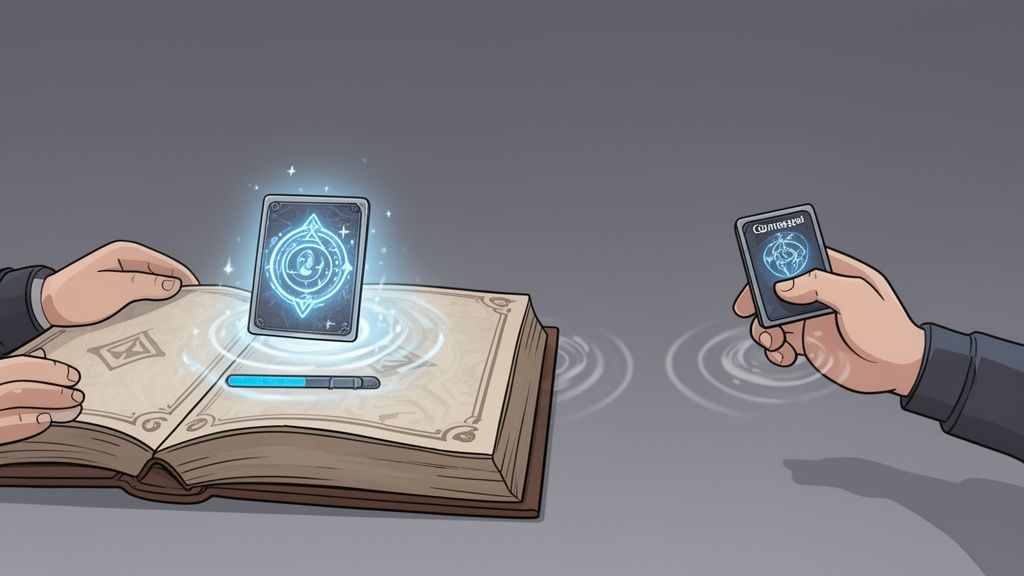
This constant weighing of risk versus reward is the engine that drives every single game. It’s what makes each match feel less like a rigid set of rules and more like a unique story unfolding right there on the table.
The karmic system in TerraClash™ Grimoire is about so much more than just attacking and defending. It fosters a wonderfully fluid social dynamic where temporary alliances can be just as powerful as your strongest cards.
Instead of going on an all-out attack, you could play a defensive card to shield a player who's falling behind. It might not win you the game on its own, but it could earn you a crucial ally for a turn or two. That simple act of kindness could be just what you need to divert attention, letting you quietly prepare your next big move while your rivals deal with a more obvious threat.
The game is absolutely packed with these moments, where your decisions create temporary truces and fresh rivalries with every hand. A player you help one moment could easily become your final opponent the next.
This kind of player-driven drama really resonates with the card gaming community. Here in the United Kingdom, the trading card game market was valued at an impressive USD 192.33 million in 2023 and is projected to nearly double to USD 400.1 million by 2033. This growth highlights a vibrant scene where strategic player interactions are everything, and it points to a strong appetite for quick, customisable fantasy games. You can find more data on the UK's thriving market in this detailed report on trading card games.
Ultimately, the fast-paced design of TerraClash™ Grimoire means the karmic slate is wiped clean with every new match. An enemy from your last game might be your most valued ally in the next, all depending on how the magical cards fall. It’s a design choice that guarantees no two games ever feel quite the same.
It encourages you to constantly read the table, anticipate what others will do, and decide when to be the aggressor versus when to play the diplomat. It’s this rich, player-driven narrative that gives the game its incredible depth and replayability, proving that even in a quick 10-minute battle, a complex story of betrayal and allegiance can unfold. For a closer look at the kinds of spells that create these moments, you might want to check out our deep dive on the world of goblin magic cards.
If you’re ready to experience this fast-paced magical combat for yourself, you can discover more about the game's mechanics on the TerraClash™ Grimoire page or see it in action by visiting the live Kickstarter campaign.
Succeeding in a game built around card game karma isn't just about playing the most powerful cards. It's about sharp social reads and flawless strategic timing. Mastering this unspoken layer of the game is what truly separates the good players from the great ones. The core skill here is what veterans call threat assessment—knowing exactly when to be the aggressor and when to let everyone else duke it out.
Sometimes, the best move you can make is no move at all. Flying under the radar and quietly stockpiling resources while another player paints a huge target on their back is a time-honoured tactic. Let someone else become the table's villain. While they're busy fending off attacks from all sides, you can be calmly putting the pieces together for a game-winning play, completely unnoticed. It’s all about managing perceptions.
In any karmic card game, forging a temporary truce is an essential skill. This is where your powers of persuasion really shine. Can you convince the table that that other player is the bigger, more immediate threat, just long enough to get your own plans in motion?
A successful truce isn't built on trust; it's built on a shared, short-term enemy. The moment that enemy is dealt with, all bets are off. Your job is to make sure you're in the strongest position when that happens.
In a blistering game like TerraClash™ Grimoire, a full match is over in 10-15 minutes. These social games are compressed into a few intense rounds. You don’t have an hour to build goodwill; you have maybe two or three turns. The stakes are high, and the payback is swift. If you enjoy that rapid cycle of action and reaction, the quick rounds will feel instantly familiar, as karmic payback gets delivered in a matter of minutes.
A small act of ‘kindness’—like choosing not to finish off a player who’s on the ropes—can be remembered for the precious two minutes you need to secure victory. That player might just return the favour, targeting the leader instead of you on their next turn and giving you the exact opening you were waiting for.
This is the essence of playing the table, not just the cards in your hand. It's about realising the other players aren't just obstacles; they're resources, potential allies, and temporary shields. To see how these fast-paced dynamics play out, you can get a closer look at the TerraClash™ Grimoire page.
If this high-speed magical combat sounds like your kind of thrilling chaos, you should also check out our Kickstarter campaign to see how you can become part of the action.
So, what does all this talk of 'karma' in card games really boil down to?
Ultimately, it’s the secret sauce that takes a game from a simple set of rules to an unforgettable, shared experience. It’s what fuels the laughter, the groans of mock betrayal, and the wild comeback stories you’ll be telling each other long after the table’s been cleared. This beautiful chaos is what breathes life into paper and ink, turning a game into a real human connection.
Plenty of games nail this feeling, but it’s often in a fast-paced game that you get the most concentrated dose. The rapid swings of fortune, the delicate dance of shifting alliances—it’s the very heart of what makes tabletop gaming so compelling. And that thrill is dialled all the way up when payback isn’t some far-off possibility, but could be coming your way on the very next turn.
We’ve poured that exact dynamic into TerraClash™ Grimoire, where a whole game unfolds in just 10–15 minutes. It captures the spirit of karmic justice found in classic card games but packs it into a quick, punchy magical duel where every single choice has immediate consequences.
If you love that thrilling cycle of action and reaction, there’s nothing better than finding a game that truly lives and breathes it. Experiencing that fast-paced karmic excitement firsthand is what makes every single match feel completely unique.
For anyone who feels that pull towards this kind of beautiful chaos, you can dive deeper into how we've built our game on the TerraClash™ Grimoire page. You can also see the whole vision brought to life by checking out our live Kickstarter campaign.
Got a few lingering questions about karma in card games? Let’s clear things up. Here are some quick answers to the most common queries we get, helping you get a handle on the strategic and social side of things before your next game night.
Think of it like cause and effect. A ‘take that’ mechanic is the initial punch—that one direct, aggressive action you take, like forcing someone to discard their entire hand or making them draw a bunch of unwanted cards. It's a single moment.
Card game karma, on the other hand, is the ripple effect that follows. It's the unwritten rule, the social memory of the table. You hit Bob, and now Bob has every reason to come after you. Good games don't just use ‘take that’ moments for a cheap shot; they use them as fuel for the bigger karmic engine that drives rivalries and shifting alliances.
They can be brilliant for beginners, actually. The clear cause-and-effect loop in a karmic system is incredibly intuitive. When a new player sees their actions have immediate and obvious consequences, they learn the social side of the game much faster.
This is especially true for snappy games like TerraClash™ Grimoire. With rounds lasting just 10-15 minutes, a new player can try a strategy, see the karmic payback unfold, and then immediately apply that lesson to the next game. It’s a fun, quick learning cycle, which is far more engaging than being punished for a mistake you made an hour ago in a marathon game.
It all comes down to balance. In TerraClash™ Grimoire, we’ve made sure that no single bad move or karmic hit can knock you out of the running completely. The pace is so quick that fortunes can turn on a dime, which stops any one player from getting an unbeatable lead or being left hopelessly behind.
Landing a massive attack might feel great, but it could also paint a target on your back. The crucial part is that the game always gives you multiple paths to recover, stage a comeback, and turn the tables. This design creates a constant, thrilling tension where everyone feels in with a chance right up until the very end.
Here at TerraClash, we truly believe that the best games are the ones that create unforgettable stories. The beautiful, karmic chaos that comes from fast and strategic card play is right at the heart of that philosophy. To see this magical combat for yourself, you can discover more on the TerraClash™ Grimoire page.
Even better, why not join our amazing community and help us bring this game to the world? Head over to our Kickstarter campaign to get involved.

