Finding the right card game for three people can feel like a bit of a puzzle. So many classics are built for pairs or big groups, leaving the trio in a weird limbo. But the truth is, the best three-player games don’t just accommodate the odd number—they turn it into their greatest strength, creating a brilliant dynamic of shifting alliances and high-stakes gambles you just don't get anywhere else.
It's this unique social tension that keeps everyone on the edge of their seat right until the very last card is played.
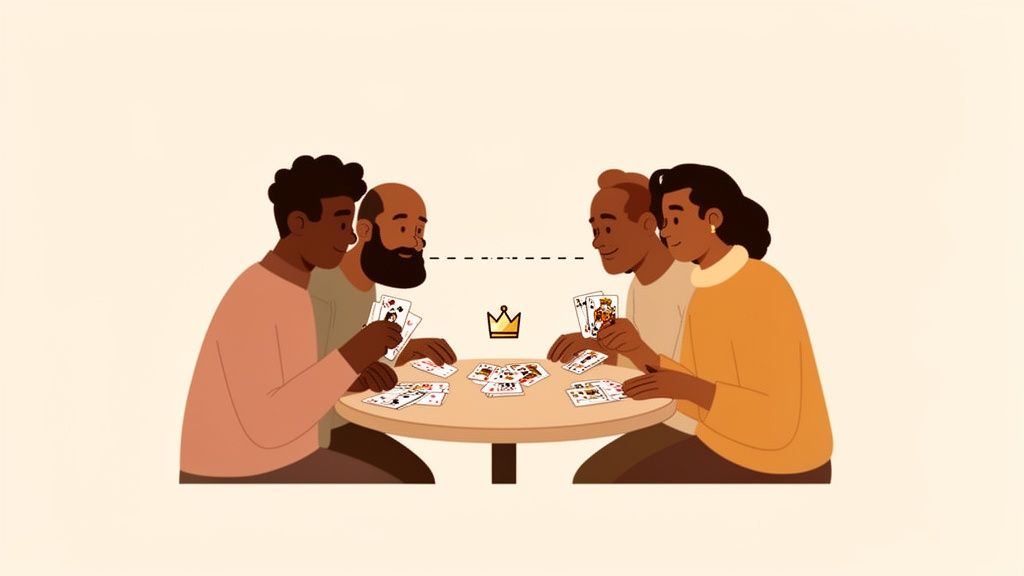
Ever been the third wheel in a conversation? A three-player card game basically takes that energy and makes it strategic fun. Instead of a straightforward duel, the game becomes a fascinating triangle of diplomacy, betrayal, and unexpected opportunities. It’s a completely different kind of mental workout, forcing you to think not just about your hand, but about what the other two are plotting.
This setup does bring a classic dilemma to the table: the 'kingmaker problem'. This is that awkward moment when one player realises they can't win, but their next move will single-handedly decide which of their opponents gets the crown. It can leave a bitter taste, making the winner feel like their victory was handed to them rather than earned.
Thankfully, the most cleverly designed card games for 3 people manage to dodge this pitfall. They have built-in mechanics that keep every player in the running until the very end. The constant threat of two players ganging up on the leader forces everyone to tread carefully, forge temporary truces, and know the perfect moment to stab their 'ally' in the back.
This delicate balance is precisely what makes three-player games so electric. Your opponents aren't just obstacles; they're potential partners one moment and your biggest threat the next. Winning comes down to reading the room just as much as playing the cards in your hand.
Many modern games are now built with this flexibility from the ground up. Take a fast-paced game like TerraClash™ Grimoire, for instance. It absolutely shines with three players. Its smart blend of cooperating to defeat monsters while competing for the rewards creates that same 'political' vibe where alliances are made and broken in a single turn.
Best of all, a full game wraps up in just 10-15 minutes, making it ideal for a few quick, intense rounds. You can see how the game nurtures this dynamic over on the official TerraClash™ Grimoire page.
Ultimately, a truly great three-player experience isn’t about trying to make a two-player game work. It’s about embracing a format that offers a richer, more complex strategic puzzle. It’s a chance to indulge in some friendly backstabbing and clever deal-making, which always makes for an unforgettable game night.
If you fancy being part of a new game designed for this kind of action, check out the Kickstarter campaign and help bring it to the table.
We’ve all been there. You’ve got a standard 52-card deck, a couple of friends, but many of the classics just don’t quite work. Games like Bridge or traditional Whist are built around the elegant symmetry of two-on-two partnerships, a structure that completely unravels when you’re a trio. But don't give up and pack the cards away just yet. With a few smart tweaks, you can breathe new life into these old favourites.
Think of it as stepping into the role of a game designer for the night. You're not trying to reinvent the wheel, just make a few clever adjustments to keep the original spirit of the game alive while making sure everyone has a fair crack at winning. It’s all about turning a potentially awkward game night into a properly strategic and memorable battle.
One of the neatest tricks for adapting partnership games is to bring in a 'dummy' or 'ghost' hand. It's a technique borrowed straight from the playbook of games like Bridge, and it works a treat for three players.
It's simpler than it sounds:
This one simple change brilliantly restores the four-player feel. It forces one person to juggle the strategy of two hands at once, while the other two players naturally team up against them. The result is a tense 2-vs-1 dynamic that keeps everyone on their toes. If you're looking for games with straightforward rules, we've got plenty of ideas in our guide to easy-to-learn card games.
Of course, not every game needs a phantom fourth player. When it comes to trick-takers like Hearts or competitive meld-builders like Rummy, the best approach is often to tweak the deck and the scoring system instead.
An easy fix for many games is to simply remove one card—the Two of Clubs is a common choice—to make the deck divisible by three. This tiny adjustment stops one player from getting an extra card, levelling the playing field from the very first deal.
For a game like Rummy, you can just lean into the chaos and play a 'cut-throat' variant where it's every person for themselves. The whole social feel shifts from cooperative to fiercely competitive, which is a fantastic dynamic in its own right. The trick is to keep the pace brisk and the scoring tight, preventing any one person from sprinting ahead with an untouchable lead.
This kind of free-for-all action is exactly what makes modern games like TerraClash™ Grimoire so thrilling; the constantly shifting balance of power is woven right into its DNA. You can find out more about its unique approach to player dynamics over on the TerraClash™ Grimoire page. It’s a fast-paced card game that’s perfect for three, with a whole match wrapping up in just 10-15 minutes.
In the end, making classic card games work for three is all about being a bit flexible and creative. The main goal is to create a fun, competitive atmosphere where every single player feels they have a genuine shot at victory, right down to the last card played. If you’re hungry for a new challenge, why not check out the Kickstarter campaign and help bring a fresh adventure to game nights everywhere?
Playing a card game with three people isn't a simple duel; it’s more like a tense political thriller. The whole dynamic shifts away from pure mechanical skill and becomes a delicate dance of psychology, negotiation, and perfect timing. To come out on top, you have to learn to read the room, not just the cards in your hand.
Your strategy has to be fluid and reactive. At any given moment, you need to ask yourself: who is the biggest threat right now? Is someone hoarding resources, or are they one move away from winning? This constant threat assessment is the absolute core of mastering the three-player game.
The most powerful weapon you have is the temporary alliance. Ganging up with one opponent to slow down the leader is often the only way to keep yourself in the running. But be warned, these truces are fragile things, built on mutual self-interest and absolutely designed to be broken.
Knowing exactly when to turn on your ally is what separates the good players from the great ones. Jump ship too early, and you might accidentally hand the victory to the very person you were trying to stop. Wait too long, and your "partner" could use the chaos to pull ahead of you both. It's a real high-stakes balancing act.
The ultimate goal is to avoid the dreaded 'kingmaker' trap, where your final move ends up deciding the winner between the other two. True strategy lies in making sure every decision—even one that helps an opponent for a moment—ultimately serves your own path to victory.
This decision tree gives you a framework for thinking through rule adaptations, which is the first step towards creating that strategic balance in any game.

As the flowchart shows, achieving a fair starting point through things like dummy players or tweaked scoring systems is foundational to any good strategic play.
This psychological layer is precisely what makes three-player games so endlessly fascinating and replayable. The same principles of engagement and motivation are used everywhere, not just in games. For example, you can see similar ideas in discussions around gamification in e-learning, where game mechanics are used to boost motivation and strategic thinking.
It's this kind of depth we've built right into TerraClash™ Grimoire. The gameplay naturally encourages negotiation and brief team-ups, as you might need a hand to defeat a particularly nasty creature. But since there can only be one winner, every alliance has an expiration date. Its fast-paced nature, with games wrapping up in just 10-15 minutes, forces you to make these crucial strategic calls on the fly.
If this kind of dynamic gameplay sounds like your cup of tea, you can dive into the game’s world on the official TerraClash™ Grimoire page. And for those keen to sharpen their skills, you might find our guide on how to improve strategic thinking really helpful.
Ready for a new challenge? Consider supporting the Kickstarter campaign and be one of the first to master this exciting game.
While it’s always fun to adapt the classics, the world of tabletop gaming has exploded with incredible new games designed from the ground up to handle odd player counts. Today's designers get it; they understand the unique dynamics a trio brings to the table. The result? Card games that don't just work for three people—they sing.
These games are smart. They weave clever mechanics right into their DNA to keep things balanced and exciting from the first card drawn to the final play. They move beyond a simple free-for-all, often introducing shared goals or rules that encourage shifting alliances. This kind of design thinking neatly dodges the old 'kingmaker problem', making sure every player is invested right up to the very end.
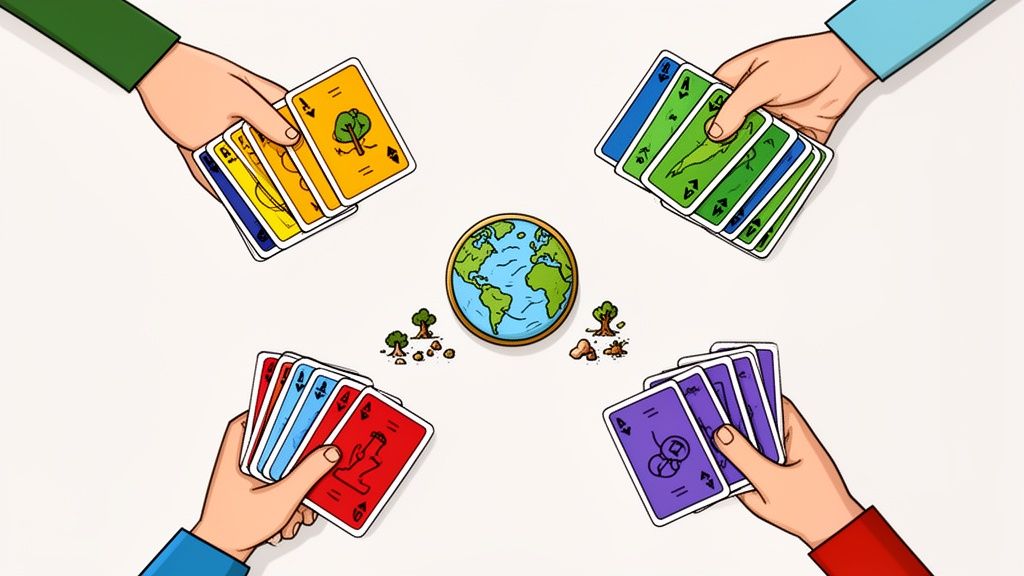
A perfect example of this modern approach is TerraClash™ Grimoire. It’s a game that really comes alive with the chaotic energy of three players. At its heart, you're all working together to take down powerful monsters from a randomised world deck, which creates an instant feeling of camaraderie. But here's the twist: there's not enough loot to go around.
This beautiful tension between cooperation and competition is what makes it so brilliant for a trio. One minute, you're helping a friend take down a nasty goblin; the next, you're swooping in to snatch a powerful spell they had their eye on. It’s this constant push and pull that keeps everyone on their toes.
Modern games are less about enforcing rigid rules and more about creating a sandbox for memorable social moments. They recognise that with a trio, the real game isn't just on the table—it's in the deals, the banter, and the temporary rivalries between players.
Let's be honest, we don't always have a whole evening to dedicate to one game. Another massive win for contemporary card games is their focus on speed. Quick, action-packed rounds are perfect for a weeknight get-together or a lunchtime session. This is another area where TerraClash™ Grimoire nails it. A full game is a whirlwind of strategy that’s all over in just 10-15 minutes.
This snappy pace means you can easily play several rounds in one sitting. Strategies can evolve, and friendly grudges can spill over from one game to the next. The quick playtime keeps the energy high and means a crushing defeat is quickly forgotten when a fresh chance at glory is just moments away.
If you’re hunting for a game that captures the strategic depth and political manoeuvring that makes three-player gaming so special, you can dive into the lore on the official TerraClash™ Grimoire page. For those ready to jump in, you can help bring this experience to more tables by supporting the Kickstarter campaign.
Something special is happening across the UK. In pubs, living rooms, and community halls, people are setting aside their phones and shuffling decks of cards. It’s a quiet but powerful return to the simple joy of a shared tabletop adventure. This isn’t just a passing fad; it’s a real cultural shift, and if you’re searching for great card games 3 people can play, you’re part of a massive, enthusiastic movement.
You can see this growing hunger for strategic, social entertainment in some incredible numbers. The UK's trading card game market was valued at a whopping USD 192.33 million in 2024. But it's not stopping there. Projections show it’s set to more than double, hitting an estimated USD 400.1 million by 2033. This explosion points to a clear, sustained demand for engaging, collectible card games that offer real strategic depth.
This boom has thrown the doors wide open for a new generation of indie game designers. Players are actively hunting for fresh experiences—games with unique mechanics and fascinating themes that break away from the old classics. They're looking for games that tell a story, test their minds, and forge memorable moments with friends.
It’s in this exciting new landscape that games like TerraClash™ Grimoire have really found their footing. It taps directly into that desire for something different, mixing familiar deck-building ideas with a new, randomised world that guarantees no two games ever play out the same. Plus, its fast-paced design, with matches wrapping up in just 10 to 15 minutes, is a perfect fit for modern life.
This new wave isn't just about buying more games; it's about investing in shared experiences. Players are building communities around these new titles, proving that tabletop gaming is one of the most powerful ways to connect.
This movement shows that games like TerraClash™ Grimoire are more than just products; they represent a new era in social fun—one that is strategic, quick, and capturing the nation’s imagination. To see how it fits into this new wave, you can explore its unique world on the official TerraClash™ Grimoire page.
If you’re excited to be part of this growing community right from the start, why not check out the Kickstarter campaign? It's a great way to help bring a fresh adventure to life.
We’ve spent a good deal of time talking about what makes the best card games for 3 people really tick. Now, I want to show you something that was built from the very start to capture that exact magic. Let me introduce you to the world of TerraClash™ Grimoire.
Picture this: you and two mates are huddled around the table, working together to defeat some truly fearsome monsters pulled from a randomised deck. One moment, you're forging a fragile alliance to take down a massive beast. The next, the real fight begins.
There's not enough loot for everyone, and this is where things get interesting. Suddenly, it’s all about tense negotiations, back-of-the-hand deals, and maybe even a cheeky betrayal to make sure you walk away with the best spoils.
TerraClash™ Grimoire is more than just a game; it's a social puzzle. Its core loop of shared risk followed by competitive reward is the perfect recipe for a trio. The pace is frantic, keeping everyone on their toes, and a full match is over in a blistering 10 to 15 minutes.
That speed means you can get a whole evening's worth of adventure packed into several short, sharp sessions, with each game telling its own unique tale.
The game is loaded with strategic depth and endless replayability. You might find yourself arguing over who gets a powerful spell one minute, only to be pleading for their help against the next monster. If you fancy a deeper look at some of the game's more whimsical elements, check out our article on Goblin Magic Cards.
This isn't just about playing cards; it's about crafting a story together, one quick and exciting round at a time. It delivers that epic adventure feeling without needing to clear your entire schedule.
This is your chance to jump into something special right at the beginning. You can explore the game's unique universe over on the official TerraClash™ Grimoire page.
Better yet, you can help bring this world to life by backing the project over on our Kickstarter campaign. Come and join the adventure.
Got a few nagging questions about playing card games with three people? You're not alone. Let's tackle some of the most common queries so you can head into your next game night feeling prepared.
You've probably felt this one, even if you didn't know its name. The 'kingmaker problem' is that frustrating moment in a three-player game when one person, who clearly can't win, has to make a move that hands the victory to one of the other two.
It can leave a sour taste, making the win feel a bit hollow or unearned. The best-designed three-player games have clever mechanics that sidestep this entirely, keeping everyone invested and competitive right up to the final move.
Absolutely! Cooperative games are a brilliant choice for a trio. They completely remove the head-to-head competition and instead, pit all three of you against the game itself.
This setup is perfect for groups that would rather work together, strategise as a team, and celebrate a shared victory. It's all about communication and collaboration, not confrontation.
Getting a traditional game to work for three often just needs a few creative tweaks. If you're playing a four-player partnership game, you could introduce a 'dummy hand' that one of the players also controls. For games built for two, you can try a 'free-for-all' format where the first player to hit a certain score wins.
The main thing is to adjust the rules just enough to keep the game balanced and fun for everyone.
The best modern games are designed from the ground up to be dynamic and fair whether you have two, three, or more players. Look for features like open negotiation or rotating objectives.
Games like TerraClash™ Grimoire are a perfect example. Its gameplay scales beautifully, so the tension stays high no matter how many people are at the table. Better yet, each match is a quick, punchy affair, over in just 10-15 minutes.
Ready for a new adventure built for your game night? Find out more about TerraClash at the official TerraClash™ Grimoire page and join the community by backing the Kickstarter campaign.

