You know that feeling? The one where your heart thumps in your chest just before a card is flipped over. Will it be higher, or will it be lower? That simple question is the engine behind one of the most enduring and beloved mechanics in the world of card games. It’s a feeling we all get, a shot of pure tension that works just as well in a casual pub game as it does in a high-stakes strategic battle.
The real magic of Higher or Lower is just how brilliantly simple it is. At its heart, the game is a raw test of luck and gut instinct—a 50/50 punt that anyone can pick up and play instantly. There are no complicated rules to get your head around or fiddly setups to worry about, which is a big reason so many people gravitate towards easy-to-learn card games that deliver immediate fun.
This incredible accessibility has made it a cornerstone of social gaming for generations. Think of all the family get-togethers and friendly wagers with mates built around it. The game's quick-fire rounds create these fantastic, shared moments of suspense and explosive celebration (or commiseration!). The booming tabletop scene shows just how much we still love these simple, engaging mechanics. In fact, the UK card game market is projected to reach an incredible US$129.82 million in revenue by 2026, which proves its staying power.
But don't let its simplicity fool you. Underneath that straightforward exterior, there's a surprising amount of room for strategy. As we’ll get into later, seasoned players don't just guess; they start tracking which cards have been played and calculating the shifting odds. This clever mix of raw luck and light strategy transforms a game of pure chance into one of calculated risk, and it’s what keeps you coming back for just one more round.
It's this very spirit of making quick, high-stakes decisions that modern games have embraced and refined. A game like TerraClash™ Grimoire, for instance, bottles that same feeling of tension and rapid-fire judgement. It takes the thrill of a grand strategic showdown and boils it down into a fast-pace 10-15 minute duel. You're constantly forced to make tactical calls with limited information, echoing that core 'higher or lower' dilemma.
If you thrive on making fast, impactful choices under pressure, you’ll feel right at home with the gameplay of today’s modern card games. You can learn more about TerraClash™ Grimoire and see for yourself how it evolves this exciting dynamic.
In this guide, we'll take a journey from the classic, no-frills rules of Higher or Lower to its clever applications in modern tabletop games. We'll explore how this fundamental concept of risk versus reward continues to influence the way we play and invite you to join the adventure.
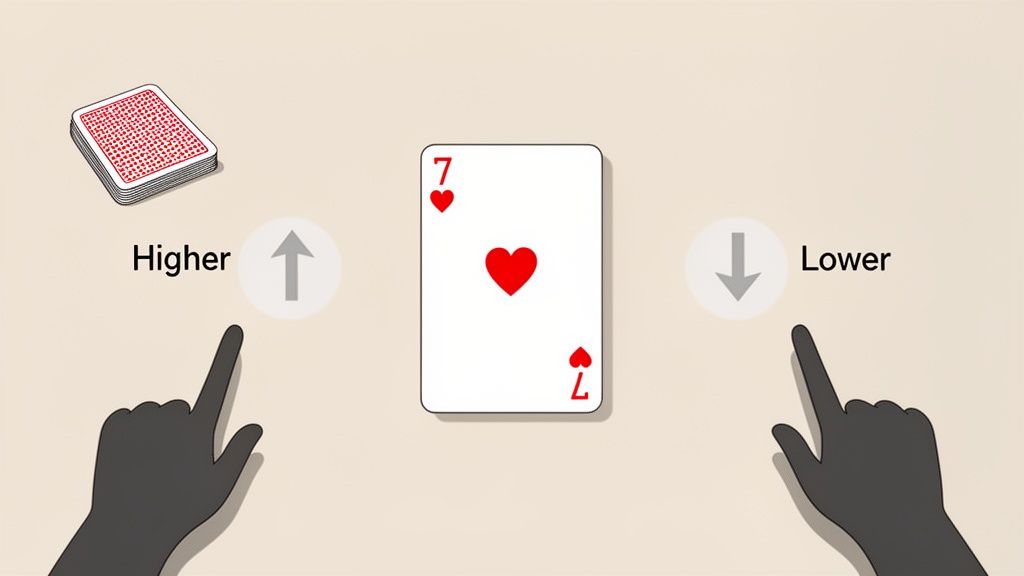
Forget thick rulebooks and complex setups. The best way to understand Higher or Lower is to picture yourself at the table. The dealer has just shuffled a fresh deck and flips over the first card. It’s a 7 of Hearts. Now, it’s all on you: is the next card going to be higher or lower?
That single, simple question is the heart and soul of the game. Its beauty lies in that pure simplicity. You can set up a game in seconds and teach the rules in a breath, which is why it’s been a go-to icebreaker and a bit of quick-fire fun for generations.
While the game is incredibly simple, each turn is packed with a surprising amount of suspense. Every round follows the same basic steps, building the tension with each card flip.
The core mechanic is so intuitive that it serves as a fantastic foundation for more complex games. For another example of mastering a card game's rules quickly, you might be interested in this comprehensive guide to Exploding Kittens instructions.
The game’s appeal is so broad because it feels like a pure test of luck, but there’s a subtle layer of probability that experienced players lean on. If the base card is a 7, you’re looking at a genuine 50/50 shot. But if it’s a 3, betting on ‘higher’ just makes sense.
This mix of chance and light strategy is something we see in modern games, too. Take TerraClash™ Grimoire, where you’re constantly making gut decisions based on the odds. In its fast-pace 10-15 minute matches, you’re always weighing your hand against what your opponent might play next.
If you enjoy that feeling of making quick, decisive calls, you can learn more on the TerraClash™ Grimoire page or even check out the game on its Kickstarter campaign. We also cover more basics in our other articles on how to play card games.
While the classic game is a ton of fun on its own, the real magic of Higher or Lower is how beautifully simple it is to adapt. A few small tweaks can completely change the feel of the game, adding new layers of strategy and keeping your game nights fresh. These variants are perfect for when you want to mix things up without having to learn a brand-new set of rules from scratch.
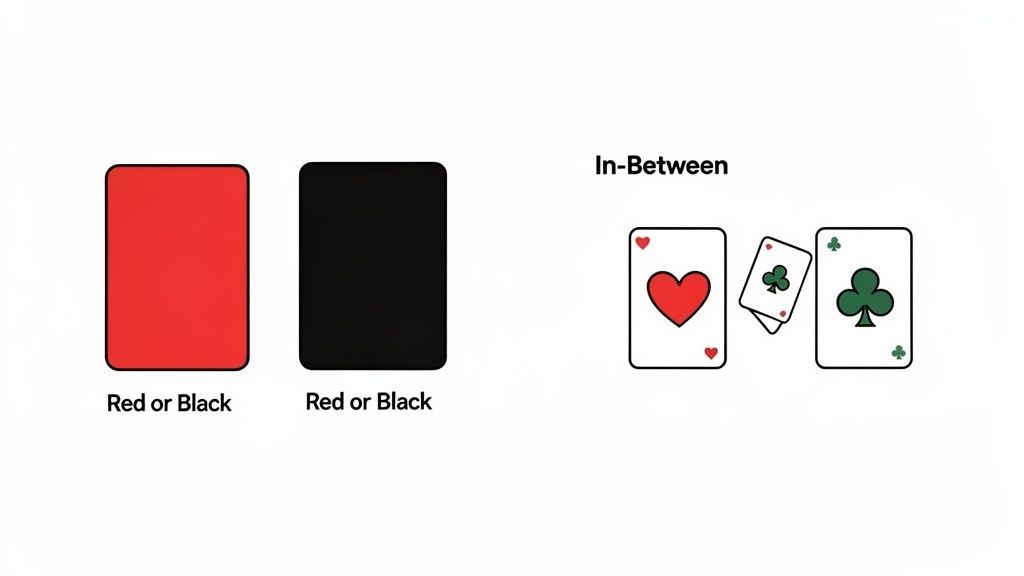
One of the most common and easiest variants is Red or Black. It’s exactly what it sounds like: instead of guessing the card’s value, you just bet on its colour. This strips away a lot of the strategy and turns the game into a pure 50/50 coin flip. It’s a game of pure luck and gut instinct, which can be a real rollercoaster.
Another fantastic alternative that brings back a bit more thought is In-Between. Here, the dealer lays out two cards face-up. Your job is to bet whether the next card drawn will fall somewhere between their values. The real tension comes from the gap between the two cards. A bet on a card landing between a 3 and a Jack feels pretty safe, right? But what about between a 6 and an 8? Suddenly, the odds feel a lot slimmer, and the game becomes all about probability.
To help you decide which twist to try next, here’s a quick look at how these popular variants stack up against each other.
| Variant Name | Core Mechanic | Primary Objective | Best For |
|---|---|---|---|
| Classic Higher or Lower | Guess if the next card is higher or lower than the previous one. | Achieve the longest streak of correct guesses. | Quick, simple fun that balances luck and basic probability. |
| Red or Black | Guess if the next card will be red or black. | Correctly guess the colour as many times as possible. | A pure game of chance; great for fast-paced betting or drinking games. |
| In-Between | Guess if the next card's value is between two face-up cards. | Win bets by correctly predicting if a card falls within a specific range. | Players who enjoy thinking about odds and probability. |
Each version offers a slightly different flavour, but they all hinge on that same satisfying moment of truth when the card is finally flipped.
To really turn up the heat, many groups add penalty systems or rewards for winning streaks. A popular house rule is the 'three strikes' system. Get three guesses wrong, and you're out! This turns the game into a tense, last-person-standing battle. On the other hand, you could reward a player for a long streak of correct guesses, encouraging them to push their luck for those high-risk, high-reward moments everyone remembers.
These simple but effective changes really show how flexible card games can be. They prove that a simple core idea can be a fantastic springboard for creativity—a principle that continues to inspire modern game design.
The thrill of weighing your odds and making a quick, decisive call is a feeling captured perfectly in TerraClash™ Grimoire. Although it involves deep strategy with spells and creatures, the fast-pace nature of its 10-15 minute matches often boils down to similar moments of calculated risk.
That heart-pounding pace and the constant need to adapt are what make these games so captivating. The core tension is remarkably similar, whether you're guessing if a card is higher or deciding if your hand has what it takes to overcome an unknown threat on the board.
If that kind of rapid-fire strategic thinking gets your pulse racing, you should explore the world of TerraClash™ Grimoire on our website. You can also support its development and be one of the first to play by visiting the Kickstarter campaign.
It’s a fascinating story, how a simple pub game managed to take over the digital world.
The Higher or Lower mechanic, born from a sticky-fingered deck of cards on a pub table, found a natural home on our screens. Its formula is just perfect for the kind of quick-fire entertainment we all crave on our phones and computers: it's simple, it's fast, and you know instantly if you've won or lost.
But while this digital success was happening, something else was brewing in the UK's tabletop scene. Despite all the apps and video games vying for our attention, the feel of shuffling a real deck and the satisfying snap of a physical card still has a magic all its own. That physical connection is what turns a solitary game into a real, shared experience, especially with modern card games where every single play counts.
What's really interesting is that the digital boom didn't kill off tabletop games. If anything, it seems to have made us appreciate them even more. You only have to look at the numbers for the UK Playing Cards and Board Games market to see it. In 2025, it's set to generate a whopping USD 1,049.0 million. And while board games have the biggest slice of the pie right now, it's the simple playing card segment that's growing the fastest. It’s expected to push the whole market to USD 1,499.5 million by 2031, a trend you can explore in the latest market research. That’s a clear signal that we’re seeing a real comeback for addictive, easy-to-learn games based on wagering on a card’s value.
This tells us that as much as we love the convenience of a quick game on our phone, we still crave that genuine social spark you only get from a physical game. We want to see our opponent's face fall when we draw the perfect card, share a laugh over a terrible guess, and feel the actual weight of the deck in our hands. A screen just can't give you that.
Modern games are nailing this balance, blending deep strategy with the quick pace we’ve come to expect from digital entertainment. The design of TerraClash™ Grimoire, for example, is built entirely around this idea, packing its intense fantasy duels into just 10-15 minutes.
This lightning-fast gameplay means you get all the satisfaction of a bigger, more strategic game without needing to clear your entire evening for it. Every move you make is a quick, calculated risk, just like guessing higher or lower. You're constantly weighing up the cards in your hand against what your opponent might have, deciding whether to go all-in or play it safe. It’s that same classic feeling of suspense and reward.
The journey from a humble pub game to a major influence on modern tabletop design really shows how powerful a great game mechanic can be. It’s a thrill that works no matter where you play it, proving that a brilliant idea never gets old.
If that blend of quick-thinking strategy and heart-pounding moments sounds like your kind of thing, we'd love for you to see the full experience over on the TerraClash™ Grimoire page. You could also be one of the first to get it to your own table by backing the Kickstarter campaign.
Right, so you're ready to stop just guessing and start winning? While a big part of Higher or Lower is the thrill of the unknown, a few simple tricks can really sharpen your instincts. It's not about becoming a Vegas card sharp; it's about paying a bit more attention to the flow of the game to tilt the odds in your favour.
The most powerful tool in your arsenal is a simplified form of card counting. Don't let the name intimidate you. It’s really just about keeping a rough mental note of which cards have already been played. For instance, if you've seen a flurry of high cards like Kings and Queens come and go, what does that tell you? It means the deck is now richer in low cards, and that's a massive clue for your next guess.
Think about it. When you start with a fresh deck, a card like a 7 is a genuine coin toss. But if you've already seen three Kings and a couple of Queens dealt, betting 'lower' on that same 7 suddenly feels like a much smarter move. You're no longer just hoping; you're making an informed decision based on the game's history. This is where you start playing the odds, not just the cards.
So, when should you go for it?
This kind of strategic thinking – weighing what you know against what you don't – is the same pulse-pounding core you'll find in the duels of TerraClash™ Grimoire. While it's a game of wizards and monsters, at its heart, you're constantly evaluating your hand and the battlefield, trying to get one step ahead of your opponent.
That tension is exactly what makes Higher or Lower so compelling. You're making quick-fire choices with limited information, turning a game of chance into one of skill. The rapid pace of TerraClash™ Grimoire, where matches are over in just 10-15 minutes, delivers that same exhilarating feeling of calculated risk, moment after moment. If that sounds like your kind of game, have a look at the TerraClash™ Grimoire page.
Ultimately, it all comes down to developing a better feel for the game. Once you start paying closer attention, you'll find your gut feelings are suddenly backed by a bit of logic. It transforms every flip of the card into a much more satisfying challenge. Fancy being part of the journey? You can help bring the game to life by backing the Kickstarter campaign.
The simple, heart-pounding thrill of ‘Higher or Lower’—that brilliant mix of guesswork, gut feeling, and instant reward—hasn't gone anywhere. You can find its DNA woven into many of today's best tabletop games and interactive games that are built to get everyone involved.
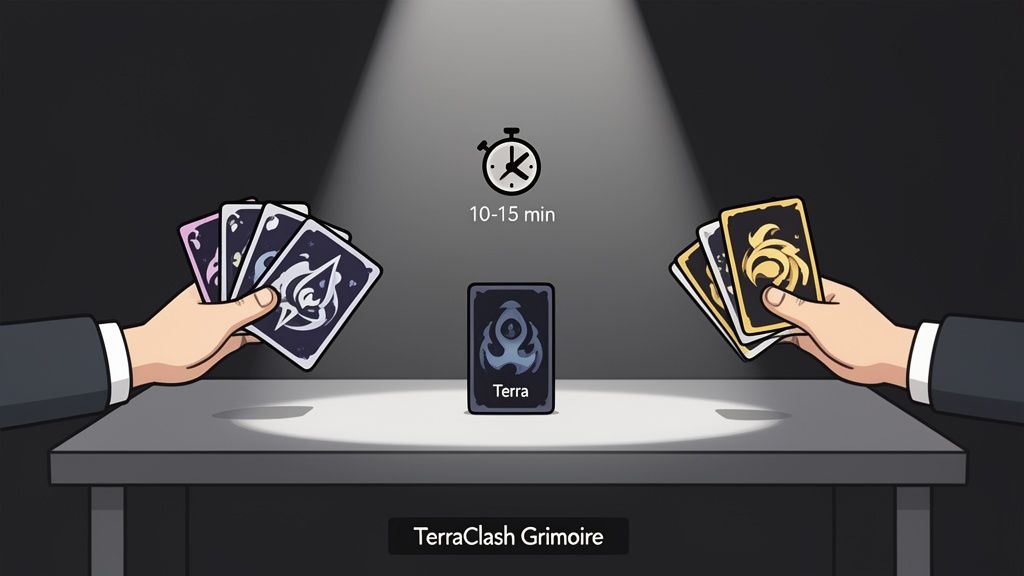
You can really feel this spirit in the fast and furious duels of TerraClash™ Grimoire. When you're playing, you're constantly making those same kinds of split-second calls that feel so familiar. Is your hand of spells strong enough to beat the mystery Terra Card you just flipped? It's all about calculated risks and strategic gambles, using what you know to predict what you don't.
This connection between old-school card-flipping fun and modern strategy is a big part of what’s driving the UK's tabletop scene right now. In the United Kingdom, the Trading Card Game (TCG) market, which is full of games with these sorts of predictive mechanics, was worth a hefty USD 192.33 million in 2025. It's expected to rocket to USD 400.1 million by 2034.
Physical cards are still king, making up most of that revenue thanks to their collectable nature and the simple joy of holding them. It's an appeal that speaks directly to anyone who loves building a deck and venturing into fantasy worlds, which you can read more about in these insights on the UK trading card market.
TerraClash™ Grimoire packs all that tense excitement into snappy 10-15 minute matches. It’s the perfect game for people who crave deep strategy but don’t have hours to spare. The brisk pace means every single decision matters, capturing that high-stakes feeling of a classic ‘Higher or Lower’ bet. To see how this idea has evolved, why not check out our other posts on fantasy card games.
If you love that rush of making quick, game-changing decisions, find out more about TerraClash™ Grimoire, or jump right in and support its journey on the Kickstarter campaign. It’s a brilliant way to get that classic adrenaline fix in an exciting new fantasy setting.
Got questions about 'Higher or Lower'? You're not alone. Let's dive into some of the most common queries about this classic card game and explore how its nail-biting suspense has found a new home in modern tabletop games.
While a bit of luck never hurts, the smartest way to play is to simply work the odds. Think about it: in a standard 52-card deck, an 8 sits right in the middle. If the card on the table is low—say, a 2, 3, or 4—your best bet is almost always ‘higher’. On the flip side, if you see a high card like a Jack, Queen, or King, then ‘lower’ is the statistically safer call.
Want to get a real edge? Start keeping a mental tally of the cards that have already been dealt. If you've seen a run of high-value cards come and go, you know the deck is now 'rich' with low ones. Suddenly, guessing ‘lower’ becomes a much stronger move, even when facing a tricky mid-range card. It's this simple risk assessment that shifts the game from pure chance to one of calculated skill.
To really ramp up the fun for a group, it’s all about adding rules that create tension and a bit of friendly competition. A ‘streak’ system is one of the best ways to do this. The current player keeps taking their turn as long as they guess correctly, and it becomes a personal challenge to see who can build the longest run of right answers.
Another fantastic option is a ‘three lives’ rule. Give everyone three chances. After three wrong guesses, they’re out. This turns the game into a thrilling last-person-standing showdown that’s guaranteed to keep everyone invested. For even more variety, you could always throw in a ‘Red or Black’ guess to mix things up.
That electric feeling of risk versus reward is the beating heart of so many modern games, and you can definitely feel it in TerraClash™ Grimoire. You might not be literally guessing if a card is higher or lower, but you're constantly making similar high-stakes judgements under pressure. For instance, when you’re deciding whether to launch an attack, you’re weighing the spells you hold against the ones your opponent might be hiding.
When you draw a Terra Card, you're facing the unknown. You have to decide in a split second if the resources you have are enough to tackle a potentially monstrous threat. These constant, rapid-fire predictions in TerraClash™ Grimoire's fast-pace 10-15 minute matches give you that same rush of strategic satisfaction and adrenaline you get from a tense round of Higher or Lower.
If that blend of quick thinking and deep strategy sounds like your kind of fun, then TerraClash is calling. You can discover the full experience on the TerraClash™ Grimoire page or, better yet, join the community and help bring the game to life by visiting the Kickstarter campaign.

