Welcome to the wonderfully chaotic world of Shed, the card game that's practically a British institution. If you've ever spent time in a UK pub, on a family holiday, or in a university common room, you've likely seen it played. The objective couldn't be simpler: get rid of all your cards before anyone else does.
This guide is your complete companion to mastering the shed card game rules. We'll cover everything from the initial deal to the sneaky tactics that will help you avoid the dreaded title of 'Shed'.
Shed, which you might know by its more colourful name, Shithead, is a brilliant mix of luck, sharp memory, and cunning strategy. It’s a game that started life as a backpacker's favourite and grew into a beloved UK staple, famous for its social, often hilarious, nature. One minute, you're on a clear path to victory; the next, a single card from your opponent can completely upend the game.
It's this fast-paced, unpredictable dynamic that will feel familiar to anyone who enjoys modern card games. The gameplay has a similar feel to TerraClash™ Grimoire, where you can play a full, deeply strategic match in just 10-15 minutes. If you're a fan of games that are simple to learn but have hidden layers of tactics, Shed will be right up your street. You can get a feel for that kind of fast-paced game by checking out the TerraClash™ Grimoire page.
Honestly, the real magic of Shed isn't in the rules; it's in the people you play with. It’s less about complex card counting and more about reading your friends, pulling off a cheeky bluff, and sharing a laugh when it all goes wrong. The game has been a fixture in British pubs and homes ever since travellers brought it back in the late 20th century.
Its appeal is still incredibly strong, especially with a younger crowd. A recent survey pointed out that 62% of adults aged 16-24 have played shedding-style games like Shed at least once a month, making it a go-to for uni freshers' weeks and family get-togethers. You can read more about these fascinating card game trends and insights.
The goal is simple: shed your cards and avoid being the last one holding any. That person earns the not-so-coveted title of the 'Shed'. This straightforward aim is the perfect setup for endless fun and truly memorable moments.
The real beauty of Shed is just how accessible it is. All you need is a standard deck of cards and a couple of mates, which makes it one of the best games to play absolutely anywhere.
For those who get a kick out of this style of play, you'll find there are many other easy to learn card games waiting to be discovered. And if the quick, tactical thrill of Shed has you hooked, why not support a brand-new adventure by visiting the TerraClash™ Grimoire Kickstarter campaign?
One of the best things about Shed is how quickly you can get a game going. There's no complicated board or a hundred tiny pieces to worry about. All you need is a standard 52-card deck and at least one other person. This is a game you can learn and start playing in just a few minutes, which is exactly why it's a classic.
The deal itself is more than just handing out cards; it’s the first step in the game's strategy. You're building the foundation for the entire match, with three distinct tiers of cards that will come into play at different times.
The dealer will give each player nine cards, but they're dealt in a very specific way, creating three distinct sets in front of everyone.
Whatever is left of the deck gets plonked in the middle of the table, creating the draw pile.
Here's a quick reference for the standard setup:
This table breaks down the standard card distribution for each player at the beginning of the game. It's the same for everyone, no matter how many people are playing.
| Card Type | Quantity Per Player | Placement | Initial Action |
|---|---|---|---|
| Face-Down | 3 | In a row on the table | Must not be looked at |
| Face-Up | 3 | Placed on top of face-down cards | Visible to all players |
| Hand | 3 | Held by the player | Can be swapped with face-up cards |
Once the cards are dealt, you've got your first real taste of Shed's strategy.
Your first big decision happens right now, before anyone plays a thing. You get one chance to swap cards between your hand and your face-up row. This is your only opportunity to shape your mid-game, so make it count.
Take a good look at your hand. Got a powerful 10 (which burns the pile) or a handy 2 (which resets it)? I often like to place one of those face-up, keeping it in my back pocket as a tactical bomb for later. On the flip side, if your hand is full of awkward middle cards like 6s or 7s, now’s your chance to swap them for something better you were dealt on the table.
The standard nine-card deal works perfectly for two to four players. But if you’ve got a bigger group, you’ll notice the draw pile vanishes in no time.
A common house rule for five or more players is to simply shuffle two 52-card decks together. This makes sure there are plenty of cards to go around and stops the game from ending prematurely. It keeps things balanced and the fun flowing.
That quick, get-stuck-in setup is something I love. It’s a feature in games like TerraClash™ Grimoire, where you can be deep in a strategic match in under 15 minutes. If that kind of fast-paced, engaging gameplay sounds like your cup of tea, you can see how it works on the TerraClash™ Grimoire page.
Once everyone has had a chance to arrange their hand and face-up cards, the setup is done. The game is ready to kick off, usually with whoever has the lowest starting card (typically a 3). And for those who enjoy being part of a new game from the ground up, you might want to support the TerraClash™ Grimoire Kickstarter campaign and join a new gaming community.
Alright, with the cards dealt and your face-up row looking perfect, we get to the good bit. The core of Shed is a simple, satisfying cycle: play cards, draw back up, and race to get rid of everything before your mates do. It sounds easy, but the tactical choices start piling up from the very first card.
To get things started, whoever has the lowest card in play (usually a Three) lays it down in the centre of the table. This is the start of the 'play pile'—or as we often call it, the 'burn pile'. From there, the game moves clockwise.
The golden rule is beautifully simple: you have to play a card that's the same rank or higher than the top card of the play pile. So, if a Five is sitting there, you can chuck down another Five, a Six, an Eight, or anything all the way up to an Ace.
Once you get into the swing of things, each turn follows a pretty natural rhythm. Nail this down, and you're halfway to mastering the game.
This straightforward flow creates a surprising amount of strategic depth. The game’s tension builds as you go from a hand full of options to relying on your carefully chosen face-up cards, and finally, to the blind faith of your face-down cards. It's a journey from calculated plays to pure luck.
Here’s a quick visual that shows how the setup flows right into the start of play.
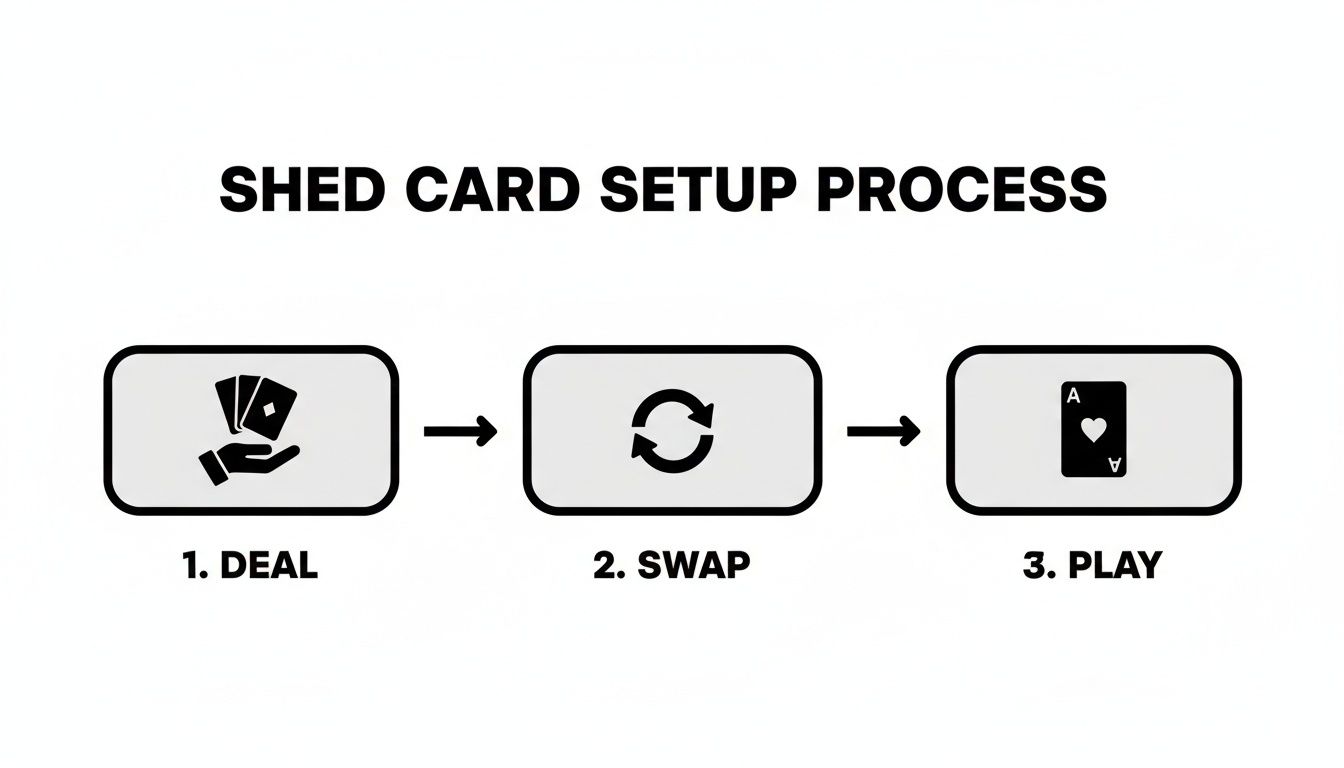
As you can see, the 'Swap' phase is your last chance to prepare before the 'Play' phase kicks off, which is what we're talking about now. For more general tips that apply across many different games, check out our guide on how to play card games.
So, what happens when it's your turn, there’s a King staring up at you from the pile, and the best card you’ve got is a measly Jack? Well, you’re stuck.
When you can’t make a legal play, you have to pick up the entire play pile. All those cards get added straight into your hand. It’s a gut-wrenching moment that can completely change the game's direction. Your turn ends right there—no playing a card, just the grim task of collecting your new, massive hand.
This is the game's biggest penalty and a massive momentum swing. One minute you're about to win, the next you're holding half the deck. The whole challenge of Shed is trying to avoid this fate.
Shed isn't just one long slog; it unfolds across three distinct phases, each with its own feel and requiring a different strategy.
Navigating these three phases is what gives Shed its addictive, replayable quality. Every game feels different.
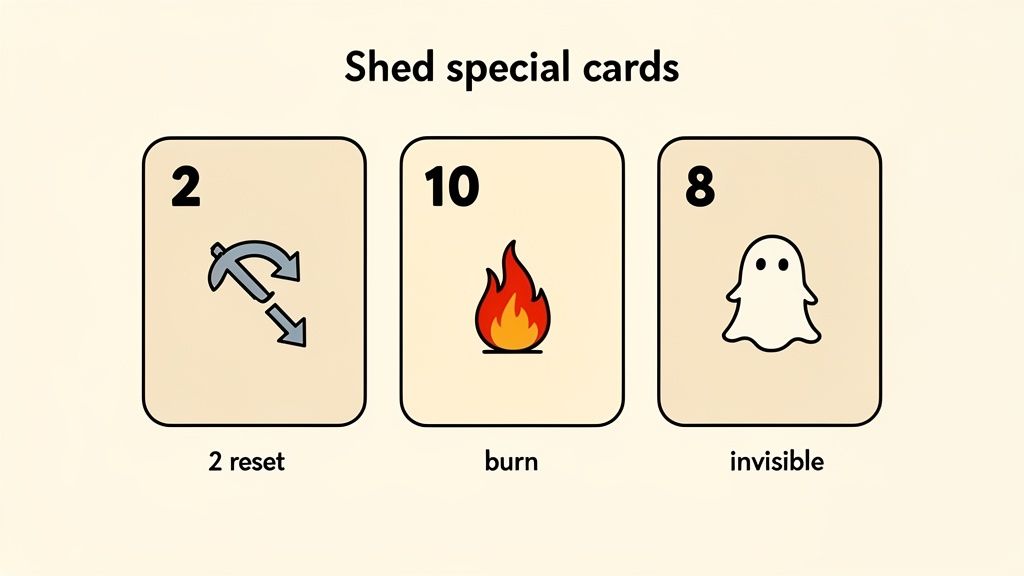
While anyone can learn the basic flow of Shed in a few minutes, the real magic—and the path to victory—is in the special 'power' cards. These are the game-changers. They break the normal rules, turn a losing hand into a winning one, and are the absolute heart of Shed strategy.
Honestly, mastering these cards is what separates the novices from the seasoned players. It's a bit like the thrill you get in modern card games. A perfectly timed special card in Shed feels just as powerful as dropping a game-winning spell in TerraClash™ Grimoire. It can completely flip the table, creating those memorable moments that have you talking long after the game is over.
Certain cards in the deck don't follow the standard 'higher or same' rule. They have unique abilities that can completely disrupt the flow of play. Getting to grips with what each one does, and more importantly, when to unleash it, is the key to outsmarting your opponents.
Let's break down the essential power cards you'll find in almost every game of Shed.
The Two (Reset Card): This is your ultimate escape artist. Playing a Two resets the pile, meaning the next player can play absolutely anything they want. It’s the perfect answer when someone slaps down a King or an Ace and you're left holding nothing but low cards.
The Ten (Burn Card): Think of the Ten as a tactical nuke. Playing it 'burns' the entire pile, removing every card in it from the game for good. Not only does this clear away a threatening stack of cards, but it also grants you an extra turn. This is your go-to move for clearing a massive pile or for chaining plays together to quickly empty your hand.
These two cards are the foundation of Shed strategy, but the fun doesn't stop there. Most groups I've played with have their own house rules that add even more chaos to the mix.
While Twos and Tens are pretty much universal, you'll often come across other cards with special powers. These extra layers of strategy are what make Shed so replayable. Here are a couple of the most popular additions you're likely to encounter.
The Seven (Lower Than): When someone plays a Seven, the tables turn. The next player is forced to play a card that's lower than a Seven. It's a fantastic way to trip up an opponent you suspect is hoarding all their high cards for the end game.
The Eight (Invisible Card): An Eight is often treated as an 'invisible' or 'see-through' card. You can play it on anything, but the game acts as if it's not even there. The next player has to beat the card underneath the Eight. For instance, if a Jack is on the pile and you play an Eight, the next person still has to beat that Jack.
Pro Tip: Patience is a virtue. Don't be too quick to play your Ten. Holding onto it until the pile is stacked with ten or more cards can be absolutely devastating for everyone else. Likewise, a well-timed Two just before an opponent who's struggling can force them to pick up the whole lot.
To help you keep track, here's a quick reference guide for the special cards you'll most likely run into during a standard UK game of Shed.
| Card | Power | Strategic Use Case |
|---|---|---|
| 2 | Resets the pile. The next card can be anything. | Get out of a tough spot when a high card is played, or start a new sequence with a low card. |
| 10 | Burns the entire pile and gives you an extra turn. | Clear a massive pile from the game, or string multiple plays together to empty your hand faster. |
| 7 | The next player must play a card lower than 7. | Trap an opponent holding only high cards, forcing them to pick up the pile. |
| 8 | Invisible. The next player must beat the card underneath. | A versatile "pass" that forces the next player to deal with the card you couldn't beat. |
Think of this table as your toolkit. Knowing which tool to use and when is what will win you the game.
Let's walk through a real-world example. It's your turn, and the player before you just put down a King. The only card in your hand that can top it is your Ace, but playing it now feels like a waste of your best card.
What's the smart move? You play a Two. The pile is instantly reset. Now you're in control and can start a new run with a humble 3, keeping your powerful Ace in reserve for when it really matters. That single move is the difference between simply playing your cards and playing with intent.
The satisfaction of chaining these special cards together is immense. It’s a dynamic that fans of fast, tactical card games will instantly appreciate. If you enjoy games that pack deep strategic choices into a short playtime, you'll feel right at home with TerraClash™ Grimoire, where you can get a full, satisfying match in just 10-15 minutes.
You can see this style of strategic gameplay in action on the TerraClash™ Grimoire page. And if you fancy being part of a new gaming community from the ground up, check out the Kickstarter campaign.
Knowing the rules is one thing, but consistently winning at Shed? That’s a different beast entirely. It’s about thinking a few moves ahead, managing your hand like a seasoned general, and sometimes, just being a little bit ruthless. It’s less about the cards you're dealt and much more about how you play them.
A classic rookie mistake I see all the time is burning through power cards way too early. It's so tempting to slap down that Ten to clear a small pile or use a Two just to get it out of your hand. Trust me, patience is the real skill here.
Hold onto those game-changers. Wait until an opponent is down to their last couple of cards, then drop a high card like a Jack or Queen. If they can’t play, you’ve just forced them to pick up a massive pile, completely derailing their endgame.
Winning Shed often comes down to those nail-biting final few plays. The draw pile is gone, you're staring at your face-up and face-down cards, and the tension is thick enough to cut with a knife. Your entire goal now is to control the pile's value and set yourself up for a clean finish.
This blend of calculated risk and adapting on the fly is what makes shedding-style games so addictive. The fast-paced, customisable gameplay, where you’re constantly shifting your strategy, will feel instantly familiar to anyone who enjoys modern card games. You’ll find a similar thrill in the quick 10-15 minute matches of TerraClash™ Grimoire, where every single decision counts. If that sounds like your kind of fun, you can explore the TerraClash™ Grimoire page for a closer look.
Shed is famous for its endless variations. In fact, I’d bet almost every group has its own unique twists on the rules, passed down like old family stories. This customisable, community-driven nature is a huge part of its charm.
The beauty of house rules is that there's no 'wrong' way to play. As long as everyone agrees before the first card is dealt, you can create your own perfect version of the game.
Here are a few popular house rules you're likely to stumble across:
Believe it or not, gameplay stats even highlight the power of certain strategies. A dataset from 10,000 games in the UK showed that players who strategically held onto an Ace for a final, high-value play won 42% more often. The same data noted that the "OFCOM rule" with four 8s successfully cleared the decks in 18% of really drawn-out matches. You can discover more about the evolution of Shed's rules on Wikipedia).
For those who love the strategic depth that comes from customisable rules, you might also enjoy our look into the world of fantasy card games.
This ability to tailor the experience is something we absolutely love, and it’s a spirit we've built into our own games. If you enjoy creating unique gameplay experiences and adapting your strategies on the fly, come and be a part of a new community of strategy lovers by checking out the TerraClash™ Grimoire Kickstarter campaign.
Even with the best instructions, every card game has those grey areas that spark a heated debate mid-game. Shed is no exception. Let's clear up some of the most common rule disputes that crop up around the table, so you can settle them quickly and get back to playing.
This is where the endgame truly begins. The moment that last card is snatched from the draw pile, a crucial rule changes: you no longer have to keep three cards in your hand. Forget drawing back up.
From here on out, your only mission is to get rid of the cards you're holding. Once your hand is empty, you can finally start playing your three face-up cards on the table. Only after those are all gone can you move on to the nail-biting finale of playing your three face-down cards, one at a time, completely blind.
You absolutely can, and it's probably the most satisfying move in the entire game. Dropping four cards of the same rank on the pile acts like a super-powered Ten. It burns the entire play pile, sending all those cards out of the game for good.
This can play out in a couple of ways. You might have two Kings in your hand and see two already on the pile, or you might even have all four in your hand at once (lucky you!). The outcome is always the same: the pile vanishes, and you get to take another turn immediately. It's a brilliant way to reset the board and swing the game in your favour.
The rush of landing a rare, game-changing move like that is something I've always loved. It has a similar feel to playing TerraClash™ Grimoire, where a single smart combo can completely flip the script. If you're a fan of games where one play can make all the difference, its fast-paced, strategic gameplay is packed into a quick 10-15 minute match.
Expert Tip: Getting four of a kind is a true game-changer. It doesn’t just get rid of a potentially huge pile of cards; it gives you a free turn to really press your advantage. Think of it as the ultimate combo.
Adding Jokers is a classic house rule, but it’s worth remembering they aren't part of the original Shed rulebook. If your group decides to throw them in, the standard is to add two Jokers to the 52-card deck.
What they actually do can vary wildly from one house to the next. One of the most common, and brutal, variations is that playing a Joker forces the next player to pick up the entire pile and lose their turn. This makes the Joker the ultimate attack card – you’ll want to save it for the perfect moment.
The "Shed" (or, let's be honest, the "Shithead" in most games!) is simply the last person left holding cards. The penalty isn't meant to be serious; it's all part of the fun.
The traditional forfeit is that the Shed has to deal the next hand. Other popular, good-natured punishments include being on tea-making duty or having to fetch the snacks for everyone else. It’s all about keeping the social, friendly spirit of the game alive.
If you love Shed for its mix of simple rules, clever tactics, and social fun, we think you'll find TerraClash™ Grimoire is right up your alley. It's a fast-paced card game that delivers a complete, satisfying adventure in just 10-15 minutes.
You can learn more and see it in action over on the official TerraClash™ Grimoire page.
Better yet, why not join our community from the ground floor? Come be part of a new world of strategy lovers by supporting our journey on Kickstarter. Check out the TerraClash™ Grimoire Kickstarter campaign today.

