Gather 'round, adventurers, and listen well. Tonight, we shall pull back the arcane curtain on the true power behind the cards and dice. This is a tale not of whispered spells, but of silent statistics; not of blind luck, but of cold, hard logic. Behind every critical hit and every timely draw lies a hidden force some call fate, but we, the initiated, know it as the secret language of mathematics.
This is your primer on the math in magic that secretly governs the tabletop realms we love to lose ourselves in.
We shall now journey beyond playing on a mere hunch. Instead, we'll delve into how probability is the true lifeblood of any grand strategy. Do not think of this as some dry, academic lecture—think of it as an initiation. You join a select fellowship of players who see the elegant patterns hiding within the chaos of the fray.
For as long as stage magicians have pulled rabbits from hats, there has been a hidden method to their craft. They have always relied on clever mechanics and misdirection, not actual sorcery, to create that sense of wonder. Learn more about the ancient origins of illusionary magic.
In the same way, a master of the tabletop doesn't just hope for the best; they use the principles of mathematics to bend the odds in their favour. This is how you level up your play from a game of chance to one of calculated skill.
At its core, every move you make in a game like Magic: The Gathering or a classic dungeon crawl is a small, rapid-fire calculation. Should you press the attack now, or bolster your defences? Is it time to unleash that game-changing spell, or should you hold it back for a greater threat yet to emerge?
These are not just gut feelings. They are decisions rooted in understanding the odds.
A true strategist doesn't just hope for a lucky roll; they create a situation where even an unlucky roll can still lead to victory. That shift in mindset is what separates a good player from a legendary one.
When you begin to see the numbers behind the fantasy art and flavour text, you gain a formidable advantage. You begin to instinctively understand things like:
You need not be a grand vizier of mathematics to grasp these concepts. They are intuitive principles that, once you get the hang of them, become second nature. It's a vital skill for any hero facing the dynamic, strategic puzzles our favourite games throw at us.
This journey into the math in magic will prepare you for all manner of challenges, including the roguelite trials that await in TerraClash, a new realm for ages 12 and up. It is time to sharpen your mind as you would sharpen your blade. The path to mastery is paved with numbers, and it begins here. You can even follow our own quest over on the TerraClash Kickstarter page.
Let us begin with the most fundamental tool in your arsenal: your deck. Gaining a feel for the probability of drawing the card you need, precisely when you need it, is the first true step from simply playing the game to mastering it. This is the real secret behind the math in magic – it’s about turning blind hope into a calculated advantage.
Think of your deck as a library of 40 spell scrolls. If you’ve built it so that 10 of those are the crucial 'mana' scrolls you need to cast your big hitters, what are the chances you’ll get one in your opening hand? You don't need a scrying pool for this; it's about building an intuition for the flow of the game.
Every single card you draw changes the entire mathematical landscape of your deck. At the very start of the game, your chance of drawing a mana scroll is a straightforward 10 in 40, which is 25%. Simple enough.
But what happens after you draw a few cards, and none of them are mana? Your library of spells has thinned. Suddenly, with 35 scrolls left, your odds of pulling that mana have improved. This constant, dynamic shift is the true heartbeat of the game.
Getting comfortable with these shifting odds is key. A great way to sharpen this skill is to work through some practical probability problems with solutions that mimic the kinds of situations you'll face in a real match. It’s this kind of practice that helps you see the patterns and transforms you from a player who hopes for a good draw into one who can genuinely anticipate it.
This chart drives home how much of tabletop gaming rests on these mathematical pillars.
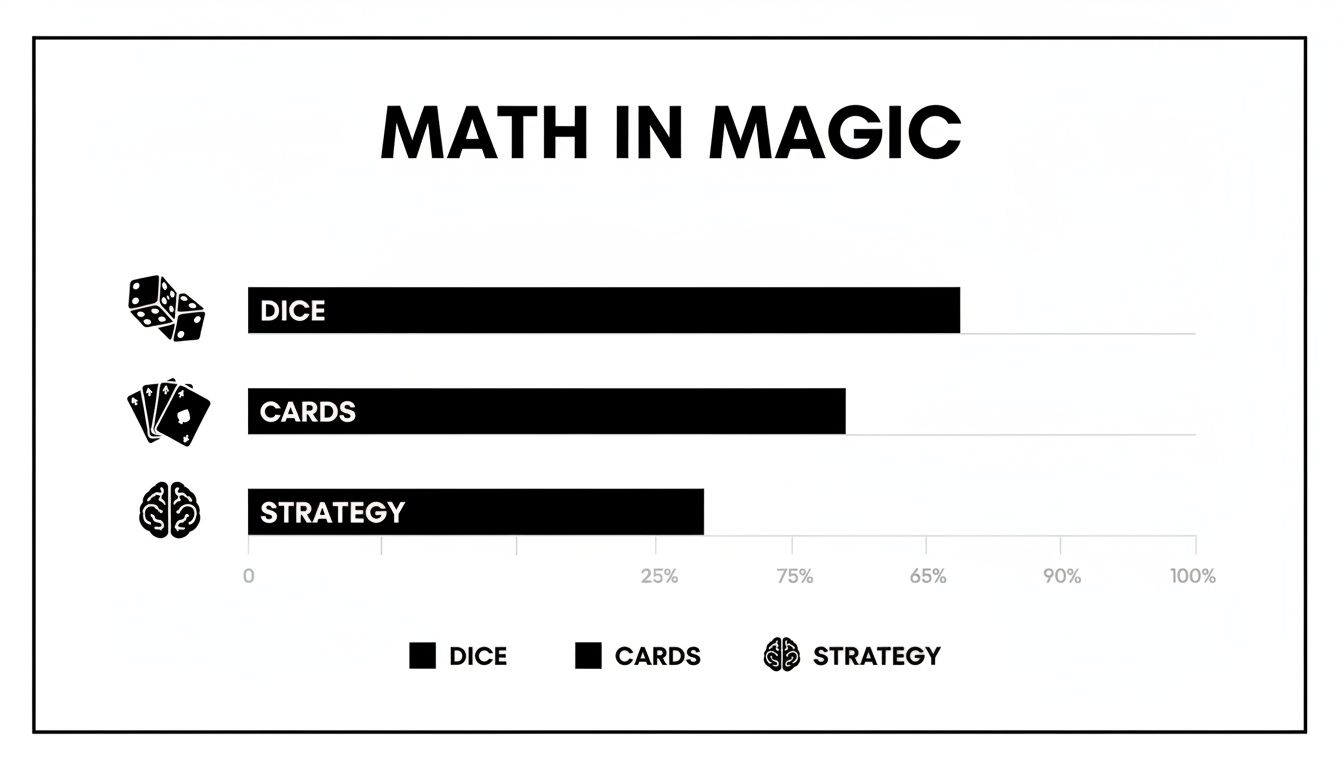
As you can see, a solid grasp of the numbers behind your cards and dice is the bedrock of any high-level strategy.
A deck isn't just a pile of cards; it's a finely tuned instrument of probability. Every shuffle is a new prophecy waiting to be read, and every draw is your chance to see the future.
This kind of insight is a game-changer. It allows you to make bolder, more confident plays. When you know there’s a solid chance of drawing the final piece of your game-winning combo, you can commit your resources without hesitation. This awareness is a cornerstone of victory, and you can dig deeper into these core mechanics by reading up on how to play card games strategically.
Let's put this into practice. See how your chances of drawing that one specific card you need change as a typical game unfolds and your deck gets smaller.
| Game Stage | Cards Left in Deck | Key Cards Remaining | Chance of Drawing Next |
|---|---|---|---|
| Opening Hand | 40 | 4 | 10.0% |
| Early Game | 30 | 4 | 13.3% |
| Mid-Game | 20 | 3 | 15.0% |
| Late Game | 10 | 2 | 20.0% |
| Down to the Wire | 5 | 1 | 20.0% |
Notice how the odds improve dramatically? Knowing this helps you decide when to hold back and when to go all-in.
Whether you're facing down dragons or outsmarting a rival mage, the numbers are your allies. They whisper the secrets of what’s likely to happen next, letting you stay one step ahead. Listen to them, and your path to victory will become a whole lot clearer.
A grand wizard doesn't just stuff any old spell into their grimoire; they carefully curate it to be reliable and powerful. That’s the soul of deckbuilding, an art built on a foundation I like to call statistical sorcery. It's all about digging into the numbers that forge a consistently winning deck, turning raw luck into a calculated advantage.
It goes way beyond just cramming your most powerful cards together and hoping for the best. A truly great deck is a balanced ecosystem. How do you ensure you draw the right mix of creatures, spells, and resources when you need them? The secret is understanding the maths in magic that holds it all together. For anyone serious about this, a tool like a Pokemon Card Collection Tracker can be surprisingly useful for managing your card pool and seeing what you have to work with.
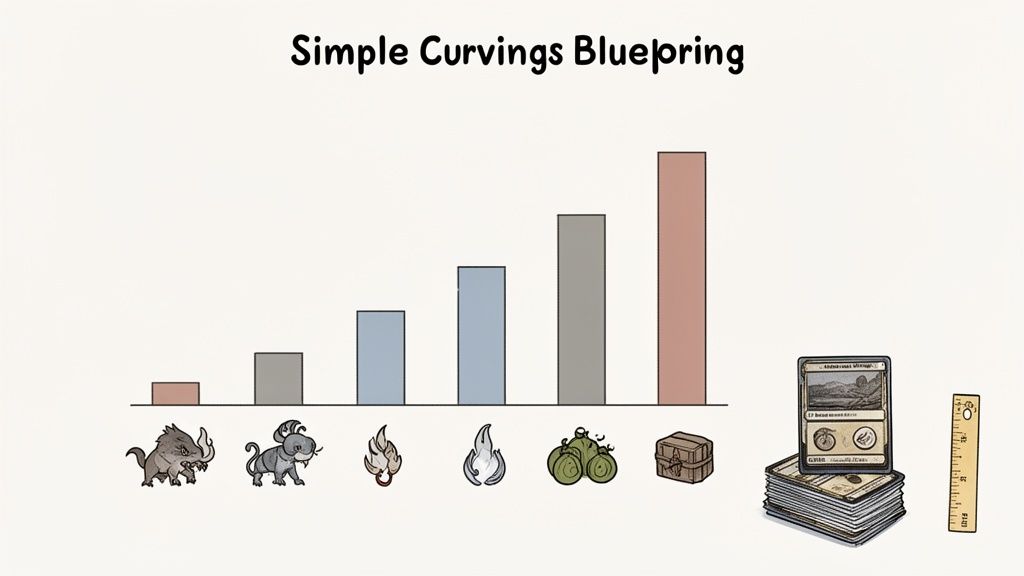
One of the most powerful tools in any deckbuilder's kit is the 'mana curve'. Don't let the name fool you; this isn't some mystical incantation. It's a simple bar chart showing how many cards you have at each mana cost. A good curve is the key to making a meaningful play every single turn.
Think about it. If your deck is choked with expensive, high-cost spells, you’ll be a sitting duck in the early game. On the flip side, a deck full of cheap, weak cards will get steamrolled later on. The mana curve is your blueprint for avoiding both of those grim fates, helping you create a smooth, reliable flow of power from turn one to the final blow.
A well-built deck isn’t a product of luck. It's a finely engineered machine, where every single part has been statistically weighed and placed to ensure it performs its function with deadly consistency.
The greatest stage magicians pull off their illusions with meticulous preparation, not actual sorcery. Your deck’s performance is decided long before you ever draw your first card.
To make your draws more reliable, many seasoned players lean on simple heuristics, and one of the best is the 'Rule of 9'. The guideline is simple: if you want a particular effect to be a core part of your strategy, you should include around nine cards that do that job.
This isn't an unbreakable law, of course, but it's a fantastic statistical shortcut. It forces you to think about your deck in terms of functions—like card draw, creature removal, or direct damage—instead of just individual cards. For a deeper dive, check out our full guide on how to build a magic deck. Mastering these principles is exactly what you need to forge a legendary hero in a realm like TerraClash and secure your victory.
Every quest, every dungeon crawl, boils down to a choice. Do you take the safe, well-trodden path, or do you risk a perilous shortcut for a shot at greater glory? In the world of tabletop games, we call this risk management. It’s the art of weighing a spectacular outcome against the grim chance of failure—a true test of a commander's nerve.
This is the very heart of the math in magic. Should you launch that desperate final attack on the dragon, knowing you only have a 30% chance to land the winning blow? Or is it smarter to spend a turn rallying, hoping you survive the beast's next fiery assault? Legends are forged in these moments, and all of them are governed by numbers.
To make these heroic decisions with the mind of a sage, we can use a powerful tool called 'Expected Value' (EV). It might sound complex, but it's a surprisingly simple way to figure out which plays are mathematically the best choices over the long haul. EV helps you look past a single, hopeful dice roll and understand what the average outcome of an action would be if you could repeat it a thousand times.
Let's break it down. Imagine you have a spell that deals a massive 10 damage, but it only has a 50% chance to hit. Its expected value is 5 damage (10 damage × 0.50 probability). Now, compare that to a weaker but more reliable spell that deals a guaranteed 4 damage with a 100% chance to hit. Its expected value is 4 damage. In a pure damage race, the risky spell is, mathematically, the better choice over time, even though it will whiff half the time.
A seasoned adventurer doesn't just look at the best-case scenario. They weigh the potential reward against the likelihood of it happening, turning every decision into a calculated gambit rather than a blind leap of faith.
Once you start thinking this way, you can assess risk with real clarity. Elite players in games like Gloomhaven: Jaws of the Lion are constantly doing these quick mental calculations. They're analysing their modifier decks and the enemy's likely actions to figure out which abilities will have the highest average impact, consistently tipping the odds in their favour.
This strategic mindset is your greatest weapon. It’s what transforms you from a simple player into a master tactician, ready to navigate the perilous choices that await. When you face the randomised trials and formidable foes in the world of TerraClash, your ability to master risk will define your legend. Prepare to test your skills by following our journey to launch on the TerraClash Kickstarter page.
Ah, the dice. We’ve all been there, holding our breath as those little cubes of fate tumble across the table. Many players see it as pure, uncontrollable luck, a roll of the dice in the truest sense. But a real strategist—a true sage of the tabletop—knows better.
You cannot command a single roll, no. But what you can do is understand the deep mathematical patterns behind their tumbles and start bending the odds in your favour.
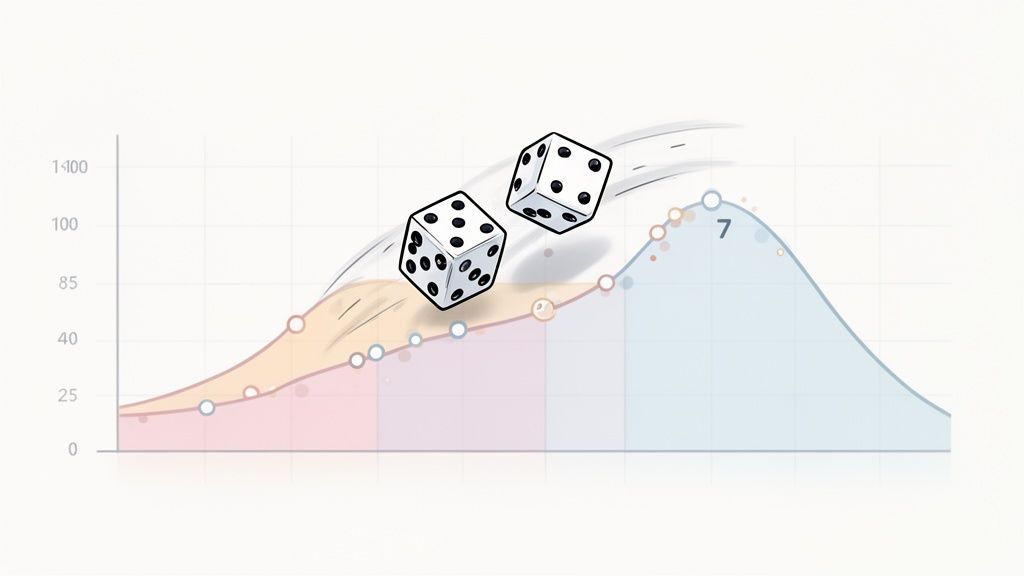
This is where we pull back the curtain on the math in magic that secretly governs these chaotic little objects. It isn't about cheating fate; it’s about learning to speak its language. When you grasp the numbers, you can build strategies so resilient that even the worst rolls won't completely shatter your grand design.
Think about a single six-sided die, the humble d6. One roll gives you a straight 1 in 6 chance for any number to land face-up. Simple enough. But what happens when you roll two of them, a mechanic many of us know from games like Catan? Suddenly, the maths gets a whole lot more interesting.
The results arrange themselves into a predictable pattern called a 'bell curve'. There’s only one way to roll a 2 (1+1) and only one way to roll a 12 (6+6), making them the rarest outcomes. A 7, on the other hand, can be made in six different ways (1+6, 2+5, 3+4, and their reverses). That makes it the most common result by a country mile.
Understanding the bell curve is like having a glimpse into the future. You know which outcomes are most likely, allowing you to place your bets—or your settlements—on the numbers that have the best shot at paying off.
This principle is absolutely fundamental. Knowing that a 7 is the most probable roll lets you anticipate and plan around it, turning what seems like a random event into a calculated part of your strategy. This same logic applies to all sorts of tabletop gear, a topic we dive into deeper in our guide to essential D&D accessories.
Many modern RPGs have moved on from simple rolls to 'dice pools', where you're chucking a whole handful of dice at once. In these systems, you’re usually looking for a certain number of 'successes'—rolls that meet or beat a target number.
Adding more dice to your pool doesn't just improve your odds; it changes them dramatically. Each extra die you roll exponentially increases your chances of hitting the required number of successes. This is the real math in magic that makes your hero feel more powerful as they gain new skills and abilities.
The greatest illusions often rely on subtle mathematical principles to create a sense of wonder, a tradition compiled in lists of the 50 Greatest Magic Tricks. In the same way, understanding how dice pools work allows you to turn chaos into a predictable tool. It's a vital skill for the dice-driven encounters that await you in the world of TerraClash.
So, we have journeyed through the arcane theories together, peeling back the curtain to glimpse the numbers that make our favourite games tick. Now, a new realm is calling for heroes ready to wield this forbidden knowledge. That realm is TerraClash, a roguelite deckbuilder and dice RPG where every principle we've discussed comes roaring to life.
This is where your new-found mastery of the math in magic gets put to the ultimate test. You’ll face down randomised challenges and formidable foes where a solid grasp of probability, risk, and smart deckbuilding isn't just an edge—it's the only way to survive and claim victory. The path is perilous, but the rewards are worth it.
If you're the kind of player who loves the deep, satisfying strategy of indie classics like Slay the Spire or gets a kick out of solving the intricate co-op puzzles in Gloomhaven Jaws of the Lion, then your next adventure is waiting. These games are legendary for their strategic depth, rewarding players who think several moves ahead and truly master the odds. TerraClash is forged in that very same spirit, built for those of us who live for crafting that perfect deck and making a calculated gambit pay off.
Every shuffle of the deck is a new prophecy, every roll of the dice a challenge from fate. In TerraClash, you are the one who will write the legend, using logic and strategy as your ink.
The quest to bring this world into existence is already gathering its first champions. The portal to our Kickstarter campaign will open very soon, offering the first real glimpse into the adventure that awaits.
We invite you to follow along with our journey and prepare to join the campaign when the time comes. Learn more on the TerraClash Kickstarter page and be prepared to answer the call. A new legend is waiting to be written—will it be yours?
It is natural to have questions when you first start peering behind the curtain to see the numbers that make these games tick. Fear not, for we have all been there. Here are a few common questions that arise on the path to mastering the maths of magic.
The trick is to start small. Forget about calculating every possible outcome. Just focus on one thing you truly need.
Let’s say you’re desperate for a healing potion. Count how many you have left in your deck and how many cards remain in that draw pile. If you have four potions in a 20-card deck, your chance of drawing one on your next turn is 4 in 20, which is 20%. That is all. This one small calculation is the cornerstone of building a powerful, almost intuitive, sense of the odds.
The fundamental principles do not change, but your entire goal does. In a head-to-head game, you’re using probability as a weapon to outplay your opponent.
In a cooperative game like the fantastic Aeon's End, however, you're using those same principles to maximise the entire group's chances against the game itself. It becomes a shared puzzle, making your collective decisions feel more impactful and your eventual victory that much sweeter.
Absolutely! The indie scene is a treasure trove of brilliant games that every strategist should check out.
Exploring different games is like studying under different masters. Each one teaches a new perspective on strategy, revealing the diverse ways mathematics can shape an adventure and preparing you for the challenges ahead.
For cooperative play, Aeon's End is a masterclass in shared strategy and managing threats. If you're after something a bit faster and more aggressive, Shards of Infinity offers a slick, competitive duel. Playing these games is a fantastic way to see how different mathematical systems create unique experiences, which will only sharpen your skills for the trials awaiting you in TerraClash.
Your own grand adventure is just over the horizon. TerraClash calls for heroes who can see the numbers behind the magic. Prepare for the quest by following our journey to launch on the TerraClash Kickstarter page.

