Gather 'round, adventurers, and quiet your thoughts. If the whispers of fate have led you here, you are about to embark upon a grand journey through one of fantasy's most storied landscapes—the continent of Faerûn. Consider this scroll your mystic compass, inscribed to help you master the map of Faerûn for your 5e campaigns. So, gather your party. A world of untold adventure awaits your mark.
Hark, and listen well: the map of Faerûn is far more than mere ink upon parchment. It is a living, breathing world, a tapestry woven from epic sagas, forgotten gods, and the countless journeys of heroes and villains. For any Dungeon Master weaving a tale for the 5th Edition, this map is not just a tool; it is your most powerful artefact.
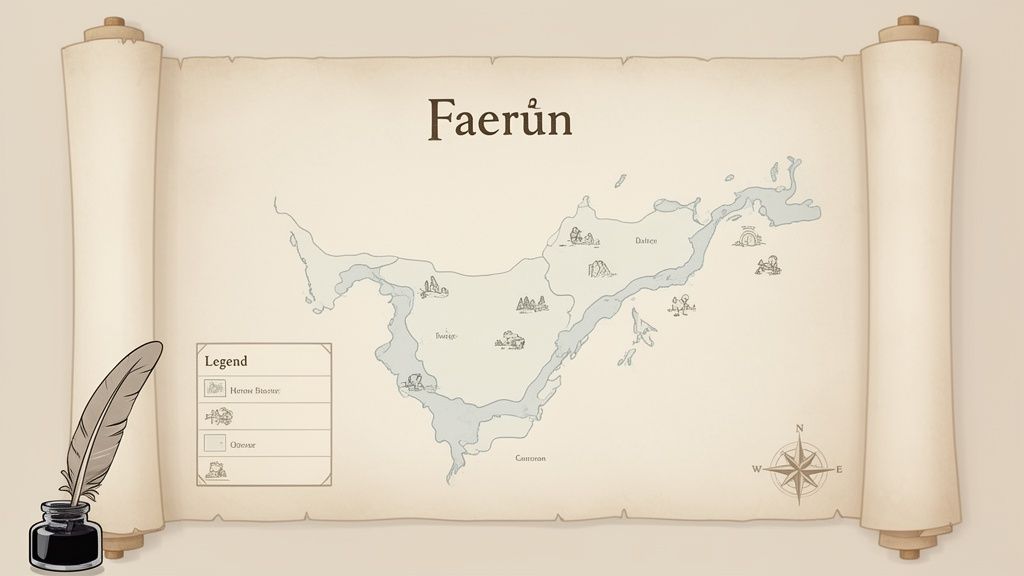
From the salt-laced winds of the Sword Coast to the vast, shimmering Sea of Fallen Stars, every league of this continent hums with mystic potential. The geography itself tells tales of ages past. You have ancient forests veiling elven ruins, and colossal mountain ranges guarding the gates to dwarven strongholds. Your sacred task, as the storyteller, is to breathe life into these hallowed places.
To truly wield the power of Faerûn, you must see beyond the ink and lines. The map is the very foundation of your campaign. It gives your world context, a sense of immense scale, and helps your players feel their characters truly belong. When they can physically trace their path from the crowded streets of Waterdeep to the biting cold of Icewind Dale, the world suddenly feels real, its dangers palpable.
A good map is a promise of adventure. It is the blank space on the parchment where your party's legend is still waiting to be written. It turns a simple trip into a genuine odyssey, making the world feel vast and ripe with possibility.
This is the heart of world-building, the sacred art of any great DM. It's the same creative spark that drives the entire tabletop world, from sprawling RPGs like the much-loved Gloomhaven to clever indie card games. The thrill of uncovering a new corner of the map is just like drawing that perfect, game-changing card in a deck-builder like Slay the Spire, where the whole board shifts in an instant.
It is no surprise that so many incredible games, born from a love of fantasy and strategy, get their start on platforms like Kickstarter, where new worlds are always looking for champions. For those of you just setting out on this path, our guide on D&D for beginners is the perfect place to take those first fateful steps.
Ultimately, the spirit of exploration is what we are all here for. Whether your players are charting a course across the Trackless Sea or planning their next move in a tactical card game like TerraClash, the real joy is in discovery and mastery. This guide will be your compass, helping you not just to read the map of Faerûn, but to truly make it your own. Your next great adventure is waiting for its cartographer.
Every grand adventure, every whispered legend, begins with a single mark on a map. To truly harness the map of Faerûn 5e, you must know the lay of the land. This is not just ink on parchment; it is a living, breathing world awaiting your players' footsteps. Consider this your cartographer's key, unlocking the realms that will shape your entire saga.
Faerûn is a continent of wild contrasts and breathtaking scale. You have the biting, relentless winds of Icewind Dale in the far north and the sweltering, unforgiving jungles of Chult to the south. The geography itself tells a story. The map is your script, filled with cryptic symbols and ancient boundaries that are not just lines—they are invitations. Understanding these regions is what elevates a storyteller to a true world-builder.
For most 5e campaigns, the Sword Coast is where destiny is forged. It’s a rugged, untamed stretch of coastline that’s home to some of the most famous places in the Forgotten Realms. Chances are, this is where your party will carve their legends into history.
This focus on iconic, adventure-rich regions is a huge part of why tabletop RPGs have such a grip on our imaginations. The UK gaming market has seen explosive growth, and you can bet that the immersive worlds found in RPGs are a massive driver of that. In gaming hubs across the land, D&D sessions centred on Faerûn’s major regions are seeing attendance spikes, proving that a well-drawn map never goes out of style. You can read more about the explosive growth of the UK gaming market to see just how vibrant this world has become.
Before we venture further, let this serve as a spark for your own ideas, a cheat sheet for dropping your players right into the heart of the action.
| Region | Prominent Locations | Common Adventure Hooks |
|---|---|---|
| The Sword Coast | Waterdeep, Baldur's Gate, Neverwinter | Urban intrigue, monster hunting, guild conflicts, classic heroic quests. |
| Icewind Dale | Ten-Towns, Kelvin's Cairn, Spine of the World | Survival against the elements, battling savage beasts, uncovering ancient magic frozen in ice. |
| The Silver Marches | Silverymoon, Sundabar, Mithral Hall | Defending civilisation from orc hordes, delving into dwarven ruins, navigating elven politics. |
| Amn | Athkatla, the Cloud Peaks | Merchant guild rivalries, shadow wars, quests for immense wealth and power. |
| The Underdark | Menzoberranzan, Gracklstugh, Blingdenstone | Escaping drow slavers, navigating treacherous caverns, dealing with mind flayers and beholders. |
| Chult | Port Nyanzaru, the Jungles of Chult, Omu | Dinosaur-filled jungle exploration, tomb raiding, lifting a deadly curse. |
This, of course, is but a glimpse. Each of these places could host a dozen campaigns, each feeling utterly different from the last.
While the Sword Coast often steals the spotlight, the true depth of a Faerûn map reveals itself when you dare to venture beyond its borders. The sheer variety of landscapes provides endless fuel for unique, terrain-based encounters and a vast range of stories.
The scale of the world is a tool. A journey of a thousand miles should feel like it, filled with peril, wonder, and discovery. Each hex on the map is a chapter waiting to be written by the footsteps of your players.
Think of the vast Anauroch Desert, a sea of sand hiding the ruins of forgotten empires. Or what of the misty expanse of the High Moor, where ancient curses and fell beasts linger in the fog? These aren't just empty spaces between cities; they are the adventures. This idea of a diverse, modular world is a thrilling one, and it's the same philosophy that inspires new kinds of tabletop experiences. In a game like the beloved Betrayal at House on the Hill, the map is built one tile at a time, creating suspense and a unique layout every session. This spirit of modular world-building is also at the heart of games like TerraClash, where the world is reshaped with every adventure.
By getting to grips with the regions, the political boundaries, and the hidden lore of the Faerûn map, you give your players a true sense of place. Their decisions—to brave the mountains, sail the seas, or tread the dark paths of the Underdark—will carry real weight, grounded in a world that feels as real and dangerous as you can make it. Your support for Kickstarter projects like TerraClash helps bring new worlds with this same spirit of high adventure to life.
Let us speak plainly, storyteller. There is a special kind of magic in a map your players can actually hold. A digital image on a screen is useful, but a physical scroll unfurled across the gaming table? That is an invitation. It is an artefact that turns your story from a mere tale into a shared reality. Think of this section as your alchemist’s grimoire, filled with secrets for transmuting a digital map of Faerûn 5e into a tangible relic for your campaign.
Bringing a map to life is an art, but it need not drain your treasury. Whether you seek a simple, weathered handout or a grand centrepiece for your war room, the methods are well within your grasp. The trick is to match your ambition to your means, ensuring the final creation serves its true purpose: to pull your players deeper into the world you build together.
This chart breaks down the core process of truly mastering a map of Faerûn, from understanding its layout to weaving it into an unforgettable player experience.
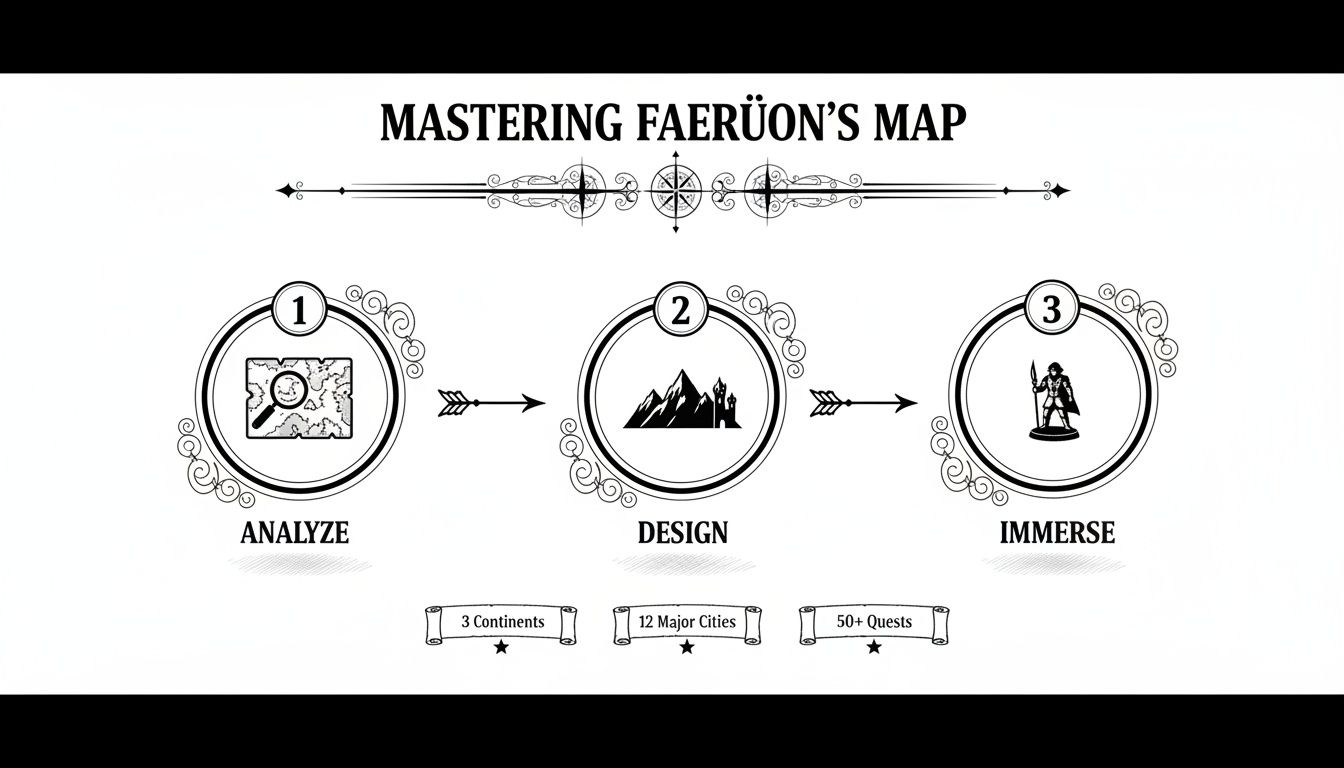
As you see, a legendary map is born from a thoughtful process, blending careful analysis with creative design to forge a genuinely immersive tool for your game.
Your first great decision as a cartographer-artisan is the material itself. This choice will define the map’s entire character and feel at the table.
Here are a few paths to consider:
Whatever you choose, the quality of your digital file is paramount. A high-resolution image is your non-negotiable starting point. Anything less than 300 dots per inch (DPI) will yield a blurry, pixelated mess that shatters the very illusion you work so hard to create. Always hunt down the highest quality digital version of the Faerûn map you can find before you even think about printing.
Once your printed map is in hand, the real alchemy begins. This is where you add the small, immersive details that elevate a simple print into a believable prop. These are the finishing touches your players will speak of long after the dice are put away.
A map is more than geography; it is a story waiting to be told. The scorched edge hints at a dragon's breath, the wax seal a king's decree. These details are the whispers of the world itself.
Try adding a touch of authenticity with these techniques:
To take it a step further, you could enhance your campaign's visual storytelling with a World Map Wall Art Decal Sticker With 20 Pin Points, perfect for tracking the party's progress across Faerûn. By transforming the digital map into a physical object, you give your world a tangible anchor. It becomes a shared focal point, a record of the party's journey, and a constant reminder of the adventures that still lie ahead. To learn more about creating an immersive environment, explore our thoughts on essential D&D accessories. Trust me, this process is a powerful act of world-building, and one your players will never forget.
In an age where we gather around digital hearths instead of wooden tables, the way we experience Faerûn has transformed. A good digital map is not merely a convenience; it is as vital to an online campaign as a wizard's spellbook. Let us delve into the craft of making your map of Faerûn 5e shine on Virtual Tabletops (VTTs) like Roll20 or Foundry. These platforms are not just software; they are our modern-day scrying pools, allowing us to build worlds that feel just as real and immersive as any physical setup.
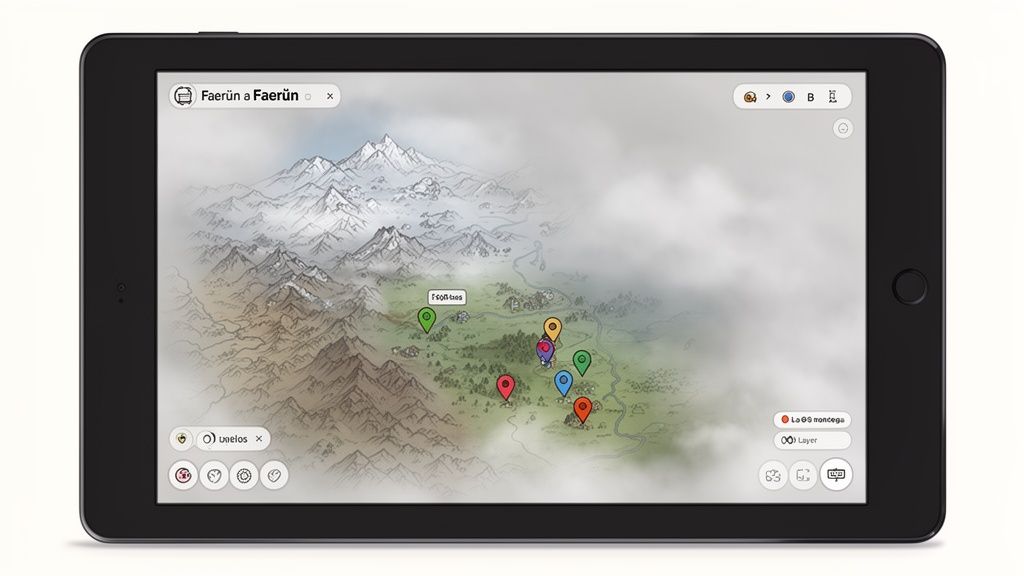
First, you must acquire a high-resolution digital chart of Faerûn. Do not settle for a fuzzy image. Seek out maps with a resolution of at least 150 DPI (dots per inch), though 300 DPI is the true gold standard for crisp detail. Once you have your map, importing it into your VTT is usually a simple ritual. Most platforms allow you to upload it, set the grid size, and align everything with but a few clicks. This simple step ensures your player tokens move correctly across the world's scale.
With your map in place, the true magic begins. VTTs come packed with tools that allow you, as the DM, to breathe life into the world. Mastering these is the key to creating a dynamic environment that reacts to your players' choices and makes them feel as if they are truly there.
Here are a few essential techniques you will want to master:
When you master these digital tools, you are no longer just showing your players a map. You are opening a portal. The VTT becomes a window into Faerûn, where every shadow might hide a secret and every horizon promises a new adventure.
This whole shift to digital adventuring is part of a bigger picture. The online gaming market continues to grow, fuelled by the same desire for shared stories and epic journeys that we love in D&D, with multiplayer games capturing that same collaborative spirit.
Beyond the basics, there is always more you can do to draw your players in. Think about creating custom handouts or prop art that you can share digitally. Need a unique illustration for a mysterious letter your players found, or a portrait of a key NPC? Modern AI art generators can be a great help here, letting you quickly create visual aids that bring your campaign elements to life.
And of course, a great map is the foundation for thrilling combat. Ultimately, the goal is to make your online space as rich and interactive as possible. Every tool you master adds another layer of believability, pulling your players deeper into the grand saga of Faerûn.
A great map, you see, is a canvas, not a cage. The true magic of any map of Faerûn 5e lies not just in the lore it holds, but in your courage to make it your own. This is your invitation to become the cartographer of your own saga—to take the familiar and twist it into something new, something legendary. It is where you weave your own stories into the very fabric of the world.
Think of the official map as your foundational clay. You have the mountains, the rivers, and the cities, but what of all those tantalising spaces in between? What forgotten ruins lie buried in the sands of the Anauroch Desert? What secret kingdoms thrive in the hidden valleys of the Spine of the World? Adding these personal touches is how you transform a shared setting into your world.
To begin, simply look for the empty spaces on your map of Faerûn. These uncharted territories brim with potential, awaiting your creative spark.
When you add these custom locations, you do more than just fill in the blanks; you write a unique history for your campaign. The world feels so much more alive when the players know there are secrets lurking just off the main road—secrets that only exist in your version of Faerûn.
The design principles that make Faerûn so compelling are a brilliant source of inspiration. Its diverse biomes, from frozen tundra to sweltering jungles, offer a perfect blueprint for creating dynamic and varied adventures. Now, imagine taking that concept a step further—a world where the very landscape is modular and unpredictable, shaped by the draw of a card.
A map's greatest strength is the promise of the unknown. When players realise the world is not set in stone, their sense of wonder and agency ignites. This is the spirit that fuels every great tabletop adventure.
This idea of a randomised, ever-changing world is the beating heart of many modern board and card games. It’s the driving force behind the roguelite deckbuilder, TerraClash, which forges a new world map for every single campaign. One game might see you trekking through dense woodlands, while the next could have you navigating treacherous mountain passes, all dictated by the luck of the draw.
Here's a little glimpse of the TerraClash project, where that spirit of exploration and strategic world-building is right at the centre of the experience.
This visual really captures the game's vibrant art style and the card-based mechanics that shape each unique adventure, blending classic fantasy with fresh gameplay.
This kind of creative ownership—blending established lore with a unique vision—is what builds unforgettable experiences. The fantasy gaming scene thrives on the allure of worlds like Faerûn's, showing a real hunger for deep, explorable worlds. This mirrors how a game like TerraClash’s uses its systems to randomise adventures much like rolling up a new Faerûn campaign. You can learn more about the UK's thriving gaming market and its fascinating trends.
Supporting innovative indie projects on Kickstarter is how new legends are born in our community. It’s how we ensure that the spirit of adventure, first sparked by sprawling maps like Faerûn's, continues to inspire the next generation of games and storytellers.
So, our long journey across Faerûn comes to a close. But remember, any map of Faerûn 5e, no matter how detailed, is but the starting point. The true story is not in the ink and parchment; it is written by the choices your adventurers make, the paths they walk, and the legends they forge.
We have explored this incredible continent together, uncovering its cartographic secrets and learning how to make its mountains, forests, and sprawling cities feel real at your table. It is a world that has been the spark for a thousand quests and countless epic tales.
It is that powerful spirit of exploration that drives not just grand Dungeons & Dragons sagas but also fuels the next wave of indie tabletop games. The thrill you get from revealing a new stretch of the Sword Coast is the same magic a player feels when they flip a card in a game like TerraClash, revealing an unknown fate. That shared wonder of discovery is what holds our community together, whether we roll dice in a massive RPG campaign or face off in a tense deck-building duel.
This is not the end; it is the beginning. You have the map now. It is a tool, yes, but it is also a blank canvas for the stories you are about to tell and the worlds you are going to build.
Get Your Crew Together: Whether they are a band of heroes destined to save Baldur's Gate or rivals clashing over a hand of powerful cards, assemble your party. The friendships forged around the table are the true treasure.
Champion New Worlds: The spirit of creation is what keeps our hobby fresh and exciting. Stand behind the indie developers and dreamers building the next legendary realms. Projects launching on Kickstarter, like the TerraClash Kickstarter campaign, are where new adventures are born, and they thrive on the passion of players like you.
Tell Your Tale: Let the map be your muse. Let the dice clatter. Let the cards fall where they may. Your saga is simply waiting for you to write it.
As you put this guide down, let that call to adventure ring in your ears. Every blank space on the map, every unplayed card in the deck, holds a promise—a promise of danger, of glory, and of a story that belongs to you and no one else.
It is your turn now. Take up the mantle of Dungeon Master, of player, of creator. Unfurl the scroll, shuffle the deck, and step boldly into the unknown. Your next great adventure is waiting.
Even the most well-travelled Dungeon Masters can be stumped by the winding roads and strange symbols on a map of Faerûn. It happens. Think of this as your quick-reference guide, answering the questions most often whispered across gaming tables.
Honestly, for most groups diving into a 5th Edition campaign, the best place to start is the gorgeous map that comes with the Sword Coast Adventurer's Guide. It’s the canonical, go-to resource, giving you a wonderfully detailed look at the heartlands where most of the big published adventures happen. It's a must-have.
Of course, if your players decide to venture into more specific, far-flung regions, you'll want to grab the books for those areas. A campaign in the frozen north is made infinitely better with the detailed maps from Icewind Dale: Rime of the Frostmaiden, just as Tomb of Annihilation is indispensable for any jungle trek through Chult.
The secret is to make the map itself a character in your story. Don't just say "three days pass." Instead, pull out the map and describe the rolling hills slowly giving way to the jagged peaks they see on the horizon. Talk about the change in the air, the different trees, the kinds of creatures they might encounter, all prompted by the terrain they're crossing.
A few tricks can make a world of difference. Use region-specific random encounter tables to make challenges feel like they belong to that part of the world. Drop memorable NPCs at a crossroads inn or a lonely watchtower. And if you're playing online, use the fog of war tool on your virtual tabletop. Revealing the map bit by bit gives your players a genuine feeling of exploration, turning a simple journey into a real adventure.
Absolutely! In fact, you should. The map of Faerûn is a brilliant creative springboard. Its layout is a fantastic foundation for you to build your own sagas upon. Don't be afraid to change the names of cities, mountains, and entire kingdoms to fit your own lore. The geography is already there, ancient and believable, just waiting for your stories.
You can even let the design of Faerûn inspire entirely new ways to play. Think of its diverse biomes—the deserts, the frozen wastes, the sprawling forests—as modular pieces. You could reveal them randomly, like drawing cards in a modern deck-building RPG, creating a world that unfolds with every session.
This approach gives a classic, beloved map a whole new lease of life. You get to blend geography your players might recognise with a vision that is entirely your own, creating something truly special for your table.
Your own grand adventure, filled with unique challenges and strategic depth, awaits. At TerraClash, we believe in worlds shaped by player choice and the thrill of discovery. To see how we're reimagining fantasy adventures, follow our journey and support the next generation of tabletop gaming.
Prepare for battle and explore a world revealed by the cards you play by checking out the TerraClash Kickstarter.

