Hark, adventurer, and welcome to your guide on mastering martial weapons in 5e. These are the tools of the trade for true combat specialists, separating the hardened warrior from the town guard. They represent a significant step up from simple weapons, offering greater damage dice and more tactical options, but they demand proper training to wield effectively.
In the perilous realms of Dungeons & Dragons, your choice of weapon is more than mere preference; it’s a declaration. It’s the first line in your character’s saga, defining how you face your foes and protect your allies. It is not just about the cold steel in your hand, but about the very role you play in the crucible of battle.
This guide will serve as your armoury, breaking down these instruments of fate. We shall delve into the heart of what proficiency means—that mystical bond between a warrior and their weapon. Without it, even a legendary greataxe is but a clumsy, dangerous lump of metal.
Consider the classic fantasy archetypes, and how their weapons define their legend. A towering Fighter in full plate is not one for poking at foes with a dagger; they are found cleaving through the front lines with the devastating arc of a greatsword. This choice cements their role as a high-damage powerhouse, a bastion against the encroaching darkness.
In contrast, a nimble Rogue slips through the shadows, their rapier a blur of deadly motion. Their art is not of brute strength but of surgical precision, exploiting the weaknesses in an enemy's guard. They dance across the battlefield, awaiting the perfect moment for a single, decisive strike. Your weapon is fundamental to breathing life into these iconic roles.
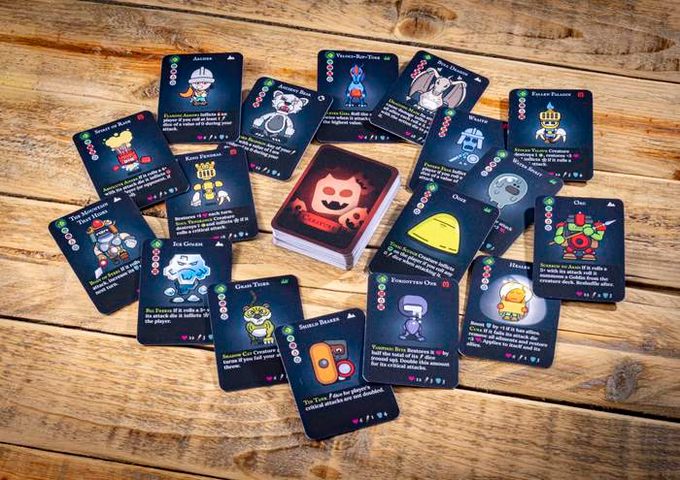
This kind of tactical depth is a powerful magic that draws so many to tabletop gaming. In the UK alone, the market for such adventures—which includes grand tales like D&D and burgeoning deck-builders like TerraClash—is a treasure hoard valued at USD 412.21 million, and it is foretold to nearly double by 2033. It is a testament to how much players love to immerse themselves in complex systems and the crafting of heroes.
A weapon is an extension of the will. For some, it is a hammer to shatter obstacles. For others, it is a key to unlock victory through subtlety. Choose the tool that best reflects the soul of your hero.
Grasping the nature of these weapons is a vital step for any hero-in-the-making. If you are just beginning your journey, understanding these core tenets will serve you well in any campaign that lies ahead. For those entirely new to the world of dice and dragons, our tome on D&D for beginners is a fine place to start your quest.
This guide will give you the foundation you need to master the art of combat. Whether you see yourself as a brutal damage-dealer, a quick-footed skirmisher, or an unshakeable defender, the journey begins with choosing the right weapon. Now, let us unbar the armoury doors.
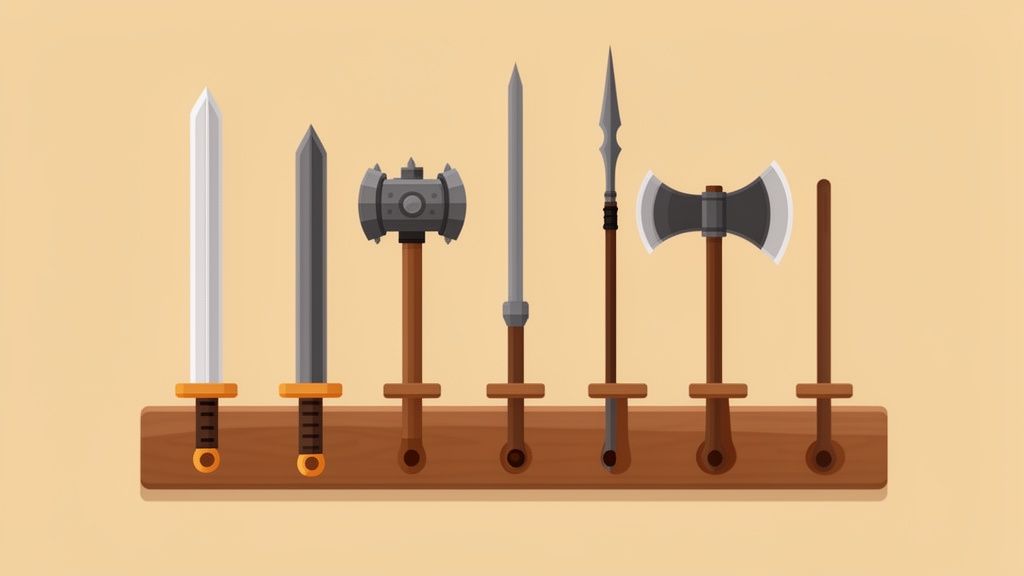
Here is where the real work of heroes is done. Simple weapons are for farmhands and town guards; the martial armoury holds the true instruments of war, each one demanding skill, strength, and tactical wit to wield effectively. From the elegant longsword to the brutal maul, the weapon you choose speaks volumes about how you intend to walk the battlefield.
Think of this section as your personal master-at-arms, guiding you through every core martial melee weapon in the game. We will go beyond mere statistics. I will impart the practical advice and tactical lore that turns a good fighter into a legendary one. Understanding these details is your first step towards mastery.
For those moments when you just need the numbers, this quick reference table lays out all the core details at a glance. It's a fine tool for comparing your options side-by-side before delving into the finer points of each weapon.
| Weapon Name | Damage | Damage Type | Weight | Properties |
|---|---|---|---|---|
| Battleaxe | 1d8 / 1d10 | Slashing | 4 lb. | Versatile (1d10) |
| Flail | 1d8 | Bludgeoning | 2 lb. | - |
| Glaive | 1d10 | Slashing | 6 lb. | Heavy, Reach, Two-handed |
| Greataxe | 1d12 | Slashing | 7 lb. | Heavy, Two-handed |
| Greatsword | 2d6 | Slashing | 6 lb. | Heavy, Two-handed |
| Halberd | 1d10 | Slashing | 6 lb. | Heavy, Reach, Two-handed |
| Lance | 1d12 | Piercing | 6 lb. | Reach, Special |
| Longsword | 1d8 / 1d10 | Slashing | 3 lb. | Versatile (1d10) |
| Maul | 2d6 | Bludgeoning | 10 lb. | Heavy, Two-handed |
| Morningstar | 1d8 | Piercing | 4 lb. | - |
| Pike | 1d10 | Piercing | 18 lb. | Heavy, Reach, Two-handed |
| Rapier | 1d8 | Piercing | 2 lb. | Finesse |
| Scimitar | 1d6 | Slashing | 3 lb. | Finesse, Light |
| Shortsword | 1d6 | Piercing | 2 lb. | Finesse, Light |
| Trident | 1d6 / 1d8 | Piercing | 4 lb. | Thrown (range 20/60), Versatile (1d8) |
| Warhammer | 1d8 / 1d10 | Bludgeoning | 2 lb. | Versatile (1d10) |
| Whip | 1d4 | Slashing | 3 lb. | Finesse, Reach |
Each of these weapons has its place, and a skilled warrior knows when to choose one over the other. Let us now speak of the specifics of how they handle in a real fight.
These are the workhorses of any adventurer's arsenal. Wielding a weapon in one hand leaves the other free for a shield, a torch, a spell component, or even another weapon. That flexibility is what makes them so enduringly popular.
Battleaxe, Longsword, & Warhammer: This trio forms the very backbone of one-handed fighting. They all bring a respectable 1d8 damage die to the fray (slashing, slashing, and bludgeoning, respectively). What truly makes them shine is the Versatile property, allowing you to grip them with two hands to increase the damage to a 1d10. It is a fine trade-off: sacrifice your shield for a turn to land a much mightier blow.
Flail: A brutal and straightforward weapon, the flail deals a solid 1d8 bludgeoning damage. While it lacks special properties in the rules, its chained head represents a weapon that is difficult to block, making it a great flavour choice for an intimidating warrior.
Morningstar: For when you must punch holes in plate armour. The morningstar delivers 1d8 piercing damage, making it a favourite for Paladins and Clerics who expect to face heavily armoured adversaries.
Rapier: The duelist's dream. It is all about precision over power, dealing 1d8 piercing damage. Its key property, Finesse, lets you use your Dexterity instead of Strength for attack and damage rolls. This makes it the chosen martial weapon for Rogues, nimble Fighters, and swashbuckling Bards.
Scimitar & Shortsword: If you fancy fighting with two blades, look no further. These deal 1d6 damage (slashing and piercing) and come with both the Finesse and Light properties. That combination is essential for two-weapon fighting, allowing you to make that crucial bonus action attack.
Trident: A bit of a specialist's tool, the trident deals 1d6 piercing damage. It has the Versatile property (for 1d8 damage) but can also be thrown, giving you a ranged option that most other one-handed weapons lack.
Whip: Do not be fooled by the meager 1d4 slashing damage. The whip is a tactical masterpiece. It has Finesse, but its killer feature is Reach, letting you strike enemies from 10 feet away. For certain builds, that control is worth far more than raw power.
When you must absolutely, positively bring the pain, you reach for a two-handed weapon. You forsake any chance of using a shield, but what you gain in return is the highest damage output in the game.
Glaive, Halberd, & Pike: These are the kings of battlefield control. As polearms, they all have the Reach property, giving you a 10-foot attack range. They are all Heavy and Two-Handed, with the glaive and halberd dealing 1d10 slashing damage, while the pike deals 1d10 piercing. Perfect for keeping foes at bay.
Greataxe: The iconic weapon of the raging Barbarian, and for good reason. Its massive 1d12 slashing damage die offers the highest single-hit potential in the game. This pairs beautifully with any feature that adds extra damage dice on a critical hit, like the Barbarian's Brutal Critical.
Greatsword: While the greataxe has a higher damage ceiling, the greatsword’s 2d6 slashing damage is far more reliable. Averaging 7 damage per hit versus the greataxe's 6.5, it is the preferred choice for Fighters and Paladins who desire consistent, dependable damage round after round.
Lance: The cavalry specialist's weapon of choice. It deals a hefty 1d12 piercing damage and has Reach, but there is a catch: you have disadvantage when attacking someone within 5 feet. This penalty vanishes entirely when you are mounted, making you a terror on horseback.
Maul: Essentially a greatsword that deals bludgeoning damage. Its 2d6 damage is perfect for smashing skeletons, breaking down fortified doors, and generally making a very loud statement in a fight.
Choosing a martial weapon is a personal decision, a signature of your character's fighting style. The core concepts of damage types, special properties, and tactical positioning are universal, and you can see their influence far beyond D&D. For instance, the design philosophy behind these weapons echoes in other complex games; you can see how systems in deck-builders like the TerraClash Kickstarter campaign translate these foundational ideas into unique card abilities and strategic choices.
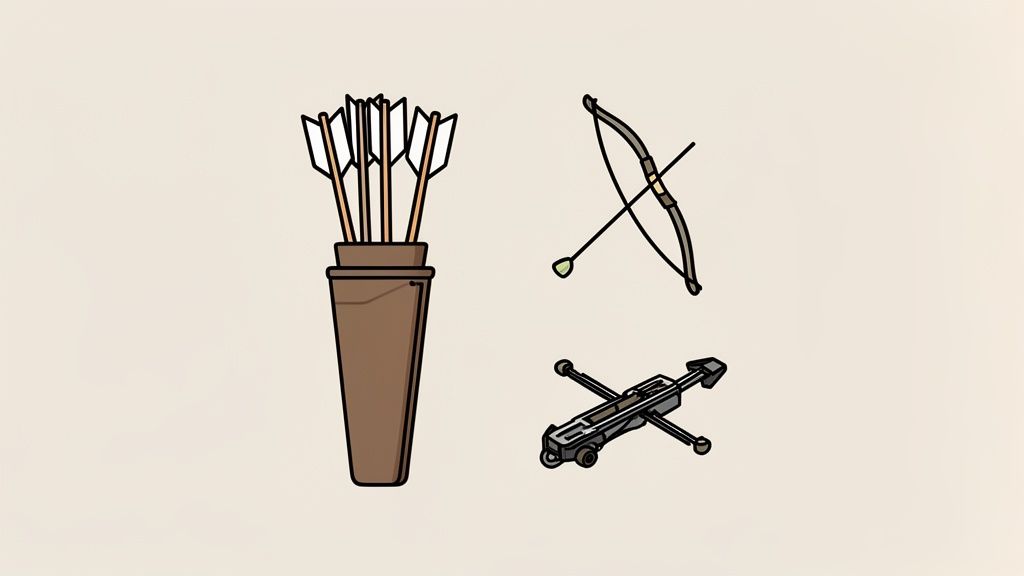
Not every battle is won up close with the ring of steel. Some victories are decided by the whisper of a fletching past your ear or the sharp thwack of a crossbow bolt finding its mark. This is the domain of the archer, the skirmisher, the battlefield controller.
Mastering these weapons is about more than just a keen eye. It is about dictating the terms of engagement, controlling the flow of battle from afar, and picking off your enemies before they can even draw their swords. From the relentless volleys of a longbow to the armour-piercing impact of a heavy crossbow, each of these martial weapons 5e offers a completely different way to fight.
To help you choose your tool before the battle begins, here is a quick-glance table with all the core stats you need to make a tactical decision.
| Weapon Name | Damage | Damage Type | Range | Properties |
|---|---|---|---|---|
| Blowgun | 1 | Piercing | 25/100 | Ammunition, Loading |
| Crossbow, hand | 1d6 | Piercing | 30/120 | Ammunition, Light, Loading |
| Crossbow, heavy | 1d10 | Piercing | 100/400 | Ammunition, Heavy, Loading, Two-handed |
| Longbow | 1d8 | Piercing | 150/600 | Ammunition, Heavy, Two-handed |
| Net | - | - | 5/15 | Special, Thrown |
This table provides the raw data, but the true art lies in knowing how to use these tools. Let us nock an arrow and speak of the specifics of each.
For the dedicated archer, the bow is the classic choice. It is all about speed and raining a continuous hail of arrows downrange, rather than relying on a single, perfectly aimed shot. This is the bread and butter of Rangers and archery-focused Fighters who wish to rain death from the back lines.
Think on it: a high-level Fighter with a longbow can use Action Surge to fire off four arrows in a single turn. That is enough to potentially take an enemy spellcaster out of the fight before they have even uttered their first cantrip. Now that is battlefield control.
Where bows offer speed, crossbows deliver raw, focused power. They are fantastic for characters who might not be full-time archers but still desire a reliable ranged option. The Loading property is their main drawback, limiting you to one shot per action, but the damage they punch out can make it worthwhile.
Heavy Crossbow: This is the sniper rifle of D&D. It has an excellent range of 100/400 feet and hits with a massive 1d10 piercing damage, the highest of any ranged weapon. It is the perfect weapon for an opening ambush, delivering one devastating bolt from hiding to begin combat with a bang.
Hand Crossbow: The weapon of choice for agile skirmishers and anyone who loves dual-wielding. It deals a respectable 1d6 piercing damage and has the Light property. This little beauty truly comes alive when you pair it with the Crossbow Expert feat, which allows you to fire it as a bonus action. Suddenly, your Rogue or Ranger becomes a whirlwind of bolts.
Mastering the bolt means mastering patience. One perfectly placed shot can change a battle more than a dozen stray arrows ever could. It’s all about the opportune strike.
Not every ranged weapon is about dealing damage. Sometimes, controlling an enemy is a much smarter move, and for that, you have specialised gear that can turn the tide of a fight without spilling a single drop of blood.
Blowgun: This one is often overlooked. On its own, the 1 point of piercing damage is laughable. But that is not its true purpose. The blowgun is a delivery system for poison. A silent puff from the shadows can be all it takes to incapacitate a guard or weaken a tough monster before the real fight begins.
Net: This is the ultimate non-lethal lockdown tool. Landing a hit with a net restrains a creature, making them an easy target for the rest of your party. It has its quirks—you only get one attack with it per turn, no matter what—but successfully capturing a key enemy can win you the battle right there.
The kind of thinking needed to use a Net or Blowgun effectively is similar to the tactical depth you'd find in other realms of play. For instance, in many deckbuilding games, some cards do not deal damage but instead apply a condition that sets you up for a much bigger play later. That principle of strategic setup is a cornerstone of great game design, something you see in games from D&D to indie projects like the TerraClash Kickstarter.
Knowing how to swing a sword is one thing. Truly mastering it is another entirely. That is where Feats and Fighting Styles come in. These are not just minor statistical bumps; they represent specialised training and hard-won battlefield experience. They are the secret techniques and combat philosophies that elevate a mere soldier into a true legend.
Think of a Fighting Style as your character's fundamental combat doctrine. It’s the core of their martial art, something classes like the Fighter, Paladin, and Ranger learn early in their calling. Feats, on the other hand, are those breakthrough moments of mastery. They let you bend, and sometimes outright break, the normal rules of a fight to pull off spectacular manoeuvres.
Some feats are so powerful they can define a character's entire approach to combat. They create incredible synergy with certain martial weapons and open up devastating new tactics.
Great Weapon Master: If you love swinging a greataxe or maul, this is your feat. It’s the ultimate high-risk, high-reward option, letting you take a -5 penalty on your attack roll for a whopping +10 to damage. When it connects, it really connects, often ending fights before they have barely begun.
Sharpshooter: This is the Great Weapon Master for archers and a non-negotiable for anyone serious about ranged combat. You get the same -5 to hit for +10 damage trade-off, but it also lets you ignore most cover and shoot at long range without disadvantage. A Ranger with Sharpshooter becomes a terrifying sniper, able to pick off a wizard hiding behind battlements from the other side of the field.
Polearm Master: This feat turns anyone with a glaive, halberd, or quarterstaff into a zone-controlling menace. Not only do you get a neat bonus action attack with the butt of your weapon, but more crucially, you get to make an opportunity attack when an enemy enters your reach. They cannot even get close without getting hit.
This level of tactical choice is a huge part of what makes tabletop RPGs so compelling. It is no surprise the UK board games market is a hoard valued at USD 611.49 million and is foretold to climb to USD 1,505.75 million by 2033. This growth is fuelled by community-focused games that offer the same kind of satisfying tactical decisions as picking the right martial weapons in 5e. You can read more on these market trends over at the IMARC Group's website.
Picked up early in your career, a Fighting Style is a constant, reliable buff that defines how you fight.
As a DM, I always see Fighting Styles as a glimpse into a character's backstory. Dueling suggests a duellist's refined training, while Great Weapon Fighting paints a picture of a brutal warrior whose every swing is meant to shatter shields and bone.
Here are a few of the most popular choices:
The real magic happens when you pair the right feat with the perfect fighting style. A Battle Master Fighter running both Polearm Master and the Sentinel feat, for instance, becomes a lockdown specialist, an impassable wall of steel that stops enemies dead in their tracks. It’s these kinds of synergies that form the heart of tactical play—a design principle seen in many great games, including deck-builders like the TerraClash Kickstarter, where clever card combos create incredible effects.
The weapon a hero wields often tells their story. From a gleaming longsword to a brutal greataxe, your choice of martial weapon is more than just a set of stats; it’s about defining your character’s identity on the battlefield. It’s a core part of bringing your combat fantasy to life.
If you are wondering where to even begin, this quick decision tree can help you focus on a particular combat philosophy.
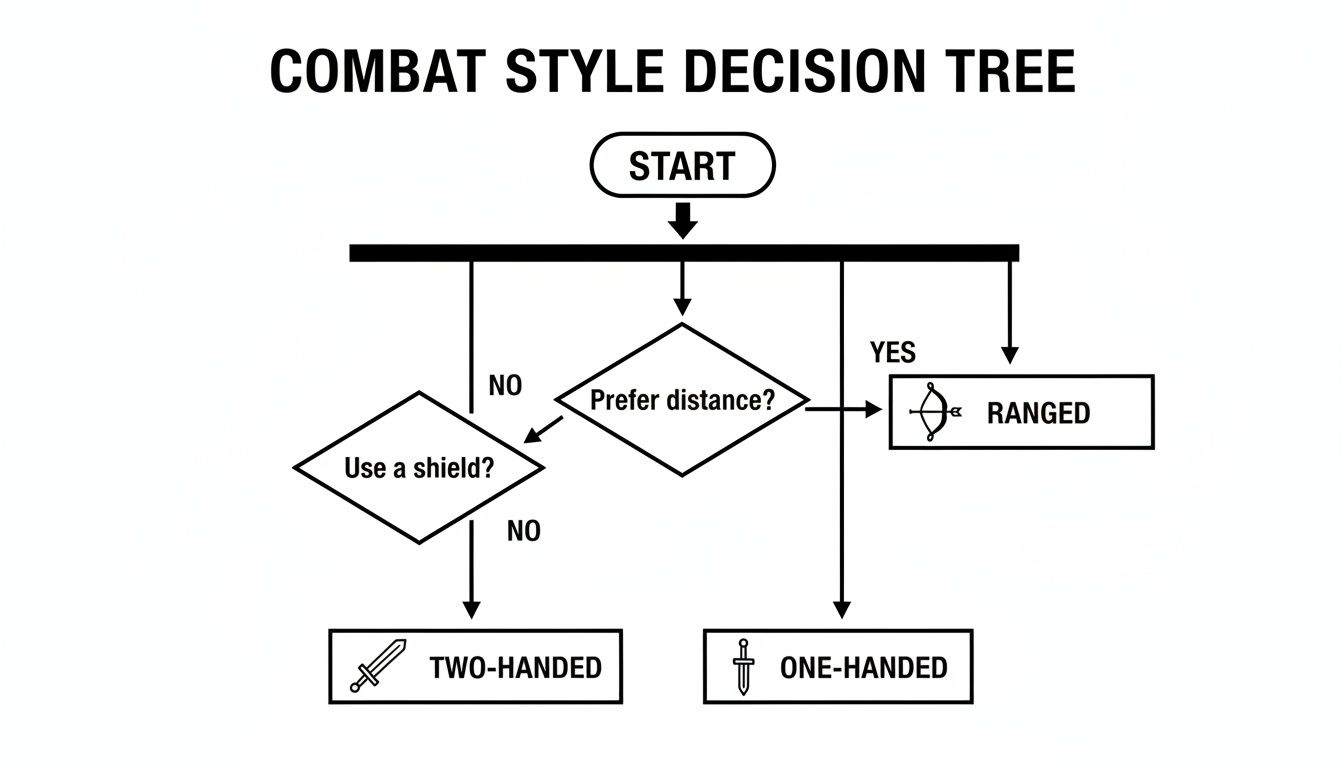
Each of these paths leads to a different way of fighting, complete with its own tactical advantages and unique feel at the table.
To get the ideas flowing, let us look at some classic hero archetypes and the weapons they are famous for. Think of these as proven starting points, not restrictive rules. Getting this pairing right is a huge part of the fun, and if you need a hand with the whole process, our guide on how to make a Dungeons and Dragons character walks you through every step.
The Towering Barbarian: When you think of raw, untamed fury, you probably picture a Greataxe. Its massive d12 damage die is the perfect match for a Barbarian's high-risk, high-reward combat style, especially when combined with their Brutal Critical feature. It just feels right.
The Nimble Swashbuckler: For characters built on grace, precision, and a bit of flair, the Rapier is the only real choice. As a Finesse weapon, it lets Dexterity-based fighters land devastatingly accurate strikes. It is the go-to for Rogues, swashbuckling Bards, and anyone who prefers a flash of steel to brute force.
The Disciplined Controller: A true battlefield tactician needs a weapon that dictates the flow of combat. The Glaive or Halberd is perfect for this. Their Reach property lets you attack from 10 feet away, creating a zone of control and keeping enemies exactly where you want them.
Your weapon choice should feel like an extension of your character's soul. It is not unlike building a deck in a game where a single card choice can shape your entire strategy for a match. Let these classic pairings inspire you as you arm your own hero for the adventures ahead.
The world of tabletop gaming never stands still; it is a multiverse of brilliant ideas and clever mechanics. While this guide has walked you through the nuts and bolts of D&D 5e’s martial weapons, the very idea of what combat can be is constantly being reinvented by creators and players. The core skills you've honed here—understanding reach, damage types, and tactical positioning—are the very foundation you’ll need to find victory in any new arena you step into.
This creative spark is everywhere you look. Crowdfunding continues to be a massive force, with over 6,000 tabletop projects getting their start on Kickstarter. Fantasy games, in particular, receive much love, pulling in 28% more funding than other genres. This is all part of a huge 8.4% market growth that has seen the global industry swell to $22.03 billion. Here in Britain alone, D&D 5e has over 1.2 million players, all of whom have likely mastered weapons like the trusty greataxe (1d12 slashing) since the game's 2014 launch. You can dig into more of these numbers over at Grand View Research.
It is fascinating to see how these classic D&D concepts are being reforged in new games. Take the roguelite deck-builder, TerraClash, for example. In a game like that, a weapon is not just a static line on your character sheet. Instead, it might be a dynamic card you draw from a deck—a deck you build and fine-tune as your adventure unfolds.
This approach brilliantly captures that classic thrill of finding a magic sword in some forgotten tomb, but it blends it with the deep, satisfying strategy of deckbuilding. Your armoury literally becomes a living, evolving part of your character's journey.
A hero’s true weapon is not the steel in their hand, but the wit to adapt to any challenge the fates throw their way. The form of the weapon matters less than the mind that wields it.
So, as you gear up for your next campaign, whether you're rolling dice or drawing cards, remember that the heart of any great game is strategic choice. Every decision matters, from picking your spells to crafting the perfect challenge with an encounter builder 5e. It all shapes the story. To see how these classic ideas are being reimagined, it is well worth exploring innovative projects like the TerraClash Kickstarter.
Even the most seasoned veterans have questions that arise mid-combat, those little queries about steel and tactics that can make all the difference. Let us tackle some of the most common questions that are heard around the training yard about martial weapons in 5e.
Think of it as the difference between a farmhand's tool and a soldier's instrument of war. At its core, the distinction comes down to specialised training, which is what proficiency represents in the game. Simple weapons are straightforward and easy to pick up, but they are not designed for the complexities of a real fight.
Martial weapons, on the other hand, require dedicated practice to use effectively. This training unlocks their true potential: better damage dice (like a greataxe's d12 over a club's d4) and, more importantly, tactical properties. Features like Reach or Heavy are almost exclusively found on martial weapons, and they are the gateway to some of the most powerful character builds and feat combinations in the game.
If your class did not grant you this training from the start, do not worry, you are not out of luck. The most common way to acquire it is through the Weapon Master feat. It is a straightforward trade: you spend an Ability Score Improvement to gain proficiency with four weapons of your choice, reflecting a period of intense training.
Alternatively, some class specialisations grant this skill. A Cleric who follows the War Domain or a Bard from the College of Valour, for instance, blends their divine or artistic talents with martial prowess, getting all the necessary proficiencies. Your DM might also allow you to train during downtime, though this usually costs a goodly sum of gold and time.
If we are speaking of a single, raw, unbuffed swing, the title goes to the Greataxe and the Maul. Both boast a massive d12 damage die, giving them the highest potential damage for one hit.
But the conversation changes once you factor in popular feats like Great Weapon Master. At that point, any weapon with the Heavy property—the Greataxe, Maul, and Greatsword—becomes a top-tier damage dealer. The choice then becomes a matter of preference. Do you prefer the steady, reliable damage of the Greatsword's 2d6, or do you wish to swing for the fences with the all-or-nothing volatility of the Greataxe's 1d12?
Some adventurers are simply built for the front line, practically born with a blade in hand. The classes that come standard with proficiency in all martial weapons are the Barbarian, Fighter, Paladin, and Ranger. For these classes, knowing how to handle any weapon of war is a fundamental part of who they are.
Mastering the art of combat is one of the most rewarding parts of D&D, full of tactical choices and epic moments. If you love the strategic side of character building, you'll feel right at home with the challenges in TerraClash. Check out our roguelite deckbuilding and dice RPG by visiting the TerraClash Kickstarter page and get ready for a new kind of adventure.