Greetings, adventurer. Gather close, and listen. Have you ever gazed upon a raven perched on a gnarled branch and wondered at the ancient secrets it has witnessed? That flicker of curiosity is the very spark of the Speak with Animals spell—a mystical key that unlocks a world of knowledge whispered on the wind and chittered in the undergrowth.
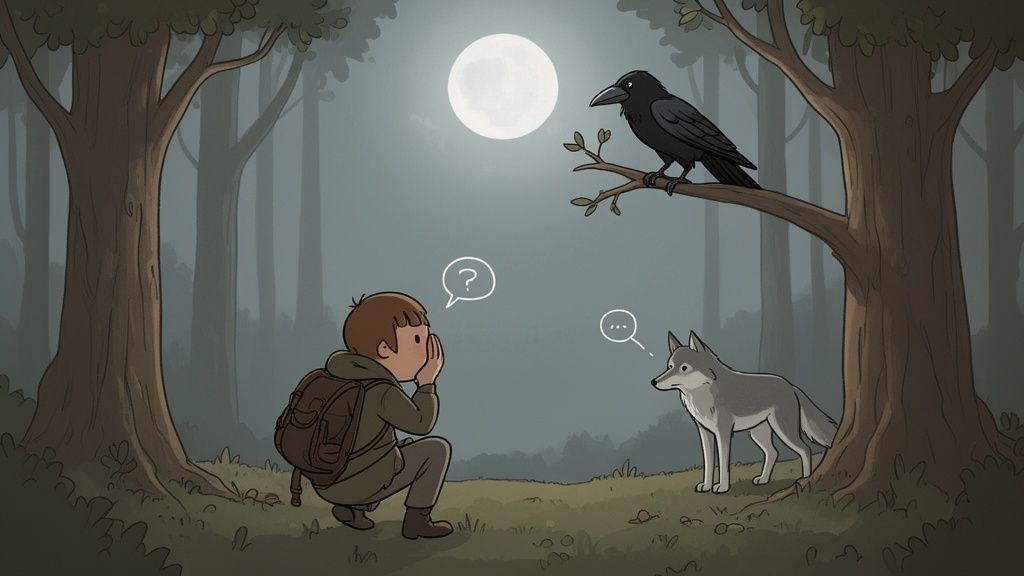
Have you ever yearned to ask a wolf of the hidden paths it roams, or a spider of who has passed through its silken web? This is the power the incantation grants. It transforms the wilderness from a mere backdrop into a living, breathing network of potential spies, guides, and ancient storytellers.
This tome is here to guide you far beyond the spell's basic text. I shall show you how to turn what some might dismiss as a minor charm into one of the most powerful tools in your arsenal for solving mysteries and forging unexpected alliances.
It is this fantasy of communicating with nature that resonates so deeply, fuelling the incredible growth of tabletop roleplaying games. The desire to connect with and understand the wild is a powerful one, and it's a theme that runs through the very heart of everything from grand TTRPGs to tactical deckbuilders, where every card played is a pact made with the forces of the world.
It is easy to dismiss this spell as a simple parlour trick—a whimsical way to chat with a squirrel about its hoard. But a seasoned adventurer knows better. The ability to speak with animals offers some truly unique tactical advantages.
As we delve deeper into the art of conversing with creatures, it can be fun to spark your imagination with visual aids like these free animal coloring pages to appreciate the sheer diversity of life in the wild. It is that very spirit of forming pacts with the natural world that inspires new adventures, like the roguelite deckbuilder TerraClash, where your bond with the land's inhabitants shapes your entire destiny.
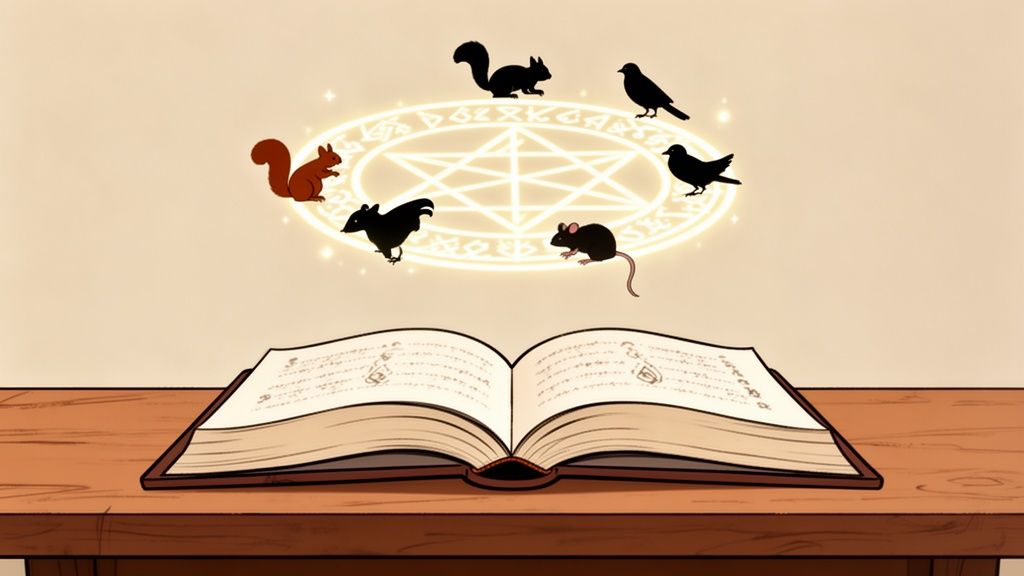
Before you can begin interrogating squirrels about hidden stashes of nuts (or treasure), you must understand the arcane rules that bind the magic. At its core, Speak with Animals is a 1st-level divination spell. That may not sound flashy, but its true power lies in a small but mighty detail: it can be cast as a ritual.
This, my friend, is the secret that separates the novices from the veterans. Casting it as a ritual stretches the casting time to 10 minutes, but here’s the game-changer—it does not consume a precious spell slot. This means you can commune with the local wildlife all day long without tapping into the magical reserves you'll need for battle. Think of it less like a magical grenade and more like a skill you can call upon whenever the need arises.
Unleashing the spell is straightforward. You only need Verbal (V) and Somatic (S) components, which is a scholar's way of saying you must speak the magic words and weave the correct gestures. Once the magic takes hold, it lasts for a solid 10 minutes, letting you chat with any beast that wanders within a 30-foot range.
To get you up to speed quickly, here is a handy table summarising the spell's core features.
| Attribute | Details | Gameplay Implication |
|---|---|---|
| Spell Level | 1st | Accessible early on for many classes. |
| School | Divination | Focused on gathering information, not direct effects. |
| Casting Time | 1 action or 10 minutes (Ritual) | Fast in a pinch, or free to cast with a little time. |
| Range | Self | The effect centres on you, affecting beasts near you. |
| Components | Verbal (V), Somatic (S) | Cannot be cast while silenced or with your hands bound. |
| Duration | 10 minutes | Plenty of time for a good conversation or two. |
This table is your go-to reference during a session, keeping the key stats right at your fingertips when you need them most.
Now, let us get to the important part of the spell's description: you can only chat with beasts of "limited intelligence". This is not just a bit of flavour text; it is a vital clue for both mechanics and roleplaying. An animal’s world is a whirlwind of instinct, survival, and whatever is happening right now.
You gain the ability to comprehend and verbally communicate with beasts for the duration. The knowledge and awareness of many beasts are limited by their intelligence, but at a minimum, beasts can give you information about nearby locations and monsters, including whatever they can see, hear, or smell.
This means you are not going to have a philosophical debate with a badger about the meaning of life. You must frame your questions around its direct, sensory experiences.
The answers you get will be filtered through that animal's unique perspective. A rabbit will not describe a knight as a "human in full plate armour." It will be a "loud, shiny, hard-shelled walker." The real fun of the spell is piecing together these primal clues.
And remember, the creature is not magically compelled to help you or even tell you the truth. Your approach matters. A friendly word and a good Persuasion check can often turn a skittish mouse into a willing informant. In that sense, the spell isn't just about magic; it tests your character's social skills, much like trying to overcome a difficult spell save DC 5e.
Too many adventurers, bedazzled by flashy fireballs and crackling lightning bolts, dismiss this spell as a charming little trick for talking to squirrels. That, my friends, is a grave error. For the player who thinks beyond the obvious, Speak with Animals is a master key, capable of unlocking secrets that remain completely hidden from those who only listen to the words of people.
Think about it. You could turn a city's ever-present rat population into a sprawling network of furry spies, their whiskers twitching with every detail of a villain's movements. You could persuade a lord's prized hunting hound to conveniently ignore your party as you slip past a guarded gate, its silence bought with the promise of a juicy bone. This spell is not about pleasantries; it is about turning the entire natural world into your own personal intelligence agency.
The real magic of Speak with Animals happens in the shadows, where a single piece of information is worth more than a pouch of gold. Beasts are the perfect, unassuming witnesses to all manner of deeds, both foul and fair. They notice things that people are trained to ignore.
An animal's perspective is refreshingly simple. They do not lie about allegiances or spin complicated tales for political gain. They report what their senses tell them—the smell of fear, the sound of marching boots, the sight of a hidden lever.
Just by asking the right questions, you can gather raw, unfiltered intelligence. This elevates you from a simple adventurer into a master strategist, always one step ahead of your enemies. It is the kind of smart play that defines the best tabletop games, where knowledge and clever alliances pave the road to victory.
When a mystery arises, most adventurers immediately start questioning guards, merchants, and nobles. They completely forget about the silent witnesses that were there the whole time. A crime scene in an alleyway might just be a mess of bricks and rubbish to a detective, but to the spider in the corner, it is a detailed account of everything that happened.
The spider cannot tell you the killer's motive, of course, but it can describe the "big, loud stomper" who smashed its web and the strange perfume they left behind. A mouse hiding behind the walls of a noble's study might have overheard a whispered conspiracy, even if it only understood the tones of fear and greed. For any character in tune with nature, this is an essential tool, right up there with the most powerful D&D druid spells.
It is these little fragments of information, once you piece them together, that can crack a case wide open. You are no longer limited by what people choose to tell you; you have tapped into a hidden layer of truth, spoken in the language of instinct and survival.
So, you have mastered the incantation and are ready to chat with the local wildlife. But now you face the true gatekeeper: the Dungeon Master. The straightforward text of Speak with Animals often opens up a whole cavern of curiosities, leaving every DM to make the final call on some tricky questions.
What happens when you try to talk to an entire swarm of bees? Do they buzz back with a single hive mind, or is it just a cacophony of a thousand tiny voices? What about those creatures on the fringe, like an Owlbear or a Griffon? Sure, the rulebook labels them 'Monstrosities', not 'Beasts', but their minds are far closer to a bear or an eagle than a scheming goblin. A good DM knows the rules are just the foundation of the story, and letting a player have a broken, frustrating chat with an Owlbear can create a truly memorable scene. It is in these little judgements that a world starts to feel properly real. Our Dungeons and Dragons Dungeon Master guide has more advice on making these kinds of calls at the table.
The greatest challenge—and the most fun—for a DM is getting inside an animal's head. How do you roleplay a creature whose world is built on instinct, smell, and the constant hum of survival? A wolf does not think in terms of ‘good’ and ‘evil’; its reality is the pack, its territory, hunger, and immediate threats.
An animal's reply should always come through the filter of its own senses and priorities. A badger would not describe a passing knight by the crest on his shield. It would be something more like, "the loud, shiny-shelled thing that smelled of cooked meat and fear." This is not just for flavour—it is a genuine clue, a puzzle for your players to piece together.
This is where the magic of the spell truly comes alive. The DM's job is to translate the party's questions into answers that are both authentic to the creature and genuinely useful. When you get it right, an encounter with a simple field mouse can become just as engaging as a parley with a king. This depth of interaction is a massive draw for players, who relish the chance to immerse themselves in a rich and believable world.
This flowchart can be a great little tool for both DMs and players to figure out the best approach. Are you trying to get information, or are you trying to get the animal to do something?
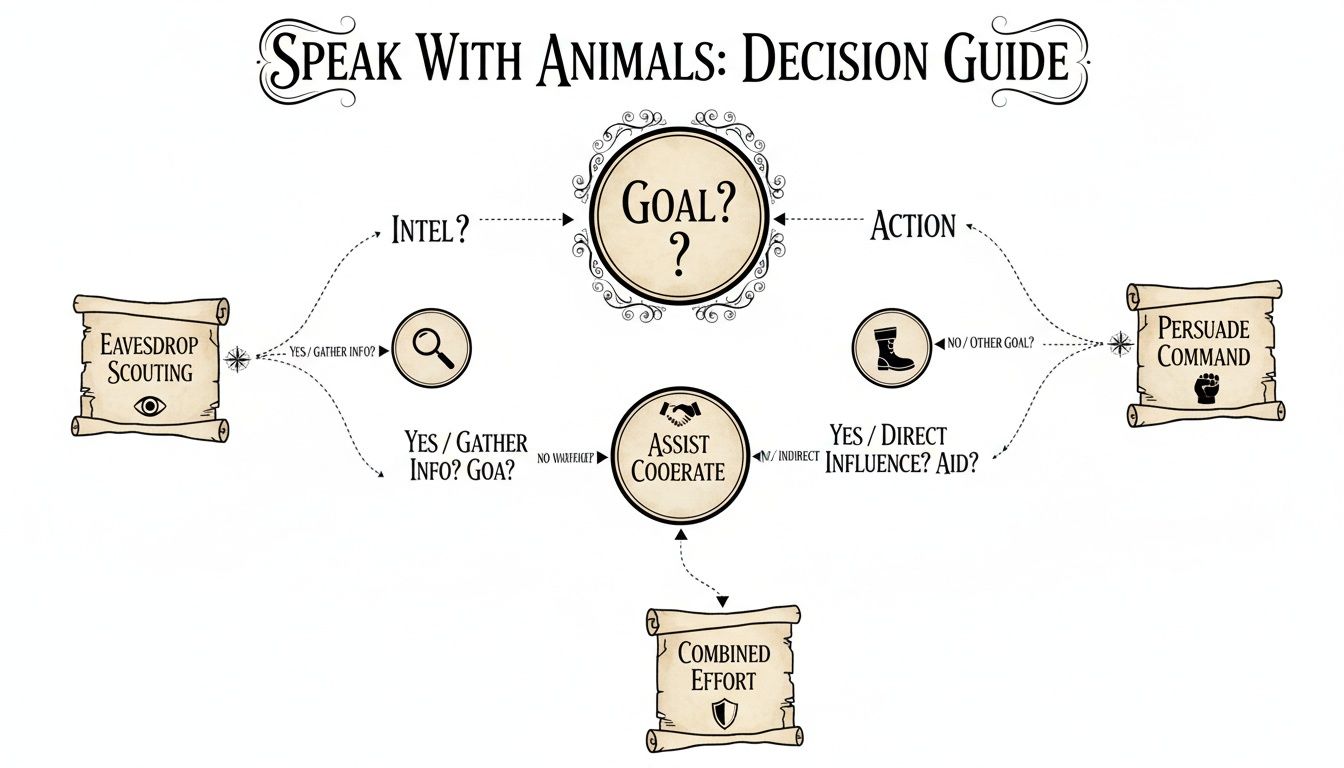
Thinking about your goal beforehand—intel or action—will help you ask much better questions and get much better results from the spell.
Let us delve into a few of the classic head-scratchers that always seem to crop up at the table:
Having consistent rulings for these edge cases helps everyone at the table, while still leaving room for plenty of creativity. It's that mix of solid rules and imaginative storytelling that makes TTRPGs so special.
The dream of talking to animals is one of those classic fantasy tropes that goes way beyond a single D&D campaign. You see it pop up everywhere, woven into the fabric of countless tabletop and card games, which really speaks to its timeless appeal. It is like a shared language connecting different gaming worlds.
Look to the great deckbuilders, like the venerable Magic: The Gathering. In that realm, a creature's abilities often hint at a deeper, almost symbiotic bond with the planeswalker summoning them. A colossal wurm or a tricky faerie isn't just a blunt instrument you throw at your opponent; it works with you. Its unique skills become a key piece of your overall strategy, which is not so different from convincing a wolf to scout ahead for your party.
This idea of communing with the natural world creates a brilliant bridge between games. In many story-focused board games, such as Gloomhaven or the upcoming Frosthaven, gaining an animal companion isn't just a bit of fun flavour. It often unlocks entirely new ways to play, giving you access to abilities no one else at the table possesses. It’s a mechanic that rewards players for thinking outside the box and connecting with the game's world.
This shared fascination is also a massive well of inspiration for game designers. It's the core idea behind exciting new projects like the deckbuilding roguelite, TerraClash, where making pacts with the creatures of the land is absolutely central to survival. Mechanics like these let us explore what an alliance truly means, moving beyond just hitting things with a sword. You can actually follow TerraClash's journey to its Kickstarter here.
The love for these themes is not some niche interest. The UK's fantasy gaming market shows just how much these ideas connect with people. In a recent quarter, high‑fantasy mobile games brought in vast revenues, with player counts in the millions. These games are built on the idea that every creature card has its own tactical personality, proving the wide appeal of animal-centric strategy. You can discover more insights about these gaming trends if you are curious.
And so, our journey through the whispers of the wild draws to a close. But for you, this is just the beginning. We have broken down the spell's mechanics, explored its tactical depths, and navigated the finer points of actually roleplaying a chat with a squirrel. From grilling a city rat for secrets to getting a bird's-eye view from a soaring eagle, you now have a real sense of the power packed into those ten precious minutes.
Speak with Animals is a fantastic reminder that the biggest impact does not always come from a flashy fireball. Sometimes, true strength lies in cleverness, in knowing something others do not, and in making an unexpected connection. It is about seeing the world through different eyes and using that unique perspective to your advantage.
That same spirit—valuing creative thinking and forging unusual alliances—is the very heart of the tabletop gaming community. It is what drives so many brilliant indie projects that try to capture that exact feeling of adventure, creating games for ages 12+ that reward cunning and a bond with the world's creatures, not just brute force.
This philosophy is exactly what is fuelling projects like the roguelite deckbuilder, TerraClash. It is a game that looks to be built from the ground up on the idea of mastering a world full of strange beasts and tactical decisions.
You can get a feel for the deep, strategic gameplay they are aiming for from this early development image.
Just a glance shows a rich tapestry of card abilities and character stats, hinting at the sort of complex choices and synergies players will get to sink their teeth into. If that kind of world-building and tactical depth sounds like your cup of tea, you might want to follow the TerraClash Kickstarter campaign and see how their adventure develops.
May your dice roll well, and may your tales be memorable. Now, go forth and listen to what the animals have to say.
Every adventurer who learns to speak with the wild eventually runs into the same tricky questions. Let us clear up some of the most common head-scratchers that pop up when you start chatting with squirrels and wolves.
Ah, the classic Owlbear problem. This is one of those areas where the official rules and your Dungeon Master's world might diverge a little.
Strictly by the book, speak with animals only works on creatures with the ‘Beast’ type. Things like Griffons, Owlbears, or Displacer Beasts are categorised as ‘Monstrosities’, so RAW (Rules As Written), the spell fizzles out. They are just not animals in the magical sense.
That said, many DMs love to bend this rule for the sake of a good story. A common house rule is that you might get a jumble of raw feeling and instinct instead of a real conversation. You will not be discussing philosophy with an Owlbear, but you might get a powerful sense of its rage, its hunger, or its fierce desire to protect its cubs – which can be just as useful.
Not a chance. This is probably the biggest misunderstanding about the spell. It is a translation tool, not a mind-control spell.
Think of it this way: the animal is not your servant. It is just a creature that can now understand your words. It still has its own instincts, fears, and goals. You will need to win it over the old-fashioned way – a tasty snack, a friendly approach, or a successful Charisma (Persuasion) check might just do the trick.
If you are looking for a proper conversation, you will want to find one of the brainier beasts. Officially, creatures like Apes, Dolphins, and Giant Owls are at the top of the class with an Intelligence score of 6. That is smart enough to grasp more complex concepts, so you could ask them things like "Who's in charge around here?" or "Where is the shiny thing hidden?"
On the other end of the scale, you have creatures with an Intelligence of 1 or 2, like most fish or insects. Do not expect much from them. Their world is all about instinct, so the best you will get is a simple "danger nearby" or "food over there".
If you love the idea of making allies out of strange creatures and diving into deep, tactical gameplay, you will want to keep an eye on this. TerraClash is a new roguelite deckbuilding and dice RPG that really leans into that sense of adventure and discovery. Follow its journey and be one of the first to join the fray by checking out the TerraClash Kickstarter campaign. Independent creators are the lifeblood of our hobby, and you can discover other amazing projects on platforms like Kickstarter or Gamefound.

