Hark, adventurer! You have heard the whispers on the wind. Tales of wondrous new worlds and epic quests brought to life not by ancient, monolithic guilds, but by a fellowship of loyal patrons. This is the sorcery of Kickstarter, a realm where creators of arcane lore and cunning games forge a pact directly with the heroes who will champion them. If you dwell in the lands of the UK and your heart quickens at the sound of rolling dice and the scent of a new game box, then you have found your guild hall.
The platform has shattered the old ways of the tabletop scribes. It tears down the obsidian walls between a brilliant vision and a game you can hold in your hands, creating a powerful, direct bond between the lore-master and their future champions. Do not mistake this for a mere marketplace—it is a sacred pact.
As a backer, you are not simply acquiring goods. You are pledging your gold and your faith to help a creator see their quest through to its glorious end. It is an oath that bankrolls the entire ritual of creation, turning ethereal sketches and wooden prototypes into a real, tangible artifact you can finally bring to your table.
This is precisely how grand sagas, from sprawling fantasy epics to cunning deckbuilding duels, are now forged. For any who heed the call of the tabletop, it is a chance to be present at the very dawn of a game's legend.
Heed my words! Kickstarter is where you, the player, hold the power to shape the future. Your pledge is a spell. It is you declaring, "I wish to play this. This game deserves to exist in our world."
You become a founding member of that game's fellowship, often granted visions of its creation as it evolves from rough scrawls to a final, magnificent artifact. Many of this age's greatest indie triumphs began their journey thus.
Consider titans like Gloomhaven or Scythe. Their campaigns were but a humble plea for aid that erupted into worldwide phenomena, all thanks to a fellowship that believed in their quest.
This grimoire shall guide you through the mystical lands of Kickstarter in the UK. We will reveal its inner workings, whether you seek to back a tactical deckbuilder like the forthcoming TerraClash campaign or merely wish to uncover the next hidden treasure. The time has come to help forge the next tabletop legend.
So, you have uncovered a quest you deem worthy and are ready to pledge your support. Excellent! Enlisting as a backer on Kickstarter in the UK is a simple rite, but it is wise to understand the pact you are making.
First, you must create a Kickstarter account. It is a swift enchantment, and once inscribed, you must link a method of payment. For most of us in the UK, this will be a standard debit or credit card.
Here lies the most crucial piece of lore about Kickstarter's magic: your coin is not taken the moment you pledge. The realm operates on an all-or-nothing enchantment. Your gold is only collected if the quest successfully reaches its funding goal by the appointed hour. Should it fall short, no gold changes hands. It is a powerful ward that minimises risk for all who enter the pact.
When you go to back a quest, you will not see a single price. You will find a scroll of different pledge tiers, which are essentially reward bundles offered by the creator. Think of it as a menu of tributes for supporting the campaign.
Choosing a tier depends on how deeply you wish to be involved and what treasures you seek. Each pledge, great or small, helps the creator manifest their vision, be it a grand board game saga or an innovative deckbuilder like the TerraClash campaign.
Before you seal your pledge, it is wise to be aware of the king's tariffs (VAT) and customs. If you are backing a UK-based quest and you also dwell in the UK, this is usually simple – the creator has likely woven any VAT into the pledge price.
The tapestry changes for quests from distant lands. If a game is being shipped from across the sea, you may be liable for import VAT and handling fees when it arrives in the UK. This is an extra cost atop your pledge and shipping.
Any quest leader worth their salt will be forthright about these potential costs. They should have a clear "Shipping" section on their campaign scroll with estimates for different regions and an explanation of how they are handling taxes.
Always, always read the shipping section carefully before you pledge. Honesty here is a powerful sign of a well-run campaign and means you will not face a nasty surprise when your game finally arrives at your stronghold.
The chronicles of Kickstarter in the UK are filled with epic sagas, especially when you gaze upon the tabletop games that have been summoned into existence. These are not just funding campaigns; they are modern legends where creators and backers unite to build something truly special. By delving into these legendary quests, we can see what makes a campaign resonate with thousands of souls.
Take Dark Souls: The Board Game. That campaign was a masterclass in transmuting a beloved video game into a tangible, brutally challenging tabletop ordeal. The creators captured the very essence of the source material—the punishing difficulty, the immense satisfaction of victory, and the deep, atmospheric world. They translated it all perfectly to the board.
Its monumental success proved that UK adventurers have a ravenous appetite for quests that mix familiar worlds with fresh, strategic gameplay. Their journey shows just how powerful a strong, established theme can be. When backers already have an emotional bond to a universe, they are far more likely to join the quest.
Another shining example is Monster Hunter World: The Board Game. This project also drew from a massive video game franchise, promising huge miniatures and deep, tactical combat that perfectly mirrored the exhilarating hunts of its digital sibling. It wasn't just a game being sold; it was an event. It was a chance for fans to bring a piece of that epic world right onto their own tables.
Here in the UK, Kickstarter has become a true forge for board games, which consistently top the scrolls as the most-funded projects. The undisputed champion is Dark Souls: The Board Game, which summoned an incredible £3.77 million from its passionate fellowship. Hot on its heels is Monster Hunter World, which secured £3.44 million, proving how much the UK loves immersive gaming. If you explore the data on top UK projects, you will see just how dominant the tabletop fellowship is.
These triumphs teach us vital lessons. A powerful theme, a faithful adaptation, and deep, replayable mechanics are the cornerstones of a winning Kickstarter campaign in the UK. They show that backers aren't just buying a product; they're investing in an experience, a world they already love. These titans paved the way for new games, like the shapeshifting world of TerraClash, to follow.
This is a glimpse of the TerraClash Kickstarter page, showing how a new project introduces its unique world to potential backers.
The page immediately sets a mystical tone, inviting players into a world of adventure, which is crucial for capturing the imagination of fantasy and tabletop game fans.
Beyond a grand idea, these legendary campaigns mastered two other critical arts: communication and stretch goals. The creators did not simply launch their quest and vanish into the ether. They sent constant missives, sharing behind-the-scenes progress and actively engaging with their fellowship of backers in the comments. This is how you build trust and make backers feel like true partners on the journey.
Stretch goals were also wielded brilliantly. They were not just funding milestones; they were exciting new chapters in the adventure. Unlocking a new hero, a terrifying monster, or a deluxe component adds to the fervour and gives the entire fellowship a shared goal to strive for. It turns the campaign from a simple transaction into a cooperative quest, much like the best cooperative board games that master this sense of shared purpose.
The lessons are clear for any aspiring creator or discerning backer. A strong vision rooted in a compelling world, paired with transparent communication and exciting, evolving rewards, is the formula for a legendary Kickstarter quest. It’s this spirit of adventure that continues to make the UK a vibrant nexus for tabletop game creation, paving the way for the next great story, like the one waiting to unfold in the TerraClash campaign.
So, you possess a brilliant vision for a game and are ready to breathe life into it? Excellent. For any who seek to launch a Kickstarter in the UK, it is an incredible journey, but heed my warning: it is also a perilous one. Think of it less as a sprint and more as a meticulously planned expedition into uncharted territory.
Before you even consider sounding the horn of 'launch', you must consult your ledgers. I speak of a deep dive into your production costs, a realistic estimate for shipping (a notorious campaign-slaying beast), and, of course, Kickstarter’s own tithe. This is not the dull part; it is the foundation of your entire fortress. Falter here, and even the most magnificent game can end up costing you your treasure hoard.
And there is another beast lurking in the shadows that catches so many UK creators unawares: VAT. Truly, do not underestimate it. Forgetting to factor in VAT can turn a triumphant success into a financial cataclysm. My finest counsel? Converse with an accountant who knows the ways of crowdfunding. They will help you navigate the treacherous paths and ensure your treasure chest is protected.
The path from a spark of an idea to a fully funded project is not a random walk. It is a ritual, where each step follows the last. You need a theme that ensnares the imagination, mechanics that keep heroes enthralled, and communication that makes them feel part of the fellowship.
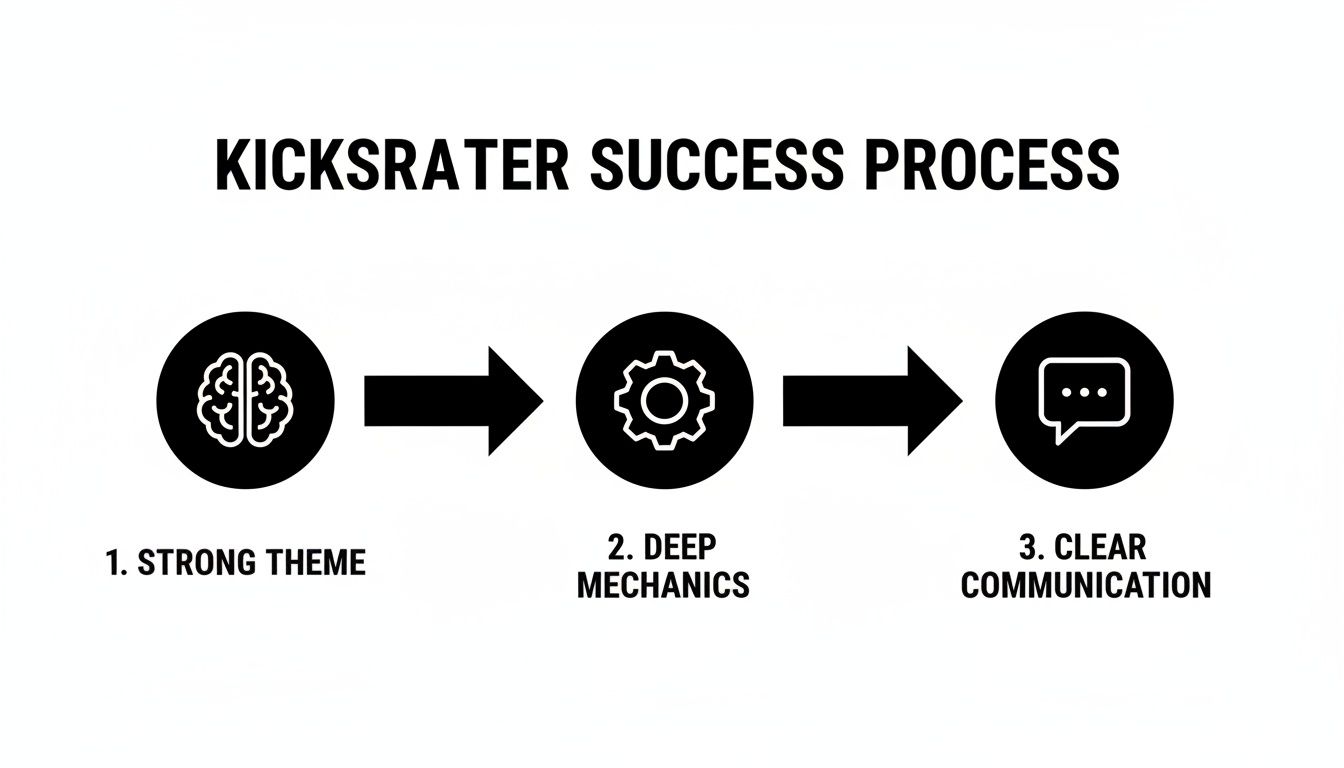
As you can see, it is not one single element that makes a campaign take flight. It is the alchemy of a captivating world, solid gameplay, and being open and honest with the heroes who are placing their faith in you.
To help you organise your quest, think of your journey in phases. Here is a quick checklist framed as an adventurer's quest to keep things in perspective.
| Quest Phase | Key Considerations | Mystical Analogy |
|---|---|---|
| The Scouting Mission | Budgeting for manufacturing, shipping, fees, and VAT. | Charting the map and gathering supplies before the journey. |
| The Call to Arms | Crafting a compelling story, art, and gameplay videos. | Sounding the horn to rally allies to your banner. |
| Forging the Fellowship | Building a community through updates and engagement. | Sharing tales around the campfire to build camaraderie. |
| The Final Siege | Executing the live campaign and hitting funding goals. | The final push to claim the castle. |
This is not just a list; it is your sacred map. Following it will keep you from getting lost in the enchanted woods.
Your primary role is to be the storyteller, the bard singing the epic tale of your game. You must craft a narrative that draws people in, display jaw-dropping art that makes your world real, and offer them a taste of the action with gameplay videos or a print-and-play demo. Your passion must shine through every rune you scribe.
Your campaign page is your grand unveiling. It is where you make your plea. If you struggle to structure it, consulting a guide to creating impactful pitch decks can offer surprisingly potent wisdom. A clear, well-presented scroll is often the difference between being funded in hours and fading into obscurity.
Remember, you are not just selling an artifact; you are building a fellowship. These early backers are more than customers—they are your champions. Every update you post, every question you answer, every scrap of concept art you share tightens that bond. Make them feel they are right there with you on the adventure. Because they are.
You are your own gatekeeper. In this age of creation, the platforms are there. The problem is that you might have a dream project, but you haven't brought it forth yet. You are the only thing standing in your way.
These words ring true. The tools we need to create something like TerraClash are all around us. The greatest obstacle is often finding the courage to begin the quest.
People back people. It is that simple. Be true, be authentic, and share your journey—the triumphs and the tribulations. When backers see the genuine passion and the soul behind the project, they are far more willing to join your quest.
Do not be afraid to delve into the arcane details. Explain why you made a certain design choice. Plunge into the lore of the world you have built. This is what makes your world feel alive. Your story becomes their story. By sharing the entire process, from rough sketches to the final manufactured copy, you create a narrative that people will feel proud to have been a part of. The TerraClash campaign is a perfect example of a story just waiting for its first heroes to join in.
Crowdfunding in the UK is entering a new age of power. You can feel a palpable energy building, fundamentally changing how creative quests get off the ground. This is not just a passing fancy; it is a genuine shift in how great ideas become real, tangible things you can hold.
For the tabletop gaming fellowship, this is joyous news. It means creators have the freedom to be more ambitious, designing games with better components and exploring a wider variety of themes. They no longer have to persuade a handful of traditional publishers; they can go straight to the people who will actually play and love their game.
What drives this surge? A massive hunger for unique, engaging entertainment. It is the same social magic that has kept people gathered around tables for games like Dungeons & Dragons for generations. Now, independent creators can tap directly into that wellspring of passion.
The growth we are witnessing is staggering. The UK crowdfunding market, powered by realms like Kickstarter, is on an incredible upward trajectory. Divinations show revenue climbing from USD 106.4 million to a massive USD 270.1 million by 2030. That is a compound annual growth rate of 17.2%, a pace that leaves many old-world funding models in the dust. You can delve into the specifics in these UK crowdfunding market findings.
So, what does that truly mean for you, the gamer? More choice. More creativity. And more chances to be there at the beginning of something legendary. We are living in a golden age for independent games.
This surge isn't just about the gold. It's proof that a community can bring new worlds to life, one pledge at a time. It’s the collective voice of gamers declaring, "This is what we want to play next."
For a game like TerraClash, which is for ages 12 and up and blends deep strategy with an accessible system, this expanding market is a monumental opportunity. There is a growing audience out there, ready and waiting to explore new worlds and create their own legends.
This growth is not just about financial metrics; it is about connection. When you back a project, you are not just placing a pre-order. You are becoming part of the creator’s journey, gaining a seer’s view of the entire process and even helping to shape the final artifact.
Consider the giants on whose shoulders we all stand.
This is exactly the kind of environment where new classics are born. The current climate in the UK is perfect for fresh ideas to take root, nurtured by a passionate community hungry for the next great adventure. It’s a moment of huge potential, where a game like the TerraClash campaign can find its fellowship and make its mark.
So, our tale comes to a close. You have journeyed through the realm of Kickstarter, from the first spark of an idea to the tangled paths of shipping and tariffs in the UK. You have seen how creators and backers forge a fellowship, learned from the sagas of the past, and now hold a map for your own quests. The path is clear.
And just as one quest ends, another begins. On the horizon, a new call to adventure is sounding: a game called TerraClash. It is a roguelite deckbuilding RPG that promises a completely fresh, thrilling challenge every single time you play. The world is not fixed—it is built on the fly with randomised cards, ensuring you will never have the same adventure twice as you face down monstrous foes and master its deep, strategic combat.
The campaign for TerraClash is set to launch anon, and it is your chance to be more than just a player—you can be a founder of its universe. This is not just about adding another box to your hoard. When you back a project like this, you are helping to forge a world from the very ether. You become part of its first chapter, a name etched into its history.
You are your own gatekeeper. In this age of creation, the platforms are there... You are the only thing standing in your way.
That wisdom applies not just to the makers of games, but to the fellowship that brings them to life. Your pledge is the key that opens the gate and allows these incredible indie projects to march into reality. Backing a campaign is a powerful act of creation in its own right.
We would be honored if you would follow the quest for TerraClash and consider joining its fellowship. The life of a true adventurer is all about discovery, after all. Keep exploring other campaigns, lend your support to passionate indie creators, and become a true patron of the incredible UK tabletop scene. Your next great story is out there, and you have the power to help write it.
Follow the TerraClash campaign here to be notified the moment the adventure begins.
Right then, let's consult the oracle on a few common questions that arise whenever we speak of running or backing a Kickstarter quest here in the UK. Think of this as the essential intel you need before you embark.
Simply put, no gold leaves your pouch. Kickstarter operates under an all-or-nothing enchantment, which is a powerful ward for everyone involved. If a quest does not reach its financial goal by the appointed deadline, no money changes hands.
Backers are not charged a single coin, and the creator receives no funds. The quest is simply marked as unsuccessful, and the tale ends there. This system protects you from pledging coin to an idea that may not have enough resources to actually be forged and delivered.
Generally, no. If you are in the UK and backing a quest that is also based and shipping from within the UK, you should not have to worry about customs or import tariffs. The price you see is the price you pay, plus whatever shipping cost the creator has specified.
However, it pays to read the shipping scroll of the campaign page carefully. The creator must state where they are shipping from. Sometimes, even for a UK-based company, the rewards are manufactured and shipped directly from another land (like China). If that is the case, you could face customs charges when the parcel arrives.
A key enchantment to remember is that your pledge is not set in stone until the campaign is over. You can change your pledge amount or even cancel it at any point while the project is still live.
This flexibility is a great boon. It means you can increase your support if an exciting new stretch goal is revealed, or you can withdraw if your own coffers run low. It is only when the campaign successfully concludes that your pledge is locked in and your card is charged.
Ready to put this knowledge to use? The tabletop adventure TerraClash is gearing up for its own grand campaign. You can follow along and be notified the second it launches by heading over to the TerraClash Kickstarter page.

