Hark, adventurer, and gather 'round the hearth. The time has come to breathe life into a new hero, to take a flicker of an idea and forge it into a legend worthy of song. Before any die is cast or any map unfurled, the grand journey begins here, with the sacred act of creation. This is where we shape the soul of the hero you are destined to become.
Your epic tale begins not with a swing of a sword or the whisper of a spell, but with a simple, resonant question: who are you? Before we delve into the arcane arts of statistics and abilities, we must first uncover the heart of your character. Let us move beyond the well-trodden paths of the "gruff dwarf fighter" or "wise elf wizard" and seek the core of what truly makes them burn with purpose.
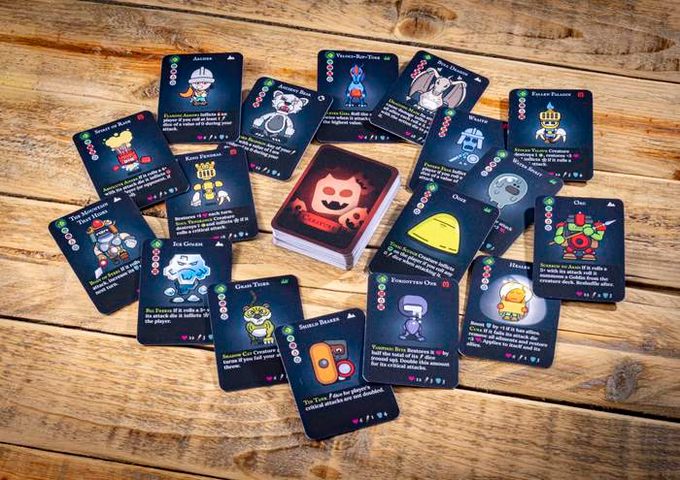
Consider it akin to assembling a master deck for a game of strategy and fate, like TerraClash. Your character's core concept is the grand strategy—it informs every card you draw, every gambit you risk. What ancient ambition drives them toward the horizon? What shadow from their past clings to them still? The answers to these questions are the very foundation upon which sagas are built.
The most memorable champions I have ever witnessed were not mighty because of their stats; their power came from the clarity of their purpose. This first stage of creation is about asking "why?" long before you consider the "what."
Why does your character walk the perilous path of an adventurer? Are they fleeing a forgotten crime? Pursuing a ghostly promise? Perhaps they seek forbidden lore to unravel a cosmic mystery, or simply wish to earn enough coin to save their humble village. A powerful motivation is the North Star of your journey, guiding every choice you will make in the trials to come.
If this is your first foray into such a grand undertaking, our guide on D&D for beginners is a worthy tome to consult.
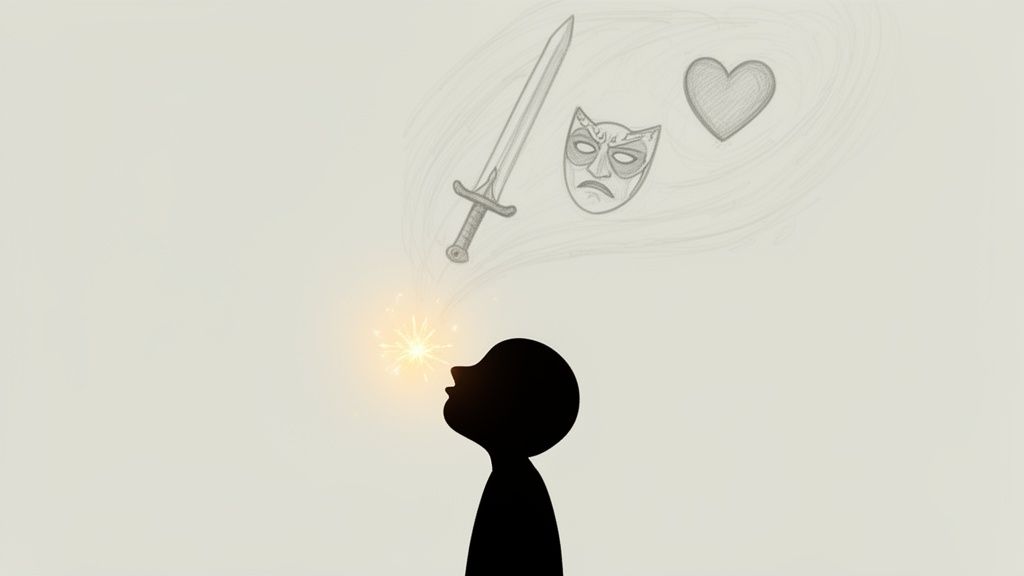
This simple flowchart illustrates how a fleeting thought can become the bedrock of your hero's destiny.

It is a simple ritual: you imagine a flicker of a soul, you ask the hard questions to grant them depth, and then you define the very essence of who they are.
This love for deep, personal storytelling is a powerful magic, and it is why the realm of tabletop gaming is flourishing. The board games market, which includes these grand RPGs, reached a staggering USD 611.49 million in 2024. It is foretold to climb to USD 1,505.75 million by 2033, a testament to how many of us are gathering to weave our own legends.
To stir the cauldrons of creation, it helps to consider the core elements that make a character feel truly alive. This table offers a few starting points for your sacred brainstorming.
| Concept Element | Guiding Question | Example Idea |
|---|---|---|
| Motivation | What drives them to risk their life? | To find a cure for a magical plague that afflicted their family. |
| Flaw | What is their greatest weakness or fear? | Overwhelming pride; they refuse to admit when they are wrong. |
| Bond | Who or what do they care about most? | An old mentor who vanished under mysterious circumstances. |
| Secret | What do they hide from the world? | They are the last surviving member of a disgraced noble house. |
These are not mere boxes to be checked; they are the potent seeds from which your character's entire saga will grow.
Sometimes, a vision is worth a thousand words. If you struggle to picture your character—how they stand, the look in their eye, the sigil upon their shield—visual inspiration can be a powerful scrying tool.
Spending a moment to gaze upon Fantasy RPG collections can ignite your imagination, offering visions for everything from the cut of their cloak to the ancient runes etched into their armour.
Remember, traveler, the greatest heroes are born from the most personal of sparks. Do not shy away from pouring your own hopes, fears, and quirks into your creation. It is this touch of the mortal soul that will make them truly legendary, both on the field of battle and around the council table.
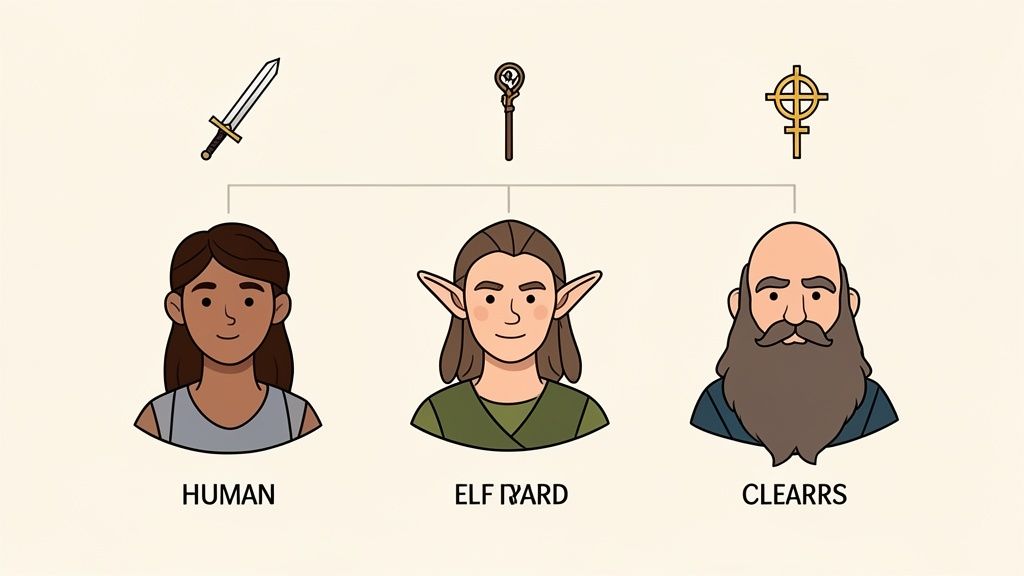
Heed the call! You have captured the spark of your hero's soul. Now, we must give that concept a form, a foundation of bone and purpose. In any worthy dnd character creator, this means choosing three sacred pillars: your Ancestry, your Class, and your Background. This is where the daydream solidifies and your adventurer takes their first breath.
First, we speak of heritage. What are you? A stoic, bearded Dwarf, hewn from the very stone of the mountains? Or perhaps a lithe and graceful Elf, with the wisdom of ages reflected in your eyes? To be a plucky Halfling or an adaptable Human is not merely a matter of statistics; it fundamentally colours how you perceive the world, and just as importantly, how the world perceives you.
Think of this as the bedrock of your being—the innate talents, cultural whispers, and physical traits that have been with you since birth.
With your roots firmly planted, it is time to decide your path. What is your calling? Your Class is arguably the most significant mechanical choice you will make, defining your entire approach to conflict and conundrum. Are you a Paladin, cloaked in steel and divine certainty? Or perhaps a Warlock, who bartered with some... otherworldly entity for your power?
Each Class offers a unique lens through which to view the world and its challenges. It is your primary grimoire for the entire campaign.
But do not think only of combat. A Bard might charm their way past a sentry that a Fighter could only challenge. A Monk’s inner discipline allows them to perform feats of agility that defy mortal limits. Your Class is your vocation, your area of mastery, and your road forward.
Finally, let us divine who you were before you chose this life of peril, chasing glory and gold. Your Background is the tale of your life until this very moment, granting you skills and tool proficiencies that echo your former trade. Were you a devout Acolyte, sequestered in a remote temple? A grim-faced Soldier, haunted by the spectres of war? Or perhaps a travelling Entertainer, with a story for every town and a song for every tavern?
Your background is the "why" behind your talents. A Folk Hero isn't just skilled with animals because the scroll says so; they likely grew up on the land. A Sage doesn't just know history; they spent their youth with their nose buried in dusty, forgotten tomes.
This choice is a great boon to your Dungeon Master, offering threads for the grand tapestry of the story, and it provides you with a deep well of motivation. These three elements—Ancestry, Class, and Background—are the pillars of your character. It is the interplay between them that creates a truly compelling hero, one prepared for any challenge, be it a classic dungeon delve or a strategic, deck-building campaign like the tales woven in TerraClash.
Now, for the alchemy. We have the concept, we know the role they will play, but what are they truly capable of? It is time to discover this by bestowing upon them their six core ability scores—the raw numbers that govern everything from the might of their swing to the power of their persuasive words.
These scores are the mechanical heart of your character, the engine that drives their every action.
So, how do you obtain these potent numbers? You have two classic paths. The first is to leave it to the whims of fate and roll the dice. This method is a thrill—you may end up with a genius Barbarian or a clumsy Rogue, and these unexpected quirks often birth the most memorable of heroes.
The other path is the point-buy system. Here, you are granted a set budget of points to distribute amongst your scores as you see fit. It is a more tactical, controlled approach, perfect for those who have a precise vision for their hero and wish to execute it perfectly. This feels much like building a deck for a card game, where every choice is deliberate and carries great weight.
Once you possess your six numbers, the true artistry begins: deciding where they belong. Let your character concept and Class be your guide. The Barbarian you are forging will require a high Strength score to be effective. Your shadowy Rogue will lean heavily upon Dexterity.
For a spellcaster, their primary ability score is paramount. A Wizard's power is tied directly to their Intelligence, which dictates the potency of their magic. If you consult the arcane formulae for calculating a spell save DC in 5e, you will see that your main casting statistic is the most crucial piece of the puzzle.
But do not fixate only on making your greatest score as high as possible. Sometimes, a low score is a gift to the storyteller. A Paladin with a low Charisma might be pious and just, but also socially awkward and unable to deliver an inspiring speech. A Wizard with rock-bottom Strength might genuinely require assistance to carry their own spellbooks. These flaws are what make a character feel real.
Think of your ability scores as your hero's raw materials. They are the clay from which you will sculpt not just an effective warrior, but a person with genuine, believable talents and shortcomings.
This deep, strategic customisation is the magic of tabletop gaming. It is a key reason the UK's playing cards and board games market is thriving, set to conjure USD 1,049.0 million in 2024. With prophecies suggesting that figure will rise to USD 1,499.5 million by 2030, it is clear that players relish the challenge of crafting something unique—a spirit any good dnd character creator should champion.
You can read the full research about the UK tabletop market should your curiosity compel you. This growth reflects a true love for strategic play, a spirit we aspire to capture with our own indie game, TerraClash.
No hero of worth ever stumbled into a dragon's lair empty-handed. The gear you carry is more than mere equipment; it is an extension of who your character is, as vital as their spells or their sword arm. We have given our adventurer a personality and a set of skills; now, it is time to arm them for the dangers that await.
Your Class and Background will bestow upon you a starting pack of equipment, a welcome kit for your new life of peril. Do not merely glance over these choices. The decision between a brutal greataxe and a trusty longsword is not just about damage dice; it speaks to your character's entire philosophy of battle. Do they favour overwhelming, decisive blows, or a more measured, tactical approach?
Beyond the sharpened steel, your adventurer's pack is filled with clever solutions to problems you have not yet foreseen. It is easy to dismiss a simple coil of rope or a bag of caltrops, but a cunning player can transform these mundane items into instruments of salvation.
This is the kind of strategic thinking that separates veterans from novices. It is the same mindset required for deck-building games, where every card is a precious resource to be played at the perfect moment. Think of your inventory as your opening hand. Play it wisely.
A true adventurer sees a backpack not as a collection of items, but as a pouch full of possibilities. The clever use of a ten-foot pole or a vial of oil has saved more lives than the sharpest of blades.
You will often begin your quest with a handful of gold pieces. The novice's move is to spend it all on the largest, shiniest sword in the market. A seasoned player knows better.
Pause and consider what your character—and your party—truly requires. If your fellowship already includes two heavily armoured warriors, perhaps your gold is better spent on healing potions, a climber’s kit, or simply extra rations for the long road. Making shrewd economic choices from the outset can pave the way for future triumphs.
Of course, for any character who intends to face danger head-on, choosing the right weapon is a momentous decision. It shapes your entire combat identity. If you are wrestling with the various options, our comprehensive guide to D&D martial weapons can help you weigh the pros and cons.
Ultimately, gearing up is the final ritual before your character steps into the world. It is where your hero’s identity meets practical, tactical reality, preparing them for the story about to unfold. It's a skill that will prove just as valuable whether you are delving into ancient dungeons or facing rivals in the world of TerraClash.
Let us now speak of the hero's soul. At this moment, you possess a scroll filled with numbers, abilities, and gear. It is a solid foundation, but only that—a foundation. Now comes the magic, where we breathe true life into those statistics and transform a collection of mechanics into a person.
A compelling backstory is what separates a character you play from a character you become. It grants them hopes, fears, and a genuine reason to risk everything in some forgotten, monster-haunted tomb. This is where your hero truly awakens.
Your backstory need not be a ten-page epic. Indeed, some of the most potent backstories I have ever heard whispered around the gaming table are brutally simple. They focus on a few key, unresolved details that give your Dungeon Master (DM) something to grasp. Think of it as leaving a few tantalisingly loose threads for them to pull upon.
The greatest backstories are active. They create forward momentum. Instead of merely writing "my character is an orphan," delve deeper and ask why. Perhaps a rival wizard’s fireball practice went awry and consumed their village. Or maybe they were left on the steps of a monastery dedicated to a forgotten god. Do you see? These details are not mere flavour; they are adventure seeds, ready to sprout.
If you find yourself at a crossroads, meditate on these prompts:
Answering these questions gives your character immediate, personal stakes. Suddenly, the quest is not just about saving the world; it is about saving their world. This is the kind of personal narrative that fuels the passion of tabletop players and drives the incredible indie TTRPG scene found on platforms like Kickstarter.
This glimpse from the TerraClash campaign is a perfect illustration. It shows just how many souls are hungry for new worlds built on rich, character-driven storytelling.
Your character did not simply materialise in the starting tavern. Where did they grow up? Were they a scrappy child of the city streets, a quiet hunter from a deep forest, or an acolyte from a harsh mountain citadel? Tying your hero to a specific place in the campaign world gives them roots, and it is a gift to your DM.
The same holds true for organisations. Perhaps they have ties to a thieves' guild, a holy order, or a college of mages. This instantly creates a web of potential allies, enemies, and contacts that can make the world feel alive and breathing.
A backstory is your pact with the storyteller. You provide the threads—the old wounds, the burning ambitions, the lingering questions—and in return, the Dungeon Master weaves them into the fabric of the adventure itself, making the story uniquely yours.
This sacred interplay is the absolute heart of roleplaying. It is what transforms a game night into a saga. If you are the kind of player who lives for this creative fire, the world of indie games is a treasure trove of new stages for your heroes. Projects like TerraClash are built upon this very foundation, where every choice, from your backstory to the cards you play, shapes your journey. You can keep a watchful eye on its development over on the TerraClash Kickstarter page.
Before you set forth on your grand quest, you likely have a few questions flickering in your mind, like candlelight in a draughty tavern. Fear not, for every great adventurer began right where you now stand. Let us address some of the most common queries whispered by aspiring heroes, so you may begin your journey with confidence.
For a novice, the surest path is to follow the guide within the Player's Handbook. Truly, it will walk you through every step of the ritual.
My counsel? Embrace a classic concept for your first hero—a valiant fighter, a scholarly wizard, a cunning rogue. The goal here is not to forge some perfectly optimised, nigh-invincible warrior. It is to create someone you will genuinely enjoy portraying. Beginning with a familiar archetype makes it far easier to master the rules and feel comfortable in your roleplaying.
A powerful backstory need not be a sprawling epic. In truth, it is often better if it is not. Simply focus on three key pillars:
These three pillars provide your Dungeon Master with wonderful material to weave into the campaign and give you clear motivations. And the best part? It is simple enough to recall in the heat of the moment.
Your backstory is a conversation starter, not a complete history. It should ask more questions than it answers, leaving room for the story to unfold naturally at the table. A simple, evocative hook is always more powerful than a convoluted epic.
Absolutely! The heart of your character—their personality, their ambitions, their core identity—is incredibly versatile. The specific game mechanics will naturally shift from one system to another, but the essence of your hero can be reimagined in any realm.
Consider this: a tactical D&D wizard, who meticulously plans every spell, could easily inspire a strategic player in a deck-building game like TerraClash. They would be the one carefully curating every card to control the flow of battle. The spirit of the character lives on, simply in a new form. This kind of creative adaptation is a huge part of what makes the indie board game scene, especially on Kickstarter, such a vibrant community for players aged 12+ and beyond.
The path of an adventurer is a journey of imagination, strategy, and collaborative storytelling. If the thrill of forging a hero from nothing but an idea excites your spirit, why not lend your support to a new saga waiting to be told?
Here at TerraClash, we are crafting a roguelite deck-building adventure where every card you play writes a new chapter in your legend. We invite you to join our quest and help bring this new world to life by visiting the TerraClash Kickstarter campaign.