Gather 'round, adventurers, and listen well. Let us speak of a tool of subtle power, a favourite among those who command the arcane arts: the 5e Chromatic Orb. A fledgling mage might see a simple blast of energy, but a seasoned archmage knows its true nature. This is no mere spark; it is a shimmering sphere of raw elemental chaos, ready to be shaped into acid, cold, fire, lightning, poison, or thunder at your command.
So, you conjure a mote of energy and hurl it at your foe. Simple, is it not? On the surface, yes. But the true magic of Chromatic Orb lies not in its brute force, but in its exquisite adaptability. It is the master key to unlocking a monster’s hidden elemental vulnerability.
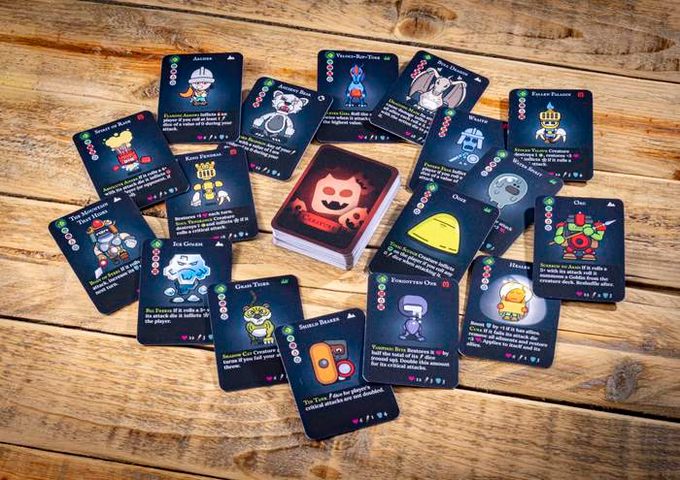
Picture it thus: while the fighter wields a single, trusty blade, your spellbook grants you six different elemental swords. This tactical flexibility is the very heart of what makes Dungeons & Dragons combat so thrilling. It echoes that satisfying moment in a great deck-building game when you draw the one card that can shift the tides of battle. The right choice at the right moment can turn certain doom into glorious victory.
Let us consult the ancient texts and lay bare the spell's core nature in a simple grimoire.
Here is a simple chart, a page from the arcanist's primer, detailing all you must know to begin your mastery of the Chromatic Orb.
| Attribute | Details |
|---|---|
| Casting Time | 1 Action |
| Range/Area | 90 feet |
| Components | Verbal, Somatic, Material (a diamond worth at least 50 gp) |
| Duration | Instantaneous |
| School | Evocation |
| Attack/Save | Ranged Spell Attack |
| Damage/Effect | 3d8 damage of your choice: acid, cold, fire, lightning, poison, or thunder |
As you can see, the mechanics are but simple runes. It is in their application that true power is found.
The true art of wielding the Chromatic Orb is in reading the grand theatre of combat. It compels you to think like a veteran adventurer, transforming keen observation into a potent weapon.
You stand before an unknown monstrosity. What do your senses tell you?
These are the tactical questions that separate a novice spell-slinger from a true battle-mage. You are not merely casting dice; you are solving a living, breathing puzzle. It is the same strategic cunning a wise Dungeon Master employs when weaving their encounters, a skill we explore in our Dungeons and Dragons Dungeon Master guide.
In the grand theatre of combat, the Chromatic Orb is a versatile actor, capable of playing any elemental role required. Its caster is not just a warrior, but a director, choosing the perfect performance to exploit the enemy's fatal flaw.
Consider this your grimoire for mastering the orb. We are about to delve deeper, breaking down every component and tactical secret so you might wield this power with the precision of a true archmage. Let our lesson begin.
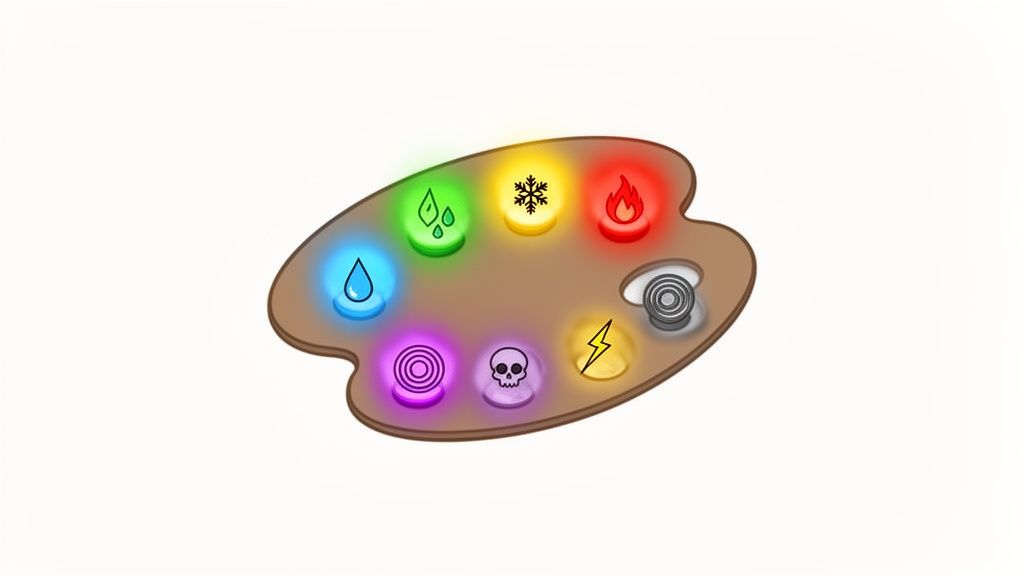
True mastery of the Chromatic Orb is not found in the raw power it commands, but in its beautiful, deadly flexibility. A novice wizard sees a simple bolt of energy. An archmage, however, sees a palette of six elemental hues, each a key to unlocking a specific enemy's downfall. This, adventurer, is where the true art of the spell lies.
Learning when to sling acid versus when to call down thunder is what separates a decent spellcaster from a true battlefield controller. Every monster that crawls from the shadows has a story, and more often than not, that story includes a weakness. Remember that. Knowledge is your sharpest weapon.
Chromatic Orb gifts you six distinct flavours of magical punishment. To wield them wisely, you must understand their nature and which creatures of the dark despise them most.
This very principle—choosing the right tool for the job—is one of the great joys of a fine tabletop game. The art of exploiting a weakness resonates deeply in tactical card games, too, where playing a single, clever card can completely dismantle an opponent's grand strategy. Games like our own TerraClash, designed for adventurers aged 12 and up, are built upon this exact premise, where knowledge of your enemy is the cornerstone of victory.
Picture this: your party slogs through a forgotten swamp when you find two trolls feasting. Your fighter charges in, but you know each wound they inflict will simply close again. You, however, see the true solution.
Instead of a flashy fireball, you gather the arcane energies into a roiling, green sphere of acid. It slams into a troll, and its scream is different—not just pain, but pure panic. Its flesh bubbles, and its regeneration sputters to a halt. The beast goes down for good.
Later, in a wizard’s crumbling tower, a stone golem lurches to life. Swords glance off its magical hide. You remember your lore. You weave a different orb, one of pure sonic force. The thunder orb hits with a deafening CRACK, and fissures spiderweb across the golem's body. It is vulnerable.
The Chromatic Orb teaches a vital lesson: power is not absolute, it is relative. The mightiest fire is but a gentle warmth to a red dragon, while a simple burst of thunder can fell a creature of solid rock. The wise arcanist knows the difference.
This world of tactical magic and monster lore thrives. Here in the UK, the passion for such games is immense, with a projected 44.37 million digital gamers expected by 2027. This growth shows the deep love for the very mechanics that make spells like Chromatic Orb so compelling. You can read more portents on the UK’s gaming community on Statista.com.
Every spell possesses its own secret rhythm, a set of rules defining its power. To truly command the 5e Chromatic Orb, you must understand the subtle symphony of its creation. So, let us pull back the curtain and demystify the art of its casting, moving beyond picking an element and into the very weave of magic itself.
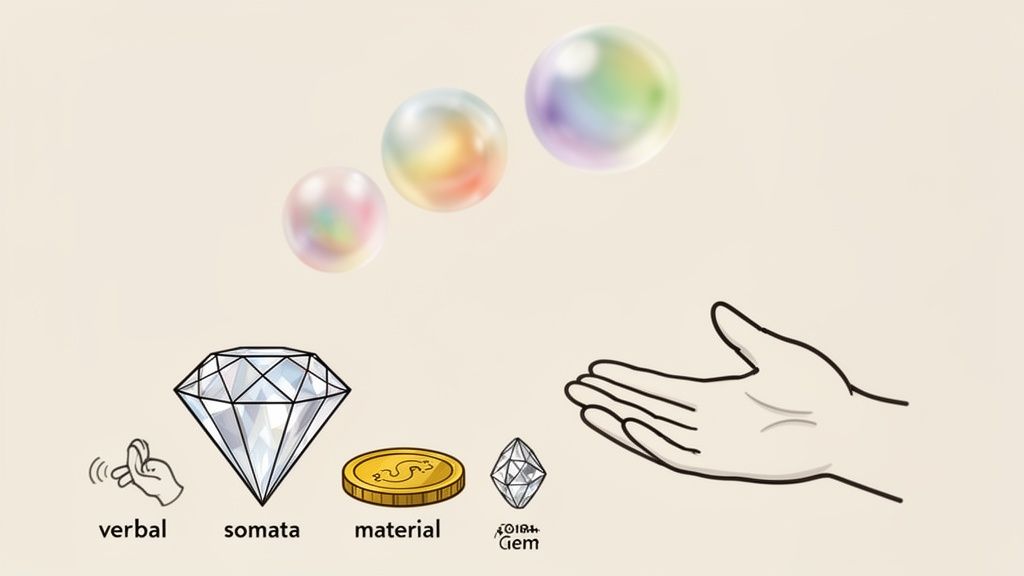
This spell is not something you can simply think into existence. It demands a focused mind, a precise execution, and a performance of arcane will. It requires specific components to coalesce the orb from raw magic. Without them, your efforts are but whispers on the wind.
To conjure the orb, you must unite three distinct acts of spellcraft in a single moment. Each plays a crucial role in shaping the chaos of the Weave into a potent, tangible force.
Many a young spellcaster has baulked at that material cost. But fear not, for the diamond is a catalyst, not a sacrifice. The spell's description never states it is consumed, meaning you can use the same gem to cast the orb again and again. It is a one-time investment for a lifetime of elemental versatility.
Once all components are aligned, you unleash the spell. But the Chromatic Orb is not a guaranteed blow—it is a ranged spell attack. You must make an attack roll, pitting your magical skill against your target's defences. This is where your battlefield awareness truly shines. If you wish to delve into the nitty-gritty of how your abilities affect these rolls, you can explore the lore of how Spell Save DC works in 5e.
With a generous range of 90 feet, you can strike from a safe distance, staying clear of clashing steel and snapping jaws. That reach makes it a reliable tool for almost any encounter.
A spell's components are its soul. The words give it voice, the gesture gives it direction, and the material gives it substance. To neglect one is to create a flawed and powerless echo of true magic.
As you grow in power, so too can your spells. Chromatic Orb is not bound to its basic form. By channelling more of your magical essence into it—that is, by using a higher-level spell slot—you can amplify its destructive potential.
This process, known as upcasting, adds another 1d8 of damage for each spell slot level used above 1st. For instance, using a 3rd-level slot unleashes a potent 5d8 orb. This ensures the spell remains a relevant and formidable threat as you face greater challenges.
Watching a spell scale like this is one of the most satisfying parts of an adventurer's journey. It feels much like upgrading a favourite card in a deck-building game, turning a reliable early-game tool into a late-game powerhouse that can turn the tide of a critical battle.
A spell is but ink on a scroll until a clever mind puts it to work. We have covered the fundamentals, but now it is time for the truly exciting arts: advanced tactics. Let us examine how Chromatic Orb can be woven together with class features, clever feats, and the reality-bending power of Metamagic to create truly devastating combinations.
Anyone can hurl an orb at a goblin. But a true master of the arcane arts weaves it into a tactical web, anticipating an enemy's weakness and turning a simple spell into the cornerstone of their legend.
No one twists the raw fabric of magic quite like a Sorcerer. Their innate power lets them reshape spells on the fly, and Chromatic Orb is a perfect canvas for their unique artistry.
Twinned Spell: Why strike one foe when you can strike two? For a single sorcery point, you can duplicate your Chromatic Orb and send it flying at a second target. This is fantastically efficient, especially in the early game, letting you potentially neutralize two threats in a single turn.
Empowered Spell: We have all been there. You land the perfect shot, only for the dice to betray you with a pathetic damage roll. With Empowered Spell, you may spend one sorcery point to reroll a few of those troublesome d8s (up to your Charisma modifier). It is a fine way to smooth the whims of fate and turn a fizzle into a serious sizzle.
Subtle Spell: Sometimes, the most potent magic is that which no one sees coming. Casting a spell without words or gestures is a powerful trick if you are bound, magically silenced, or simply being clandestine. A Subtle Chromatic Orb is the perfect tool for a quiet dispatch or a surprise blast from the shadows.
It is this kind of strategic thought that makes spellcasting so rewarding. Finding the perfect synergy feels like unlocking a great secret, turning a good spell into a truly legendary one.
While Sorcerers break the rules, Wizards master them through sheer intellect and study. A few Wizard subclasses, in particular, can take Chromatic Orb and turn it into their signature weapon.
The Order of Scribes Wizard is perhaps the ultimate master of this spell. Their Awakened Spellbook feature is a thing of beauty: it allows them to change a spell's damage type to that of any other spell of the same level they have prepared.
Consider this for a moment. With Tasha's Caustic Brew (acid) and Ice Knife (cold) in your spellbook, you can now cast Chromatic Orb and, in that very instant, decide to make it acid or cold damage, without choosing beforehand! This makes you an unparalleled elemental tactician, always ready to strike an enemy where it hurts most.
One of the greatest virtues of Chromatic Orb is how well it slots into so many different character concepts. The foundation of any great adventurer begins with a grand idea, and this spell can be the magical core that brings it to life. If you are brainstorming such legends, our guide on how to make a Dungeons and Dragons character can help you begin your heroic journey.
The greatest mages do not simply know many spells; they know one spell in a thousand different ways. They see the infinite possibilities held within a single incantation and bend them to their will.
Here are a few concepts to spark your imagination:
The Prismatic Assassin (Arcane Trickster Rogue): By gaining Chromatic Orb via the Magic Initiate feat, this character blends stealth with surgical magical strikes. They use their cunning to uncover a target's weakness, then deliver the perfect elemental payload from the shadows.
The Storm Herald (Tempest Domain Cleric): This is a classic powerhouse build. Take the Magic Initiate feat to learn Chromatic Orb. Now, when you choose lightning or thunder damage, you can use your Channel Divinity: Destructive Wrath. This lets you deal the maximum possible damage, turning your 3d8 orb into a guaranteed 24 damage explosion of divine power. A truly fearsome strike.
The Elemental Scholar (Order of Scribes Wizard): This build is all about total elemental domination. They collect spells of every damage type, not to cast them all, but to have a massive library of damage options to fuel their Awakened Spellbook. With Chromatic Orb as their delivery system, they possess the perfect tool for any enemy, at any time.
No spell is an island. In the grand tapestry of D&D magic, every incantation has its place, its strength defined by the spells that sit alongside it in your spellbook. A wise caster knows when to unleash a Chromatic Orb and when another tool is better suited for the task. That choice is the heart of good strategy, a skill you learn at the gaming table, not just from reading rules.
Think of it as building a deck for a card game. Every slot is precious. You must know exactly why each spell has earned its place. So, let us place the orb side-by-side with its 1st-level peers to truly understand its unique role.
The most obvious rival to Chromatic Orb is another 1st-level classic: Magic Missile. On paper, they appear as simple ranged attacks, but their philosophies could not be more different.
Magic Missile is the very definition of reliability. It simply works. It never misses. The damage (1d4+1 per dart) is modest, but it is guaranteed. When you face a foe with impossibly high Armour Class or one hiding behind cover, that certainty is a blessing.
Chromatic Orb, however, is a gamble. It requires an attack roll, meaning it can miss completely, wasting your action and spell slot for naught. But the potential reward is so much greater—a hefty 3d8 damage, plus that all-important flexibility to strike an enemy's elemental weakness.
Deciding between them is a classic dilemma. Do you take the guaranteed, lesser damage, or do you roll the dice for a potentially massive blow? There is no single right answer; it all depends on the situation on the board.
Another spell vying for that same 1st-level slot is Guiding Bolt. This one presents a different choice, trading some raw personal power for a great tactical advantage for your entire party.
Guiding Bolt deals slightly more damage on average (4d6 radiant) than the orb, but its true magic is in its secondary effect. If it hits, the next attack roll made against that target has advantage. That can be a battle-winning moment, setting up your party's Rogue for a massive Sneak Attack or ensuring the Paladin's Divine Smite finds its mark. The orb, for all its power, offers no such aid to your allies.
This infographic breaks down a few ways Sorcerers can twist their Chromatic Orbs with Metamagic, adding yet another tactical layer to consider.
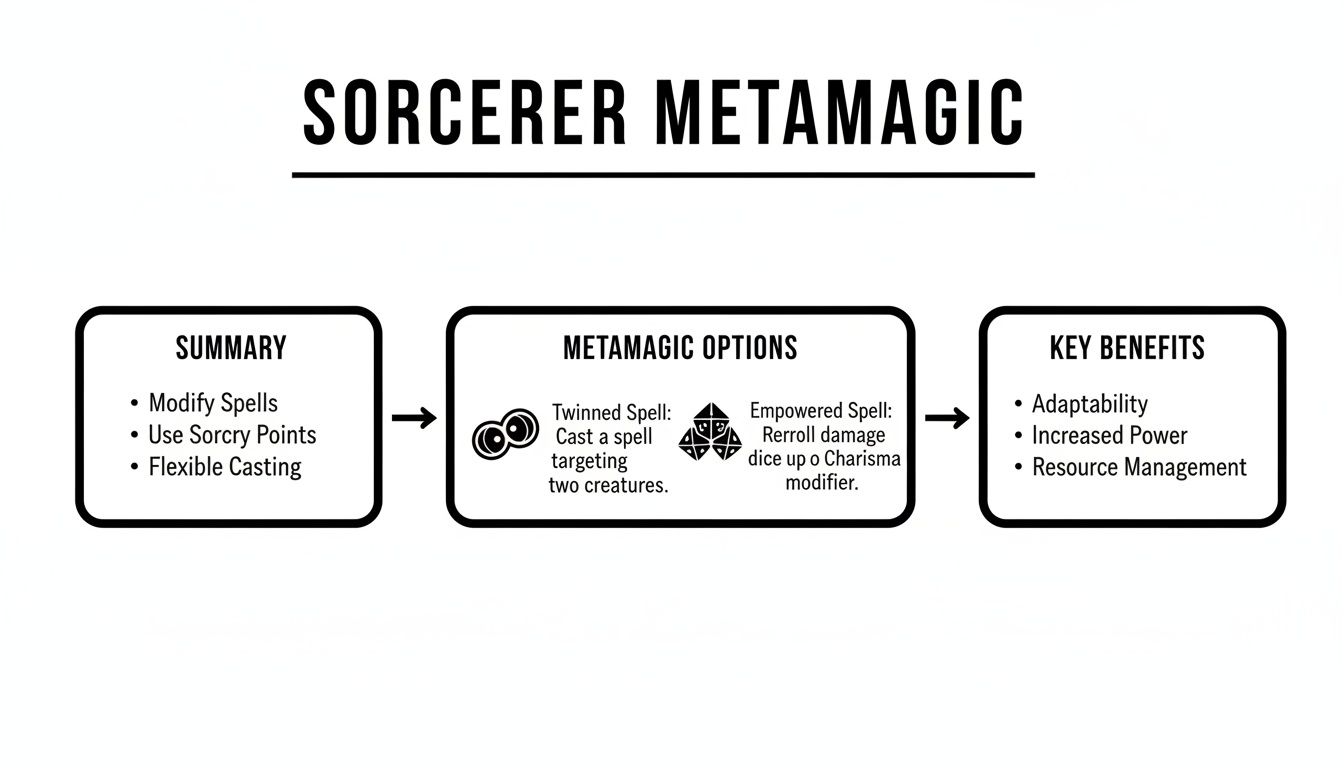
As you can see, options like Twinned Spell can double the orb's presence on the battlefield, while Empowered Spell can help you squeeze every last drop of damage out of it.
The decision here comes down to immediate versus delayed impact. Do you need to unleash the most damage you can, right now? Or is it wiser to set up a teammate for an even greater strike on their turn? This kind of thinking is what makes tabletop combat so compelling.
In fact, the tabletop scene in the UK is booming, with the total market hitting a staggering USD 12,160.9 million in revenue for 2024. That growth highlights how much people love deep, strategic gameplay. It is easy to see the appeal of D&D-style magic blended with tactical depth. You can find more fascinating stats on the UK's gaming market growth on grandviewresearch.com.
A spellbook isn't just a list of powers; it's a carefully chosen arsenal. The mark of a great mage isn't the strength of their biggest spell, but the wisdom to know which spell is the right one for the moment.
To put it all in perspective, here is a quick tactical breakdown of how Chromatic Orb stacks up against some of its main competitors at 1st level. This is not about which spell is "best," but which is best for the task at hand.
| Spell | Average Damage | Key Advantage | Key Disadvantage |
|---|---|---|---|
| Chromatic Orb | 13.5 | Huge damage and can target vulnerabilities. | Can miss and wastes a costly component. |
| Magic Missile | 10.5 (3 darts) | Guaranteed to hit; great against high AC. | Low damage potential; no extra effects. |
| Guiding Bolt | 14 | Grants advantage to the next attacker. | Can miss; offers no damage flexibility. |
| Catapult | 13.5 | Forces a DEX save, not an attack roll. | Damage type (bludgeoning) is often resisted. |
Ultimately, Chromatic Orb's place is as your go-to flexible damage spell. When you must exploit a weakness or simply need a solid chance at high damage, it is a fantastic choice. But when reliability or team support is more important, it is wise to have other tools ready in your arcane kit.
Even a straightforward spell like Chromatic Orb can stir up plenty of debate around the gaming table. Let us clear the air and address some of the most common questions that arise, so you may cast it with the confidence of a master.
Getting these details right is not merely about rules; it can be the difference between a spell that merely stings an enemy and one that ends the fight. As with any good strategy game, mastering the fundamentals is where true power lies.
First, the great question that troubles many a mage with a light coin purse: Is the 50 gp diamond consumed when I cast the spell?
Breathe easy, spellcaster. The diamond is not consumed. Think of it as a permanent magical tool. A material component in 5e is only expended if the spell's description specifically says so. For Chromatic Orb, the diamond acts as a reusable focus, a perfect little prism to channel elemental energy through, again and again.
Here is another query I hear often, especially from adventurers growing in power: Is Chromatic Orb still a good spell at higher levels?
Indeed, it is. While you will gain access to spells that boast larger numbers, the orb's true magic is its incredible flexibility. Its enduring strength lies in striking an enemy's elemental weakness.
When you target a vulnerability, you often get to double your damage dice. Suddenly, your 1st-level spell slot is punching far above its weight. That kind of efficiency keeps it a valuable part of your arsenal, from your first goblin skirmish to your tenth dragon hunt.
That moment—having the perfect tool for a specific job—is a feeling we cherish in tactical games. It’s that same thrill of playing the right card at the right time that we are building into our own deck-building game, TerraClash. Knowing which elemental orb, or which card, to unleash is the heart of a great victory.
The path of a magic-user is a long one, filled with discovery. If you love tactical choices, wielding elemental power, and carving out your own legend, then you’ll want to keep an eye on TerraClash. We're building an adventure for ages 12 and up where every card played tells a part of your story. Get your strategies ready for the battles ahead, for our Kickstarter campaign launches soon! Learn more at https://terraclash.co.uk.
And if your journeys take you to other wondrous indie realms, consider exploring the worlds of Gloomhaven or the Kickstarter for Frosthaven. The world of tabletop gaming is vast and full of treasures.